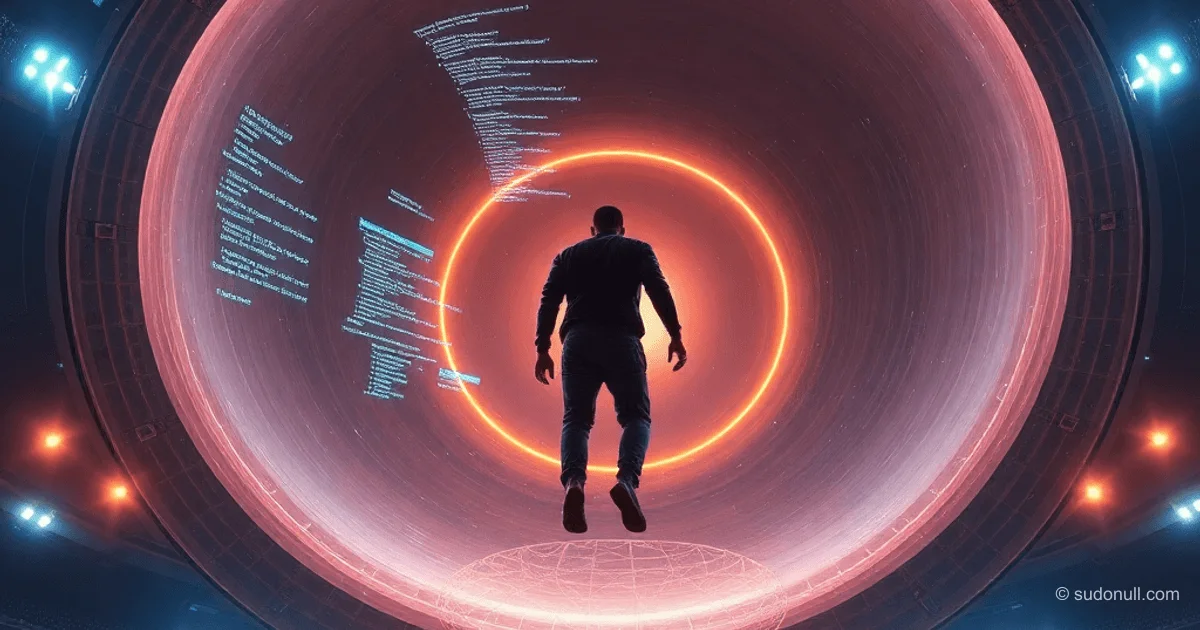
Gravity Mechanics for Walking on the Inner Surface of a Sphere in Godot 4.5
In Godot Engine 4.5, implementing a first-person controller for walking on the inner surface of a hollow sphere requires a non-standard gravity model. The gravity direction is always oriented along the surface normal, meaning towards the center of the sphere. This defines the gravity vector as a function of position \vec{g}(\vec{r}).
A simplified model assumes constant acceleration g_0 on the surface (h=0), but for realistic jumps up to 0.3R height, a dependency on height h = R - |\vec{r}| is needed. The sphere is symmetric, so g depends only on h: \vec{g} = g(h) \frac{\vec{r}}{|\vec{r}|}.
Model Principles:
- No gravity at the center: g(R) = 0.
- Continuity and smooth changes in g(h).
- No extrema on [0, R].
The linear function g(h) = g_0 \frac{R - h}{R} simplifies to \vec{g} = g_0 \frac{\vec{r}}{R}. This ensures intuitive physics: slow hovering near the center and standard falling near the surface.
Jump Dynamics and Numerical Integration
Vertical motion is described by the equation \ddot{h} = -g_0 (1 - \frac{h}{R}). To calculate the trajectory with initial conditions h(0)=0, \dot{h}(0)=v_0, the Euler method is used.
Advantages of the Euler method for game physics:
- Compact code with simple iteration.
- Low computational load per frame.
- Acceptable error margin at 60 FPS and float32.
The analytical solution is more complex but useful for analysis. Graphs show that for v_0 < 80% of the speed to the center, the dynamics are close to parabolic on Earth.
Jump Limit Analysis
A jump to the center with a stop requires speed dependent on R and g_0. For human capabilities (v_0 ≤ 5 m/s, g_0=9.8 m/s²), the sphere radius is limited to ~5 m. Larger spheres require reducing g_0 or make reaching the center impossible.
Impact of parameters on h(t):
- Increasing R makes dynamics closer to flat gravity.
- High v_0 near the center causes unusual hovering.
- For R ≥ 20 m, jumps feel standard at typical speeds.
Boundaries of "special" dynamics: v_0 < 0.8 v_center or R > 2R_ref.
Key Takeaways
- Linear model g(h): Simple implementation \vec{g} = g_0 \frac{\vec{r}}{R}, smooth change from g_0 to 0.
- Euler method: Suitable for real-time, minimal load.
- Realistic limits: Jumping to the center is only possible for R < 10 m at g_0=9.8 and v_0=5 m/s.
- Game feel: Unusual physics manifest only when approaching the center.
- Godot 4.5: Similar to the Möbius strip controller, focusing on local vertical.
Controller Implementation
In the controller, gravity determines the "head-to-feet" orientation. For flight during a jump, only gravity is considered; aerodynamics are optional. Special handling of the sphere center prevents division by zero.
For large R (world scales), the model maintains symmetry but requires integration optimization at low FPS. Testing on float32 confirms stability.
— Editorial Team










No comments yet.