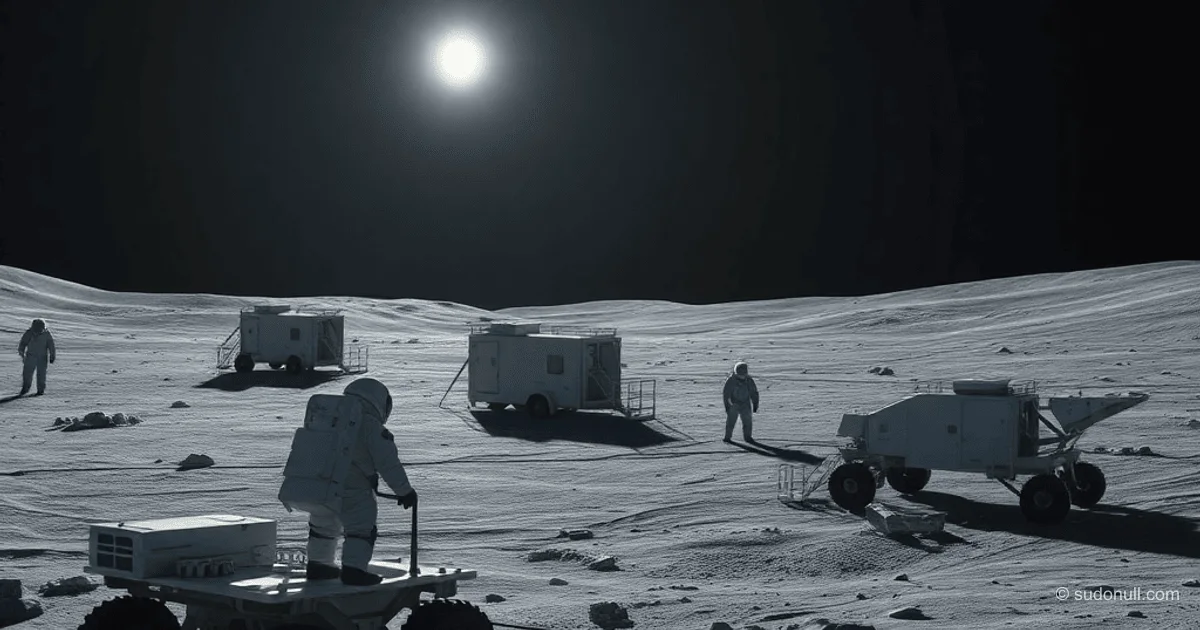
NASA Changes Course: $20 Billion Lunar Base Instead of Orbital Station
NASA Administrator Jared Isaacman announced plans to build a lunar base costing $20 billion. The project will unfold in three stages, focusing on permanent human presence on the Moon's surface. Funds and technologies from the partially built Lunar Gateway station will be redirected to surface infrastructure.
The Artemis program has been updated: a new mission added in 2027, with a standardized configuration for the Space Launch System rocket. The Artemis 3 landing has been moved to low Earth orbit for testing, the first Moon landing is now expected with Artemis 4 no earlier than 2028, and base construction will kick off with Artemis 5.
Stages of Lunar Infrastructure Deployment
The first stage shifts from one-off missions to repeatable operations:
- Deployment of rovers and instruments via Commercial Lunar Payload Services (CLPS).
- Introduction of the Lunar Terrain Vehicle (LTV) to boost mobility.
- Testing of power systems (radioisotope heater units, RTG), communications, navigation, and scientific equipment.
The second stage establishes semi-permanent infrastructure:
- Regular logistics and astronaut operations.
- International collaboration: Lunar Cruiser from JAXA and Toyota, plus rovers and transport from partners.
The third stage enables long-term stays:
- Human Landing System for heavy infrastructure.
- Multi-purpose Habitats (MPH) from the Italian Space Agency.
- Lunar Utility Vehicle (LRV) from the Canadian Space Agency.
Landings will ramp up to every six months using commercial reusable hardware.
Ditching Lunar Gateway in Favor of the Surface
NASA is scrapping the Lunar Gateway orbital station in its current form. Some modules will head to space for other missions, with resources shifted to the lunar base. This lets the agency focus on surface operations rather than orbital infrastructure.
Comparison to the ISS: it took 37 shuttle flights, 160 EVAs, and over $100 billion to build. The ISS service life has been extended to 2032, and NASA is setting requirements for private orbital platforms.
Additional NASA Initiatives
By the end of 2028, Space Reactor-1 Freedom will launch to Mars with a nuclear engine. The spacecraft will deploy Ingenuity-style helicopters equipped with cameras and radars to hunt for frozen water.
A competition has been announced to replace SLS and Orion: at least two companies will develop a new rocket and spacecraft.
The next mission, Artemis 2, will send Orion on a crewed lunar flyby, with the crew's menu published in March.
Key Takeaways
- The lunar base will cost $20 billion and roll out in three stages with international partners.
- Lunar Gateway canceled: focus shifts to surface infrastructure.
- Landings every 6 months using commercial gear.
- Competition to replace SLS/Orion, plus the SR-1 Freedom Mars mission by 2028.
- Artemis 2 launches in the coming weeks.
— Editorial Team










No comments yet.