Life Beyond Earth: Molecular Clocks and Cosmic Clues
The molecular clock method allows dating the Last Universal Common Ancestor (LUCA) of all terrestrial organisms. In 2023, a Nature article estimated it at 4.4 billion years. Given Earth's age of 4.54 billion years, this leaves minimal time for abiogenesis and evolution to the bacterial level. A reviewer noted no errors in the calculations but pointed out a contradiction with the dogmatic idea of terrestrial origin.
A year later, another Nature article adjusted the date to 4.2 billion years. The key factor is calibration: shifting the lower bound from 3.35 billion years (age of stromatolites) to 2.945 billion years (onset of oxygenic photosynthesis). A difference of 400 million years led to a reduction of 200 million years. LUCA did not possess photosynthesis, making the calibration questionable.
The upper bound is often fixed at 4.51 billion years (collision with Theia). Without it, estimates exceed 5 billion years—predating the formation of the Solar System. LUCA is not the first organism but the ancestor of all life, meaning abiogenesis occurred earlier.
Extrapolating Genomic Growth
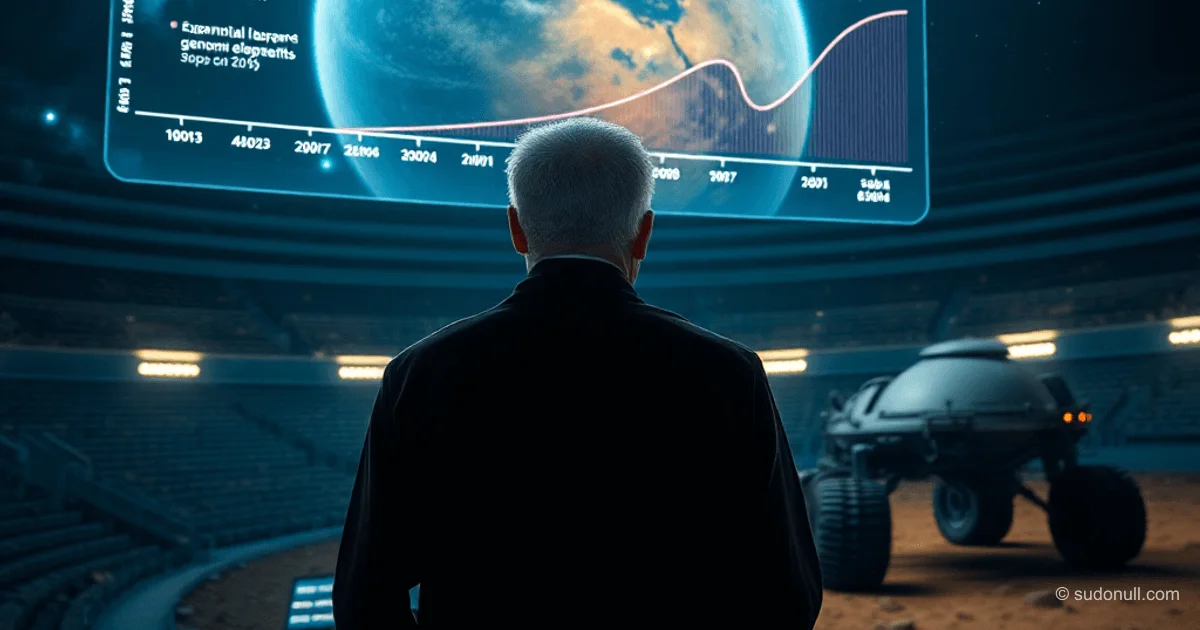
A. Sharov approximated the exponential growth of functional genome length. Extending the trend yields a genome of a few nucleotides around 10 billion years ago.
A similar analysis using data from Markov, Anisimov, and Korotaev (minimum genome size vs. time of group appearance) confirms ~9 billion years. The methods are independent but converge: life is older than Earth.
- Genome-time dependency: Exponential growth of functional regions.
- Markov's data: X-axis—time in million years, Y-axis—genome size from prokaryotes to mammals.
- Independence: Molecular clocks and extrapolation are not correlated.
Cosmic Evidence of Extraterrestrial Life
Organic molecules (amino acids, nucleotides, sugars) have been detected in molecular clouds, asteroids, and meteorites. Mars rovers record signs: Perseverance—leopard spots in Jezero Crater (analogous to bacterial activity), Curiosity—alkanes in Gale Crater (membrane degradation).
Astronomical data indicate material exchange. A study of trans-Neptunian objects from the Oort Cloud shows uneven color and orbit distribution, explainable by the passage of a star with mass 0.8 M☉ at 110 AU from the Sun.
The discovery of a sednoid with a perihelion of 66 AU suggests the influence of a massive object in the first 100–200 million years of the Solar System. Scenario: exchange with another system, transferring life.
The deficit of molybdenum and selenium in Earth's crust (Sagan) is explainable by import from a star like HD 160617 (10–12 billion years old, 0.75–0.9 M☉, rich in these element lines).
Key Takeaways
- LUCA's age by molecular clocks exceeds Earth's history without arbitrary calibration.
- Genomic growth extrapolation dates the minimal genome to 9–10 billion years ago.
- Martian findings and organics in space support panspermia.
- A star passing the young Solar System is a transfer mechanism.
- Rare elements (Mo, Se) indicate extraterrestrial contribution.
— Editorial Team










No comments yet.