Yota Team Rescue Rangers! or One day in the life of a Yota tester
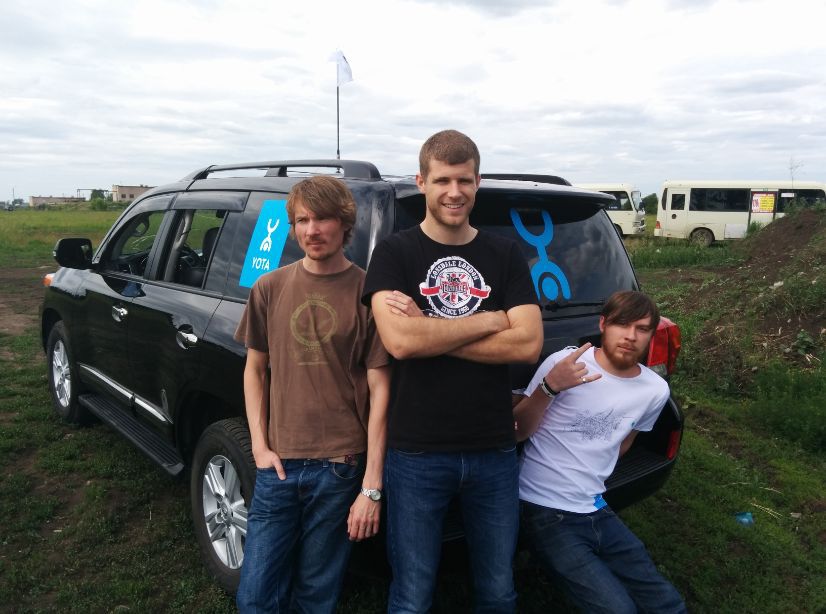
Hello! My name is Vladimir, I am an employee of the Yota technical team. As you already hopefully know (), Yota, together with the Echo of Moscow radio station, recently held a rally along the route Moscow - Kazan - Kirov - Perm - Yekaterinburg - Ufa - Orenburg - Samara - Saratov - Moscow. It was attended by journalists and we, Yota technical experts. We joined the expedition to help Echo Moscow colleagues with any questions that arise and “in the field” test the services of the fourth federal mobile operator Yota before launching it in wide commercial operation. An operator that will soon provide not only unlimited mobile Internet, but also voice communications - moreover, throughout the country and without roaming.
In general, about this project you can find quite a lot of information in social networks on the hashtags #echoroad and #yotamobile.
Technical information : A few words about voice communication in the Yota network, which is also implemented over LTE (or 4G) networks, which, as you know, transmit only data. If voice and 3G networks have long been a universally resolved problem, then in the case of 4G, Yota pioneered. In fact, two voice support technologies are currently being used in LTE - VoLTE and CSFB.
VoLTE (Voice over LTE) - assumes that voice traffic is transmitted through a packet radio network, with guaranteed provision of this traffic with radio resources. However, the use of VoLTE, for operators who have been operating 2G / 3G for a long time and have begun to implement LTE, is quite revolutionary and expensive. Therefore, at this stage, the vast majority of operators are introducing a “more evolutionary" CSFB technology.
CSFB (CS Fall Back) assumes that for a device (UE) connected to an LTE network, when it becomes necessary to make an incoming or outgoing voice call, the network performs procedures that move the device to a 2G / 3G network, where this call is served. After the call ends, the network moves the device back to LTE. This technology does not require additional equipment (to the fact that the operator has already installed 3G and 4G for its networks) and is relatively easily implemented by existing equipment (with modified software)
I want to talk about one day from our real trip. Why real? Because it was a classic “dust, roads”, early hikes, short breaks to sleep and rest, a lot of acquaintances (Ekho Moskvy met with its listeners in the broadcasting cities), many interesting places (which costs one farm with pigs and ... peacocks under the city of Orenburg shawls!) - and tests, tests, tests, as well as assistance to journalists who used exclusively Yota services during the trip.
We traveled on a black Land Cruiser 200 with branded stickers - of course, not because of the "show-offs", but because it is a suitable car for long trips around Russian off-road places! And she did not let us down!
So, the most significant day ...
It is every day travel! It began with tests and ended with them: in a new city, beyond its borders, on the highway - we were faced with the task of conducting their standard set, namely:
- testing mobile data and voice services both in 2 / 3G networks and networks 4G (in separate work and joint mode);
- voice calls - both incoming and outgoing, within the Yota network, to the network of other mobile operators and from them (MegaFon, Beeline, MTS, Tele2, local cellular companies), as well as voice calls from the local telephone network.
Technical information : Regarding testing in the joint and separate operation mode in 2 / 3G and 4G networks. As already mentioned, Yota operates in fact in two networks - historically its own - 4G, and on the basis of MegaFon as a virtual operator - 2 / 3G networks. At the same time, when the mobile phone is connected to the cellular network, it is registered in two subnets: the CS domain (Circuit switch, voice communication) and the PS domain (Packet switch, data transfer). This is necessary for voice calls and data transfer. But in 4G networks, connection to the CS domain is not made, and to receive voice services, the subscriber device is transferred to the CS domain of 2 / 3G networks.
One day in the iconic city of Orenburg in many ways became the middle of our expedition - not only from the point of view of the route of movement, but also from the geographical one - the city stands in two parts of the world at once - both in Europe and in Asia. Just like Istanbul.
So, after an early breakfast, we set off in the morning in our car in the local square Yu.A. Gagarin, to work - at 9 in the morning we were already there.
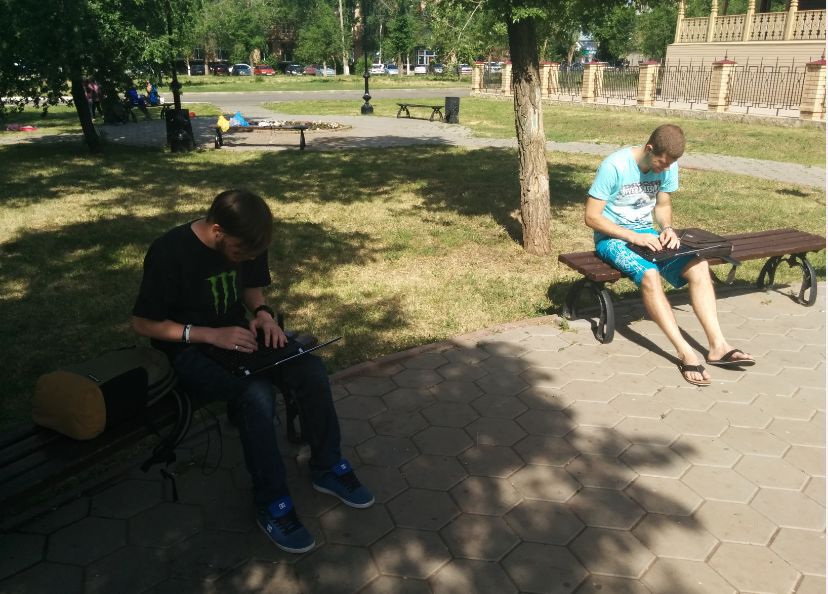
Despite such an earlier time, there was already heat in the city, rightly picking up at around 30 degrees. She scared only me - but not my colleagues, who, apparently, were accustomed to hot weather - she accompanied us all the way. The only exception was Saratov, who met us with rains. The weather didn’t scare local children either - they had fun wrapping themselves in carpets (I wonder if this could be a local custom or a survival game?).
According to the test results, the speed was reached in maximum volumes, that is, 20 Mbit / s for downloading and 6 Mbit / s for upload (the same on the modem and phone). Voice tests took about three hours and were successful. In the square, we bravely held out until 11 a.m., but when we were completely "sick", we relocated towards the nearest cafe. We were pleased that we managed to pass the tests completely - not every city had such an opportunity on the road of our rally.
Technical information : The upper parameters of the Yota network in terms of data transfer are, as already mentioned, 20 Mbit / s for downloading and 6 Mbit / s for return. These parameters are set by the operator on the network. The reason is not in its limitations, but in the fact that Yota, as you know, is focused on providing unlimited Internet traffic. Thus, the overload situation is avoided (in the WiMAX era, at Yota - at the very beginning of its existence - the maximum download speed was set at 10 Mbit / s). A speed of 20 Mbps is more than enough for any online activities: from surfing and social networks to video calling via Skype (see below) and watching videos.
Regarding the speed of return - if you look at the Yota tariffs, then its ratio to download speed is on average 1: 3, respectively, in this case - 6 Mbit / s. But this is already connected not with the network, but with subscriber devices - their transmitters are not designed for very high speed of return (you do not want the modem to be the size of, for example, a brick?)
About the sufficiency of speeds - for example - here are some of the technical Skype’s video calling requirements:
- video calling / screen sharing, minimum download and upload speed - 128 Kbps / 128 Kbps, recommended - 300 Kbps / 300 Kbps;
- video communication (in HD format), the minimum download and send speed is 1.2 Mbit / s / 1.2 Mbit / s, the recommended -1.5 Mbit / s / 1.5 Mbit / s;
- group video communication (5 participants), the minimum download and send speed of 2 Mbit / s / 128 Kbit / s, recommended - 4 Mbit / s / 512 Kbit / s.
(Source - support.skype.com)
Next was a long meeting of the Echo of Moscow at the Taras Shevchenko Memorial Museum-Guardhouse.

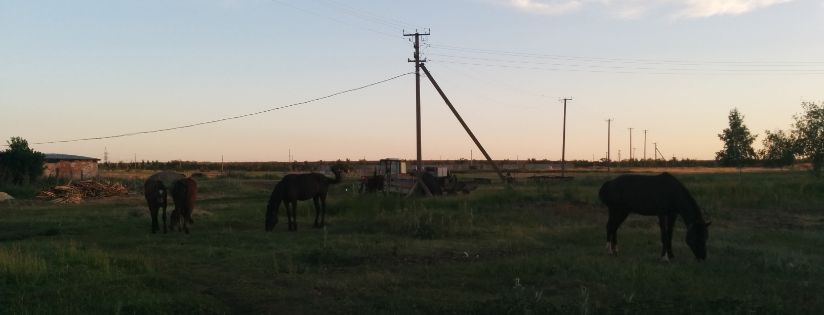
After the meeting, we were invited to visit one of the fans of the radio station on the farm. She became a breath of clean air after hundreds of kilometers of road.

There were a lot of animals, the farm :)

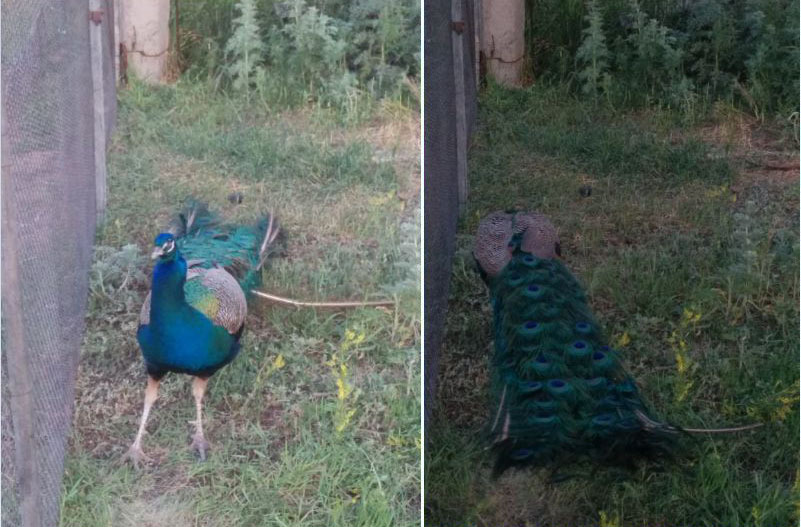
But the presence of a peacock most of all surprised me.
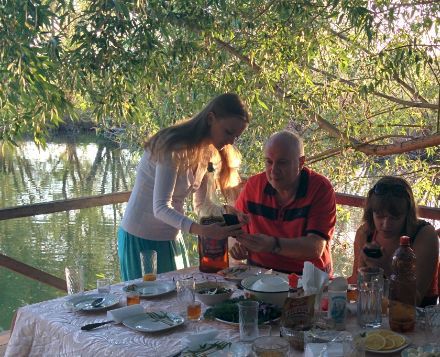
We had dinner at the farm in a cozy company of representatives of the Echo of Moscow.
They did not remain idle even after dinner - they mastered the control of the tractor.

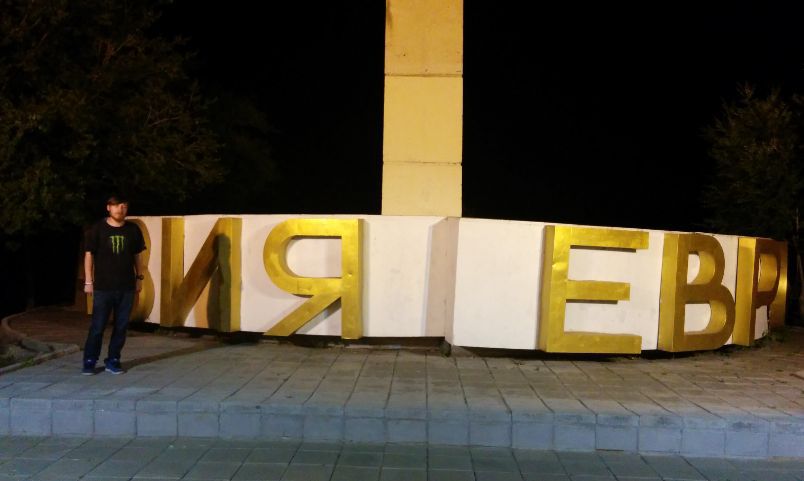
Late at night, it was decided to re-test the network - first in Europe, then in Asia. In Asia, there was a connection.
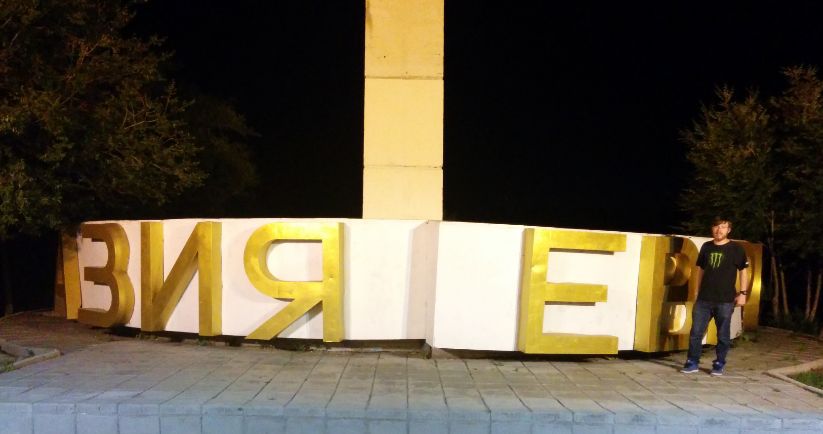
Yes, and in Europe too.
Here is such a day! :)
As a result
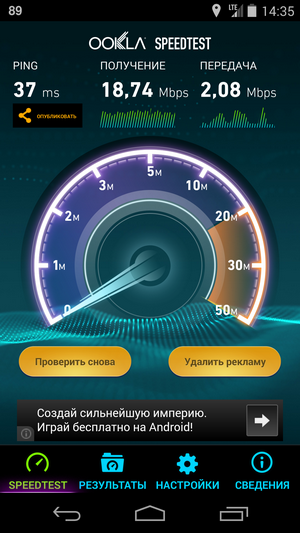
On my phone (I used LG Nexus 5), about 50 screenshots of speed tests were accumulated during the trip (they used Speedtest + G-NetTrack). Measured speeds - from zeros in a clean field to the already mentioned maximum 20/6 Mbit / s. At the same time, the speeds could be different and in one place. This is one of the most frequently asked questions - why does speed vary so much? The answer is simple - the access speed in a particular place depends on the signal strength (in the bunker it will be minimal) and network load - if you are one in a cell, then the entire Internet is yours;)
Technical information : The access speed also depends on the range of the subscriber's location relative to the base station - the farther he is, the lower the speed. However, here 4G technology has its advantages over 3G networks. In the latter, the cell has the so-called “breathing effect” - that is, if the load on the network is large, then the base station (BS) simply reduces its radius of action, and the remote subscriber can simply fall outside its boundaries (if, for example, it is connected to the same BS some more clients who downloaded it). In 4G, there is no such effect - due to the fact that the network itself is more powerful and can serve a subscriber in the far radius - although in order to provide it with a service, it will be necessary to spend 3-4 times more network resources. But they, as they say, is with her.
Rescue of the drowning ...
Not without rescuers. Our co-travelers, Echo of Moscow journalists, also did not stand aside and, using Yota’s mobile Internet every day and making calls, actually also participated in tests. In addition, they sent us measurements of mobile Internet access speeds. In general, the picture here was even. If there were small problems, then journalists quite often solved them on their own. I had to come to the “place of events” several times when my colleagues had more serious problems. As I mentioned, Ekho Moskvy held meetings with its listeners, and broadcasting from these meetings went live and through devices connected to our network. And now, several times it disappeared ... but in the end the problem, as it turned out, was connected with gadgets. The issue was mainly resolved by rebooting,

Technical Information : Speaking of phones. The team at the disposal of the trip was not only the Nexus, but also other smartphones, including the iPhone 5C, Samsung Galaxy, YotaPhone, Nokia - all with unique Yota SIM-cards. All of them work in 4G networks, with the exception of the "apple" product. But this is a “for now” situation, as it is known, the fifth iPhone supports LTE (4G), but for it to work, the issue must be resolved at the “firmware” level of the device, which is currently being worked on with Apple. On the expedition, all smartphones were manually configured in advance.
Travel notes
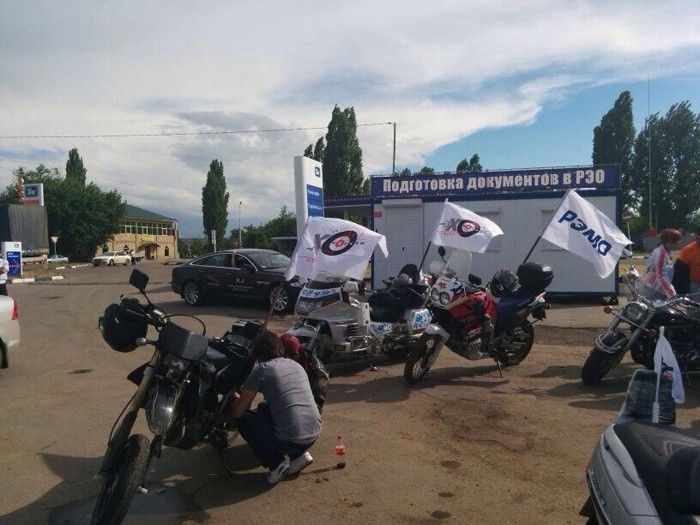
Ten days of travel in this mode, of course, could not do without interesting observations on the road - these are the bikers who meet us in the cities ...
... royal samovars, and moonshines sold on the side of the road

... and the types of steles ...
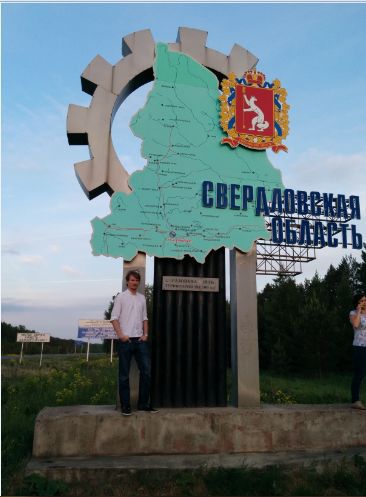
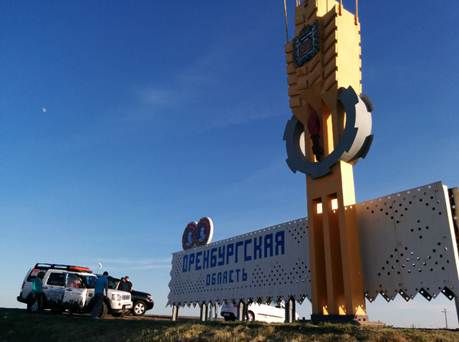
... rivers ...

... and cities ...
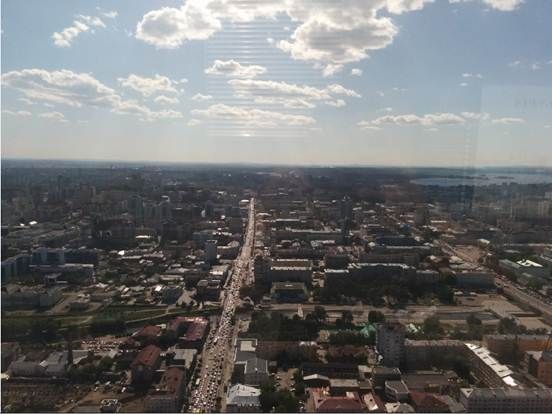
Thank gods, no critical situations arose, but I remembered the case when a truck passing by very anxiously cut it ... And once again a cat quickly ran across our path to Perm, but there were no casualties.
The quality of Russian roads is known, but “in some places - repair ”
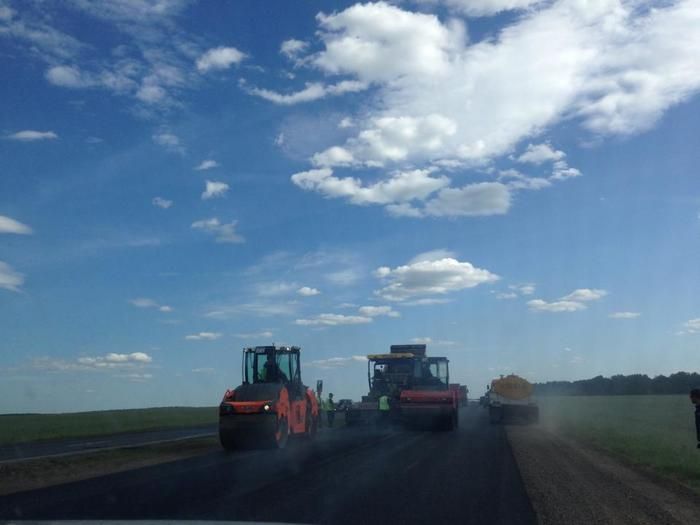
We saw several major accidents in wide and seemingly straight sections of the highway ... The view outside the windows was diluted by the audio accompaniment of truckers - we had a walkie-talkie, and we could know in advance where a jam occurred, etc. On one of the stages, the listener of Echo of Moscow caught up with us - the radio station held a special contest.
An interesting situation was when leaving Yekaterinburg - the expedition had five navigators in total, and they all showed different roads. I had to pave the way myself. We stopped in Karabash, a well-known environmentally depressive city , and found ourselves in a dark future, where the water in the lakes is strange in color and black slag dumps are around.

On the roads, we avoided roadside cafes, etc. to avoid problems - although it was clear that some of them were popular and there were a lot of cars around them. In this regard , the village of Umet was remembered , where there were more braziers, taverns and cafes than there were houses.

Summarizing
So, the summary statistics on tests of the Yota network during the 14 days of travel of our technical Uberkommand:
- more than 150 measurements of mobile transmission speeds using tests;
- more than 10 GB of downloaded information;
- More than 1500 minutes of voice calls;
- More than 20 hours of tests.

As an epilogue
What did these 10 days of road testing of Yota services in real "combat" mode show? In addition to the fact that the team of technical specialists worked out carefully and harmoniously (and that’s exactly how we always strive to work for the benefit of our customers), we have seen on the ground that the Yota network is ready for full launch throughout the country. The specificity of the project is not only work on the basis of the Scartel and MegaFon infrastructure, and in several networks at once - 4G and 2 / 3G, but also the creation of a single roaming-free space in our country - both for the Internet and for voice. Implementing such a high-tech project throughout Russia is by no means a trivial and ambitious task, taking into account both the size of the country, the technological specifics, and the lack of both analogues and experience in building such kind of operators on the Russian market. And our adventures do not end there. The most interesting is yet to come!