M-LAG as an alternative to STP and stack
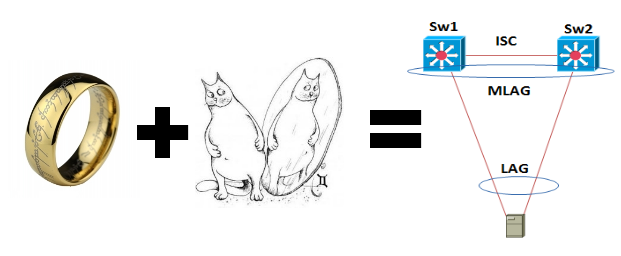
One of the main problems in the network are “loops” and “single point of failure”.
The traditional way to beat loops is to use the STP protocol. But at the same time, this protocol brings the problem of inefficient use of bandwidth ports and switch links. If there are several possible links, one will be active, anyway, it’s the same as buying a cool and expensive computer to play Solitaire solitaire - the full potential of the device is not used. Low convergence, especially in complex topologies. And if the network runs voice or streaming video? The path between two neighboring switches can go through the root - not optimal.
The traditional way to get away from the “single point of failure” and make the network fault tolerant is to use the stack. You can’t argue, the option is good, but still a number of questions arise: what will be the convergence time when the master-node fails? Is there enough bandwidth between the switches (we want more speed - we pay more)? How will the stack behave with a split-brain? About this under the cut.
Extreme Networks - M-LAG technology can successfully solve these problems and issues.
In fairness, it is worth mentioning that there are similar technologies from other manufacturers, but with some differences. Also, combinations are often used, for example: stack + M-LAG.
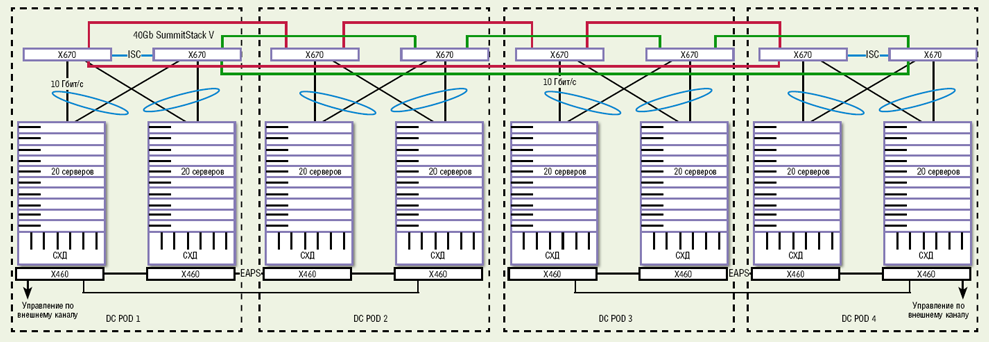
In this article, we will consider Extreme Networks M-LAG as a separate technology.
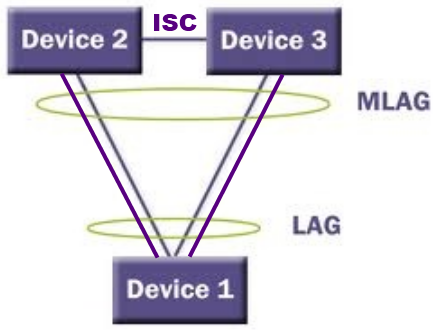
M-LAG - Multi-Chassis Link Aggregation, a modification of conventional aggregation. The difference and advantage is that in this case the links start on one device, and end on two, that is, backup not only the link as in the LAG, but also the backup device.

From the side of Device1, the usual LAG is configured, from the side of Device2 and Device3 everything is a little more complicated.
Let's look at how the M-LAG works.
Between Device2 and Device3 there should be a link on which ISC (Inter-Switch Connection) is configured.
ISC covers several tasks:
1. Since LAG is configured on the device1 side, depending on the balancing algorithm, packets can be transmitted to different switches. Since these are 2 different switches, each data plane works independently - both links are loaded. But we need synchronous and joint work of the control plane of both devices (synchronization of switching tables), for this we need ISC (Inter-Switch Connection).
2. The figure shows that we have organized a "loop". ISC blocks client traffic during normal operation if there are no link crashes or switch failures.
Also, it is worth mentioning a feature of M-LAG: the switches between which ISC is configured must be of the same manufacturer, moreover, it is strictly recommended that these switches are of the same type and series, with the same ExtremeXOS version. In addition, it is desirable to use switches with the same number of ports, for example: Summit X460-24t & Summit X460-24x; BlackDiamond 8900-G48X-xl & BlackDiamond 8900-G48T-x. At the same time, downstream or upstream devices on which the LAG is configured can be from different manufacturers.
In fairness, you need to indicate that at the moment you can configure 1 M-LAG peer, but at the same time the number of M-LAGs for each pair of switches can reach 768.
M-LAG is supported by all Extreme Networks switches except L2 switches.
This all refers to the normal operation of the M-LAG. But what happens when a fault occurs?
Consider several failure options:
1. Failure of one of a pair of switches:
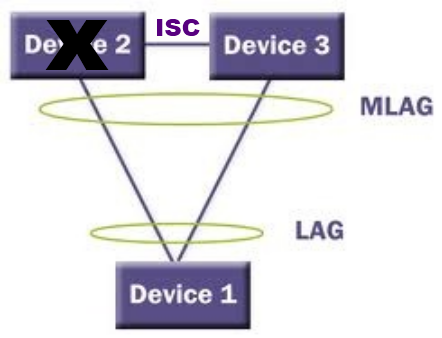
In this case, everything is simple - all traffic smoothly leaks to the link between Device1 and Device3.
2. Link failure between Device2 and Device1.
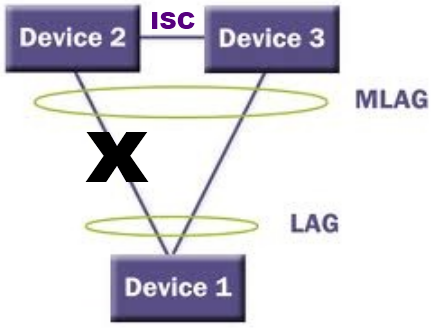
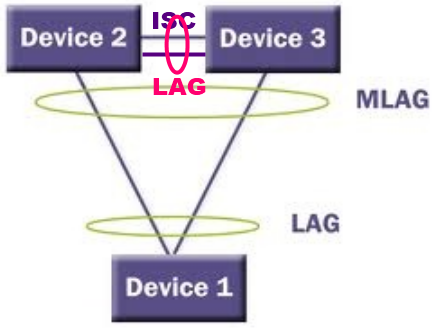
Here the ISC opens and traffic is redirected through it. To eliminate this failure, a scheme is used when on such links, for example: LAG
3 is configured between Device2 and Device1 3. ISC failure (the so-called split-brain)
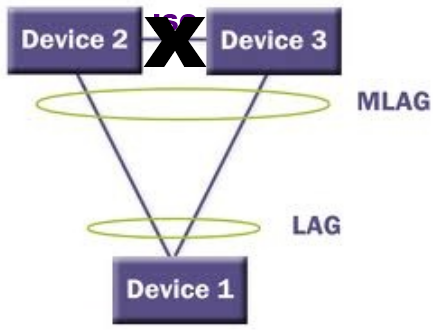
In this case, Device1 will not know about the ISC failure, Device2 and Device3 will save their System Identifier, the traffic from Device1 will be sent according to the balancing algorithm, and Device2 and Device3 will direct traffic according to their switching rules.
At the same time, to eliminate the problem of the ISC link disappearing, the LAG is configured on it:
Having assembled the stand, we can see the convergence time when simulating failures.
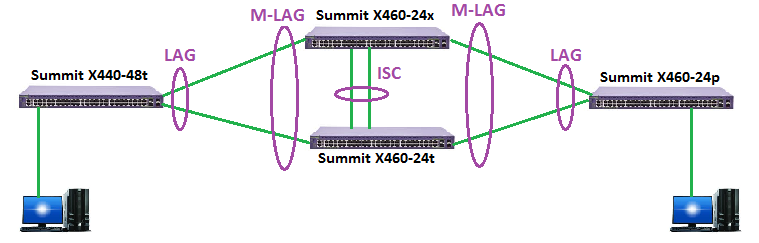
During experimentation:
1. Links between Summit X440-48t and X460-24x, X460-24t were disconnected
2. Links between Summit X460-24p and X460-24x, X460-24t were disconnected
3. ISC link between X460-24x and X460-24t was disconnected
Extreme Networks claims convergence time:

Let's try to run PING from one PC to another, when setting the ICMP interval Echo 50ms:
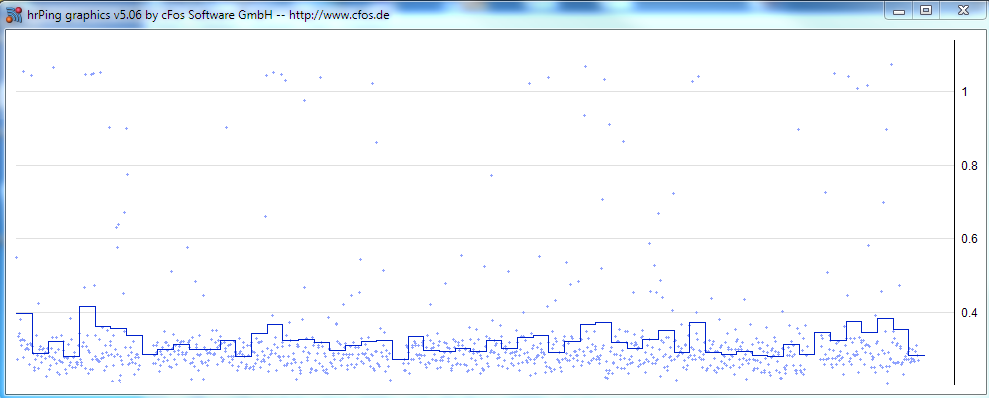
It can be seen that the convergence time is not more than 50 ms.


Moreover, the data is shown when the LAG link fails, and when the ISC link disappeared, packet loss was not observed at all.
But we do not give up and look at the ICMP interval Echo = 10ms:


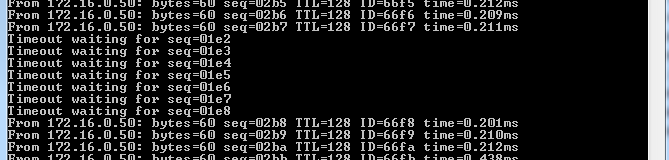
When the LAG link disappears, the convergence time is 40-70 ms, and when the ISC disappears, packet loss is not observed again.
In my opinion, the test results showed remarkable convergence values for failures, and even better than STP.
From which we conclude: M-LAG is an excellent alternative to the established STP and Stacking technologies, is easy to configure, and does not require additional investment, is not licensed, and is available in the ExtremeXOS basic license.
Conclusion:
I would like to note that M-LAG is an excellent technology that has a huge range of applications, but it is not a “pill for all diseases”, therefore it can be used in conjunction with the same STP and stack. It all depends on the network topology and the tasks that are set before it. Also, there are promising, more interesting, in my opinion, solutions, such as TRILL (Transparent Interconnection of Lots of Links) or the increasingly popular SDN (Software-Defined Networking), but this is a separate topic for the article. Yes, and Extreme Networks switches have support for these technologies.
Contact info
All additional questions: [email protected]
MUK-Service - all types of IT repair: warranty, non-warranty repair, sale of spare parts, contract service