Production of key ITER components started

ITER Thermonuclear Reactor - a small copy of the Sun
After several years of delays , work finally began on the assembly of the key components of ITER - coils of the toroidal field.
One of the largest components of a fusion reactor is made by the CNIM contractor. He was engaged in shipbuilding before switching to precision engineering. The location of the plant in La Seyne-sur-Mer in the suburbs of Toulon (France) on the coast is an advantage because some of the components are so bulky that they can only be transported by sea.
In one of the workshops, a giant drill punches channels in D-shaped steel loops about 20 meters in size. They are made of extremely strong steel, so carbide drills have to be changed every 8 minutes.
Seven of these loops are attached to each other to form one of the many magnets controlling the plasma at a temperature of 10 million ° C in a vacuum chamber.
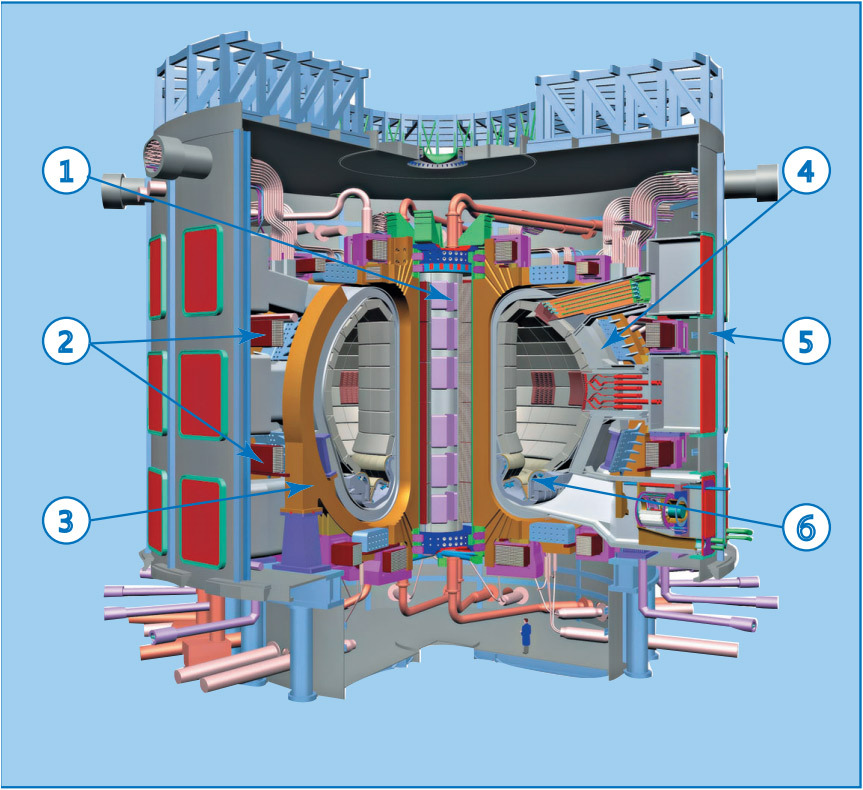
Scheme of the ITER reactor: overall dimensions of the reactor ~ 40 x 40 meters; 1 - central solenoid (inductor); 2 - coils of poloidal magnetic field; 3 - coil of a toroidal magnetic field; 4 - a vacuum chamber; 5 - cryostat; 6 - divertor
Hereinafter - illustrations from the official booklet "ITER International Project " of Rosatom Corporation
However, this is still a long way off. First you need to transfer the loops to a plant in the city of La Spezia in northern Italy, where another contractor will introduce up to 700 meters of superconducting cable into each of them. Then they will be transported to Venice, there another company Simic will complete the assembly of finished coils of the toroidal field. Each coil will weigh like a fully loaded Boeing 747. Simic is also involved in the production of other loops, so they have to make a round trip to La Spezia and back. The ITER leadership initially chose this strategy when contractors fight for contracts, and different parts of a single unit are sometimes produced on different continents.
Finished coils are transported to the French port, where 800 tons are loaded onto a 352-wheel conveyor. He slowly pulls the load to the ITER construction site 104 km from the coast. If everything goes according to plan, then the first coils will be delivered to the place of the future thermonuclear reactor in three years.

And this is just a tiny part of the work that remains to be done before starting ITER.
ITER is a tokamak-type fusion reactor, a toroidal setup for magnetic plasma confinement in order to achieve the conditions necessary for controlled fusion to occur. In the vacuum chamber, the deuterium and tritium nuclei merge to form a helium nucleus (alpha particle) and a high-energy neutron. The plasma in the tokamak is not held by the walls of the chamber, but by a combined magnetic field - a toroidal external and poloidal current field.

An ambitious international project involves Russia, the USA, the EU, China and other countries. The fusion reactor proposed by Soviet physicists in 1985 was agreed upon at a meeting of Presidents Reagan and Gorbachev. Since then, preparation and design has been underway, in 2001 a technical project was prepared, and in 2005 the participating countries decided on the construction site - the vicinity of the city of Cadarache in southern France.
ITER is the most complex technical structure in the history of mankind. The main structure consists of 10 million parts. This is more than in the Large Hadron Collider. Engineers call it a "puzzle of 10 million pieces." Not surprisingly, the preparation took so long.

ITER Playground
At least, the progress in the manufacture of coils of the toroidal field seems more significant than in the manufacture of another key component - coils of the poloidal field. For their production, a special building has been built, which is almost empty for now, not counting a few boxes and a circular crane hanging from the roof: since 2012, almost nothing has changed.
Unfortunately, the deadline for the first launch of the working plasma has recently been shifted again. The project director calls the year 2023, independent experts are inclined towards 2025. After a test run, approximately four years of testing will follow before a real mixture of deuterium and tritium is loaded into the chamber. The objective of ITER is to demonstrate a controlled fusion reaction with a thermonuclear power of several hundred megawatts and to develop a technology for its practical use. After that, you can build the same installations around the world.
At the first stage, the reactor will operate in a pulsed mode with a fusion power of 400–500 MW and a pulse duration of about 400 s. At the second stage, the continuous operation mode of the reactor, as well as the tritium reproduction system, will be worked out.
Scientists are unanimous in their opinion that the future of energy is beyond thermonuclear. The deuterium reserves in the water of the oceans are inexhaustible, the lithium content in the earth's crust is 200 times higher than that of uranium (lithium is obtained directly from ITER from lithium). There are other advantages: the radiation biological hazard of fusion reactors is about a thousand times lower than fission reactors; the ability to place the reactor anywhere; the absence of "heavy" radioactive waste that can be used to make "dirty" bombs; physical impossibility of acceleration ("explosion") of the reactor.