March 31, 2014 at 16:13
Science Fiction Technologies: Warp (Star Trek)
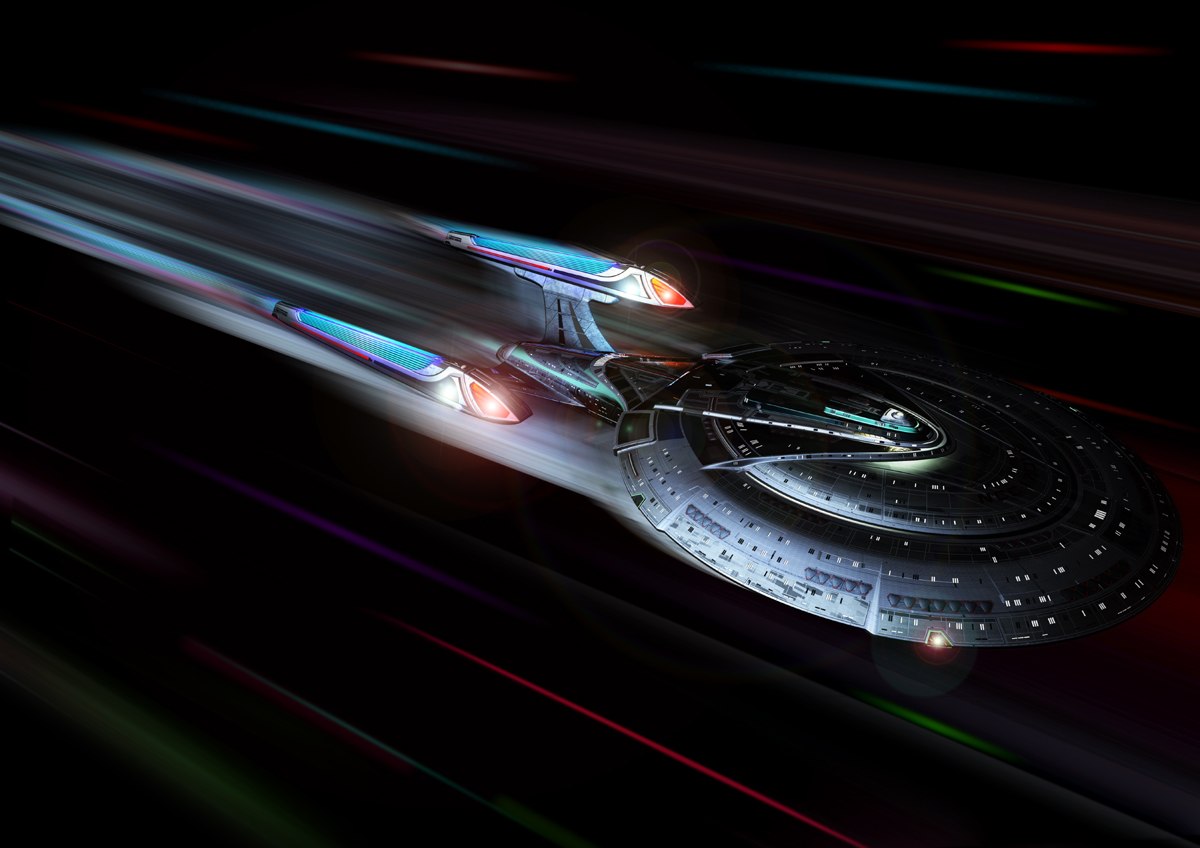
In this series of posts, many Star Trek technologies will be discussed, such as warp, sublight engines, and the like, science-fiction and technological advances that have analogues today.
Wrap, aka “curvature”, is a technology of space-time curvature using plasma and multilayer curvature coils, which can be found in several variations with different races.
Each race with warp technology and above is officially recognized as being sufficiently developed to go into space and collaborate openly with all other races, at least according to the rules of the alpha quadrant.
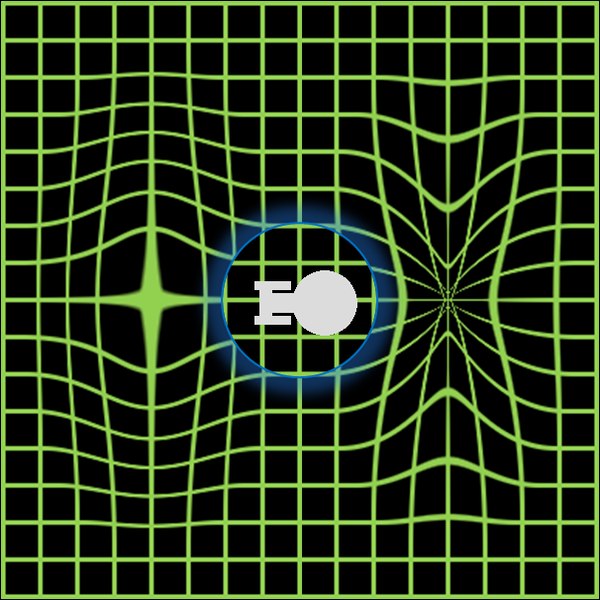
The warp itself is not an engine, it does not move the ship, it shifts the space-time inside the zone around the ship, relative to the space-time outside it. It’s inexplicable how ships can catch up with each other on the warp, since for this not only do we need the most accurate warp generators (gondolas, rings, etc.), the sensors must also be superlight and without distortion. As for the sensors, they use a subspace in which all the signals go from point to point instantly, which does not allow to find out the distance to the target, only the direction.
Also, the warp is the source of almost all spatio-temporal distortions in the series, where the ships, reaching 10 warp on the old scale, begin to move at infinite speed and appear at all points of time and space, which was repeatedly achieved, but it was not explained how the fabric of time space it transfers and regulates such interventions.
Why is 10 warp last?
The warp is superimposed in layers on the area around the ship, each layer requires more energy, but also allows you to bend space-time even more, which gives priority to speed. The picture below shows the warp scale for energy costs (yellow), which clearly illustrates how energy costs are reduced when jumping (applying a new layer) to a new warp factor.

There are 2 scales, before and after updating the systems of Cochrane, the creator of the warp engine on earth.
The old one is limited to 10 warp, the second one is slightly expanded and after warp 10 it goes 11, 12, 13 and so on, while the countdown is up to 15, while warp 13 will be approximately equal to warp 9.95 on the old scale.
Warp is also a fairly flexible field, which is shown in different numbers and shapes of emitters. The simplest type of warp emitter is the ring around the ship. These use Vulcans and with such a system the XCV330 was built.
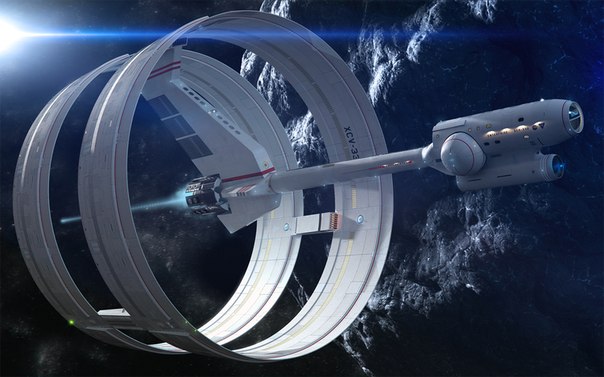
Another option is 1 gondola from below, from above or through the central axis of the ship.
Also very often, almost all races use a variation with 2 gondolas, usually on the sides of the ship.
However, this is not all, there are modifications that can be considered transitional from a full ring (it has the lowest cost of applying each new field) to a single-gondola type, which are detected by using 3 or more gondolas, sometimes of different configurations, to make warp fields cheaper and sustainable. But this affects energy consumption at speeds less than 5 warp, which is why such structures are usually used on the most high-speed ships and ships, where it is necessary to minimize the cost of superlight movement and transfer energy to shields and weapons.
Military dreadnoughts and quick-response cruisers often become such ships. An analogue with 3-4 or even 5 gondolas has been created for almost every Star Trek ship, which also represents a smooth transition between different modifications and new ship hulls.

Among other things, in the Star Trek warp field does not create spatio-temporal gaps between objects in front and behind, which translates into the need to push space debris and dust from the ship in front so that it does not hit it at superluminal speed, making a hole in the hull.
It also shows that the ships cannot pass through the stars and planets, as if pushing their space-time, which also forces us to lay the route not directly, but taking into account all the large objects that they meet.
Warp technologies have great advantages, but also disadvantages, such as the need to constantly feed each ring with high-power plasma flows, as well as the requirements for space-time and the presence of a subspace, which together translates into a Cochrane number other than 0.
Cochrane number this is the coefficient by which the entire power of the warp field is multiplied, which gives the real power of the warp field. If it is 0, warp is not possible, it also means that in this space-time the subspace tissue is burnt, which usually happens when an omega particle explodes. Accordingly, the Federation and some other space powers are doing everything in their power to prevent the creation of new omega-molecules, which, in addition to a huge explosion, can give rise to a complete rupture of the subspace within a pair of solar systems.
If the Cochrane number is in the range from 0 to 1, then warping is possible, although not at full capacity.
With Cochrane's number greater than 1, the zone becomes super-efficient and it is possible to travel on the warp through such “roads” at a much lower cost and greater speed.
Gradually, complicating the design of the coils and the power of the warp reactor, along with the accuracy of all the systems responsible for controlling the warp field, the Federation reached Warp 10, which in the first such cast (pilot Tom Paris, the Voyager series) gave an unexpected evolutionary effect, which affected on the pilot.
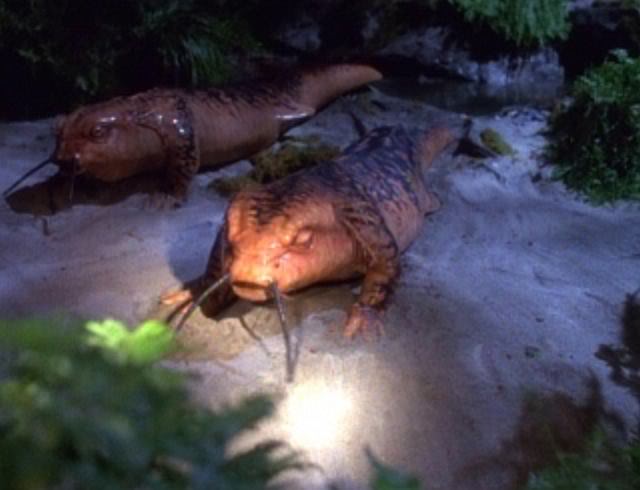
After that, the 10th warp was not used in the series, but later, as you know, the data from Voyager were analyzed by the Federation scientists and on their basis the first stable trans-temporal warp engine was created, which allowed traveling without time and risk of genetic changes in time and space without time costs. However, such a development was almost immediately classified by Section 31, but some of its details managed to leak to other races, and Janeway in the last series stole a prototype of such an engine from one scientist, which allowed her to change history.
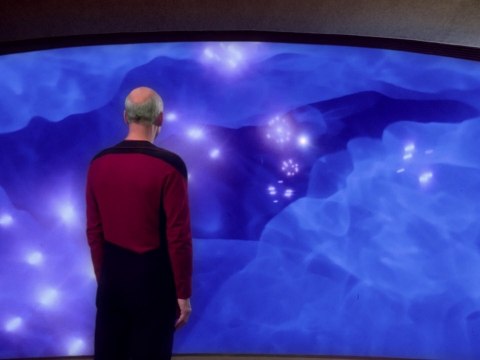
In addition to Voyager, the 10th warp also appeared in the “New Generation”, which is shown in one of the series, where the Enterprise was accelerated by the influence of a trans-temporal being who became interested in the abilities of the young Wesley Cracher, when he learned how to influence the ship and the warp field a bit creatures. As a result, the entire ship with more than 900 people on board ended up in all places at the same time, but that was not the end. The ship began to obey the crew’s thoughts, most often their fears, which shows a strong increase in mental influence in such an amazing space.
But before entering this space, a transitional boundary was shown, which was so beautiful that you need to see it yourself (last picture, the full name of the series “Where no one has gone before”):
But even without opening such an engine, Ambassador Spock himself could calculate the necessary parameters for moving in time with the help of gravity of especially massive objects, like stars and black holes, which is shown both in the TOC series and in the 4th film. (I’m sure he wasn’t the only one who later thought of it, since all the ship’s reports were naturally read by the Admirals and intelligence, which suggests that it was because of Spock that this whole story began with the main temporary directive)
It also turns out in Enterprise that in the 22nd century there is a temporary war in which many races of our galaxy participate and which was initiated by a race not from our galaxy, seeking to change space-time for itself.
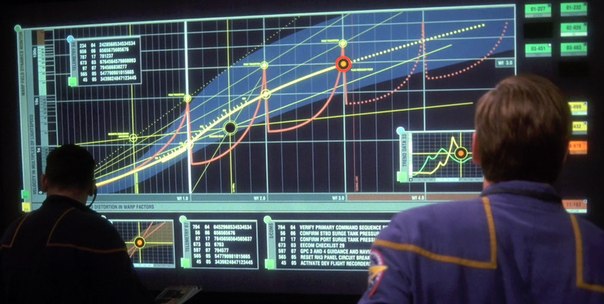
However, the warp in this series was not used as a time travel, all such transitions were the result of using either portable devices that distort a whole zone of space-time around a person or several people, or with incorrect control of the warp fields when passing through space anomalies, which in themselves represent unstable wormholes, in which, in addition to warp fields, it is often necessary to have an adaptation from temporal radiation and other types of radiation.
As a result, warp is the first, but not the most advanced technology for moving in space-time, but it is from it that all other technologies come, such as trans-temporal warp, slipstream, the creation of sharp transitions in time using massive objects that existed in the past and now , as well as various accelerators, such as the “space catapult”, shown in one of the Voyager series.