
 March 18, 2014 at 17:19
Notes for sales managers in a web studio or “Say a word about a poor marketer”
Foreword:
All of the following is not the only true point of view, but only some kind of cheat sheet for the author, who needed to conduct a series of seminars for sales staff at a software development company. Also, this article may be useful to the leaders of small outsourcing companies, to which customers come with similar requests.
Many of these questions seem so obvious that they are rarely voiced by specialists who are the link between the company and the future client, but in practice it is these specialists who often do not suspect that even at the stage of signing the contract, you can protect the future project from a lot of problems.
GENERAL IDEA:
Increasingly, customers who come to the company to develop any products or services want to get not just a turnkey product, but also prepare everything for the subsequent marketing promotion of their brainchild (Internet marketing: SEO, SMM, Email Marketing, etc. )
However, very often the customer himself does not know or misunderstands what tasks he will solve in the future. And that they need to be solved together with marketers in order to achieve the promotion of their product or service.
Accordingly, the initial task of the seller (Sales Manager) in this situation will be to talk about the methods and tools of promotion. But it is worth pointing out that in order to make an informed choice of certain methods or a whole range of measures, it is necessary to conduct a series of audits. These will be audits of the technical part of the project, the market for existing proposals and competition. After that, you can more consciously choose the technology for the future product.
Quite often, situations arise when the selected technology stack is suitable for implementing a business idea, but is categorically not suitable for its subsequent promotion. A good example would be an online store written in Flash. Or the client comes for support and “finishing up” a very old project. This is often easier to rewrite than edit. And in terms of marketing it is extremely difficult to implement support. Moreover, such projects are often very inert and any change in them affects the lowest levels of architecture and can respond in the most unexpected place.
In this case, the success of any marketing task depends on the flexibility of technology. And the complexity / impossibility of marketing support for the “dinosaur” project can become one of the bricks that will help build the foundation for product development from scratch, which, in turn, can help developers (it takes the need to dig hundreds of thousands of lines of someone else's outdated code with funny comments) .
At this stage, it is better to “overdo it than underdevelopment”. If you initially outline a circle of marketing tools that will formulate the requirements for the project, then it is much easier to take into account the requirements in the development process than to “finish” an already finished product (deliver crutches and listen to hundreds of complaints about a dramatic increase in time and human resources costs).
WHAT A SELLER CAN OFFER TO A CLIENT:
By and large, all Internet marketing services can be divided and classified according to the stages at which the project is located.
STAGE 1: Pre-release preparations and the launch phase of the Web product
- market analysis: research on topics in search engines, an approximate assessment of the target audience (CA), competition, traffic volumes in the topics and trends;
On the side of the marketing department, it is possible to implement the selection of a semantic core and conduct an approximate analysis of competitors' traffic, on the basis of which it will already be possible to judge the estimated cost and complexity of promotion in this product.
- usability design for landing pages
In order to get positive results in any commercial project, it’s not enough just to bring traffic to the resource. Qualitative indicators in this case may be conversions (transactions, subscriptions, downloads). And in order for the user to not only read the information, but take an action on the site (subscribe, order, buy), it is necessary to implement high-quality traffic landing pages.
- making recommendations for SEO for implementation on the site in the development process;
The best option. Work on the internal optimization of the site according to the requirements of search engines is being carried out in parallel with the development, therefore, after the release of the project, it will not be necessary to make serious changes to the architecture and logic of the product.
An important point!
It is necessary to explain to the client that the question “Who is your target audience?” the answer “our target audience is all Internet users” is unacceptable, which means that there is no understanding of who the site is aimed at, and therefore it is unclear what it should be.
Also, the customer must answer the standard question “What is the peculiarity of my product or service?”.
Also, the customer must answer the standard question “What is the peculiarity of my product or service?”.
STAGE 2: Work with an already launched product / service
- Audit an existing site and make recommendations on internal optimization;
Allows you to identify problem areas in the architecture of the site, the discrepancy with the requirements of search engines and make recommendations for their elimination.
- Preparing the site for promotion in search engines (SEO);
A set of measures taken to optimize the site in accordance with the recommendations drawn up based on the requirements of search engines. It is necessary in order to increase the visibility of the site in search engines, and, consequently, the traffic to the site.
An important point!
It is necessary to explain to the client that
- positions in search engines (in particular in Google) on the screen of their monitor are not identical to positions on the screens of other users entering this query not only within one country / region / state / city, but even for each user separately;
- positions on requests that the client “likes” without information on the frequency, seasonality of traffic, etc. even if they are in 1 place, they may not bring visits or conversions;
- no company can guarantee a position in search engines, and those companies that provide such guarantees simply lay the budget for risks at the expense of the client;
- Positions in search engines do not always reflect on traffic coming to the site.
- contextual advertising (PPC)
It’s easiest to promote a finished web product using contextual advertising. Even without a serious information base, it will work. In contextual advertising, everything is transparent - the customer pays a specific amount for a specific user. The user comes and does what they want or does not do from him.
If the project is a monster of the Mesozoic era, contextual advertising can be used without making changes to the site itself. It’s enough to make some good adaptive static Landing Pages (landing pages) and from there spread traffic to those corners of the site or service that you need.
Also, this tool is just perfect for “probing” key queries and other types of testing user behavior.
STAGE 3: Conversion Work
- Web analytics
An audit will allow you to identify problem areas on the site, identify key indicators by which you can track the effectiveness of certain activities, identify patterns of behavior and general features of the site’s audience.
- Website Usability Audit
It will help to find out at what stage users of the site may have problems with navigation, making decisions about transactions and give recommendations on improving the interface in order to increase conversions.
STAGE 4: Work on brand loyalty
- social media marketing (SMM)
Creation, maintenance and support of company profiles in social networks. It will help the service / product / company to become closer and “transparent” to users.
- direct marketing (e-mail marketing)
Creation of layouts, layout and content filling of various letters that will be sent to users (distribution with goods, newsletters, newsletters).
An important point!
It should be remembered: not one of the marketing channels, if you use it and only it, will not give quick and stunning results. But working through several channels at once over time often leads to a synergistic effect (when 1 + 1 is already not 2, but 3). :)
HOW AND WHEN TO OFFER:
1. The client came up with an idea, and our company will implement the website.
At the stage of discussion of the draft of the future website / web service, it is necessary to inquire about whether the client knows who his future target audience (hereinafter CA) is, what project competitors (there can be no competitors).
If the client has little idea of his target user, it is necessary to offer him a quick study of target audience. This will help determine the main sources of traffic, subscriptions, purchases that the website will have. According to this data, the architecture and structure of the project may change.
Depending on the target audience and you can offer the client to initially optimize the site for macretting needs:
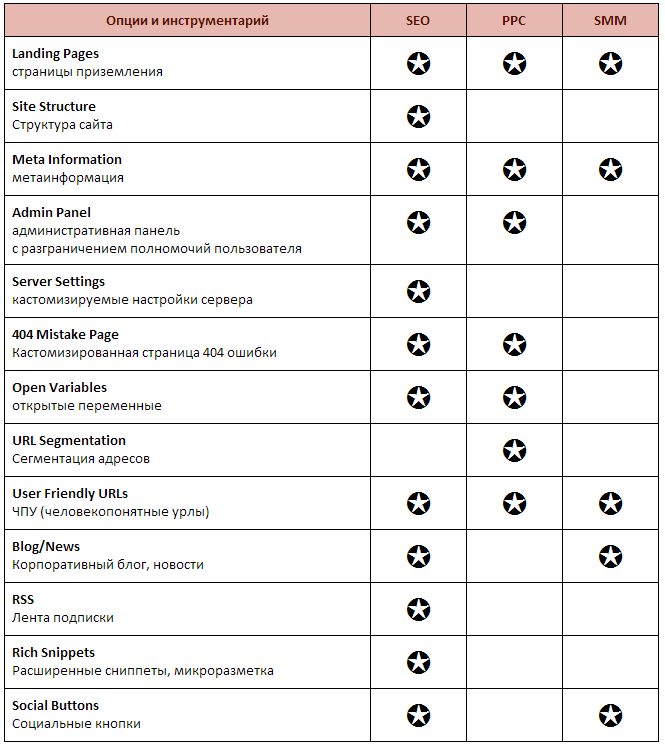
You also need to pay attention to the initial usability of all interface elements.
2. The client already has a ready site. He is interested in modernization, expansion of functionality, marketing support.
Along with changes on the site to expand the functionality, it is possible to offer the client an audit of existing channels for the influx of visitors / buyers.
To do this, you need to get access to all analytics and marketing tools that are already used on the site (Google Analytics, Google Webmaster Tools, Bing Webmaster Tools, Google AdWords, etc), access to the admin panel of the site itself, as well as get the source data conversions etc.
Further, based on the data obtained, we can compile:
- or a short list of recommendations describing the problem areas in the marketing of the client company, technical problems in the site;
- or a complete list of recommendations describing problems in marketing and technical aspects of the site.
An important point!
This recommendation report will also include data on possible problems in usability, as well as bottlenecks found during web analytics on the site.
At the output, the client receives data on where the problems were found by:
- the technical part of the site in general (Technical Issues);
- website promotion in search engines (SEO);
- optimization of paid traffic campaigns (PPC);
- company promotion in social networks (SMM).
SHORT CHECKLIST MARKETING WORKS
When choosing a marketing strategy, you can use one or several tools at once. And further for their implementation the following actions are required:
SEO
- Collecting the semantic core.
- Writing or editing existing metadata and content on the client’s website (Meta & Content Tuning):
- titles;
- meta descriptions;
- indication of canonical pages;
- image captions;
- writing text content;
- technical issues (e.g. performance).
PPC
- Connect, configure Google Analytics, Google Webmaster Tools.
- Audit and analysis of the current situation.
- Preparation and implementation of technical improvements to the project.
- Collection and approval of semantics.
- Preparation and maintenance of PPC Ads.
SMM
- Connect, configure Google Analytics, Google Webmaster Tools.
- Audit, analysis of the current situation.
- Preparation and implementation of technical improvements to the project.
- Collection and approval of semantics.
- Creation, maintenance of social accounts.
DIRECT MARKETING
- Accumulation of the user base, its further segmentation depending on the needs and capabilities of the customer.
- Choosing the direction of work on mailing lists: identifying key triggers (transactional, threshold, recurrent, informational).
- Design, layout and content layouts.
- Create campaigns for newsletters.
- Support and analytics.
Conclusion
Of course, everything described above is far from a complete list of information that sellers of services of development companies should familiarize themselves with, however, it may become a good basis for accumulating their internal knowledge base for small companies that are just starting to gain momentum.