December 20, 2013 at 09:02
x86-compatible, part 1: “The Dark Horse from Taiwan”
 Perhaps the most common question that KolibriOS developers hear is: “ When are you going to port Hummingbirds to ARM ? ” We always reply that this is not possible, KolibriOS is written in FASM assembler using x86 instructions , and porting it to ARM will mean practically full rewrite from scratch. But the main reason is that there are enough computers on the market with x86-compatible processors, the size of a Raspberry Piand costing only $ 5- $ 35 more expensive, and this makes porting not only impossible, but also worthless. So that readers do not say that an x86-compatible computer for $ 40 is a "spherical horse in a vacuum", I decided to write a review cycle of 3 articles on several such computers. I must say right away that articles are not sponsored - I bought all this hardware with my own money, and I test Hummingbirds almost every week on it - didn’t it become, by chance, too slow ? Who cares - I ask for a cat.
  For those who thought that the Taiwanese manufacturer of x86-compatible processors was called VIA , I’ll reveal a terrible secret: it turns out, besides Intel , AMD and VIA, there are currently other manufacturers occupying insignificant market shares of x86 CPU (less than 1%). One of these manufacturers is DMP Electronics , and it is about it that will be discussed in my articles.
 For transparency purposes, I note that Intel also has at least one motherboard (Arduino Galileo) the size of a Raspberry Pi , which sells for $ 69 (not including shipping) . If the size is not so important, and the Mini-ITX form factor is also suitable for you, then you can buy the Intel Desktop Board D2500HN for about $ 60 (not including RAM, + $ 10). But Intel will be able to tell about its motherboards better than me, since they have their own corporate blog on the Habré

DM&P Group established in 1989, and consists of several units:
- Actually, DMP Electronics itself , which produces x86-compatible Vortex86 processors
- The ICOP Technology Division , which manufactures embedded boards based on these processors
- The CompactPC division of eBox industrial computers based on the above boards
ToyPC’snot-so-independentdivision thattakes all the stuffing out of the aluminum case of the eBox computers and inserts it into theplastic case Edubook and KeyboardPC- The Roboard division , which manufactures boards and controllers for robots, naturally, using its own processors.
Hidden text
Why can these Taiwanese have a separate website for each division, with different designs and conflicting information - in my opinion, this only creates confusion and makes it difficult to quickly find the right product, and in the absence of cross-links between different sites, it can also suggest that these are different manufacturers, although in reality they are one and the same manufacturer. But the moped is not mine - I write as it is.

DMP Electronics began its journey with the release of an i386-compatible processor under license from ALi . The ALi M6117C processor included a core that is a copy of the Intel 386SX and runs at a frequency of 25-40 MHz, and an integrated ALi M1217B chipset . DMP slightly modified the processor to fit its needs, and named it ALi M6117D . The processor was produced in the form of a 208-pin PQFP Package , and had the following characteristics ( copy as is from the DMP website ):
- Intel TM 386SX core (5V - 25-40MHz Operation)
- Supports EDO DRAM controller including FP mode (4 Bank)
- Coprocessor interface
- ISA interface
- Peripheral Interface (includes two cascaded 8237 DMA controllers, a 74612 memory mapper, 2 cascaded 8259 interrupt controller, and a 8254 programmer counter)
- Built-in RTC
- Programmable 2 channels chip select
- Built-in PS2 Keyboard Controller and Mouse
- Built-in WATCHDOG timer
- 16-bits GPI / O via SD bus and 16-bits independent GPIO
- IDE interface
On the basis of M6117D CPU, a division of ICOP has released internal cards, and even ready-made instruments . M6117D was produced until 2007, when it was replaced by Vortex86SX / DX . Full specifications and a block diagram of the processor were posted on the DMP website, but about a year ago they were removed from there, due to obsolescence. For those who wish, the page is available through the Web Archive . From the point of view of KolibriOS, this processor is not interesting, since KolibriOS requires at least an i586-compatible processor to work (I talked about it only for the sake of completeness).

(I know that on the right photo there is not a processor, but a heatsink, but, unfortunately, I could not find a photo of the processor itself in the public domain. Whoever puts the photograph of the CPU itself in the comments will receive a prize from me.) EDIT: I need Vortex86, not Vortex86SX / DX (I have a lot of SX / DX photos).
In the late 90s of the 20th century, it became clear that the i386-compatible processor and the solutions offered on its basis can no longer satisfy the growing demand for computer performance, and in order to not lose market share, DMP Electronics bought in 2002 SiS licensed to manufacture an i586-compatible CPU. SiS is better known as a manufacturer of graphics cards and chipsets for motherboards, but 10 years ago it also released its own processors for embedded systems. The processor line was called SiS 55x , and was, in turn, based on the Rise mP6 processor , the rights to which, along with production technology, SiS bought in 1999 from Rise Technology . DMP licensed the SiS550 processor, slightly modified it to fit its needs, and released under the name Vortex86 (M6127D) .I must say right away that this name caused a great deal of confusion, since one of its variants, M6127D, differed in just one digit from the M6117D, which I talked about above, but at the same time had nothing to do with it (except the manufacturer). Another variant of the name, Vortex86, was confused by many in the future with the Vortex86SX released a few years later, with which it also had nothing to do.
Vortex86 is a system on a chip (System-on-a-Chip, SoC): the chip in the 686-pin BGA package was produced according to the 180nm technical process, and included, in addition to the Pentium-compatible processor with support for FPU and MMX instructions operating at 200 MHz, also built-in northbridge, graphics card and southbridge:
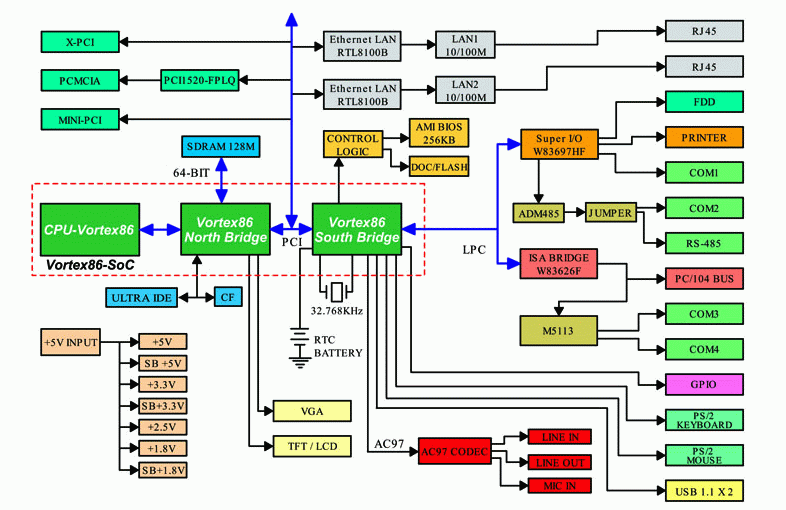
Full processor information is available on the DMP website. The CompactPC division based on this processor released the eBox-2300 industrial mini-computer (not to be confused with the eBox-2300SX , in which a completely different processor is installed: Vortex86SX ). The characteristics of this computer are more than sufficient to run KolibriOS:
| Processor | Vortex86 SoC-200MHz (Fanless) i586-MMX compatible, FPU |
| Memory | 128MB SDRAM onboard (Hummingbird enough 8MB) |
| Flash Memory (Disk) | Support EmbedDisk 32MB to 2GB (Hummingbirds need 1MB disk) |
| Vga | Shared System Memory Area 8 MB (Hummingbird Enough) External 15-pin D-type female VGA connector |
| Ethernet Interface | Realtek 8100B single chip x 1 Throughput: 10/100 Mbps RJ-45 Ethernet Connector |
| I / O | Enhanced IDE interface, 44pin box header x 1 Type I / II Compact Flash Slot x 1 Mini PCI Socket x 1 (Optional) RS-232 Port x 2 (Optional) External 6-pin Mini DIN for PS2 Keyboard External 6-pin Mini DIN for ps2 mouse |
| Audio | AC97 CODEC, Fully Compliant with AC97 V2.1 Phone Jack for MIC-in and Line-Out |
| USB | 3 connectors (USB 1.1) (2 on Front) |
| Power requirements | Single Voltage + 5V @ 2A, w / ACPI function Support Power Push Button x 1 |
| The Dimensions (size) | 115 x 115 x 35 mm |
| Weight (weight) | 505g |
| Operating termperature | 0 ~ + 60 ° C |

However, for unknown reasons, the Vortex86 processor was discontinued almost simultaneously with the very first M6117D processor (in 2007), and replaced by a completely different processor with a similar name, Vortex86SX. The eBox-2300 computer based on it was still sold for some time (obviously, from old stocks from the warehouse), but already in 2010, almost all stores selling them had a “Out of stock” sign. I could not find any information on why this was done; it is also absent on the firm’s website. Perhaps the disclaimer published at the very bottom of the page at www.dmp.com.tw will serve as a hint :
Notice: MMP Technology by TPL Group:This disclaimer may well be directly related to what happened, since the second processor of the Vortex86 line ( Vortex86SX ) was released in 2007.
DMP has purchased an Implementation License to the Moore Microprocessor Patent (MMP) Portfolio from the TPL Group on Sep. 7 2007 . An Implementation License empowers manufacturers of microprocessors and / or other component parts to incorporate MMP technology (ie "Implementations"). Supply of semiconductors implementing TPL's MMP technology does not convey a license nor imply a right under any patent, or any other industrial or intellectual property right of TPL, to use such semiconductor in any finished end-user or ready-to-use final product. You are hereby notified that a license for such use may be required from TPL. Contact: [email protected]
To release the second processor of the Vortex86 line (and the third one from DMP), she again did what she did in the past 2 times: she bought a license to manufacture (and finalize) the processor from another company. This time around , RDC Semiconductor (another Taiwanese manufacturer of x86-compatible processors, even less known than DMP Electronics itself) acted as a seller .

Today, the Vortex86 processor lineup includes 7 processors (in addition to the original Vortex86, made under the SiS license, all other processors were based on the IAD 100xx family of processorsRDC). However, unlike the M6117D and Vortex86, which were almost a complete copy of their “grandparents,” the new processors have more variety: some technologies were taken from the same SiS, and DMP Electronics introduced some part of the design itself. For example, the RDC design consists of 2 chips (the first is CPU + North Bridge, the second is South Bridge), while the DMP design is still SoC (1 chip that includes a CPU, North Bridge and South Bridge). I could not find any information about which part of the processor the RDC Semiconductor technologies are now (and which - the DMP Electronics and / or SiS technologies), and it is also not available on the company's website. According to datasheets, we can talk about 70-80% of similarities.
Be that as it may, the result of this turn was an interesting curiosity: the second Vortex86 processor (based on most RDC Semiconductor technologies) in terms of performance and characteristics came out worse than the first processor (made using SiS technologies). The third ( Vortex86DX ) caught up with the first, and only starting from the fourth, processors became better than the first. But more about that in the next part.
Only registered users can participate in the survey. Please come in.
The second part of the article to be?
- 90.2% Afftar, walk ischo! 687
- 9.7% Afftara - ftopku! 74