November 22, 2013 at 00:13
Interview with Elon Musk. Part 1 - about how he wanted to become a physicist, but became an entrepreneur
- Transfer
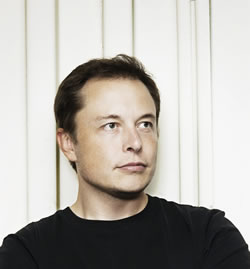 Elon Musk, founder and co-founder of companies such as PayPal, SpaceX, Tesla Motors, studied physics at the University of Pennsylvania. In the first part of the interview that Musk gave to Elena Levin, columnist of the American Physical Society APT News, he talks about how he uses thinking based on principles, what advantages he has gained from studying physics, and why he proudly calls himself nerdom.
 Levin : Recently, in an interview you advised people who want to engage in innovative business to "study physics and learn to think, guided by principles, not analogies." Can you tell us in more detail what you meant?
Mask: Physicists were forced to develop a way of thinking that allows us to understand the counterintuitive elements of reality. Things like quantum physics are not very intuitive, and to advance in their study of physics, they created a thinking technique that allows you to get the right answers, even if they are completely unobvious. And this requires tremendous mental stress. In everyday life, one cannot be guided all the time by principles, it will require too much mental energy. So most of life you have to act by analogy, simply copying the behavior of other people with minimal variations. But if you are trying to become a pioneer, to invent something really new, then you will have to go to thinking based on principles, identify the most fundamental truths in your industry, and derive your thought from them.
Levin : Come on.
Musk : Any technology in rocket science is judged by how much it reduces the cost of space transportation. But, if you study the history of missile launches, you will see that this cost is almost unchanged, and in the USA it even rises with time. If you think in a stereotyped way, by analogy, you will have no choice but to admit that this is life. But this is not so. If you think based on principles, the first thing you need to know is what rockets are made of and how much these materials cost. When we did this, we were very surprised - materials make up only a few percent of the cost of the rocket. There is definitely something wrong with this, and we are doing something very stupid. If we were smarter, we could make rockets much cheaper.
Levin: How is your day? Do you constantly use this method of thinking, or at some point do you have to stop, because it requires too much stress?
Musk : I would be glad to say that I constantly think based on principles, but, unfortunately, I have too many things to do and I save mental energy only for the most important of them, for example, to achieve some kind of technological breakthrough, or with some serious plugging in a business that requires a creative solution. Sometimes it comes out by itself - I wake up and suddenly an insight in my soul comes to me (laughs). It sounds stereotyped, but it often happens. I think my brain is working on a problem at a subconscious level, and the next morning the solution pops into consciousness.
Levin : Why did you decide to study physics?
Musk : I was very interested in understanding how the universe works. But physics does just that - trying to understand how the world works at the most fundamental level. At some point, I seriously thought about the career of a physicist, I thought about some physical problems, but looking to the future, I began to fear that I would get stuck in bureaucratic delays with some kind of collider, and then the project might even be closed, as it was with Superconducting Supercollider , and it will suck. From this just hands fall.
Levin : So you decided in advance that you love physics, want to study it in order to know how the universe works, but are not going to work as a physicist?
Mask: For a while I wanted to be. Somewhere between 12 and 13 I had an existential crisis, I tried to understand why this is all, why we are here, is there any sense in life and all that jazz. I came to the conclusion that the best that can be done is to improve the scope and scale of consciousness and achieve higher insight, which, in turn, will allow us to ask more and more good questions, since it is obvious that the Universe is the answer, The main thing is to ask the right question. It's all about the issues.
Levin : It turns out interesting - you decided to study physics in order to understand how the Universe works, but at the same time you began to study economics, that is, did you think about business education from the very beginning?
Mask: When I tried to decide what I want to do in life, I was convinced that if I did not study economics, I would have to work for someone who studied it (laughs), and they would know all sorts of special things that I don’t know. It didn’t look very nice, so I wanted to be sure that I would know all this too (laughs). Frankly, I can’t say that I felt my own among student economists. I was more fond of hanging out with fellow physicists. I liked people from the departments of art and science. I don’t know, maybe it’s not worth publishing it? (laughs) Yes, I was not thrilled with the company of students of business specialties, I preferred artists and scientists.
Levin : Do you consider yourself a “nerd”?
Mask: Definitely, I was a nerd, and in many respects I remain them. If someone made a list of everything that real nerds are supposed to do, it would turn out that I did everything right on it. I spent many hours throwing dice at D&D.
Levin : And dressed up as characters?
Mask: (laughs) Yes, it was a couple of times, but not at home, but at D&D tournaments. It was cool. I loved it all. I grew up in South Africa and there was a very small community, I had few opportunities to share my hobbies with someone ... Among my peers, no one was interested in programming. I had to force them to play D&D almost by force. Some liked it, but they had to persuade the rest for a long time, because a team of four was needed to participate in the tournaments. I played computer games, wrote software, and I had pants with ties. (laughs) In general, it was not easy for me to live. The girls didn’t want to date me ... And I still did a lot of things - I collected radio, made rockets. In South Africa, they were not sold in stores, so I had to figure out the composition of rocket fuel myself, crush the ingredients in a mortar,
Levin : Yes, perhaps it’s true - everything is on the list of the real nerd.
Musk : (laughs) Level 80 nerd.
The translation of the second part of the interview is about why Musk believes that getting an MBA degree can be a mistake, how much it will cost to travel to Mars, and how Tesla Model S creates a story.