
 November 8, 2013 at 18:59
What is the beauty of Gentoo: Myths and Reality
In the course of reading this article and comments on it, I had a strong feeling that most users using other distributions have an incorrect idea about gentoo-like systems. Most likely the phrase “source-based” is to blame for this.
Someone, having heard it, presents at the same time a computer smoking from the efforts exerted during the endless compilation of another utility. Someone recalls the dependency-hell that awaits us when setting the tarballs. Someone believes that this is a distribution foryoung enthusiasts who are ready to sell their homeland for speeding up the system and reducing boot time by a couple of seconds. Some run in shock after learning about the almost complete absence of graphical administration tools.
Since I believe that this distribution is highly underestimated, and as a result, fewer people use it than they could (and the wider the community, the better), I decided to describe my possibly deeply subjective position on this issue and try to convince readers that the distribution is not at all as brutal and hardcore as it might seem.
Despite the peppy start, it must be clarified that a number of difficulties are still present in comparison with others (for example, Debian and the notorious ubunt).
Many people think that gentoo will give them a huge gain in the speed of programs. But let's see for yourself. Everything works quite well on the top hardware, with the exception of bloatware distributions, and, as a rule, the difference between Debian and Ghent is not so great as to bother in most cases. And on weaker hardware, where it would seem that optimization is needed, the gain will be very small, since there is not much difference between the set of instructions of your processor, and, for example, i686.
So the acceleration of work here is more likely to turn off unnecessary features and reduce the size of the software. Also, do not forget that this speed will be bought at the cost of speed of assembly and installation of software. The latter, however, is not as large as it seems. The days when a rebuild of the system took days are gone. :)
The entry threshold is indeed somewhat high, but there are several points that make life much easier.
Well, with controversial moments, it seems, they finished (almost), and now goodies! I have not just combined these two points. It is the method of installing, updating, and uninstalling applications that makes a significant contribution to system stability. There are many applications. Lots of. If in doubt, look for the utilities you need, for example, here .
I want to say that I in no way want to belittle the merits of other distributions. Many of the features described by me are present in them, but ...
Thanks to a complex installation and a high entry threshold, gentoo has very good documentation and a wiki, which ensures that the user at least encounters the existence of most of these features before they he will need. And this is IMHO good, because it eliminates the stress that arises when necessary to solve a problem, the methods for solving which you do not even imagine. Sooner or later, in any distribution you will get to the console. It's nice to have familiar tools at hand that can solve your problem, rather than looking for them on the forums.
I chose gentoo because it turned out to be easier and more understandable for me to use than others. Everything is predictable, and most are described in quality documentation.
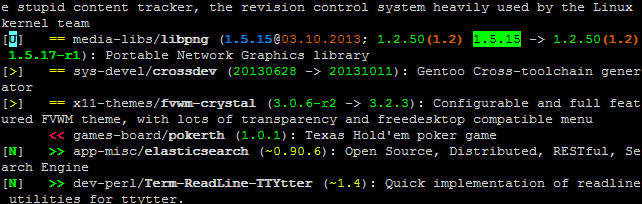
PPS Well, the beautiful console out of the box also played a role. :)
Someone, having heard it, presents at the same time a computer smoking from the efforts exerted during the endless compilation of another utility. Someone recalls the dependency-hell that awaits us when setting the tarballs. Someone believes that this is a distribution for
Since I believe that this distribution is highly underestimated, and as a result, fewer people use it than they could (and the wider the community, the better), I decided to describe my possibly deeply subjective position on this issue and try to convince readers that the distribution is not at all as brutal and hardcore as it might seem.
Everything, of course, is simple ... but not quite.
Despite the peppy start, it must be clarified that a number of difficulties are still present in comparison with others (for example, Debian and the notorious ubunt).
- No documentation anywhere. You will have to read a lot to install this distribution. It is highly desirable that it be read in English, as The Russian version does not always have the current version
- The console is our everything. If you have confephobia, you will have to overcome yourself. It is always and everywhere here: installation, updating, configuration, all this and much more.
- If you urgently need to reinstall the system, or put it on a new machine, then this can take quite a while. Keep this in mind when putting gentoo in production.
Speed
Many people think that gentoo will give them a huge gain in the speed of programs. But let's see for yourself. Everything works quite well on the top hardware, with the exception of bloatware distributions, and, as a rule, the difference between Debian and Ghent is not so great as to bother in most cases. And on weaker hardware, where it would seem that optimization is needed, the gain will be very small, since there is not much difference between the set of instructions of your processor, and, for example, i686.
So the acceleration of work here is more likely to turn off unnecessary features and reduce the size of the software. Also, do not forget that this speed will be bought at the cost of speed of assembly and installation of software. The latter, however, is not as large as it seems. The days when a rebuild of the system took days are gone. :)
Complexity
The entry threshold is indeed somewhat high, but there are several points that make life much easier.
- Community. It is rather big; it has a large Russian-speaking diaspora. In view of the complexity of the distribution and its focus on enthusiasts, there is a huge chance that your problem has already surfaced, and if not, there remains a rather small chance that they can help you solve it.
- After this threshold, when you understand what's what, using the system becomes much simpler and more predictable. Including this is achieved by hardening the user, no matter how scary it sounds. In the same ubunt, I still had to climb into the console, but it was rare there, and I managed to forget some of the necessary commands, this caused me a certain gap in the template. I’m silent about the fact that the manually corrected config was not always updated normally.
Applications and stability
Well, with controversial moments, it seems, they finished (almost), and now goodies! I have not just combined these two points. It is the method of installing, updating, and uninstalling applications that makes a significant contribution to system stability. There are many applications. Lots of. If in doubt, look for the utilities you need, for example, here .
- All this diversity is installed through emerge and eix utilities . A great feature of gentoo is its truly stable “stable branch”, combined with the ability to seamlessly install the latest versions of the programs you need. In principle, you can completely sit on unstable software, just why? And vice versa, knowing that some versions work poorly in my case, there is a possibility not to update on them.
- The system of slots contributes to resolving problems with dependencies, making it possible to install many versions of one library, and disabling dependencies by disabling USE flags. Often they frighten the need to build a kernel, but in fact there is nothing complicated, and with the help of genkernel it does not require any special skill.
- Those who care about the
karma oflicensed cleanliness can indicate with which licenses you can install the software. - Rolling releases make the update more painless.
- The eselect utility will help you set a number of environment variables, for example, default python and Java.
Conclusion
I want to say that I in no way want to belittle the merits of other distributions. Many of the features described by me are present in them, but ...
Thanks to a complex installation and a high entry threshold, gentoo has very good documentation and a wiki, which ensures that the user at least encounters the existence of most of these features before they he will need. And this is IMHO good, because it eliminates the stress that arises when necessary to solve a problem, the methods for solving which you do not even imagine. Sooner or later, in any distribution you will get to the console. It's nice to have familiar tools at hand that can solve your problem, rather than looking for them on the forums.
PS or deep IMHO
I chose gentoo because it turned out to be easier and more understandable for me to use than others. Everything is predictable, and most are described in quality documentation.
PPS Well, the beautiful console out of the box also played a role. :)