September 22, 2013 at 20:18
Jaguar uses virtual technology to organize sales
Jaguar Land Rover vehicles are distinguished from each other by their installed components, and this is a constant problem for dealers who want to visually demonstrate to customers how a car with a particular set of components will look like. As a solution to this problem, Jaguar Land Rover and IBM developed the 3D application Jaguar Land Rover Virtual Experience, which runs on a PC and allows customers to use the motion recognition technology to view and change components on the 3D model of the car right in the dealer’s demo room.
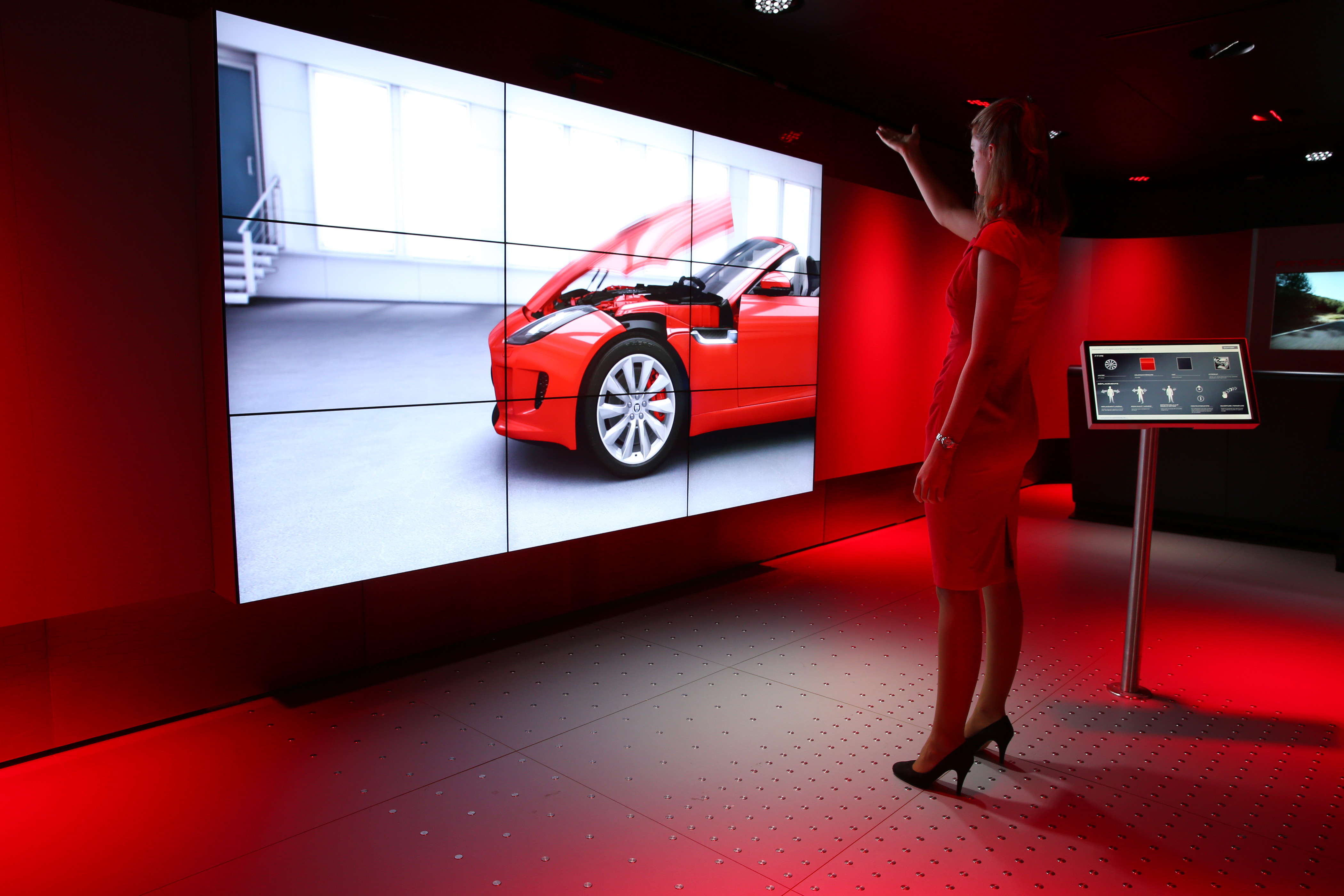
The Jaguar Land Rover Virtual Experience project demonstrates how the real and digital worlds come together to change the shopping process.
“All our cars are custom-made, so it’s important for us how convenient it is for the user to choose a car and its components , ”said Nathan Summers, Director of Digital Technologies at Jaguar Land Rover. “ If we are developing something, it should be beneficial to complement the car, as well as organically fit into the normal sales process .”
In order to use the Jaguar Land Rover Virtual Experience, the user must register in the system using the tablet and select the car, the projection of which is displayed on the big screen. Then, using gestures, he can control the image of the car and explore its capabilities, for example, open the door to view the interior. Want to listen to the sound of the engine? Just “click” the button. “We pursued one goal: to propose a solution that would be the most realistic, interactive and exciting , ”Summers emphasized.

Since Jaguar Land Rover Virtual Experience runs on a laptop, Jaguar representatives can use it anywhere, for example, at automobile exhibitions organized in different countries. The application also serves to collect data on user preferences, in particular about what characteristics of the car more often attract attention during the purchase process.
According to Sima Nadler, head of retail research at IBM Research, the Jaguar Land Rover Virtual Experience is an example of how digital technology is transforming shopping: “ Digital has found itself in the real world, and Jaguar is at the forefront in this regard."
Jaguar also plans to use the Jaguar Land Rover Virtual Experience as a design tool for a new generation of vehicles. Designers will be able to create virtual car models to see how certain design decisions affect the appearance of the car and the driving experience even before it gets off the assembly line. “ We will have to master the technology for rapid prototyping and proactive vulnerability detection ,” Summers explained.
To summarize the above, retailers are increasingly trying to combine online and offline shopping, using strategies for organizing a universal sales channel, the success of which depends heavily on the IT used. Unfortunately, a new survey conducted by IBM among marketing directors showed that only 35% of marketing directors integrate marketing initiatives across multiple distribution channels. Thus, companies are losing about $ 85 billion in potential sales revenue, and this is another reason why CIOs need to work more closely with their peers in the marketing department.
VIA CIOInsight
The Jaguar Land Rover Virtual Experience project demonstrates how the real and digital worlds come together to change the shopping process.
“All our cars are custom-made, so it’s important for us how convenient it is for the user to choose a car and its components , ”said Nathan Summers, Director of Digital Technologies at Jaguar Land Rover. “ If we are developing something, it should be beneficial to complement the car, as well as organically fit into the normal sales process .”
In order to use the Jaguar Land Rover Virtual Experience, the user must register in the system using the tablet and select the car, the projection of which is displayed on the big screen. Then, using gestures, he can control the image of the car and explore its capabilities, for example, open the door to view the interior. Want to listen to the sound of the engine? Just “click” the button. “We pursued one goal: to propose a solution that would be the most realistic, interactive and exciting , ”Summers emphasized.
Since Jaguar Land Rover Virtual Experience runs on a laptop, Jaguar representatives can use it anywhere, for example, at automobile exhibitions organized in different countries. The application also serves to collect data on user preferences, in particular about what characteristics of the car more often attract attention during the purchase process.
According to Sima Nadler, head of retail research at IBM Research, the Jaguar Land Rover Virtual Experience is an example of how digital technology is transforming shopping: “ Digital has found itself in the real world, and Jaguar is at the forefront in this regard."
Jaguar also plans to use the Jaguar Land Rover Virtual Experience as a design tool for a new generation of vehicles. Designers will be able to create virtual car models to see how certain design decisions affect the appearance of the car and the driving experience even before it gets off the assembly line. “ We will have to master the technology for rapid prototyping and proactive vulnerability detection ,” Summers explained.
To summarize the above, retailers are increasingly trying to combine online and offline shopping, using strategies for organizing a universal sales channel, the success of which depends heavily on the IT used. Unfortunately, a new survey conducted by IBM among marketing directors showed that only 35% of marketing directors integrate marketing initiatives across multiple distribution channels. Thus, companies are losing about $ 85 billion in potential sales revenue, and this is another reason why CIOs need to work more closely with their peers in the marketing department.
VIA CIOInsight