IBM Pure Flex System Overview
Colleagues, good afternoon!
On the current resource, and indeed in RuNet, there is very little information about blade systems, about their main differences, advantages and disadvantages.
Mass production of blade systems began in 2002 by various manufacturers and today does not have a single standard. The platform of each vendor has both its own characteristics. Almost all of them released them (IBM, Dell, Supermicro, SUN, HP, Intel, Fujitsu) but most of the market was occupied by IBM and HP, now they are actively catching up with Cisco (this company has been engaged in the production of such systems relatively recently) using its “network” authority among customers.
Only IBM can boast that it has maintained the platform for the entire time since 2001, i.e. Designed in 2001, the Blade Center has the same form factor of server blades and switches as it does now. The only differences are the power of the power supplies. It is clear that at the moment the platform can no longer boast of some technological advantages relative to competitors - but to be no worse than them for a 12-year platform is at least not bad.
But today, I want to talk about the platform, which is the technological leader at the moment in the market of blade systems and is an integrated platform, because its capabilities and functionality are much wider.
This is IBM Pure Systems
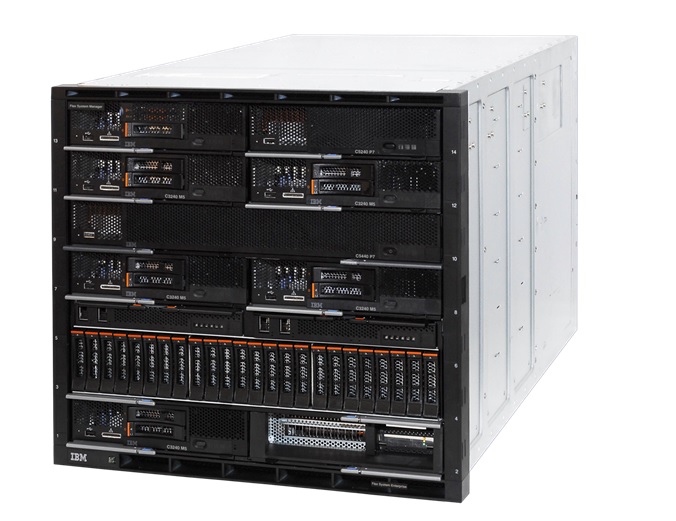
. What is its main difference from traditional blade systems:
• Consolidation and deep integration of all the necessary components (storage, various hypervisors, servers)
• A single console for managing all elements of the system
• A set of templates for automated software deployment
In addition, the system has a completely new technological design that gives the platform new features.
Network infrastructure.
A wide and flexible choice of switches, Ethernet - 1 Gbit switches, 10 Gbit switches (both L2 and L3 level), 40 Gbit switches, convergent 10 GB switches, Infiniband 56 Gbit and FC SAN 16 Gigabytes of production Brocade are presented.
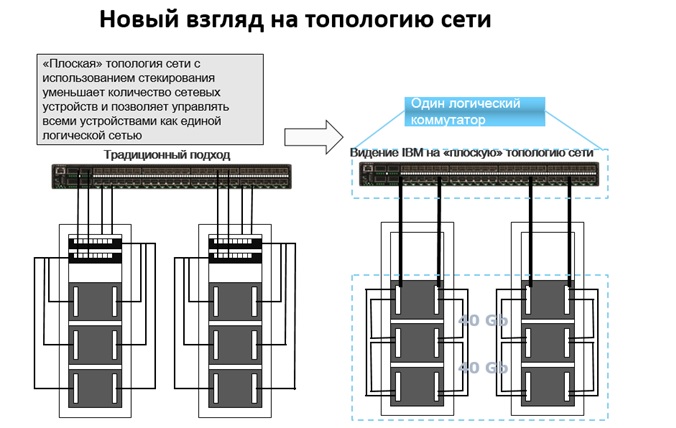
The main difference is that the network infrastructure forms a flat network and is one large logical switch. To combine 10 Gbit switches, 40 Gbit uplink is used (in 1 Gbit switches - 10 Gbit uplink), thereby creating a high-performance network, which is very popular in creating large-scale infrastructure solutions that are not limited to one chassis. Also, when creating a virtual infrastructure - virtual machines can quickly migrate across the entire available pool of computing resources and provide a wide channel for backup. Separately, I would like to note the completely non-blocking architecture of the switches with high bandwidth, low latency (and again, hello to the competitors !!!) and a large number of switch ports (up to 64 10 Gbit ports).
Servers
The platform allows you to simultaneously use two types of x86 processors - that is, Intel and alternative RISC servers based on proprietary IBM Power P7 + processors
x86 servers A
line of models ranging from basic with two Intel E5-2400 processors, and powerful ones with 4 processors.
There are also high density nodes that allow you to install up to 28 servers in 10U.
Competitive platforms have limitations on the type of processor installed and the number of memory slats (i.e., having difficulty organizing cooling inside the chassis) even for 16 blades in the same 10U
Those. The IBM servers that are used in the solution support processors with a TDP of 135W and also have up to 24 RAM slots on board (competitors have 2-processor servers with so many memory slots in their portfolio, however, it must be remembered that when using processors more than 115W all slots cannot be used). This allows you to host significantly more virtual servers on the host than on similar solutions from competitors. In addition, servers in IBM x240 can install up to 8 SSDs, which allows you to get an ultrafast local disk system inside a single server. No other manufacturer can provide such flexibility and scalability within a single node.
And what will happen when the new 10-12 core Intel Xeon
IBM Power P7 +
servers enter the market ? These servers are not compatible with the x86 platform since use a different architecture - RISC. But this architecture is more efficient and uses higher frequencies. Supported operating systems are Linux and AIX (a redesigned IBM version on the UNIX theme). Oracle database users will benefit the most - the high performance of 2 socket systems allows you to stay under the Standard license, saving hundreds of thousands of dollars compared to the enterprise option Owners of Superdome and similar ones will also appreciate the ease of migration to this platform with the ability to increase productivity.
These servers can be either two socket with 8 or 12 cores per socket, or 4 socket
Built-in storage system.
The IBM Storwize V7000 system is used in a special design that can be installed in the chassis.
The main advantages of the system:
• Virtualization of external arrays of other manufacturers, greatly simplifies migration and allows you to combine all arrays into one.
• Scalability up to 4 controller shelves in a cluster, and the total number of disks - up to 960 pcs.
• Support for SSD, auto-tier data storage, 1.2 TB in 2.5-inch and 4 TB in 3.5-inch drives, I think it’s no surprise to anyone ....
Control module .
This module manages the entire system:
• Monitoring and detection of hardware problems (chassis, server, and storage)
• Management of hardware components
• Network management (both built-in switches and external)
• Disk space
management • Management of virtualized resources
The main advantage of IBM Flex System Manager is the creation of a single center for managing, monitoring and administering both physical and virtual resources, both internal and external (through import mechanisms).
Summarizing all the above, this system offers significantly more than similar systems on the market and is the most interesting system in technical terms.
On the current resource, and indeed in RuNet, there is very little information about blade systems, about their main differences, advantages and disadvantages.
Mass production of blade systems began in 2002 by various manufacturers and today does not have a single standard. The platform of each vendor has both its own characteristics. Almost all of them released them (IBM, Dell, Supermicro, SUN, HP, Intel, Fujitsu) but most of the market was occupied by IBM and HP, now they are actively catching up with Cisco (this company has been engaged in the production of such systems relatively recently) using its “network” authority among customers.
Only IBM can boast that it has maintained the platform for the entire time since 2001, i.e. Designed in 2001, the Blade Center has the same form factor of server blades and switches as it does now. The only differences are the power of the power supplies. It is clear that at the moment the platform can no longer boast of some technological advantages relative to competitors - but to be no worse than them for a 12-year platform is at least not bad.
But today, I want to talk about the platform, which is the technological leader at the moment in the market of blade systems and is an integrated platform, because its capabilities and functionality are much wider.
This is IBM Pure Systems
. What is its main difference from traditional blade systems:
• Consolidation and deep integration of all the necessary components (storage, various hypervisors, servers)
• A single console for managing all elements of the system
• A set of templates for automated software deployment
In addition, the system has a completely new technological design that gives the platform new features.
Network infrastructure.
A wide and flexible choice of switches, Ethernet - 1 Gbit switches, 10 Gbit switches (both L2 and L3 level), 40 Gbit switches, convergent 10 GB switches, Infiniband 56 Gbit and FC SAN 16 Gigabytes of production Brocade are presented.
The main difference is that the network infrastructure forms a flat network and is one large logical switch. To combine 10 Gbit switches, 40 Gbit uplink is used (in 1 Gbit switches - 10 Gbit uplink), thereby creating a high-performance network, which is very popular in creating large-scale infrastructure solutions that are not limited to one chassis. Also, when creating a virtual infrastructure - virtual machines can quickly migrate across the entire available pool of computing resources and provide a wide channel for backup. Separately, I would like to note the completely non-blocking architecture of the switches with high bandwidth, low latency (and again, hello to the competitors !!!) and a large number of switch ports (up to 64 10 Gbit ports).
Servers
The platform allows you to simultaneously use two types of x86 processors - that is, Intel and alternative RISC servers based on proprietary IBM Power P7 + processors
x86 servers A
line of models ranging from basic with two Intel E5-2400 processors, and powerful ones with 4 processors.
There are also high density nodes that allow you to install up to 28 servers in 10U.
Competitive platforms have limitations on the type of processor installed and the number of memory slats (i.e., having difficulty organizing cooling inside the chassis) even for 16 blades in the same 10U
Those. The IBM servers that are used in the solution support processors with a TDP of 135W and also have up to 24 RAM slots on board (competitors have 2-processor servers with so many memory slots in their portfolio, however, it must be remembered that when using processors more than 115W all slots cannot be used). This allows you to host significantly more virtual servers on the host than on similar solutions from competitors. In addition, servers in IBM x240 can install up to 8 SSDs, which allows you to get an ultrafast local disk system inside a single server. No other manufacturer can provide such flexibility and scalability within a single node.
And what will happen when the new 10-12 core Intel Xeon
IBM Power P7 +
servers enter the market ? These servers are not compatible with the x86 platform since use a different architecture - RISC. But this architecture is more efficient and uses higher frequencies. Supported operating systems are Linux and AIX (a redesigned IBM version on the UNIX theme). Oracle database users will benefit the most - the high performance of 2 socket systems allows you to stay under the Standard license, saving hundreds of thousands of dollars compared to the enterprise option Owners of Superdome and similar ones will also appreciate the ease of migration to this platform with the ability to increase productivity.
These servers can be either two socket with 8 or 12 cores per socket, or 4 socket
Built-in storage system.
The IBM Storwize V7000 system is used in a special design that can be installed in the chassis.
The main advantages of the system:
• Virtualization of external arrays of other manufacturers, greatly simplifies migration and allows you to combine all arrays into one.
• Scalability up to 4 controller shelves in a cluster, and the total number of disks - up to 960 pcs.
• Support for SSD, auto-tier data storage, 1.2 TB in 2.5-inch and 4 TB in 3.5-inch drives, I think it’s no surprise to anyone ....
Control module .
This module manages the entire system:
• Monitoring and detection of hardware problems (chassis, server, and storage)
• Management of hardware components
• Network management (both built-in switches and external)
• Disk space
management • Management of virtualized resources
The main advantage of IBM Flex System Manager is the creation of a single center for managing, monitoring and administering both physical and virtual resources, both internal and external (through import mechanisms).
Summarizing all the above, this system offers significantly more than similar systems on the market and is the most interesting system in technical terms.
Only registered users can participate in the survey. Please come in.
Did you find out something interesting for yourself?
- 68.5% yes 61
- 31.4% no 28