
 August 23, 2013 at 15:35
Case story about promoting the game on your own in the tops of the US App Store
In this article we want to talk about the strategy and tactics of launching on the US market our f2p tower defense (TD) game genre. Sound budgets, share discoveries, analyze errors. The release of the game took place a year ago.
To "seed" the achievement of the game in the App Store:
1. visited the top6 and top7 of its categories in the US;
2. Featured at New & Noteworthy in 68 countries;
3. about 500,000 downloads;
4. "letter of happiness" from Apple;
5. 5 stars - average rating for all stores within six months;
6. reviews on leading international mobile portals.
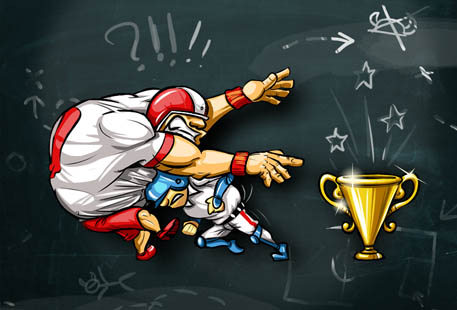
Earlier we talked about the balance of the game and the use of AI and utilities in development .
Experience in the US markets
Since 2004, our company has developed and independently released j2me games. We felt great on this platform and were able to gain a foothold not only in Russia, but also “shot” in some countries of the world. But even on j2me we did not have big victories on US sites.
Experience on iOS
At that moment, we knew almost nothing about how to make money on iOS: before the TD, which will be discussed in this article, we independently released two iOS games that we did not really promote. One of the games failed. The second itself made its way to the top RU App Store and was able to gain a foothold in good positions in its genres for a long time, but in stores in other countries it did not achieve anything significant.
TD Development Experience
Games of the Tower Defense genre we have never done before. The "horse" of our company is Tamagotchi. All tamagotchi in our portfolio are profitable. Having finished with the fish, we proceeded to seals, after seals to dogs, and so on, so there were no developments for TD at all.
Experience in f2p
We released our first f2p game on j2me in 2006, having received a hit and pioneered this business model. Without any fuss, fearing to lose this competitive advantage, we released f2p java games one after another, and continued to apply this business model for iOS games as well. Despite the great experience and success of all our f2p, we are constantly learning and looking for new options for successful monetization. So, in our TD, we decided to move away from the usual monetization scheme and conduct an experiment.
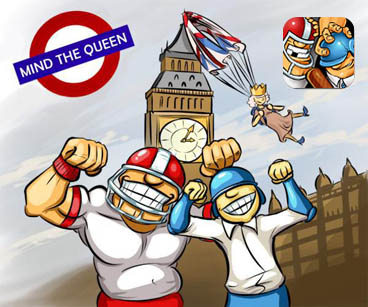
About a year before the start of development, a competition for a game for iOS / Android was held within the company. The second place was just taken by the game of the Tower Defense genre. While we were developing the winning game, the idea and setting for the proposed TD became irrelevant. But the genre of the game has sunk into our hearts very much. The developers were psychologically tired of tamagotchi, their "creative impulses" faded from work in such a narrow genre specialization. And we decided to take a chance and spend a couple of months discussing the setting and creating a TD prototype, and based on the results, either continue development, or return to dog-cats.
We decided that we would not do another TD with a setting of zombies, fantasy, military equipment or the apocalypse: to create a masterpiece in a classic shell and gameplay, you need to have good experience in developing strategies in general and TD in particular, which we did not have. And we decided to focus on the US consumer and come up with an interesting setting for him, which was not previously in TD. It was very difficult: artists painted concept after concept, which caused skepticism.
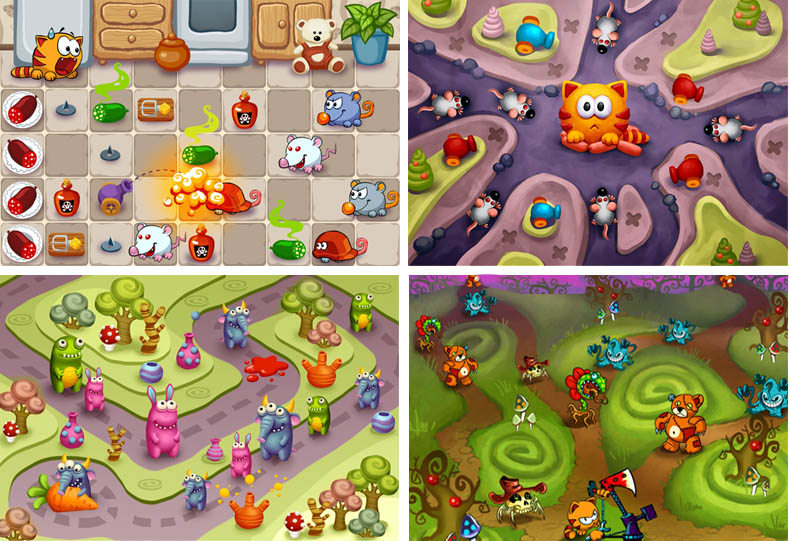
And when we were ready to abandon the idea of TD in general, one of our colleagues proposed to make the game in banter sports style - and Americans love sports, and TD has not had such a thing.
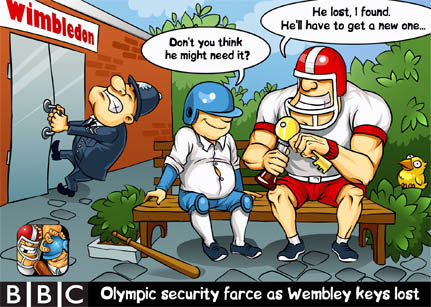
The proposal was received by the whole team positively. Ideas sprang up right away, most of which were embodied in the game: it was then that the cheerleader was invented, who slows down opponents with her short-skirt dances, and the skier, accelerating in straight sections, and the jumper as an “air” creep.
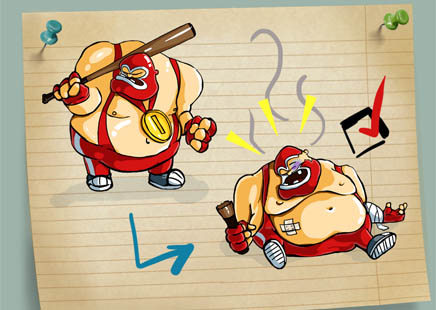
Artists offered concept after concept:
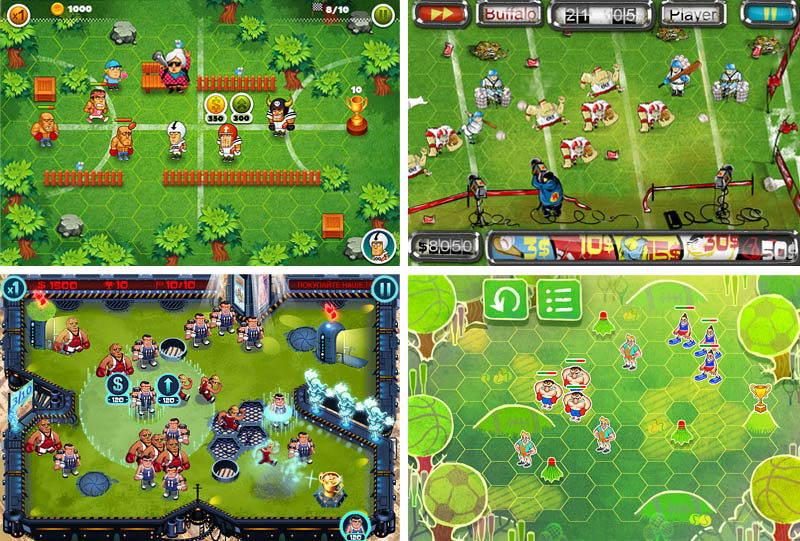
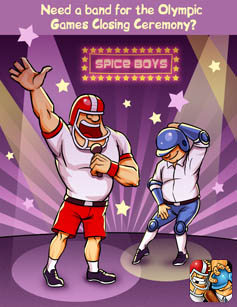
Most of all, we liked the options that reminded American comics about superheroes, and another colleague “remembered” that the 2012 Olympic Games in London will start on the release date of the game. It was like a sign of fate.
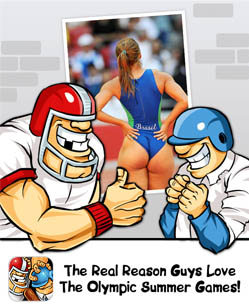
The whole team was incredibly united, before no project was discussed by so many employees of completely different job responsibilities. There was such a unity of the company in the desire to make a high-quality game, which, perhaps, even because of this, it was worth doing. In addition, I liked the prototype of the game, and development began.
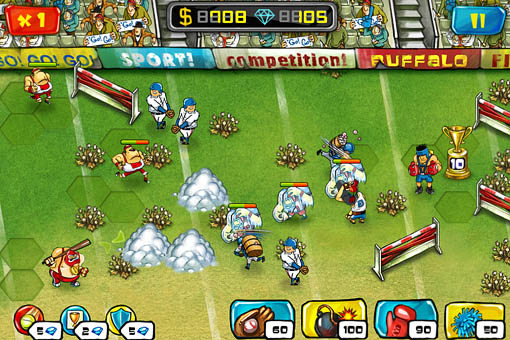
This article is dedicated to the promotion of the game, so we will not talk in detail about how this or that gameplay decision was made. Nevertheless, in summarizing we will mention some mistakes made in the development.
Publishers
Even at the stage of discussing the concept of TD, we went to talk “for life” with publishers. We simply represented the company, showed the catalog of created projects and tried to find out what games they should present. All of them spoke in general the same thing about the original idea and high-quality application, but among other things mentioned that they definitely should not go with games of the TD genre. They say that their developers send and send, it’s difficult to come up with something interesting here, but they can’t see them anymore. We realized that presenting our TD to publishers now would simply be pointless, and decided to postpone this moment closer to the end of development. Surprisingly, at this stage our desire to do TD did not decrease at all, but, on the contrary, it made us concentrate on development even more.
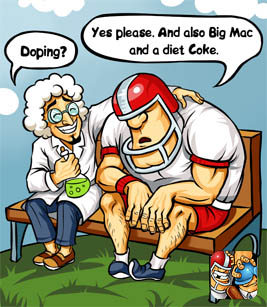
In May 2012, we sent out a presentation and video of the game to 10 foreign publishers and very quickly received the 4th response that they really like the game, and that’s exactly what they need. They began to communicate in more detail, and it turned out that for 2 companies we do not fit into the release plan for the Olympiad. These publishers could launch us only after the New Year holidays (that is, six months after the release of the game). Two other companies wanted improvements that also dragged on for several months of work.
The publishers convinced us that the Olympiad would not work, there was no sense in orienting ourselves on it, that we would start well later without it. It was a difficult decision. We wanted to work with one of the publishers, but it was impossible to wait. The following psychological moment played a big role: if the publishers liked the game, despite the fact that initially they didn’t even want to look at the games of the TD genre, then the game turned out to be amazing, and we can make our way to the top without the publisher. After all, what is a publisher: the rights to a game for several years, rework, alterations, a long coordination of all the points in the contract, what exactly they will do for promotion - we still don’t know, we will skip the Olympics, we will start at best in six months, and here she, a "live" game, almost ready for release. Something like this, reasoning,
Advertising Agencies
Next, we decided to go to the advertising agencies and buy from them any of the game promotion packages (the cost of the packages is $ 10K-30K). Previously, we, of course, conducted an analysis of which of them brought out the top games and started negotiations with 3 companies. But here we are faced with the fact that no one subscribes to anything. We will send out press releases, but we cannot guarantee publication. We’ll bring it to the top with advertising - such and such a budget, overtaking people on social networks - such and such a budget and so on. For these budgets, we ourselves were able to do all this. We were primarily interested in PR support, but there were no guarantees at all, so we decided to refuse cooperation with agencies.
Monetization
Both now and a year ago, articles were published calling for IAP to be less intrusive, and the games themselves more loyal to players. And we know that tough but well-thought-out monetization works great. But for TD, we set ourselves the primary goal to break into the tops and get a large player base. To do this, we decided to release a game with very soft monetization. It turned out completely for the lazy, and in the future even opponents of f2p games wrote good reviews and gave us fives. Our strategy was that having made our way to good positions and received excellent marks, with game updates we will gradually begin to “tighten the screws” and it is better to monetize the “hooked” players.
From paid to free
Although our TD was created as an f2p game, we decided to first sell it for several weeks, then switch to free and light up in applications that promote free games that were previously paid (there are many of them, for brevity, we introduce the term - FreeApp). We knew that some of the games that had become hits were moving forward, and we hoped that such a move would help us.
Reviews
At that time, we thought that the game was published with impressive traffic. That if you release good reviews in key publications, then we will immediately fly to the top, so we devoted a lot of time to working with journalists.
Many developers are trying in one way or another to "get" the journalist, make friends with him and "push" their project for review. Journalists are encrypted as they can: they don’t leave phones, personal e-mails anywhere, they remove the ability to send messages from Facebook, etc. They even came up with an “editor’s oath” (OATS): never, under any circumstances, “sell” for money, nor for promotional codes, nor for anything else — developers will come up with.
We started knocking on reporters a month before the release of the game. They used linkedin, facebook (for those of them who have not yet completely gone underground), the phones of the companies to which the domains are registered, their personal websites. Plus they wrote to everyone. We found contacts of 3 journalists from the publication - they wrote. Found 15 - even better, again they wrote to everyone. In our case, almost always someone answered, although sometimes he turned out to be not a journalist, but a representative of the advertising department.
No one promised anything, no one wanted to look at the game before it appeared in the store, almost everyone wanted promo codes and exclusive contests. But that was good already. At least we knew that the promo code would reach the addressee. Some of the reviews were paid, plus we allocated a budget for valuable prizes (iPads) for contests for three publications.
So, the game comes out paid for $ 1 in the Sport and Strategy categories, and after 2 days gets featured in New & Noteworthy in 68 countries. We are quickly starting to grow in positions in genres and just a few days later we are already at 13/19 places on the Ipad in the paid USA store (lower on the Iphone). For the paid version, we did not buy ads. Several reviews came out (the main pool of publications was reserved before switching to free), but we did not notice much of their impact on traffic.
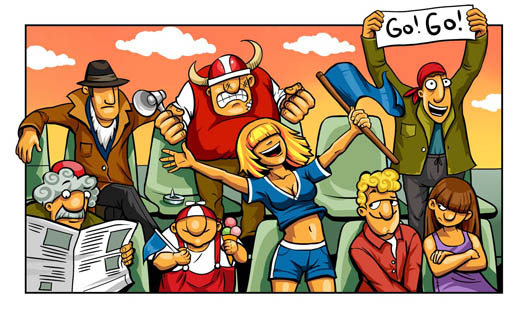
Reviews are good, players leave reviews even better, give the game mostly 5 stars. IAP in the paid version is 25% of our income, while almost no one complains about them. To begin with, everything is not bad, and we expect real success after switching to free.

The game was on sale 5 days when we received an email from Apple. It suggested that we urgently prepare a promo for a large banner on the iTunes homepage. Artists sit down at work at night, marketing lets tears of happiness from such an opportunity to "light up".
In the morning we sent a banner and almost immediately saw a surprise in the "New" store - a sequel to the Fieldrunner game. And this is like a smile of fate, because we understand that two TDs will not be given “big” featured, and Fieldrunner, unlike us, has a brand. We still have hope for phishing for the iPad, because Fieldrunner at that time did not have an HD version, plus the Olympics, but we have a sports setting.
Thursday is coming - Fieldrunner flaunts on the banner. On the same day, a letter arrives from the company, which seemed to us the most interesting for promotion in FreeApp, with a message that tomorrow they had a window open for us, and if the date does not suit us, then our reservation will be made in 3 weeks.

Actually, we also wanted to hang in paid. There was scanty hope for Apple’s "big" featured in a week, and download traffic, although it began to show a downward trend, was still holding. On the other hand, in 3 weeks without advertising support, we will most likely be already far below, which we also did not want to allow. Nevertheless, we decided not to wait 3 weeks and switch to free now.
Switch, and, of course, collapsed in positions in the huge competition free. Literally right there we appeared in several FreeApp. At the same time, most publications published reviews very quickly and placed contests with prizes. We also added ads in parallel - the game quickly climbed up in positions.
We reached 6 and 7 positions in our categories and got into the top46 Games Free US. And then it’s like a “wall”: pouring traffic, but we’re not moving up anyway.
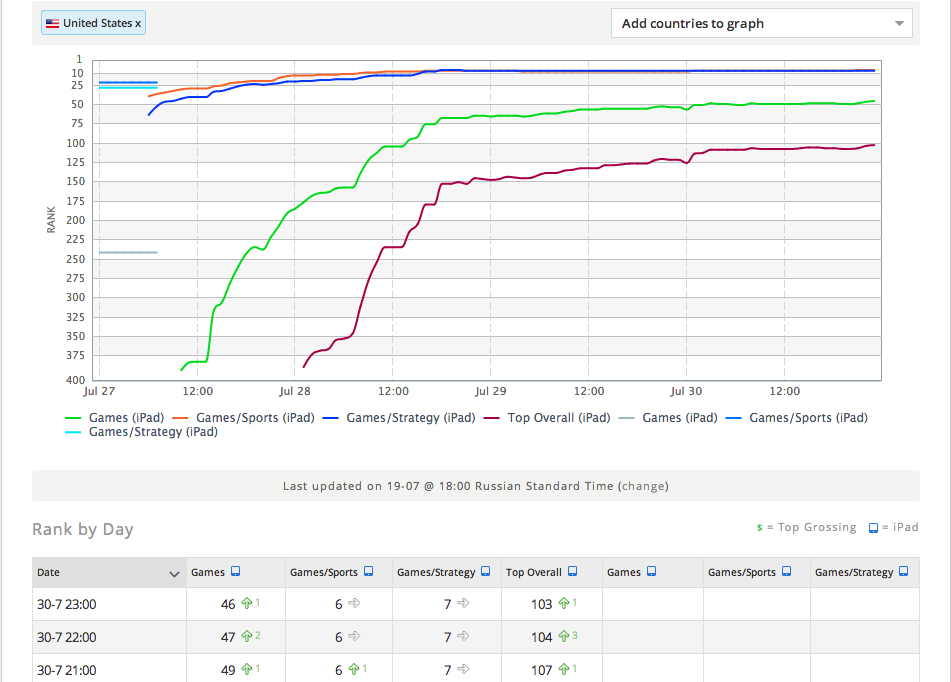
A few days later the game held in good positions, and as they stopped injecting traffic, it collapsed right there. Neither new reviews, nor competitions with the iPad as the main prize, nor activity on social networks were able to stop this decline.

Further, as it was planned, we began to “tighten the screws” with IAP and release versions in which playing without real expenses became more and more difficult. ARPU began to grow in progress as monetization tightened, and pretty quickly we got an interesting number. Unfortunately, by that time the game was no longer in the top positions.
For a long time, even despite experiments with monetization, the average rating of the game in all stores remained 5 stars. At the moment, it is 4.5 stars (3158 ratings), but this is due to several of the “toughest” versions: we wanted to understand the limit, and we deliberately went too far.

In a number of other countries, it was possible to stay in higher positions, and hang there longer. Here, for example, Russia:
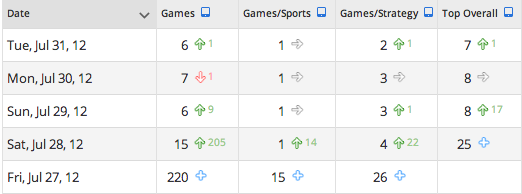

This is the budget for the US App Store, it was still its own for Android.
Ad Networks
We chose Tapjoy, we only bought ads for the f2p version. The traffic from Tapjoy, of course, is of poor quality (launched-deleted), but organic uploads, from which we were already waiting for income, gave good positions. We poured it sparingly, then “adding up”, then completely turning off the campaign. CPI turned out to be $ 0.7, Of course, we tried $ 0.1- $ 0.6, but the most optimal were the results with $ 0.7.
Work with the press
In English-language publications, they wrote about us: 148Apps, KnowYourMobile, Technologytell, Appadvice, Pocketgamer, Slidetoplay, Apptudes, Appolicious, The-App-Shack, Appcraver, plus another 20 small publications.
In the reviews, the journalists praised the game for the original banter setting, so we were not mistaken with it. Perhaps it was the setting that allowed our TD to stand out in a stream of letters to gaming journalists. By the way, interestingly, paid reviews turned out to be even more honest than free ones - in addition to the pros, they also indicated cons, probably fearing bias. The problem that is encountered here: you do not know for sure whether the reviews will be published on the right dates, even those for which they paid.
We spent a lot of resources on working with journalists, but the significant effect of publications was only in Germany, Russia and China - we rose 1-2 places in the categories, already being in good places, in the first few hours after the release of local reviews and in the absence of other types of promotion. In the USA, in our opinion, publications have given us nothing meaningful.
Initially, the budget for reviews was $ 8K, but, not seeing the effect of the ipad draws, the planned contests were canceled, and $ 3K was transferred to the budget for advertising.
Work with forums and social. networks
Where the game did not want to be reviewed, for example, on TouchArcade, we spread activity on the forums. Naturally, work began long before the release. Several accounts, comments in different threads, and not just the one that you started yourself, plus observing the rules of the forum - that's the whole trick.
For 2 months of working with the forums, we organized 7 contests. And now we can conclude: there is no big hype with these actions. The reason is this: a very specific audience is participating in the contests. These are approximately 200 people who simply earn money / prizes on this. Moreover, many of them are not residents of the United States and Europe. The maximum that you can get from this is +100 people on Facebook. When organizing contests with the distribution of prizes, we recommend that you carefully analyze the winners. Often, one person can have up to 7-8 accounts on the forum and thereby increase the chance of victory.
We did not buy banner ads on top sites. We thought that this would increase brand awareness, and more. The proposals varied, but on average they looked something like this: “The CTR of the platinum package is 0.7-2.5%, gold - 0.3-0.8%, silver - 0.15% -0.6%. The cost for two weeks: $ 7500, $ 3500 and $ 2500, respectively. " We considered allocating part of the budget for such an “image drain” to be inadmissible.
FreeApps
The effect of publications in such applications was, but our mistake was that we later came to them to agree on a posting date: in the most popular of them, everything was taken a month and a half ahead.

We do not disclose the cost of development and game revenue, but we can say that the game not only recaptured all costs, but also gave a plus (but not one iOS version, plus Android). Now we believe that we could have earned more if we had not made a number of mistakes, which we will discuss below.
Inspired by the results of TD and the many praises of its setting, after some time we started developing a new game of a completely different genre (arcade), but with characters, graphics and animations from our TD. It turned out network multiplayer via wi-fi, so far only for Android. Now this game is distributed completely free of charge without any IAP, but with updates soon a store with bonus items will appear in it. This is another of our experiments.
Errors of the game
The game did not consolidate itself on the achieved positions, therefore, of course, in the first place, the problems were in it itself. I don’t want to disassemble gameplay errors in a publication on promotion, let’s say only about the most obvious.
If you already decided to go into casualty, then you had to do everything in a completely different way. For example, unambiguous paths, but not free development. Or you should focus on the connoisseurs of the genre, but then - the graphics are more brutal, showing the parameters of the towers, etc. But we got a mismatch of the visual range and game mechanics. We understood this quickly, but such global changes take time, so we decided to align other flaws, and this option, perhaps, could be embodied in one of the new versions of the game.
We should
- Faster to release updates with tightened monetization. Too cautiously, we “tightened the nuts”.
- Do not spend so much effort and money on PR, it would be better to add these amounts to the budget for advertising. Or - they gave this part of the work to the agency. The budget + remuneration of employees involved in PR is exactly equal to the cost of a good package.
- Start with the game first in one country, gain experience and analytics, on the basis of which to make changes to the game, and then go to the USA. But in a hurry for the Olympics, they really believed in the power and “internationality” of the reviews, and, most importantly, the limited budget, which I wanted to use to the maximum in the USA.
- Do not harbor any particular attention to the game due to the Olympics. As the publishers warned, the Olympics helped us nothing.
- Still, work with the publisher. The budget was limited, and the publisher could break through the wall in which we buried ourselves in 6-7 positions in the genres, plus point out the errors of the game before its release. Of course, in hindsight it cannot be said that everything would be much better with the publisher. How to know. But since we were given a chance to work with the gurus of the market, we should use it.
What did good
1. Anti-piracy activities.
They quickly monitored IAP hacks, and sought to quickly remove the game from pirated portals.
2. Work with the press.
Despite all the disappointments associated with this phase of the work, we believe that in those conditions they did everything possible.
What did not work out completely
1. Publications from top US bloggers.
They have huge audiences, they write about everything that catches their eye, but probably prestige does not allow them to write about an unknown product. Even for the money.
2. Create a viral video about the game. Now we believe that this is no easier than promoting the game.

We do not think we have the right to give advice. Nevertheless, if you are a small and poor company that is going to publish the game yourself, we can tell you the following:
- As you develop the game, tell everyone about it: both B2B and B2C. And watch the reaction carefully. If a certain remark is repeated more than once - do not dismiss it, even if the opinions are not authoritative for you, this is really an occasion to reflect and, possibly, change something.
- With very limited budgets, priority is advertising.
- If someone needs to pay for something, bargain. If you fail to bring the price “head on”, you can discuss special conditions with restrictions that will turn out to be more profitable for you than the original offer.
And, of course, good luck!
To "seed" the achievement of the game in the App Store:
1. visited the top6 and top7 of its categories in the US;
2. Featured at New & Noteworthy in 68 countries;
3. about 500,000 downloads;
4. "letter of happiness" from Apple;
5. 5 stars - average rating for all stores within six months;
6. reviews on leading international mobile portals.
Earlier we talked about the balance of the game and the use of AI and utilities in development .
Our "baggage" of knowledge at that time
Experience in the US markets
Since 2004, our company has developed and independently released j2me games. We felt great on this platform and were able to gain a foothold not only in Russia, but also “shot” in some countries of the world. But even on j2me we did not have big victories on US sites.
Experience on iOS
At that moment, we knew almost nothing about how to make money on iOS: before the TD, which will be discussed in this article, we independently released two iOS games that we did not really promote. One of the games failed. The second itself made its way to the top RU App Store and was able to gain a foothold in good positions in its genres for a long time, but in stores in other countries it did not achieve anything significant.
TD Development Experience
Games of the Tower Defense genre we have never done before. The "horse" of our company is Tamagotchi. All tamagotchi in our portfolio are profitable. Having finished with the fish, we proceeded to seals, after seals to dogs, and so on, so there were no developments for TD at all.
Experience in f2p
We released our first f2p game on j2me in 2006, having received a hit and pioneered this business model. Without any fuss, fearing to lose this competitive advantage, we released f2p java games one after another, and continued to apply this business model for iOS games as well. Despite the great experience and success of all our f2p, we are constantly learning and looking for new options for successful monetization. So, in our TD, we decided to move away from the usual monetization scheme and conduct an experiment.
Setting history
About a year before the start of development, a competition for a game for iOS / Android was held within the company. The second place was just taken by the game of the Tower Defense genre. While we were developing the winning game, the idea and setting for the proposed TD became irrelevant. But the genre of the game has sunk into our hearts very much. The developers were psychologically tired of tamagotchi, their "creative impulses" faded from work in such a narrow genre specialization. And we decided to take a chance and spend a couple of months discussing the setting and creating a TD prototype, and based on the results, either continue development, or return to dog-cats.
We decided that we would not do another TD with a setting of zombies, fantasy, military equipment or the apocalypse: to create a masterpiece in a classic shell and gameplay, you need to have good experience in developing strategies in general and TD in particular, which we did not have. And we decided to focus on the US consumer and come up with an interesting setting for him, which was not previously in TD. It was very difficult: artists painted concept after concept, which caused skepticism.
And when we were ready to abandon the idea of TD in general, one of our colleagues proposed to make the game in banter sports style - and Americans love sports, and TD has not had such a thing.
The proposal was received by the whole team positively. Ideas sprang up right away, most of which were embodied in the game: it was then that the cheerleader was invented, who slows down opponents with her short-skirt dances, and the skier, accelerating in straight sections, and the jumper as an “air” creep.
Artists offered concept after concept:
Most of all, we liked the options that reminded American comics about superheroes, and another colleague “remembered” that the 2012 Olympic Games in London will start on the release date of the game. It was like a sign of fate.
The whole team was incredibly united, before no project was discussed by so many employees of completely different job responsibilities. There was such a unity of the company in the desire to make a high-quality game, which, perhaps, even because of this, it was worth doing. In addition, I liked the prototype of the game, and development began.
This article is dedicated to the promotion of the game, so we will not talk in detail about how this or that gameplay decision was made. Nevertheless, in summarizing we will mention some mistakes made in the development.
To promote
Publishers
Even at the stage of discussing the concept of TD, we went to talk “for life” with publishers. We simply represented the company, showed the catalog of created projects and tried to find out what games they should present. All of them spoke in general the same thing about the original idea and high-quality application, but among other things mentioned that they definitely should not go with games of the TD genre. They say that their developers send and send, it’s difficult to come up with something interesting here, but they can’t see them anymore. We realized that presenting our TD to publishers now would simply be pointless, and decided to postpone this moment closer to the end of development. Surprisingly, at this stage our desire to do TD did not decrease at all, but, on the contrary, it made us concentrate on development even more.
In May 2012, we sent out a presentation and video of the game to 10 foreign publishers and very quickly received the 4th response that they really like the game, and that’s exactly what they need. They began to communicate in more detail, and it turned out that for 2 companies we do not fit into the release plan for the Olympiad. These publishers could launch us only after the New Year holidays (that is, six months after the release of the game). Two other companies wanted improvements that also dragged on for several months of work.
The publishers convinced us that the Olympiad would not work, there was no sense in orienting ourselves on it, that we would start well later without it. It was a difficult decision. We wanted to work with one of the publishers, but it was impossible to wait. The following psychological moment played a big role: if the publishers liked the game, despite the fact that initially they didn’t even want to look at the games of the TD genre, then the game turned out to be amazing, and we can make our way to the top without the publisher. After all, what is a publisher: the rights to a game for several years, rework, alterations, a long coordination of all the points in the contract, what exactly they will do for promotion - we still don’t know, we will skip the Olympics, we will start at best in six months, and here she, a "live" game, almost ready for release. Something like this, reasoning,
Advertising Agencies
Next, we decided to go to the advertising agencies and buy from them any of the game promotion packages (the cost of the packages is $ 10K-30K). Previously, we, of course, conducted an analysis of which of them brought out the top games and started negotiations with 3 companies. But here we are faced with the fact that no one subscribes to anything. We will send out press releases, but we cannot guarantee publication. We’ll bring it to the top with advertising - such and such a budget, overtaking people on social networks - such and such a budget and so on. For these budgets, we ourselves were able to do all this. We were primarily interested in PR support, but there were no guarantees at all, so we decided to refuse cooperation with agencies.
Strategy and Tactics
Monetization
Both now and a year ago, articles were published calling for IAP to be less intrusive, and the games themselves more loyal to players. And we know that tough but well-thought-out monetization works great. But for TD, we set ourselves the primary goal to break into the tops and get a large player base. To do this, we decided to release a game with very soft monetization. It turned out completely for the lazy, and in the future even opponents of f2p games wrote good reviews and gave us fives. Our strategy was that having made our way to good positions and received excellent marks, with game updates we will gradually begin to “tighten the screws” and it is better to monetize the “hooked” players.
From paid to free
Although our TD was created as an f2p game, we decided to first sell it for several weeks, then switch to free and light up in applications that promote free games that were previously paid (there are many of them, for brevity, we introduce the term - FreeApp). We knew that some of the games that had become hits were moving forward, and we hoped that such a move would help us.
Reviews
At that time, we thought that the game was published with impressive traffic. That if you release good reviews in key publications, then we will immediately fly to the top, so we devoted a lot of time to working with journalists.
Many developers are trying in one way or another to "get" the journalist, make friends with him and "push" their project for review. Journalists are encrypted as they can: they don’t leave phones, personal e-mails anywhere, they remove the ability to send messages from Facebook, etc. They even came up with an “editor’s oath” (OATS): never, under any circumstances, “sell” for money, nor for promotional codes, nor for anything else — developers will come up with.
We started knocking on reporters a month before the release of the game. They used linkedin, facebook (for those of them who have not yet completely gone underground), the phones of the companies to which the domains are registered, their personal websites. Plus they wrote to everyone. We found contacts of 3 journalists from the publication - they wrote. Found 15 - even better, again they wrote to everyone. In our case, almost always someone answered, although sometimes he turned out to be not a journalist, but a representative of the advertising department.
No one promised anything, no one wanted to look at the game before it appeared in the store, almost everyone wanted promo codes and exclusive contests. But that was good already. At least we knew that the promo code would reach the addressee. Some of the reviews were paid, plus we allocated a budget for valuable prizes (iPads) for contests for three publications.
Timeline
So, the game comes out paid for $ 1 in the Sport and Strategy categories, and after 2 days gets featured in New & Noteworthy in 68 countries. We are quickly starting to grow in positions in genres and just a few days later we are already at 13/19 places on the Ipad in the paid USA store (lower on the Iphone). For the paid version, we did not buy ads. Several reviews came out (the main pool of publications was reserved before switching to free), but we did not notice much of their impact on traffic.
Reviews are good, players leave reviews even better, give the game mostly 5 stars. IAP in the paid version is 25% of our income, while almost no one complains about them. To begin with, everything is not bad, and we expect real success after switching to free.
The game was on sale 5 days when we received an email from Apple. It suggested that we urgently prepare a promo for a large banner on the iTunes homepage. Artists sit down at work at night, marketing lets tears of happiness from such an opportunity to "light up".
In the morning we sent a banner and almost immediately saw a surprise in the "New" store - a sequel to the Fieldrunner game. And this is like a smile of fate, because we understand that two TDs will not be given “big” featured, and Fieldrunner, unlike us, has a brand. We still have hope for phishing for the iPad, because Fieldrunner at that time did not have an HD version, plus the Olympics, but we have a sports setting.
Thursday is coming - Fieldrunner flaunts on the banner. On the same day, a letter arrives from the company, which seemed to us the most interesting for promotion in FreeApp, with a message that tomorrow they had a window open for us, and if the date does not suit us, then our reservation will be made in 3 weeks.
Actually, we also wanted to hang in paid. There was scanty hope for Apple’s "big" featured in a week, and download traffic, although it began to show a downward trend, was still holding. On the other hand, in 3 weeks without advertising support, we will most likely be already far below, which we also did not want to allow. Nevertheless, we decided not to wait 3 weeks and switch to free now.
Switch, and, of course, collapsed in positions in the huge competition free. Literally right there we appeared in several FreeApp. At the same time, most publications published reviews very quickly and placed contests with prizes. We also added ads in parallel - the game quickly climbed up in positions.
We reached 6 and 7 positions in our categories and got into the top46 Games Free US. And then it’s like a “wall”: pouring traffic, but we’re not moving up anyway.
A few days later the game held in good positions, and as they stopped injecting traffic, it collapsed right there. Neither new reviews, nor competitions with the iPad as the main prize, nor activity on social networks were able to stop this decline.
Further, as it was planned, we began to “tighten the screws” with IAP and release versions in which playing without real expenses became more and more difficult. ARPU began to grow in progress as monetization tightened, and pretty quickly we got an interesting number. Unfortunately, by that time the game was no longer in the top positions.
For a long time, even despite experiments with monetization, the average rating of the game in all stores remained 5 stars. At the moment, it is 4.5 stars (3158 ratings), but this is due to several of the “toughest” versions: we wanted to understand the limit, and we deliberately went too far.
In a number of other countries, it was possible to stay in higher positions, and hang there longer. Here, for example, Russia:
Budgets
This is the budget for the US App Store, it was still its own for Android.
Ad Networks
We chose Tapjoy, we only bought ads for the f2p version. The traffic from Tapjoy, of course, is of poor quality (launched-deleted), but organic uploads, from which we were already waiting for income, gave good positions. We poured it sparingly, then “adding up”, then completely turning off the campaign. CPI turned out to be $ 0.7, Of course, we tried $ 0.1- $ 0.6, but the most optimal were the results with $ 0.7.
Work with the press
In English-language publications, they wrote about us: 148Apps, KnowYourMobile, Technologytell, Appadvice, Pocketgamer, Slidetoplay, Apptudes, Appolicious, The-App-Shack, Appcraver, plus another 20 small publications.
In the reviews, the journalists praised the game for the original banter setting, so we were not mistaken with it. Perhaps it was the setting that allowed our TD to stand out in a stream of letters to gaming journalists. By the way, interestingly, paid reviews turned out to be even more honest than free ones - in addition to the pros, they also indicated cons, probably fearing bias. The problem that is encountered here: you do not know for sure whether the reviews will be published on the right dates, even those for which they paid.
We spent a lot of resources on working with journalists, but the significant effect of publications was only in Germany, Russia and China - we rose 1-2 places in the categories, already being in good places, in the first few hours after the release of local reviews and in the absence of other types of promotion. In the USA, in our opinion, publications have given us nothing meaningful.
Initially, the budget for reviews was $ 8K, but, not seeing the effect of the ipad draws, the planned contests were canceled, and $ 3K was transferred to the budget for advertising.
Work with forums and social. networks
Where the game did not want to be reviewed, for example, on TouchArcade, we spread activity on the forums. Naturally, work began long before the release. Several accounts, comments in different threads, and not just the one that you started yourself, plus observing the rules of the forum - that's the whole trick.
For 2 months of working with the forums, we organized 7 contests. And now we can conclude: there is no big hype with these actions. The reason is this: a very specific audience is participating in the contests. These are approximately 200 people who simply earn money / prizes on this. Moreover, many of them are not residents of the United States and Europe. The maximum that you can get from this is +100 people on Facebook. When organizing contests with the distribution of prizes, we recommend that you carefully analyze the winners. Often, one person can have up to 7-8 accounts on the forum and thereby increase the chance of victory.
We did not buy banner ads on top sites. We thought that this would increase brand awareness, and more. The proposals varied, but on average they looked something like this: “The CTR of the platinum package is 0.7-2.5%, gold - 0.3-0.8%, silver - 0.15% -0.6%. The cost for two weeks: $ 7500, $ 3500 and $ 2500, respectively. " We considered allocating part of the budget for such an “image drain” to be inadmissible.
FreeApps
The effect of publications in such applications was, but our mistake was that we later came to them to agree on a posting date: in the most popular of them, everything was taken a month and a half ahead.
Summary
We do not disclose the cost of development and game revenue, but we can say that the game not only recaptured all costs, but also gave a plus (but not one iOS version, plus Android). Now we believe that we could have earned more if we had not made a number of mistakes, which we will discuss below.
Inspired by the results of TD and the many praises of its setting, after some time we started developing a new game of a completely different genre (arcade), but with characters, graphics and animations from our TD. It turned out network multiplayer via wi-fi, so far only for Android. Now this game is distributed completely free of charge without any IAP, but with updates soon a store with bonus items will appear in it. This is another of our experiments.
Error handling
Errors of the game
The game did not consolidate itself on the achieved positions, therefore, of course, in the first place, the problems were in it itself. I don’t want to disassemble gameplay errors in a publication on promotion, let’s say only about the most obvious.
If you already decided to go into casualty, then you had to do everything in a completely different way. For example, unambiguous paths, but not free development. Or you should focus on the connoisseurs of the genre, but then - the graphics are more brutal, showing the parameters of the towers, etc. But we got a mismatch of the visual range and game mechanics. We understood this quickly, but such global changes take time, so we decided to align other flaws, and this option, perhaps, could be embodied in one of the new versions of the game.
We should
- Faster to release updates with tightened monetization. Too cautiously, we “tightened the nuts”.
- Do not spend so much effort and money on PR, it would be better to add these amounts to the budget for advertising. Or - they gave this part of the work to the agency. The budget + remuneration of employees involved in PR is exactly equal to the cost of a good package.
- Start with the game first in one country, gain experience and analytics, on the basis of which to make changes to the game, and then go to the USA. But in a hurry for the Olympics, they really believed in the power and “internationality” of the reviews, and, most importantly, the limited budget, which I wanted to use to the maximum in the USA.
- Do not harbor any particular attention to the game due to the Olympics. As the publishers warned, the Olympics helped us nothing.
- Still, work with the publisher. The budget was limited, and the publisher could break through the wall in which we buried ourselves in 6-7 positions in the genres, plus point out the errors of the game before its release. Of course, in hindsight it cannot be said that everything would be much better with the publisher. How to know. But since we were given a chance to work with the gurus of the market, we should use it.
What did good
1. Anti-piracy activities.
They quickly monitored IAP hacks, and sought to quickly remove the game from pirated portals.
2. Work with the press.
Despite all the disappointments associated with this phase of the work, we believe that in those conditions they did everything possible.
What did not work out completely
1. Publications from top US bloggers.
They have huge audiences, they write about everything that catches their eye, but probably prestige does not allow them to write about an unknown product. Even for the money.
2. Create a viral video about the game. Now we believe that this is no easier than promoting the game.
Parting words
We do not think we have the right to give advice. Nevertheless, if you are a small and poor company that is going to publish the game yourself, we can tell you the following:
- As you develop the game, tell everyone about it: both B2B and B2C. And watch the reaction carefully. If a certain remark is repeated more than once - do not dismiss it, even if the opinions are not authoritative for you, this is really an occasion to reflect and, possibly, change something.
- With very limited budgets, priority is advertising.
- If someone needs to pay for something, bargain. If you fail to bring the price “head on”, you can discuss special conditions with restrictions that will turn out to be more profitable for you than the original offer.
And, of course, good luck!