3Q month with 397 RC9730C tablet
 My acquaintance with 3Q started in a non-standard way. I decided to purchase a lightweight compact laptop with a diagonal of 11.6 for travel. The key parameters were chosen diagonal and weight at an affordable price. Then I found out that there is a 3Q company that has developed a very interesting ES1105N netbook for my requests. The device deserves a separate article, and in the meantime, the story continues. I did not have time to leave with a new beech on vacation, when it stopped working. SSD just disappeared from the system. Well, I wrote to tech support, took an old laptop and drove off to Kiev for the holidays. The thought warmed that he did not regret 300 rubles for the service of quick replacement of marriage in the store.
Upon returning, I found that technical support responded literally an hour later, offering to turn in a laptop to the service. But there was no point, I went to change. To my disappointment, there was no such device for exchange in the warehouse, after a long selection in the store catalog I took another brand. Nevertheless, the ES1105N managed to hook something and did not get out of his head. After some time, I stumbled upon the 3Q group in Vkontakte and wrote my story to them. A dialogue ensued, the result of which was my proposal to write an overview of one of the company's tablets. Yes, this article is a real order! A joke :) The condition was an impartial and honest study of the tablet with all its pros and cons in exchange for the device itself.
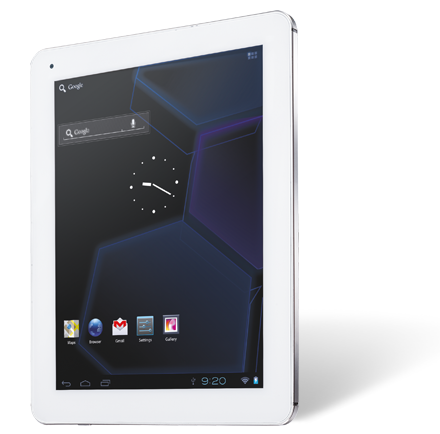
So, I got into the hands of a 9.7 inch tablet RC9730C. After a month of active use, it was possible to identify its strengths and weaknesses and to form an integral opinion about this device.
Specifications
| operating system | Google Android 4.1.1 (Jelly Bean) |
| Processor / platform | Rockchip 3066 dual-core, ARM Cortex-A9, 2 cores, 1.6 GHz |
| Screen | 9.7 "(1024 x 768) IPS, multi-touch up to 10 touch points |
| RAM | DDR3 1GB |
| Storage device | eMMC 8 GB |
| Wifi | 802.11b / g / n |
| Bluetooth | 2.1 + EDR, 3.0 |
| Camera | Front - 2.0 MP, rear - 5.0 MP with autofocus |
| Accelerometer (G-sensor) | Yes, triaxial |
| Gyrosensor (position sensor) | there is |
| Magnetic sensor | there is |
| Battery | Li-polymer battery, energy consumption 22.1 W • h (6000 mA • h @ 3.7 V) |
| Data Interfaces (Ports) | Micro USB 2.0 host, microSD card slot, headphone jack (3.5 mm jack) |
| Audio | Built-in stereo speakers, built-in microphone |
| Control | Volume control, power on / off, reboot, back key |
| Sizes, mm | 243 × 190 × 9.8 |
| Weight g | 630 |
| Colour | White |
The average price at the time of writing is about 7,000 rubles.
Packaging and equipment
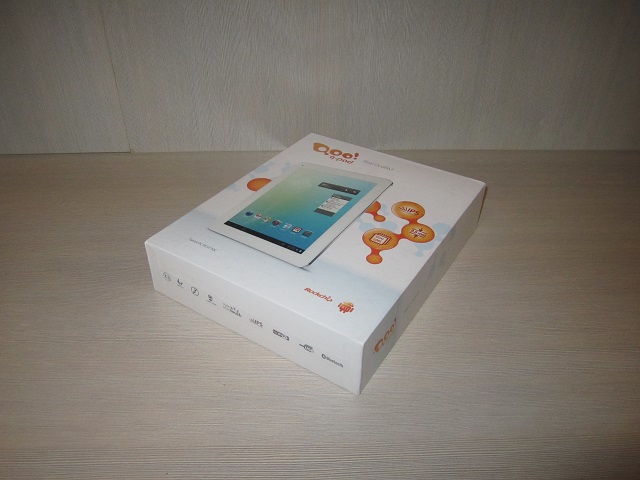
The device is packed in a small rectangular box made of thick white cardboard. Directly under the cover is a tablet, surrounded by soft inserts around the perimeter. Under the tablet is a large box with instructions in 36 languages, a micro USB cable, OTG wire, standard headphones and a charger. The charger is designed for a 100-240V network and is equipped with three types of plugs: European, American and, apparently, British. It is unlikely that such diversity is explained by the care of travelers. Rather, the reason is the unification of production for different markets.
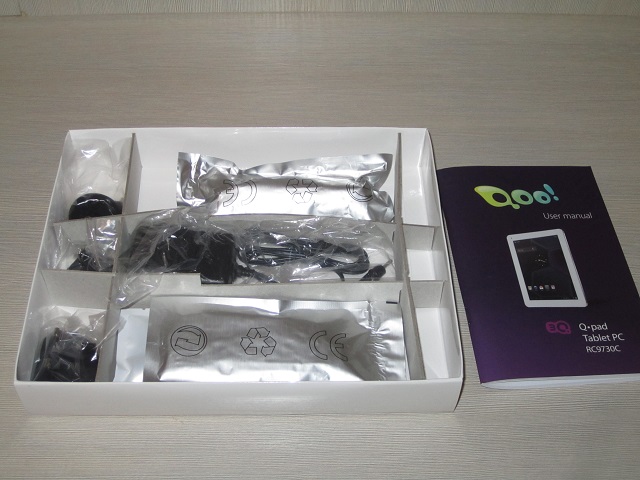
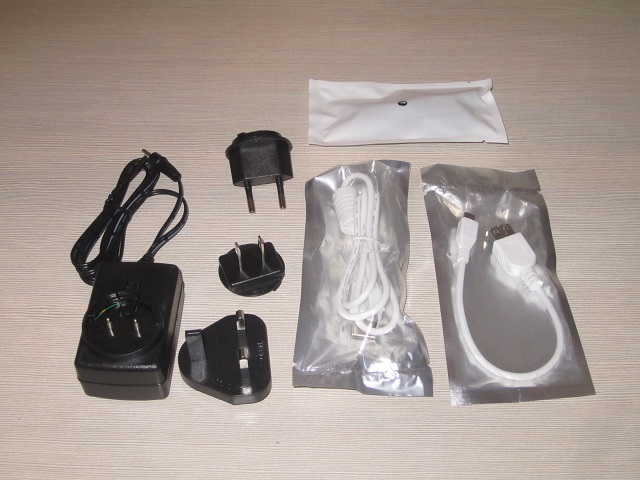
The plug of the charger is almost the same as that of old Nokia phones and gives a 5V output. If you remember, there was a “thick” charger for Nokia, then a “thin” one appeared. So here it is “thin”. Curiosity forced me to stick (with some effort) into the tablet a charger found at home from some Nokia. And you know what - it charges! Despite the passport current 2A in the native charger and 350mA in the telephone. Automotive also earned. I do not know how long it will charge, but the result is already encouraging. Given the lack of a car charger for these tablets on sale, there is a hope to “feed” the device on a long trip from an old phone charger, which you probably have if not in your car, either at a neighbor or in a communication room, at worst.
True, now a logical question arises: if the device can be charged from 5V / 350mA, why not make it possible to charge from USB, where is everything 500mA? Long though it would be a killer feature, no doubt.
Visual inspection
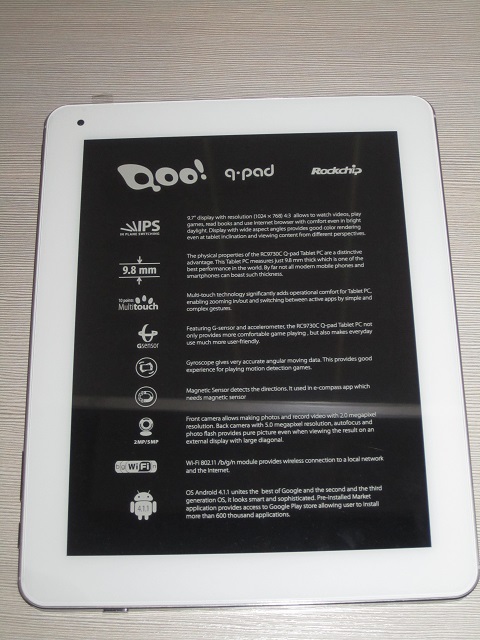
The tablet is a traditional rounded rectangle with a white frame. The back is also white, as if varnished, with a large Qoo logo! in the center (By the way, about the logo. Maybe I'm too subjective, but these cartoon characters are poorly associated with electronics). Along the perimeter, the device is edged with a metal frame like SGS4 or iPhone4. According to information from the manufacturer, this is not just a fringing, but a protruding outward internal metal carrier frame of the device. Judging by the rigidity of the device for bending and twisting - the way it is. It is hoped that the frame will help the device to endure difficult operating conditions. The tablet is weighty and monolithic, something like a tile on the senses :) Build quality. No backlash, creaks or crevices are observed.
Interfaces, Ergonomics
The first problem that I encountered during operation is that it’s difficult to navigate where the device is top and bottom. It is clear that the image always rotates as it should, the speech about the buttons and connectors located, at first glance, is somewhat chaotic. So, if you place the tablet in the standard portrait orientation in accordance with the logo on the back cover, the connectors and controls will be located as follows:
1. The front camera in the upper left corner of the frame. Behind her is the rear camera.
2. At the top end, from left to right: microSD slot, charging connector, microUSB connector, 3.5 mm headphone jack.
3. On the left side, from top to bottom: back button, volume rocker, menu button.
4. At the bottom of the left button on / off.
The right end remained empty.
The arrangement of elements becomes more logical in landscape orientation. However, it should be noted that the front camera is configured in such a way that it looks in your face in portrait orientation. All buttons, like the frame - metal, are pressed with a comfortable effort. The power button is occasionally pressed accidentally, although it does not rest on the palm of your hand.
Screen and sensor
The device is equipped with a 9.7-inch IPS-matrix with a resolution of 1024x768 pixels. The picture quality is excellent, viewing angles on both axes are close to 180 degrees. According to information from the manufacturer, the matrix is the same model as on the iPad2. The touch screen also does not cause any complaints, it works perfectly.
Performance and stability
Now you will not surprise anyone with a dual-core 1.6 GHz processor and a gigabyte of RAM. You can say this is the basic level for a modern tablet. In the race of cores and gigabytes, the manufacturer chose a pragmatic position, obviously relying on the same pragmatic buyer. The configuration “behind the eyes” is enough for OS maintenance and comfortable work with almost any application. Except, perhaps, the coolest games. Software as always does not keep pace with hardware, the history of desktop computers repeats itself.
As for stability, nothing happened during the month of active use, which could be called the slightest failure. The tablet, justifying its strong and monolithic appearance, was also on top in terms of the reliability of the internal filling and software.
power usage
The device is equipped with 6000mAh batteries. Whether it is a lot or a little depends on the consumption of the device, and here it is worth delivering a definite plus to the manufacturer. Power consumption clearly worked well. The tablet is able to play video for 6-8 hours. Or work for an hour an hour a day, practically without discharging in sleep mode. Decent performance today. A considerable merit is that of an economical processor.
Cameras
The front camera, frankly, is very mediocre. The image is grainy, gives off green, requires good lighting. After taking a couple of shots, I felt nostalgia for the first mid-2000 camera phones.

If you plan to actively use video calling, you should probably think about how important a quality picture is to you. The main camera is also not of high quality, but still noticeably better. There is no flash backlight, but there is autofocus.

Sound
The speakers of the tablet are rather weak, you can watch a movie without headphones only in silence. There are no comments on the sound in the headphones. I believe that music lovers will find something to complain about, but the tablet sounds great with a simple philistine ear.
OS, programs
I got a tablet running Android version 4.1.1. An undoubted plus and a pleasant surprise for me was the complete absence of pre-installed applications and shells. A pristine Android with an activated Market is wonderful. I will install there only what I need, and not the manufacturer. We put a plus.
OTG
The tablet allows you to connect peripheral devices via USB. It was possible to connect a 3G modem, mouse, keyboard without any problems. True, all this did not work simultaneously through the USB hub. Either the hubs are not supported in principle, or there was not enough power.
Positioning
Let's try to figure out for whom this tablet is intended and for what tasks is most suitable. If we turn to the adjacent market - smartphones, it becomes obvious that positioning is still a problem for marketers. Despite all their efforts, one can meet in the courtyard a child with a “business smartphone” or a very rich person with a plastic dialer from the last decade. Perhaps the best in this matter has advanced, perhaps, Nokia. Still that old Nokia, not today. As for tablets, the situation here is even less certain. And the reason is that the tablet, as a rule, solves the same tasks for any consumer - entertaining. Accordingly, the choice is made either by a wallet, or by cores and gigabytes, or simply by appearance. About the business use of tablets so far more talk.
Nevertheless, I would classify this tablet as a business solution. If you have a business task for the tablet, the RC9730C is what you need, thanks to its rugged case with a metal frame, long working time, lack of unnecessary applications and of course an attractive price.
Conclusion
The company 3Q turned out, of course, a very interesting tablet, despite minor flaws in ergonomics. Conditionally, this tablet can be called a business solution. He looks good, durable, reliable and lives long. For myself, I concluded that second-tier manufacturers' decisions are not necessarily plastic boxes with dubious contents. It really can be quality products, the price of which, at the same time, is not the value of the brand.