June 17, 2013 at 11:25
Conversation between Linus Torvalds and students at Aalto University (10.23.2012)
Greetings, Habr!
Once I came across on YouTube this video with Linus Torvalds and with great pleasure watched it, learned a lot of interesting things for myself and, to my surprise, discovered that it went unnoticed on Habré, especially considering that many of his previous conversations with students from this university well known for the case of sudden nVidia PR from Linus. I don’t know, maybe I was looking badly, but, in any case, the conversation is conducted in English and lasts more than an hour and maybe some of you do not speak it very well, so I decided to translate it for you into a text in Russian and publish on Habré. So, for those who want to know what Linus is doing on Linux now, how he is struggling with procrastination, what he thinks about Linux on mobile devices, what is more important to him in Linux, usability or security,
And before you start, a small “disclaimer”: not a single native speaker of English took part in the conversation, moreover, most of the people speak it with a terrible accent, abundantly clogging and distorting speech, also a sound engineer for a long time at the beginning of the conversation I woke up and did not equalize the microphone level for the hall, so at first some of the questions were simply inaudible, but by the answers you can understand what they are talking about and the whole point is in the answers. I hope for your understanding. And yes, some remarks and explanations from me in the course of the text are in brackets. Well, enjoy your reading!
Linus Torvalds talks with students at Aalto
Espoo University , Finland, October 23, 2012
Moderator: Professor Marco Turpeinen
Professor:
First of all, it is a great pleasure that you returned to Aalto University.
Linus:
Thanks.
Professor:
And not much time has passed since you were here, I suppose it was at the beginning of summer.
Linus:
Quick question. Who was here in June? (part of the hall raises her hands) Ok, that means there is fresh blood in the audience. Good.
Professor:
And I have another question, how many Aalto students are here? (they raise their hands in the hall) Excellent, because it was one of Linus’s requests. He wanted to talk to Aalto students. I'm glad you are here. If I go to YouTube right now and look for Aalto University, your entry will pop up quite high.(Linus makes the facepalm, the audience laughs) Just to warn you ...
Linus:
No more fingers this time. (laughs with the audience)
Professor:
This time, we are also recording everything and also everything is going live. Let's hope and keep your fingers crossed (laughs)that will be an equally fun and exciting event. One more thing. A few words to say. We are in the Open House of Innovation, so some of the rules of the House apply and maybe also innovation. We would like you to participate. There are several options for how you can participate and one of them is called Screen.IO, which is the startup of the people who work in this building from the Helsinki Institute of Information Technology. Through Screen.IO, everyone here can take part, our screen.io/linus address, so if you have anything the browser works on, use it. Right now you can log in, there is a certain first question (about your favorite platform) , there is from above (looks at the screen behind)if you come in, therefore guys answer it. This is one way. We have a very aesthetic way for you to keep you occupied. Screen.IO is the first. We also reserved a hashtag, if someone tweets, please use #linuseit as a hashtag for this event. Then, the third way - we have another innovation from students at Aalto University, this is something called CatchBox. Whoever wants to ask a question here, we will throw you a microphone. So this is a microphone and do not worry, it is quite soft. So there were no injuries so far. In any case, this is a microphone that we will constantly transmit, you can transfer it back to us. I think he will be with us or Linus. (Linus swings)I think there are no questions there yet. We will throw it to you when you have questions. In any case, this is a small piece of technology that was developed here at Aalto University, which we use today. I think one of the great things about being a moderator is that I have the opportunity to ask questions first and here is one of the things that excites me that I can remember by reading the book “Just for fun” about 10 years ago, which was about you and what you did and what motivations were behind it. So, 10 years have passed, can you tell us a little, firstly, about what you are doing for Linux now and what makes you continue, what motivates you?
Linus:
These days, what I'm doing on Linux is reading mail. And I reply to mail, apply patches, but more often I simply merge code from other developers. I have not coded myself for several years. I am still writing code, but the code that I am writing is simple fixes for stupid mistakes that others make. So most of the time, my contribution to the code is single-line and double-line. And what I'm really doing is just merging code from thousands of relevant developers and trying to make it easy to add code to the kernel by being accessible and meeting every day, so people don’t have to wait for me as a technical manager. And this is how we, I mean ... on average over the past year, I collected statistics, every day we make an average of about 170 sets of changes. We make about thirty merges, well, most of them are made by me, every day, on average over the past year. 15,000 lines of code are changed. For comparison, when I started and made the first Linux kernel release, the entire kernel consisted of 10,000 lines of code. Now we make changes to 15,000 lines of code every day. And as a result of this, the kernel contains more than 60 million lines of code and 40 thousand files. So I can act as a manager, but as a technical manager of the entire project, creating very little code. The coding that I do is small projects, my home projects, and as for the kernel, I'm just a boring manager. Was there another question? So I can act as a manager, but as a technical manager of the entire project, creating very little code. The coding that I do is small projects, my home projects, and as for the kernel, I'm just a boring manager. Was there another question? So I can act as a manager, but as a technical manager of the entire project, creating very little code. The coding that I do is small projects, my home projects, and as for the kernel, I'm just a boring manager. Was there another question?
Professor:
What motivates you to continue to do this, maybe those home projects?
Linus:
No, home projects are just entertainment, although they are adjoining projects. What motivates me, of course, is that I started as a true programmer writing code myself and it’s still fun and I still do it in small projects, but it turns out that although I’m a geek, I really enjoy social interactions I like to swear at people when they make mistakes, I like the exchange of opinions, I like the arguments, it motivates me very much to be part of a very sociable community. We have many engineers with a big ego and it is very exciting to participate in this. We have technical discussions and not all of them are swearing. It gives a taste of life.
Professor:
So it’s all about communities, people?
Linus:
This is community, communication, yes.
Professor:
Good. (addresses colleagues) Maybe now we will show the results of warming up? It was about a favorite platform. (look at the slide where the graph of the distribution of favorite platforms among students is shown)
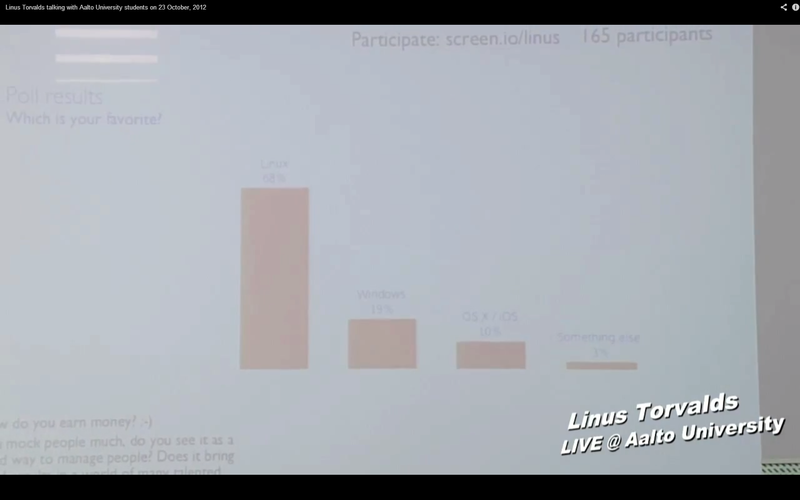
(Distribution: Linux - 68%, Windows - 19%, OS X / iOS - 10%, The rest - 3%. It would be better to show which platform students go to Screen from .IO)
Professor: approx
.
Linus:
Well, this is a big surprise. I am sure that this is partly an independent choice. (professor laughs)
Professor:
In any case, there are many fans around, this is good. On the other hand, and this will be my second question and it looks like the one that came from the audience, so let's move on. We are now in Finland and Linux, as an operating system, at the center of a very interesting technological battle between different mobile platforms ...
Linus:
Oh, is this a Nokia question?
Professor:
This is a Nokia question, exactly.
Linus:
Jesus ... (makes the facepalm, laughter)
Professor:
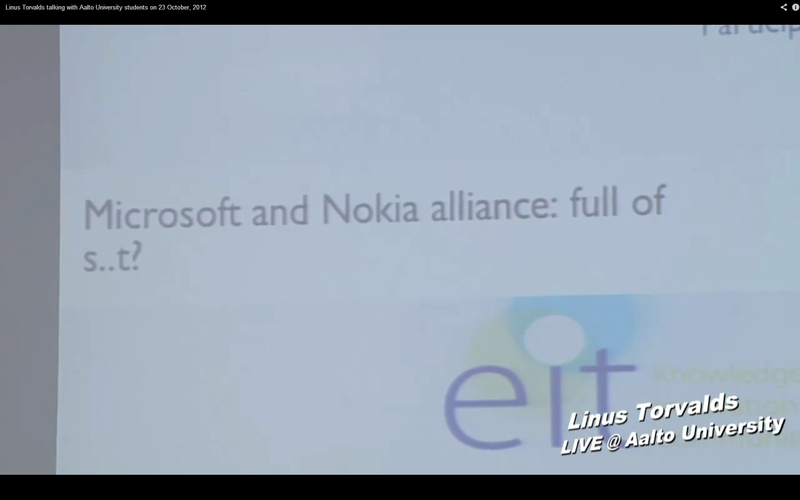
I wouldn’t ask him that way, but someone from the audience asked him that way (question on the slide: “Microsoft and Nokia alliance: is it full of Mr.?”)but anyway, I think this question is a little wider than what Nokia and Microsoft are doing. I think, for my part, the question would be - how important do you see the role of the operating system and why do you think that Linux now has all the necessary ingredients for this? I believe you think that Linux-based systems will be the ones to win the mobile battle.
Linus:
Honestly, I'm not going to answer the Nokia question. This is of no use to me. It doesn’t matter, just don’t ask. It was very interesting to see Linux on phones for several reasons. One of which was purely technical - low energy consumption features often used by people with telephones. Therefore, for the past few years, we have struggled to have power management at the core, which is more promoted by laptops. But phones also make up a huge part. Another reason that pleases me is how popular Linux is in phones, many thanks to Android, it also shows that Linux is actually very advanced in terms of the rich user interfaces that “normal people” interact with. I mean, Before Android, there were people trying to make Linux on phones more or less successful, most of them less, but people felt that user interfaces as true consumer products were not what Linux was famous for. And Android changed the situation and understanding this was very important, and many companies have taken care of this. Even if you do not use Android, and many people use Android, I think it will make Linux more acceptable in certain areas, such as the consumer interface, and it is interesting, I think this is a very important area.
Professor:
Now, I think, time for a question from the audience. Who wants to start? ... (silence) ... Wow! Well, please ...
(inaudible question from the audience)
Linus:
I don’t even know. When I studied at the University of Helsinki in the early years, I was engaged in more mathematics than computer science. And I do not recall the direct application of any of the branches of mathematics (laughter)... But! I took many very theoretical courses, I mean a set of theories, from algebra to subjects about concepts and not so much numerical material. Perhaps never using these things directly, I think a model of thinking is something that is really important. And for example, another project, not as famous as Linux, in which I participated is Git. I think that having a mathematical mind and model thinking, a set of theory and the creation of such things is very important for a programmer, even if you are not using mathematics directly. I really like mathematics, in fact, the reason I studied computer science as a main subject at the university was more related to the fact that I felt that I could rather get a job related to computer science than mathematics, but the mathematics was, in fact , my main interest.
Professor:
Good. The next question? (silence)
Linus:
Wow! You are much worse than students at the University of Helsinki. (laughter)
Professor:
This is not good. This is not good.
(slurred question from the audience)
Linus:
I have three daughters. One will soon be 16. And none of them shows any interest in programming. It is sad. But it is so. They are more interested in Facebook and things like this. I do not expect any of them to be an engineer. I tried to get them interested, but the problem is that I'm a bad teacher. I’m very upset and nervous if they don’t immediately understand what I’m trying to tell them, and this probably scares my children more than arouses the desire to learn how to program. Once I just realized that I needed to stop even trying.
Professor:
Any other questions?
(slurred question from the audience)
Linus:
What mentally resembles programming ... I really don’t know. I suppose this is more like architecture or building a bridge or design, not a scientific approach in general. But it's hard for me to even say. I would rather answer your second question, because I really cannot answer this one. The most important thing that you should keep in mind when building something new is that you should not think that you are going to change the world, doing something huge and big and completely different from what was earlier. It's nice to think that someone has one great idea and we will apply this idea to make the world a better place, but that’s not how the world actually works. I participated in many projects, but they all started with a very boring rule - to solve a specific problem that I have. Some of them did not advance anywhere, but those that were successful ... when I solved my problem, someone else came and said: “hey, it almost solves my problem too”, and they grew out of the fact that they started as small, but the roots and stems were good enough for them to grow. But do not try to aim at the moon. I mean, I did not start Linux thinking that I will take over the world(rubs his hands) , but we're almost there, right? (laughter)
Professor:
I have one question here. Is Open Source the main way for you to get good software, or do you think Open Source is such an idea, well, in a broader sense?
Linus:
For me personally, the great advantage of Open Source is that it is much more fun, much more interesting to work with other people and to be able to work with anyone. I made programs with closed source code, I worked for a company that made software, and I also made proprietary software. And I really liked it. But. Just doing it in an open community and letting everyone get involved when it really works is so much fun. This is a complete social interaction, these are completely different points of view. The fact is that in the company you usually have a vision of where you are going. It's boring! It’s much more interesting to have a project like Linux, where you don’t have vision number 1, it’s like if everyone has their own vision. There are some overlapping visions, but also full of non-overlapping ideas. One of the strengths of Linux is that you have people who make phones, but there are also people who make supercomputers. And trying to balance all of this is a great pleasure. Therefore, from my personal point of view, development in Open Source is much more interesting. There are also many other benefits. I think that from a conceptual point of view, the scientific method is also very important. And in order to achieve real progress on complex problems - you need a lot of people working together and building their work on each other's work. I will quote Newton. This is my favorite quote: "If I saw beyond others, it was because I stood on the shoulders of giants." And he talked about physics and science, but I think that absolutely the same thing develops technology into the most real technological innovation. It's not about a great new idea, it’s about the top of the gradually tested existing technologies and only after years and decades do you get what we see today from what was like a clumsy car. And again, Open Source is a kind of scientific model for computer science. And I think this is important. Next, there is the point of view of free software, which believes that Open Source is important only for moral reasons, and I find this an intriguing and interesting point of view, even if I, as a rule, disagree with this. But it’s interesting how many different people make Open Source for so many different reasons, both technical and personal. And I think this is real power. there is a point of view of free software, which believes that Open Source is important only for moral reasons, and I find this an intriguing and interesting point of view, even if I, as a rule, disagree with this. But it’s interesting how many different people make Open Source for so many different reasons, both technical and personal. And I think this is real power. there is a point of view of free software, which believes that Open Source is important only for moral reasons, and I find this an intriguing and interesting point of view, even if I, as a rule, disagree with this. But it’s interesting how many different people make Open Source for so many different reasons, both technical and personal. And I think this is real power.
(slurred question from the audience)
Linus:
I have to say that each individual part is quite slow, sometimes painful, so you want to get much faster progress and what happens is that you just make small incremental improvements in any single part and the "explosive growth" of Linux does not really refer to a separate areas of the core, as a rule. The developers are very fast, because 9,000 people work there on different parts of the kernel. And it’s as if you were looking at a small detail - things can take years before they mature, but when you look at everything as a whole, it turns out that many things change every week, so you have both slow progress and fast global progress on a different level. For example, I was very worried about all the power management work that we did, it took us years. And this is a fairly common case when something crosses borders, like power management, especially for phones, but this also applies to laptops. You need to have a scheduler, I / O is very important for power management, all the drivers ... and we support thousands of different devices, they all must get the right power management. The PCI layer should get this right, there are many different components and it took a lot of time and made a lot of nervous. Therefore, sometimes you have really slow things, and then people say: “Oh, you developed this thing so fast!”. It is true, in a sense, in a different sense - we are not faster than anyone else. I / O is very important for power management, all drivers ... and we support thousands of different devices, they all need to get the right power management. The PCI layer should get this right, there are many different components and it took a lot of time and made a lot of nervous. Therefore, sometimes you have really slow things, and then people say: “Oh, you developed this thing so fast!”. It is true, in a sense, in a different sense - we are not faster than anyone else. I / O is very important for power management, all drivers ... and we support thousands of different devices, they all need to get the right power management. The PCI layer should get this right, there are many different components and it took a lot of time and made a lot of nervous. Therefore, sometimes you have really slow things, and then people say: “Oh, you developed this thing so fast!”. It is true, in a sense, in a different sense - we are not faster than anyone else. and then people say, “Oh, you developed this thing so fast!” It is true, in a sense, in a different sense - we are not faster than anyone else. and then people say, “Oh, you developed this thing so fast!” It is true, in a sense, in a different sense - we are not faster than anyone else.
(slurred question from the hall about Android and Google)
Linus:
The question was whether I think there is room for a commercial or non-commercial operating system like Android, but not Android? I have to say that it is really difficult to develop a whole distribution, these are tons of work. Even if I completely love the grassroots efforts of Open Source and we would have had most of the core work done by loners who just get high on technology, the fact that we would need the companies involved would be very important because it turns into a specially made product. I do not know what it is, but you will probably need the direction that happens with companies. And I think it was one of the successes ... Linux was one of the first Open Source projects that was very open for commercial use. I think it’s very difficult to do something like Android without the support of the company, without a vision of who has a specific goal in mind. I really believe that commerce, although some people think it is bad, helps set the direction, in many ways. I am not saying that it is not possible to gather a community around an Android alternative, I am just saying that it is difficult.
Professor:
One question from the stream. What do you think of the upcoming open iron movement? Regarding Linux.
Linus:
I do not know about the approach. People have been trying to create open iron for a long time. There have been many projects trying to do open source iron. And ... Open iron is heavy. Because everyone can be involved in software, all you need is a computer and development environment. And you have no other costs. Open iron ... of course, you can create a design this way if you create a new processor or graphics chip or something else, but in the end someone needs to create a piece of iron. Speaking of 3D printing, which, obviously, is approaching by leaps and bounds. But this is still not what you can do as a loner or an average company. What I find more interesting is not necessarily open iron, but very cheap iron. Therefore, all these projects, if you think something like the Raspberry Pi open iron, I find it very interesting, because I think when iron is very cheap and widely available, it changes the economy of things. But open iron, in the sense that it has an open design, still seems to be somewhere far away.
(question from the audience in very broken English, something about the core development methodology)
Professor:
Those. the methodology of how you do merge? How do you manage this?
Linus:
I am a huge believer in the non-micro-management of others and in trusting people. Therefore, most of the code that I get, I get not because I look at every piece of code, because there really is no way I could do this by returning, 15,000 lines of code change every day. If I even tried just to look at the code, I would be crazy. What actually happens ... Over the years, I have been building a network of people whom I can trust, this is how people usually work. You have close friends and you know how they work. And after a while you look at the code that they generate or the code that they accept and you say: "Hey, I trust him, he is an expert in this field." To such an extent, in many cases. I have a very good overview of the current state, but in many areas I am by no means an expert, so people that I trust is often better than me in this code. Therefore, I would be a fool trying to use micromanagement in their relationship and trying to look at the code and diving into checking what they did. It would waste my time and waste their time too. It is sad. And that’s why I’m known as a not so nice and cursing type with many people. I never delve into when everything is going smoothly.(laughter)When someone makes a mistake and a code is accepted that really should not be accepted, then I must enter. And people start writing to me in the mail and say: “You broke the kernel and the latest release no longer works.” And then I start to swear at people and say: “What the hell? I trusted you! You ... You obviously shouldn't have done this to me. ” Quite often, I dive into the problem later, look at this code and say: “Jesus! This is an ugly, terrible code. How could you even accept that? ” And this is the understanding that I often have and which, in most cases, is negative, which may not be very good sometimes. I mean what people do ... some people actually think that I'm a grumpy old man. I realize that if you see only my flame and my swearing, and not private discussions, when things are going well, you think that I hate everyone. And there are days when it's almost true. But, I still check the code from people whom I do not trust. But I have the closest 10-15 developers, when they send me the code, I say: "I trust you, I'm not going to waste my and your time trying to guess your decision."
Question from the audience:
I actually had a question about hardware and vendors. What is the development of the Linux kernel today and what is the responsibility, how good is Linux support?
Linus:
There are so many iron vendors, some great, some not so great. In this conversation, I should concentrate on the good ones, right? (laughter)Because there are vendors who really do a good job. The best example is probably Intel. This is a big iron vendor. They do not only processors, they do network equipment, either wired or wireless, they do many different things. And they were very active in that they didn’t just send drivers and documentation, but also several main kernel maintainers actually work for Intel. Intel, in fact, said: “Hey, you support this area, let us pay you to support it for us.” And this is an example of an iron vendor who did everything right enough. It took them a while. When I was in Silicon Valley, in fact, maybe the first year I had a conversation with Intel about this, Intel engineers were not allowed to participate in discussions on the Linux kernel mailing list using the intel.com mail address. There were strict rules inside Intel that said, “No, you should never tell anyone what you are working at Intel, because if you do something bad, we don’t want our name to be tarnished by your actions.” But years later, they became the best of the best iron vendors. There are a wide range of really bad vendors that I will not name again.(laughter)Most painfully, these are vendors who realized that Linux is really important for them to participate in their piece of iron and they force engineers to work on writing a driver, say, for a network card. And they write the driver completely on their own, not to mention it to anyone around and then they send the driver to us. In particular, Greg, who is the maintainer of the driver tree. Most of their drivers are terrible. They are really nasty. Even if they work, the quality of the code is so poor that no one can actually read it. And all this was done inside the company that makes iron, so no one else has the documentation. You have bad code, maybe it works, maybe not, if something breaks, nobody can fix it. This is the case when a company tries to do a good thing, but because that they never interacted with the community other than “here! take this driver! ”, it ends up very painful for everyone. And then people like Greg ... he's a saint! I don’t understand how he ... because he works with many companies that are really nice and nice people and tries to convince these iron producers: “Please, we understand what you are trying to do the best, but it sucks.”(laughter) And it can take years to get two-way communication and real community interaction. Everything is getting better. I mean, it’s getting much better than we had before - almost no support from any iron producer. And these days, many manufacturers often provide us with drivers even before they release the hardware. Everything is much nicer now. But it was a great learning experience, on both sides.
Professor:
Further more about desktops and window managers, etc. The first question was - what do you think, where are the Linux desktops now, regarding current distributions, what is happening now? And there was still a specific question - what do you use yourself?
Linus:
Obviously, this question should have been asked. Because I know how I dislike some of the things that desktop people do. I must say, now everything is much better than it was a year ago. I actually returned to using Gnome 3 and I don’t like some of the things they did. But they fix the problems, it becomes less painful. They now have extensions that are still too hard to find, but with extensions you can make your desktop look almost as good as it looked 2 years ago. (laughter)There is some annoyance in my words, because I think that the desktop, which was getting pretty good on Linux, has degraded for several years. And it was very disappointing, because The desktop has always been the component that I personally use, of which I personally care most. And that was the original goal for Linux. We were very successful in phones, servers, and many other places, but obviously the desktop is very hard not to break. And over time, it became more complicated than easier.
Professor:
Well, I'll take one question from here and then continue. Returning to mobile Linux, this of course applies not only to Android, there are many different things, from those that pop up from memory is Maemo, MeeGo. People ask about Jolla, are you following this company?
Linus:
MeeGo, is this a resurrected company? In fact, I do not follow them. I hope that they will be successful and they will have a plan B. Maybe Jolla will be able to implement this plan B. This is interesting, in the sense that it is obvious that Android dominates this space. But there are companies working MeeGo, working Tizen ... Asia, in particular, and Korea, noticed that before they were only producers of iron and, partly thanks to Linux, some of these companies that created iron for software that other people wrote, now may say: “Hey, we can actually control our destiny and write our own Linux-based software.” And they are also involved. And this is one of the nice things about Open Source that allows all of these different parts of the ecosystem to realize that, “hey, I can participate too.” So, I was in Korea about two weeks ago, talking with people from Samsung and LG, and it seems they were also very interested. They want ... They are a little nervous about Android because they are not Google. They want, maybe, to make their own operating system, simply because they want to have control. Therefore, a lot of things are happening and maybe Jolla will be a separate Nokia 2, will reconsider their approaches. (shrugs)
Professor:
Perhaps there are also several people from Nokia in the audience ... By the way, Sailfish is the name of the distribution that Jolla runs on.
Linus: I
see. But is it based on MeeGo?
Professor:
This is MeeGo, but they only renamed their own version.
Question from the audience:
I want to ask you the following question, will Grsecurity get into the kernel? This is the first question. The second question is how do you prioritize security fixes and usability fixes? And third, you just noted that desktop systems are important to you, are you thinking about accepting kernel patches, such as from pf sources, which make Linux I / O work faster? That is all I wanted to ask.
Linus:
These are three different questions. Grsecurity and security patches. Much of Grsecurity, in fact, is already done in the kernel. Much that has already been done in the kernel has analogues. Security guards are sometimes a bit black and white. And by that I mean - crazy. Security guards think that any problem is either a security problem, or there’s nothing to think about. And this is wrong. Most secure systems are systems that no one wants to use because it is a pain in the ass. And many security guards seem to want to see their system in this way, because it is "really safe." Therefore, my point is that I do not want to make a big difference between security patches and other patches. This is not just about security, by the way. Many people seem to think that performance issues are different from accuracy issues. And again, I do not agree. Performance issues are real issues, as are accuracy issues. I do not want to distinguish between performance patches and patches that fix some problems with accuracy. And I do not want to distinguish them from things related to security. A good system is a balanced system. Security is part of this, but security does not play a greater role than anything else. Security is important, but that is not the issue. And many security people, they are just blind and they are too one-dimensional. Sometimes they annoy me, sometimes I call them bad names, because some of these people are actually really ... complete jerks. True. They are very smart people, but they do not think. Grsecurity contains a lot of good patches, they have a few patches that basically sound like this: “Hey, we can break compatibility, because we want to make some things safer. No matter, still no one wants to use the end result. ” What was the second question?
Question from the audience: The
question was about pf sources and the I / O scheduler. This works well for services, but are there any advantages for desktop systems?
Linus:
We have many situations where ... and this is one of the same problems where a particular niche wants to create patches for the kernel that work very well for this small area. And even when this small area is a desktop, it turns into what I do not want to do. For example, some planner patches. Some of them work really well on two- and four-processor machines, and after this point they no longer scale. And if all that bothers you is only two- and four-processor machines, you say: “Hey, this code works much better for me, why don't you take it?” and I say this: "I'm sorry, but one of the principles of Linux is that you should be able to balance all these different areas." And we, in general, can do this. So, for example, when we added SMP support, and SGI created patches to support their 4000 processor monster machines; the original patches were completely unsuitable for anyone else. There were hacks that worked very well on their large machines, but they were not what we could use on small machines. And I basically told them: “I won’t take it! In order for you to regain your achievements, you must write in such a way that your patches work for anyone. ” And they did it. And the bottom line is that they actually made the end result much better. Much better for us, but it turned out that they did even better for the people of SGI. They cleared out many of the assumptions they made. Some of the projects you mentioned seem to have these blind people as well, where they say: “We only care about our little world. It doesn’t matter to us that we do things that work worse for others. ” And if you have this approach, then you should not be surprised that I am not interested in the patches that you send me. People should be able to balance things, sometimes you can do it with the settings, but I prefer code that just works, works well on small machines and large machines. And it is possible, but it takes a lot more effort.
Question from the audience:
It has already been said that Android breaks Linux barriers for ordinary users, therefore, what do you think about Valve working with nVidia and Intel in improving Open Source drivers in order to release Steam gaming platform on Linux? Is this the year that desktop Linux is finally coming?
Linus:
Well, if Valve really is, that is, I do not mean “if”, but “when”, when Valve really releases its client for Linux, this will only help desktop Linux in a lot, because this area is small, but quite a vowel group people who care about their games, and Linux is not very strong about games. I was not personally directly associated with the Valve group, but I talked to those kernel developers who were. And they were very impressed with the development people. And it seems that it was mutual. They on both sides, in fact, enjoyed working together with each other. People from the Linux kernel, and not just from the kernel, from the OpenGL stack of user space, were happy to see high-performance 3D graphics in real conditions and be able to also watch the sources that Valve uses for its game engine. We could say: “Oh, you really don't care about speed in this case, you care about speed in that case.”, Which helped on the side of OpenGL and the kernel. The same thing works in the opposite direction, when the people from Valve were really happy talking to the Open Source people, because they could say: “Oh, that’s why it will never be fast, because you do all these crazy things.” . Thus, people communicated and were happy from two-way interaction. And this, apparently, means that we will have good gaming on Linux in the not too distant future. because they could say, “Oh, that’s why it will never be fast, because you are doing all these crazy things.” Thus, people communicated and were happy from two-way interaction. And this, apparently, means that we will have good gaming on Linux in the not too distant future. because they could say, “Oh, that’s why it will never be fast, because you are doing all these crazy things.” Thus, people communicated and were happy from two-way interaction. And this, apparently, means that we will have good gaming on Linux in the not too distant future.
Question from the audience:
You say that a lot of things have already been done. How do you deal with procrastination? How do you avoid watching kittens all day?
Linus:
I, in fact, do not have such a problem, well, I am drawing up a procedure. The reason I don’t watch videos of cats every day is because I don’t find them as interesting as the technical letters I receive. So I have no problem with procrastination, simply because I really think that my work is very, very interesting. And when I wake up in the morning ... My office is above the garage, I have to walk up the stairs, about 50 meters, about ... In order not to do this, I have a tablet behind the bed. So when I wake up in the morning, the first thing I usually do is use a tablet to check my inbox. But still, I need to work in my office to understand what is happening. This is one of the reasons why I have no problems with procrastination. Then, in other areas, I'm not so good, for example, I do not make slides, I do not prepare speeches. If I was forced to make a presentation, I inevitably delay it until 5 minutes before the presentation, and then I understand that I no longer have time to make slides. Because I just can’t make myself interested. It depends on ... The way to deal with procrastination is to find something that you just love to do and therefore you go and do.
Professor:
A little related question, this was one of the earliest questions, but do you like cats?
Linus:
We have ... I always had, well, not always, most of my life I had a cat. We still have one more cat. We also have a dog, there is a snake, several gerbils, hamsters, a rabbit, a fish that I just despise. (laughter) In our family at different times we had almost any animals you can imagine. My favorites are cats and dogs. But not a video. The whole point in pets is, of course, love, in the case of dogs, and I do not know what is the case with cats.
Professor:
We will return to that question - how much do you work during the day? And there was one more - have you ever played Angry Birds on Linux?
Linus:
I played Angry Birds. (professor giggles) Basically, I played Angry Birds when I was waiting for the kids to pick them up from the gym or something. This is a cool program when you need to kill 15 minutes, because the gymnastics drags on and you play Angry Birds on the phone. What was the first question?
Professor:
How much ... do you count the clock? How many hours do you work?
Linus:
I don't count the clock.
Professor:
You just don't count the clock.
Linus:
In fact, I can do most of my work even while I'm on a trip. So, as long as I have Wi-Fi and my laptop, I obviously can read the mail, making great painful merges. This is inconvenient during the trip due to the small keyboard, poor Internet connection, insufficient processor power to compile a kernel like this. Therefore, I try not to arrange a window for the merges during the trip, although, in fact, this happened with the last window for the merges. Today, for example, when I woke up, I try to stretch it all day, so I made 3 or 4 merges this morning when I get back, well, this evening I probably won’t make merges, but maybe I , I can make them at the airport tomorrow morning when I leave, in case I find free Wi-Fi at the Helsinki airport.
Professor:
They have it.
Linus:
Exactly, they have it, yes. Good.
Professor:
Maybe we will return a little to the technical side of these answers. There was a question about increasing the complexity of the Linux kernel. What is your view on this?
Linus:
This is a huge problem. Particularly specific areas become so complex that we have only a few people who actually understand them. VM is now that bad area in which we have certain areas where only a handful of people really know the code well enough to evaluate patches. The good news is that when you are such a compact team, there are not many patches. This is not an area where you have hundreds of patches per day. You can have hundreds of patches within a single release. Therefore, this is still a manageable thing. A little more fragile than I would like. But there are no areas that would be so complex that no one would dare touch them anymore. We were able to avoid this problem, but some areas are so esoteric that there are only a few people,
Question from the audience:
Do you always wear these oval glasses? (laughter)
Linus, smiling broadly:
Um, no ... This is not a question ... I do not think I have ever received such a question before. In fact, for almost 10 years I don’t wear glasses at all, I have LASIK, therefore (takes off my glasses) , I can see you guys even without these glasses. Before LASIK, my eyesight was so poor that I couldn’t recognize my children in the swimming pool, and it’s a little embarrassing if you start to grab the wrong child. (laughter) Therefore, I wear any glasses that my wife chooses. (laughter)
Professor:
Another, say, a family-related question, why aren't you doing torvalds-family.blogspot.fi anymore?
Linus:
Weren't the blogs on blogspot.fi blocked?
Professor:
I do not know.
Linus:
I tried to blog, I did it maybe a few months. I reached the point where it was embarrassing to write about what I was doing. Somewhere in the last year, I use Google+. And if I see something really strange, I can take it and post it on Google+ or I post some programming questions, actually, I posted some sermons, because that’s what I’m doing. But I'm not really so interested in all this blogging.
Professor:
Another question before we return is about misses and any examples of where you think you miscalculated or which you would like to share with the audience you learned from.
Linus:
On the technical side, there were many cases where I made the wrong decision. But this, usually, was not a failure, it was: “Ok, I made the wrong decision.”, While I am ready to admit it, I roll it back and do it right, who cares, in the sense, we were going in the wrong direction that time, we had it. I would like to be a nicer guy, of course, I would like to curse people less and inspire them to grow a little more, instead of saying that they are idiots. Sorry, I tried, this is not in me, I break down at times. I like the fact that we have quite different personalities in the core and many of them are strong personalities, where strong does not necessarily mean good. But ... we have people who specialize in bringing new people through the process, because they really like to accompany, I've never been like that. Maybe it's a failure.(shrugs)
Professor:
There was a question ... (points to the hall) Do you want to try to finish?
Linus:
Where?
Professor, in a whisper:
Taaam ...
Linus:
Ah, I won’t finish it ... try to catch ... (throws the box)
Professor:
Good throw.
Linus:
Close enough.
Question from the audience in very, very broken English:
And so, I thought to ask about your vision of Systemd, we know that she does a lot of things, like isolation, launching services, but there is also criticism of how she breaks the unix philosophy in terms of good performance of long tasks, in terms of programs interacting with each other, do you have an opinion on this?
Linus:
I think Systemd ...
Professor:
Maybe you should repeat the question?
Linus:
approx. The question was about my opinion on Systemd and how some people think that it breaks the unix philosophy and that it is just different. I don’t know how many people here care that Systemd is such a replacement for the traditional Init model. And she, in general, is trying to take on many other things during the launch process. I actually like a lot of what Systemd does. Personally, my biggest problem with Systemd is that many people involved seem to think that change is good in itself. I saw Lennart Pottering (Systemd developer), for example, he said that something was done badly, because something was done for 30 years and all this is bad by definition. Which makes no sense to me, because I think if it worked for 30 years, it definitely does something right. This is my point. While some of the people in the Systemd team seem to have strictly opposite desires, saying that if it worked this way for 30 years, then it's time to change that. And this mindset makes me very nervous, it seems that sometimes they make changes for the sake of change and do not really worry about what people are used to and adapted to ... This is probably the reason why Systemd generates so many negative reviews, because it knocks people out of sensation comfort and feeling good about it. And at the same time, I think that a lot of what she does is interesting.
Professor:
Good. Thanks. There is a question, and then there.
Question from the audience in very broken Indo-English:
Hello. Personal question. How exactly did you feel when you won the Millennium Technology Prize and, if you can ask ... what did you do with the money? (laughter)
Linus:
It's hard to explain how you feel when you ... It's definitely a very cool thing to get a reward for anything. This recognition and the Millennium Prize is a lot of money, actually. So what did I do with the money - I paid taxes. (laughter)What else, right now we have no special plans for premium money, I may not really care about money, but the lack of concern about money also means dislike to worry about money. I have the necessary amount of money to educate children, which is very expensive in the USA. A millionth prize means, in particular, that there is less concern. I hope that the children will come to the University of Helsinki or Aalto University (laughter in the hall) and we want to spend any money on education (laughter in the hall) and in this case I will not be able to spend money on whores and cocaine or whatever ... (laughter) in the hall) Ok, you still shouldn’t have ... (smiling, gesturing to the camera “cut out”)
Professor:
It's already gone, it's already gone ...(Linus laughs)
Linus:
But the thing is, the money is there, so I don’t need to worry about it. Not that I was really worried about money before. I'm fine.
Question from the audience:
Thank you for being here, Linus. I have two questions, one that is a little wider and one specific. One is, I would like to know your personal feelings about personal computers in the future, say, in 5-10 years and you agree with Steve Jobs, who said that these would be “trucks and cars” with such a concept? And my specific question relates to the integration of operating systems. How important is it to have a single OS between PCs, tablets and other form factors? Thanks.
Linus:
Ok, the question of technology over the next 5-10 years. I really don't care. I think the technology is interesting, but I think the technology is interesting, mainly because it is such a toy that is constantly changing and always something new appears. Therefore, the thing that I'm really interested in on a 5-10 year scale is that we reach physical limits when it comes to shortening processes. I really think that it should be a lot of fun and interesting, because it means that the industry should start to change. People who use twice as fast computers or use half as much power every 18 months will have to change their approach to work and this should cause changes in the whole industry and I think it should be very exciting and interesting. I do not think, that you will need to choose between "cars" and "trucks", small and large things. I think you will continue to observe this continuous environment and more ubiquitous things, just computers will be everywhere. And I, in fact, think that it is important to have a system that permeates the entire ecosystem. One of the things we did amazingly well and I really didn’t believe that we would do that. It is a fact that we can do it. And Linux is the only kernel that can really work from phones to supercomputers, and it really is the same underlying foundation. Everyone else did, for example, like Apple obviously did - OS X on the big side and iOS on the small side and they are not united. Microsoft did the same. We saw that it is a huge advantage to have the same source code on the whole spectrum, because it implies that things which are used in the mobile space, like power management, and we spent a lot of time on power management for mobile devices, they are also applicable where you go to any other platform, like the server room, which are being built in the world today. And eating, if not number one, then number two, is one of those things people worry about. And about such things 5-10 years ago, people didn’t even think much, some people yes, but it was not universally recognized. And having a common foundation means that you get all these different inputs and if you are able to cover the whole spectrum - this is a very powerful technological tool to be flexible. Therefore, you can take care of power on business computers. We did SMP for servers and supercomputers, and on desktops people drove one processor, on phones, people couldn't even imagine SMP 10-15 years ago. Today you can’t even buy a phone with one processor, well, you can, if you buy a phone on Windows.(laughter) Any modern non-Windows speakerphone will have 2 or 4 processors. Usually you think that this is important only for one area, but it turns out - no, not only. In fact, this is important for the whole spectrum. Therefore, I think it is also very useful for Linux - how wide the base is.
Professor:
I think this is an excellent answer, for someone who says that he does not care about the future of IT. It also reminds me with regards to power management, for example, that a third of all these web services in the world run on Linux. And the energy cost of these services is astounding. And you can save a few ... well, without building several nuclear power plants, just making power management better.
Linus:
I don’t know what the situation is in Finland now, but I know that in the USA, when people build large data centers, there is a tendency to build them, for example, close enough to power plants and especially around water reservoirs, where they can receive cheap energy all year round. It's interesting how important energy management has become for the server business. And it began relatively recently, the last 3 years, and sometimes becomes the number one cause for concern.
Professor:
I will wedge my question here, what will happen to Linux the biggest in the next 5-10 years? New, big, which is just around the corner?
Linus:
I do not think so. True. I plan 1 or 2 release cycles in advance. Those. for Linux, this means 3 to 6 months in advance. I get access to the early gland, I also get access to people who tell me about their plans for two years. I can’t talk about them, but this means that when we make releases and look at the code, many kernel developers do this, we have a window of what will happen in the near future and say, “Ok, that might make sense” or "No, this is a bad idea, because if we start now we will do this for two years, it will be wrong." But I do not have a five year plan. Most of our core work, in fact, is new hardware and new usage scenarios, which is why we are controlled externally by both iron manufacturers and companies that use Linux. And this happens very interestingly, but that does not mean that I am a seer, I do not like the word "seer". I do not plan for 5 years in advance, I do not think that this works. We are reactionaries, we try to do as well as we can with a sufficiently short time span for future plans.
Professor:
Good. The next question. Here.
Question from the audience in very broken English: do
Google, Facebook and Samsung pay you insurance bills?
Linus:
My insurance accounts? Oh no. (laughter)But they, in fact, quite directly pay me a salary. I get paid as an employee of the Linux Foundation, and the Linux Foundation is a nonprofit group paid by Google, Intel, Samsung, etc. So they pay me a salary. They pay, for example ... it's not quite ... although I suppose this can be considered a form of insurance, they also pay the Linux Foundation Legal Department, so if someone is going to sue me or Linux, I don’t have to worry about it, there’s Legal Department that intervenes. This, in fact, does not happen, why should you judge me, judge big companies that have a lot of money. (laughter)
Question from the audience in very broken English:
Following. What about your role as lead developer of Linux, what do you think of the future?
Linus:
My role in Linux development? It has remained quite stable over the past few years. We found that this model works very well. We used a release model based on adding features and we used a management model based on a version control system that didn’t work very well and had a lot of problems with both. Years later, we found what works and what doesn't. And we have a release model and a management model that seem to scale well. Development throughput has actually increased. Therefore, we have more incoming patches, more incoming changes and we maintain a high bar. And it looks like it really works. Who knows, maybe in the next few years there will be some kind of problem, which will mean that we will have to change the model and this is very, very painful. Some of the most painful changes that we have ever made in the kernel were not related to technology, they were related to how we conduct development. But now I do not see anything approaching. It seems we are doing very well.
Question from the audience in broken Indo-English:
The fact is that I have been using Linux for some time. But I want to get a whole real Windows, but this does not happen. The reason, for example, is that I use some kind of mobile phone, for which I use some own application called Keys, which is necessary to control the mobile phone. But I do not find the equivalent in Linux for this. It is my problem. I return to Windows, for example, to update my phone or to see my contacts.
Linus:
I had a problem. My wife had an iPhone. Jesus, it was a pain for the same reasons - he needed iTunes just to keep everything in sync. She was so happier when I finally bought her an Android phone and she noticed: “Hey, I can do everything through the Web, I don’t have to do any synchronization.” It was painful when certain things go along with firewood for Windows or applications. What I personally really don’t like is the hardware that comes with firmware updates, and the update program is some kind of dumb Windows program. There is no Windows in my house anywhere. Therefore, I can’t update the firmware of the iron that I have. And I say: "Ok, I need to stop ... buying such iron.". (laughter)To some extent, Apple helped in this situation, because it turned out that if you are making Windows-only applications today, Apple is big enough to annoy people. Therefore, now some manufacturers make versions for Windows and for Mac. But other manufacturers simply said, “Hey, we'll do the updates via the Web.” Therefore, the fact that Windows no longer occupies 99% of the desktop market has also helped Linux to some extent. But, yes, there are still problem areas.
A remark from the audience in broken Indo-English:
I hope these problems are resolved soon.
Professor:
Another one from Screen.IO. You started Linux when you were a student at the University of Helsinki and I suppose the question was - do you think this is the right time to start a big new project, such as Linux, or would it be better to do it in your free time, when you graduate, you have a job, then do you allocate some other resources for something that you did? Is this the right time to start Linux?
Linus:
I think so. I had a lot of free time, because studying at the University of Helsinki took me 8 years (laughter), I’m not that I studied hard. I also think that often enough you have to be a little illiterate in what you do to do something. If you knew more, you would say: "There is too much work, I will never finish anything here!". When you are a student at a university, you can ... hey, you have a choice between "have a beer" and "do something fun with the computer." I did both! (laughter) And it was not a waste of time, it helped me with my studies, it was interesting. And it would be much more difficult to do something like Linux, when I would have “real work”, both children and real life. Therefore, I think, at least in the case of Linux, my university years were absolutely the right time to start.
Professor:
Good. There was one of the earliest questions and that, I suppose, is like your answer. Of course, the university system is trying to get students to complete their studies in a short time, in 5 years, etc. What is your opinion on this trend?
Linus:
I understand why you think spending 10 years of your life on drinking is not good for society. (laughs) I have to say, I really like Helsinki University. And the fact that for eight years of training I received only a master's degree, for me it was a great success. I realize that maybe most people are not doing anything else productive at the same time. Therefore, it will be a push to make people more effective. I dont know. Enjoy while you can - this is my ... advice. All is well.
Professor:
This is not a bad time to start something big. Following.
Question from the audience with a pronounced Finnish accent:
Hello. Don't tell us a little about your home projects or, more generally, in what other areas of kernel and Git development do you participate?
Linus:
And so, the question was about my home projects and other things that I do outside the kernel. The core is my main job, I mean, the core is where I use all my time, even if I don't program, this is what I do day after day. I really have several projects that I worked on along the way. Git was obviously what I did very actively 5 years ago. These days I don’t have to worry much about Git because Git has great maintainers. I could just say: “Whatever happens, Junio Hamano has been doing an excellent escort job for the last 6+ years.” Therefore, I am no longer involved in Git like this, I sometimes send out a patch, simply because I found something that Git did not do correctly enough for my use case. Another home project I have is the Subsurface program. I love diving if I go on vacation, I want to go where there is warm water and colored fish and corals, and I can dive and scuba diving and it turns out that there is not a single good diving application that runs on Linux, so I wrote your own. And if there are divers in the audience, my co-maintainer Joe Condell has just released Subsurface version 2.1, today or yesterday, depends on your time. So I have a few other projects I'm working on, but these are toy projects, compared to the core. my co-maintainer Joe Condell just released Subsurface version 2.1, today or yesterday, depends on your time. So I have a few other projects I'm working on, but these are toy projects, compared to the core. my co-maintainer Joe Condell just released Subsurface version 2.1, today or yesterday, depends on your time. So I have a few other projects I'm working on, but these are toy projects, compared to the core.
Professor:
I guess this is the time for the last question. In good company, time flies by. And I'll take it from here. And it may sound like “which of your children is your favorite?”, But I want to ask which part of Linux are you most proud of?
Linus:
There are parts of the kernel with which I am closely related from a technical angle and I really like, for example, resolving path names, I think Linux does it better than anyone else, but at the same time on a large scale, more importantly, we have excellent community of the core and the fact that we have grown the community from empty to thousands of people involved, I will take part of this merit on myself, it is more important than the code itself, that we have a very healthy development community, where there are times of “hot” discussions, but I think that people actually do slave that get a lot of pleasure from the kernel community.
Professor:
Well, I think this is a great moment to conclude this discussion. And I hope you join me with great applause for Linus. (hall claps)
Afterword from the author of the translation
Thanks to everyone who endured and read to the end! Maybe it was worth saying at the beginning, but I'm far from a translator and this is my first translation experience. Therefore, do not judge strictly. The text had many specific terms and designations, as well as names and titles, which I learned only from the conversation. And you know what I'll tell you? It was terrible! I have to admit that the translation itself, and especially the translation of bad English from voice to text, is hellish torment and really hard work. Of all those present, Linus spoke the most worthy of English, which is obvious, although he also periodically clogged his speech, he is followed by a professor, though I also have many complaints about him, and then it's just darkness. There were also many other factors, such as overlapping laughter, sound problems, etc., which could affect the accuracy of the translation. Anyway, I hope the conversation with Linus Torvalds was interesting for you and you learned a lot of useful things for yourself. Yes, I almost forgot, you can freely use the translation or any part of it for your own purposes, indicating authorship and source. All comments and suggestions for translation send in PM.
Thanks to Aalto University and Linus! And thank you for reading!