
 April 22, 2013 at 15:16
IBM has developed a photovoltaic system with an efficiency of ~ 80%
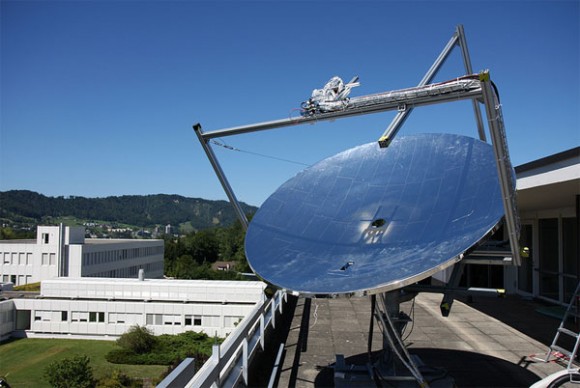
The research group , led by IBM, recently introduced its new development: an affordable photovoltaic system that can use about 80% of the incoming solar energy (that is, 80% of this energy is converted into energy useful to humans). In addition to generating electricity, the system is capable of performing a couple more functions, including desalination of water and air cooling.
This system is being developed as part of a three-year project with a total budget of $ 2.4 million. Grant allocated to the Commission on Technology and Innovation (Sweden). Several partners work with IBM, including Airlight Energy, ETH Zürich, and Interstate University of Applied Sciences of Technology - NTB.
According to IBM, only about 2% of the solar radiation in the Sahara will be enough to provide all of humanity's energy needs (at the moment). The problem, as you know, is the high cost and low efficiency of current solar panels, which is why the proportion of photovoltaic stations in the overall power system is so far very small. The system, developed by IBM, is called the High Concentration Photovoltaic Thermal system (HCPVT).
The current prototype, as seen in the photo (and video) consists of a parabolic "plate", on the inner surface of which are mirrored "facets". The device is equipped with a positioning system, which allows you to always use the most effective position in relation to the sun. The reflected rays (the concentration of solar radiation into the beam up to 2000 times amplification) fall on a special system of photovoltaic cells with liquid microchannel cooling. The sizes of photovoltaic cells are 1 * 1 centimeter.
Each chip, thanks to the focus of sunlight, can produce 200-250 watts of energy throughout the entire 8-hour sunny day. The entire system, with hundreds of such chips, is capable of producing 25 kW of energy.
According to the developers, the cost of the system is about $ 250 per square meter, which is three times cheaper than the price of similar systems. The cost of energy produced in this way (taking into account mass production, and not one system) will be $ 0.1 per kWh of energy, which is already comparable to the price of kWh of energy generated at coal-fired TPPs.
Via slashgear