
STM32 + DHT11
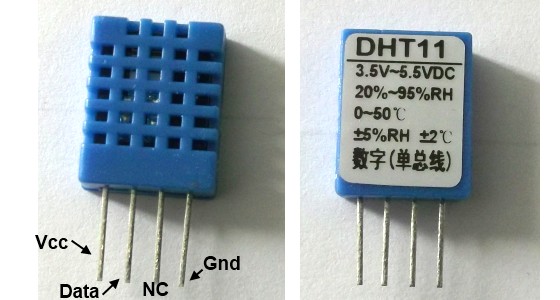
I got a DHT11 temperature and humidity sensor in my hands. Measures humidity in the range of 20-90% and temperature from 0 to 50 ° C. The error in measuring humidity is 5%, and temperature is 2 ° C. Capture time 1 sec. Communication interface single wire ( datashit ). Such modest parameters limit the scope of the sensor only to domestic even room conditions.
I wanted to compare the readings of the device on the HCH1000 + DS18B20 with DHT11.
I mistakenly concluded that the DHT11 and DS18B20 get along on the same bus. It turned out they have very different protocols. After a bad experience, hastily assembled a device to establish the truth.
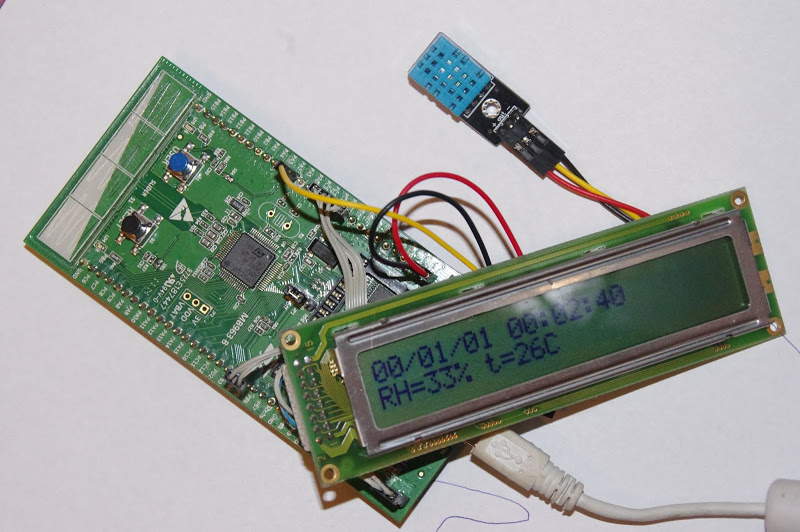
I did not find the finished DHT11 library for STM32. For arduino here. The single wire communication protocol has nothing to do with 1-wire. The difference between 0 and 1 is obtained from the difference in pulse duration.

First, we keep the bus level low for about 20 ms, then release it, after 20 ms the sensor clamps it to 0 by itself and holds 80 μs then releases it for 80 μs (generates a presence signal), it is followed by 40 bits of data, with the same start - holding the bus to 50 μs and bit. bit 0 is somewhere around 28 μs, bit 1 is 70 μs. Well, goodbye, the sensor clamps and releases the bus. 40 data bits are 5 bytes of which the first two are humidity, the next 2 are temperature and the parity byte. The parity byte is the sum of the previous bytes. 1st byte and 3rd byte transmit values, 2 and 4, as I understand it, are reserved for tenths.
The easiest way to read the duration of pulses and write them to an array. Then transform this array into a byte array. So the dht11.c library was born.
A project containing the dht11.c library is here .
I wanted to compare the readings of the device on the HCH1000 + DS18B20 with DHT11.
I mistakenly concluded that the DHT11 and DS18B20 get along on the same bus. It turned out they have very different protocols. After a bad experience, hastily assembled a device to establish the truth.
I did not find the finished DHT11 library for STM32. For arduino here. The single wire communication protocol has nothing to do with 1-wire. The difference between 0 and 1 is obtained from the difference in pulse duration.
First, we keep the bus level low for about 20 ms, then release it, after 20 ms the sensor clamps it to 0 by itself and holds 80 μs then releases it for 80 μs (generates a presence signal), it is followed by 40 bits of data, with the same start - holding the bus to 50 μs and bit. bit 0 is somewhere around 28 μs, bit 1 is 70 μs. Well, goodbye, the sensor clamps and releases the bus. 40 data bits are 5 bytes of which the first two are humidity, the next 2 are temperature and the parity byte. The parity byte is the sum of the previous bytes. 1st byte and 3rd byte transmit values, 2 and 4, as I understand it, are reserved for tenths.
The easiest way to read the duration of pulses and write them to an array. Then transform this array into a byte array. So the dht11.c library was born.
uint16_t read_cycle(uint16_t cur_tics, uint8_t neg_tic){
  uint16_t cnt_tics;
  if (cur_tics < MAX_TICS) cnt_tics = 0;
  if (neg_tic) {
    while (!GPIO_ReadInputDataBit(GPIOA,GPIO_Pin_3)&&(cnt_tics=MAX_TICS) return DHT11_NO_CONN;
  //convert data
  for(i=2;i<42;i++){
    (*buf) <<= 1;
     if (dt[i]>20) (*buf)++;
     if (!((i-1)%8) && (i>2)) buf++;
  }
  //calculate checksum
  buf -= 5;
  check_sum = 0;
  for(i=0;i<4;i++){
    check_sum += *buf;
    buf++;
  }
  if (*buf != check_sum) return DHT11_CS_ERROR;
  return DHT11_OK;
}
A project containing the dht11.c library is here .