June 5, 2012 at 14:37
The choice of high-quality hard drive by external signs
Some time ago, I had to choose a high-capacity hard drive.
After the well-known events in Thailand with the flooding of production capacities of manufacturers of components for hard drives, and the subsequent increase in prices for them, the problem of choosing such an expensive device has become even more urgent.
I opted for the hard drives of one of the famous manufacturers. For the purpose of “political correctness,” the brand of the disc is not advertised.
Before buying, specialized forums were studied, and everywhere experienced participants emphasized that these hard drives have two main assembly regions - China and Korea, and reviews about Chinese-made drives are not very good.
Finally, the hard drive is purchased and ready for inspection.
I already owned a 1.5 TB HDD of the exact same brand that was produced (judging by the label) in Korea. The new purchased disc was made in China: the order was made in an online store, so it was impossible to see and feel the goods before buying.
Under the cut - a review of differences in the quality of Chinese and Korean assemblies of the same brand of HDD, with tips and tricks on how to choose a high-quality hard drive, focusing on external signs. (Attention, a lot of photos).
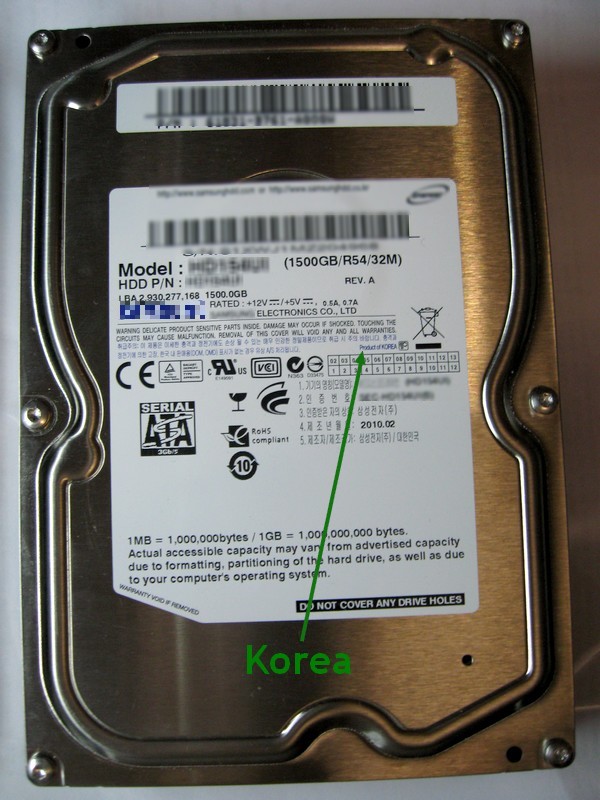
One of the specialists involved in the repair of hard drives already wrote about one of the signs of an original assembly, and about what it is recommended to pay attention to - the presence of air bubbles under the sticker, uneven labeling. In our test instances this is not observed neither in the case of the Chinese,
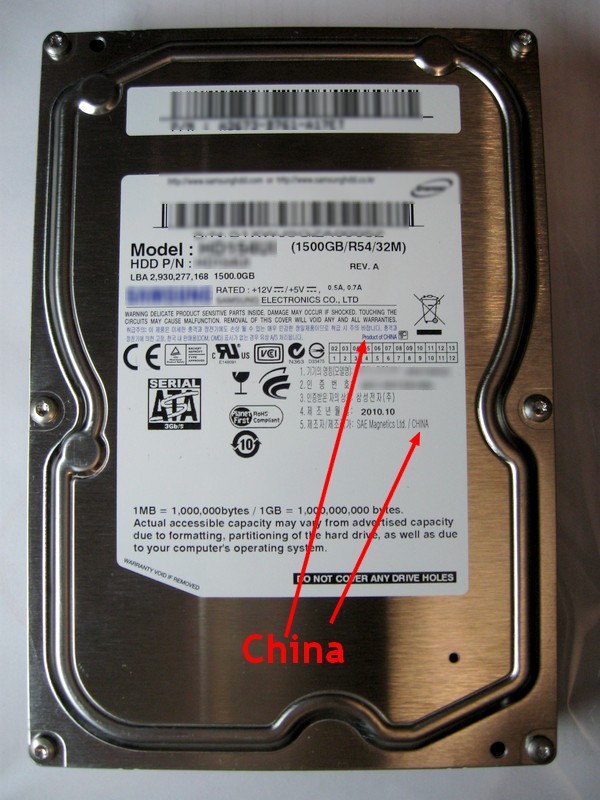
nor in the case of the Korean instance. The labels are straight and no signs of swelling and bubbles are visible:
Go ahead.
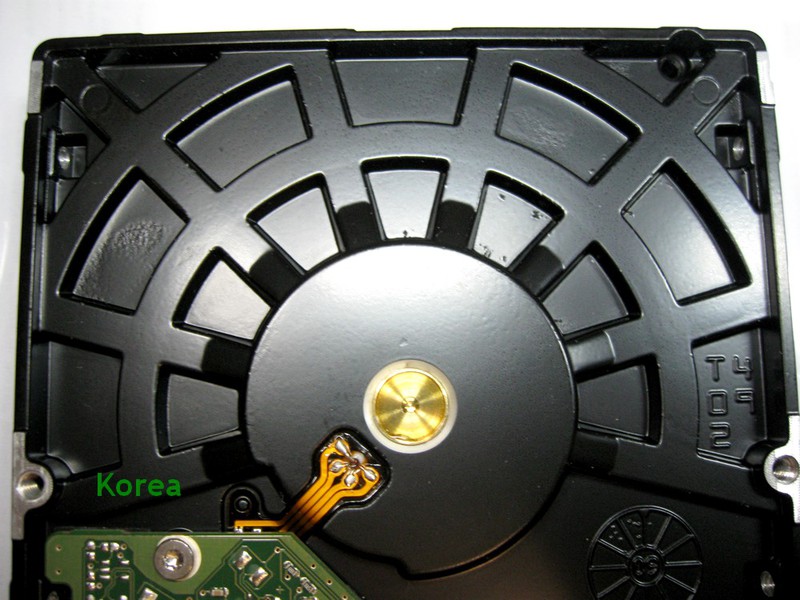
The first thing that catches your eye from the back of the discs is the bumps, scuffs and nicks on the bed of the Chinese specimen:
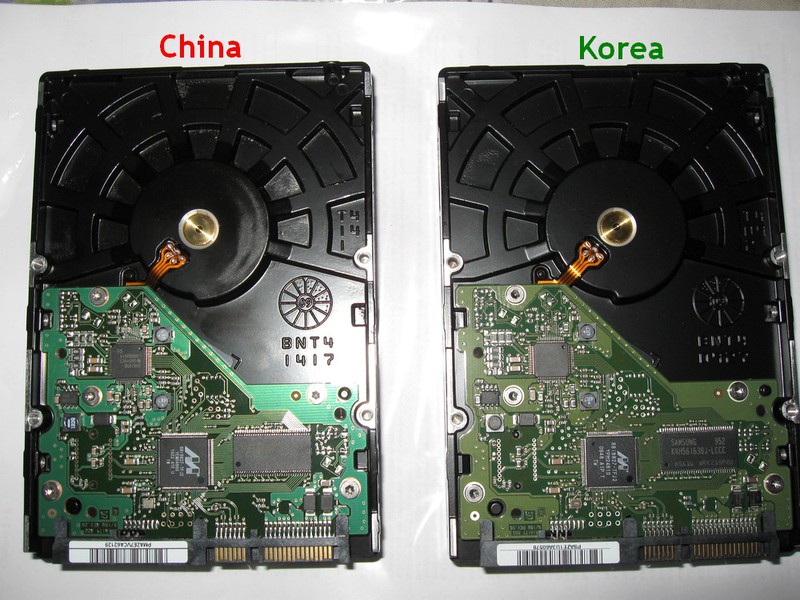
Indeed, the processing of the attachment point of the spindle of the Chinese disc does not look very good
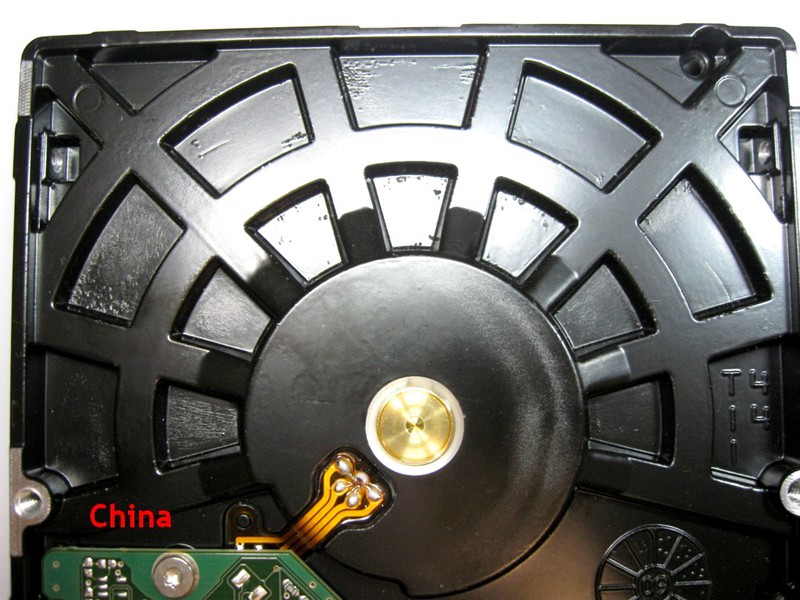
compared to the Korean specimen: From a
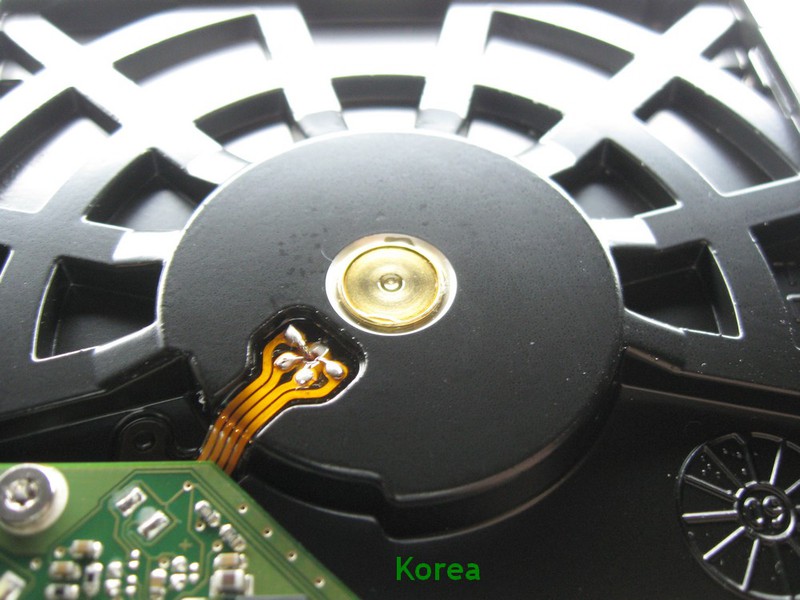
slight angle, this is even better. Scuffed surface of the "Chinese"
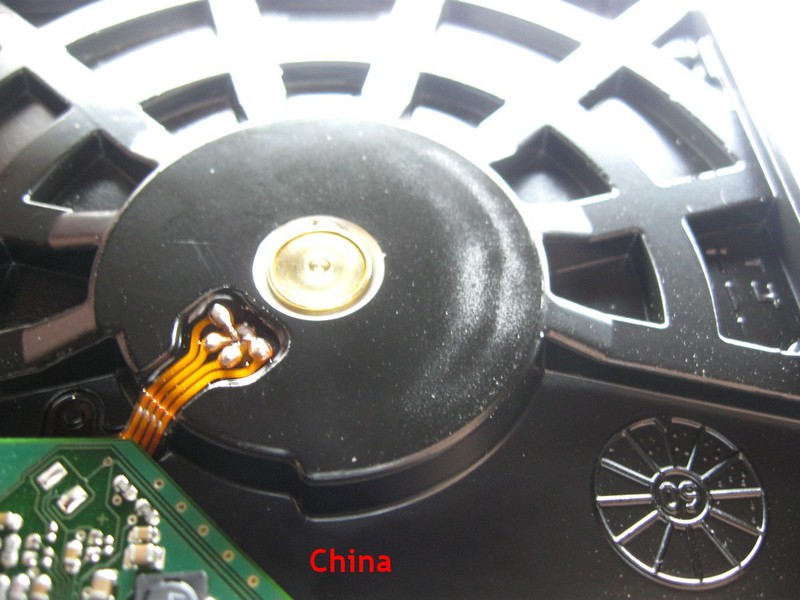
against the polished surface of the Korean copy:
In the Chinese instance, an ESMT brand chip was used as a memory chip. This may seem a little strange, since the manufacturer of the HDD itself is a manufacturer of such chips (but as they say on the forums, everything is logical - ESMT chips are less high-quality and cheaper). The areas on the board are poorly tinned (the matte shade of the contact pads indicates this):

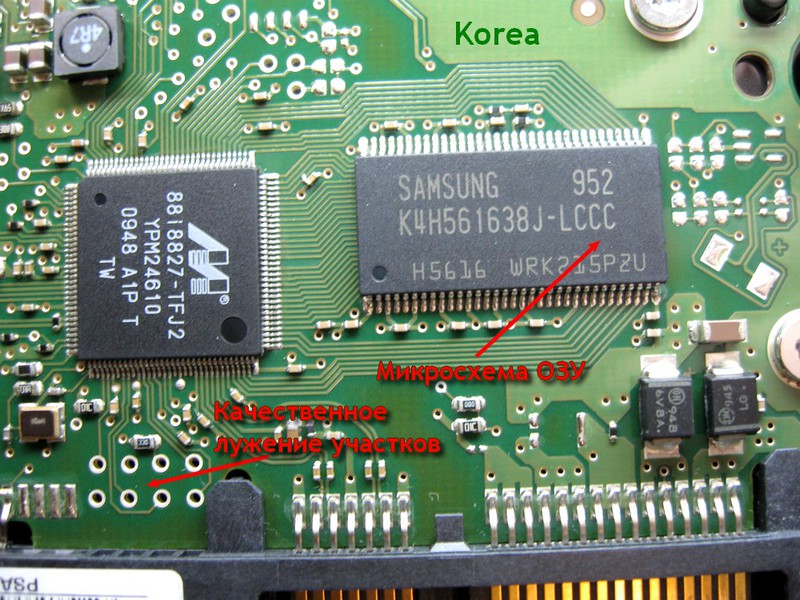
In the Korean version, a native memory chip is used as a memory chip. The quality of tinning of the plots also differs for the better (the solder is evenly distributed along the perimeter of each contact pad):
It is also worth noting that in the described models a vibration sensor is provided, but in both copies it is not soldered (absent). In fact, I think this is even a plus: I came across disks with a soldered sensor, and which, within huge limits, arbitrarily increased the value of the SMART parameter “Mechanical Shock”, despite the fact that during this the disk was fixed and was on a fixed concrete slab .
Back to the quality of tinning, it also says a lot. In the Chinese version, it is simply disgusting.
It’s better not to take such a disk, because subsequently, such savings can lead to difficult problems — the absence and periodic loss of electrical contact, etc.
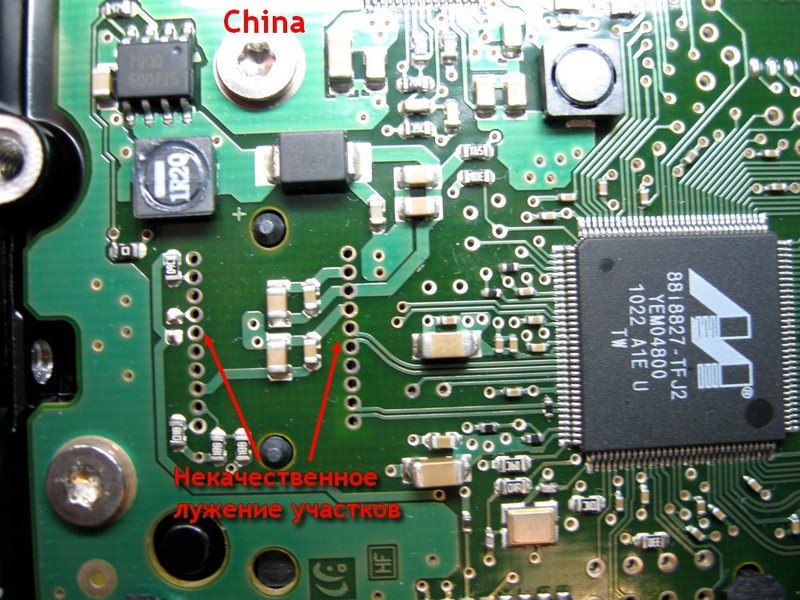
In addition, all modern printed circuit boards of complex devices are two-sided and, often, multi-layer, with metallization - this means that the contact passes from one side of the board to the other layer or side of the board. And poor quality metallization can also cause problems.
In the Korean version, the board looks just fine:

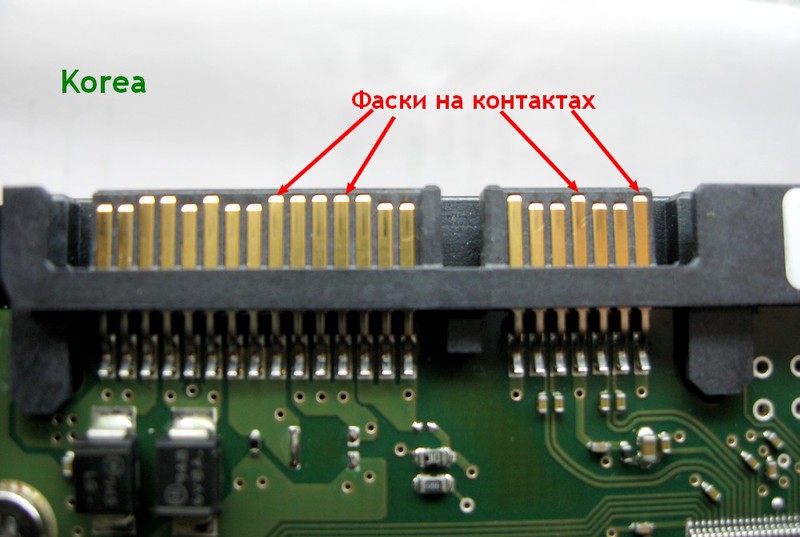
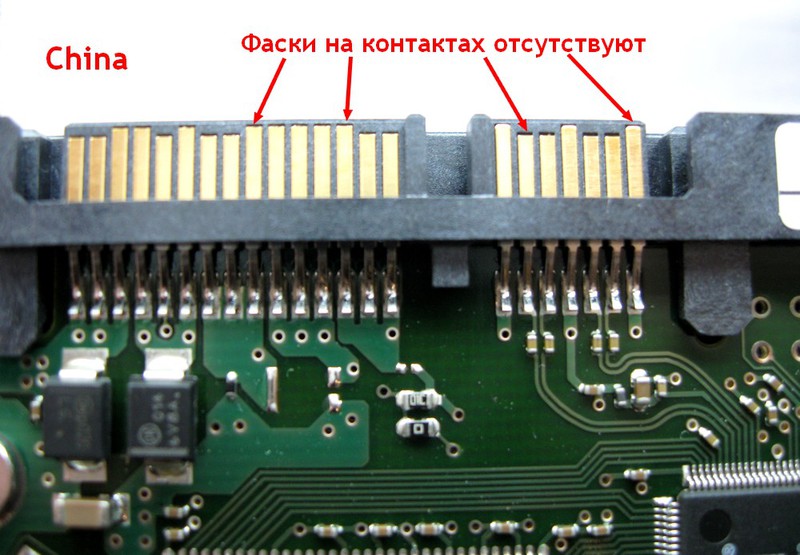
Even at first glance such a trifle as the connectors is also different.
In the instance of the Korean assembly, chamfers are present at the ends of the contacts - for less wear on the mating part of the connector.
In the Chinese version, they didn’t even think about such an excess:
As a result, the purchased new disc made in China (after a couple of inclusions) already had a couple of reassigned sectors and bad blocks, which, together with the shortcomings described above, allowed us to return it and exchange it under warranty for a similar, but already Korean assembly.
I don’t want to say that Chinese-made hard drives are completely substandard, but paying attention to details when choosing will not be superfluous, and, of course: even a high-quality selection of a hard drive by external signs does not guarantee that everything will be okay inside this drive. But reducing the chance of disk failure will certainly help.
I wish you a happy shopping, only quality products!

After the well-known events in Thailand with the flooding of production capacities of manufacturers of components for hard drives, and the subsequent increase in prices for them, the problem of choosing such an expensive device has become even more urgent.
I opted for the hard drives of one of the famous manufacturers. For the purpose of “political correctness,” the brand of the disc is not advertised.
Before buying, specialized forums were studied, and everywhere experienced participants emphasized that these hard drives have two main assembly regions - China and Korea, and reviews about Chinese-made drives are not very good.
Finally, the hard drive is purchased and ready for inspection.
I already owned a 1.5 TB HDD of the exact same brand that was produced (judging by the label) in Korea. The new purchased disc was made in China: the order was made in an online store, so it was impossible to see and feel the goods before buying.
Under the cut - a review of differences in the quality of Chinese and Korean assemblies of the same brand of HDD, with tips and tricks on how to choose a high-quality hard drive, focusing on external signs. (Attention, a lot of photos).
One of the specialists involved in the repair of hard drives already wrote about one of the signs of an original assembly, and about what it is recommended to pay attention to - the presence of air bubbles under the sticker, uneven labeling. In our test instances this is not observed neither in the case of the Chinese,
nor in the case of the Korean instance. The labels are straight and no signs of swelling and bubbles are visible:
Go ahead.
The first thing that catches your eye from the back of the discs is the bumps, scuffs and nicks on the bed of the Chinese specimen:
Indeed, the processing of the attachment point of the spindle of the Chinese disc does not look very good
compared to the Korean specimen: From a
slight angle, this is even better. Scuffed surface of the "Chinese"
against the polished surface of the Korean copy:
In the Chinese instance, an ESMT brand chip was used as a memory chip. This may seem a little strange, since the manufacturer of the HDD itself is a manufacturer of such chips (but as they say on the forums, everything is logical - ESMT chips are less high-quality and cheaper). The areas on the board are poorly tinned (the matte shade of the contact pads indicates this):
In the Korean version, a native memory chip is used as a memory chip. The quality of tinning of the plots also differs for the better (the solder is evenly distributed along the perimeter of each contact pad):
It is also worth noting that in the described models a vibration sensor is provided, but in both copies it is not soldered (absent). In fact, I think this is even a plus: I came across disks with a soldered sensor, and which, within huge limits, arbitrarily increased the value of the SMART parameter “Mechanical Shock”, despite the fact that during this the disk was fixed and was on a fixed concrete slab .
Back to the quality of tinning, it also says a lot. In the Chinese version, it is simply disgusting.
It’s better not to take such a disk, because subsequently, such savings can lead to difficult problems — the absence and periodic loss of electrical contact, etc.
In addition, all modern printed circuit boards of complex devices are two-sided and, often, multi-layer, with metallization - this means that the contact passes from one side of the board to the other layer or side of the board. And poor quality metallization can also cause problems.
In the Korean version, the board looks just fine:
Even at first glance such a trifle as the connectors is also different.
In the instance of the Korean assembly, chamfers are present at the ends of the contacts - for less wear on the mating part of the connector.
In the Chinese version, they didn’t even think about such an excess:
As a result, the purchased new disc made in China (after a couple of inclusions) already had a couple of reassigned sectors and bad blocks, which, together with the shortcomings described above, allowed us to return it and exchange it under warranty for a similar, but already Korean assembly.
I don’t want to say that Chinese-made hard drives are completely substandard, but paying attention to details when choosing will not be superfluous, and, of course: even a high-quality selection of a hard drive by external signs does not guarantee that everything will be okay inside this drive. But reducing the chance of disk failure will certainly help.
I wish you a happy shopping, only quality products!