April 14, 2012 at 15:45
10 robots that influenced history most
- Transfer
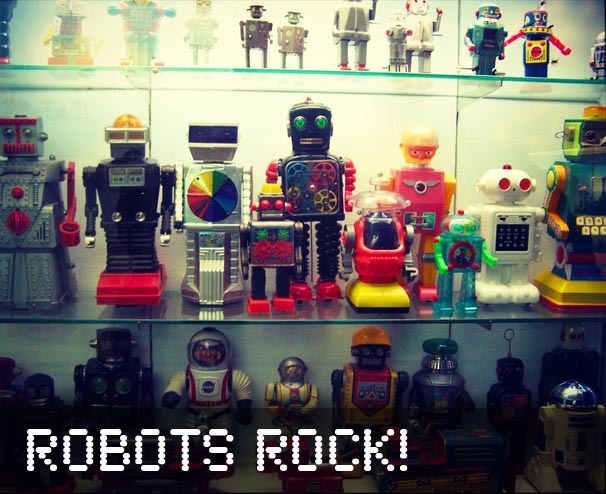
It would be wrong if GeekTech did not write anything for Robotics Week , and if there is a thing that this blog loves, then it's robots. Robots are constantly around us, from coffee makers in the kitchen to assembly lines at work. But where did the first robots come from? Who were the founders of the robots that we see now?
There are hundreds of incredible robots, but we have selected some of the most significant and memorable in chronological order.
Around 350 BC: The Pigeon
This first “robot” is really very old. Architects, Greek philosopher, astronomer, mathematician and statesman, outlined the principles of mechanics. One of his projects was a wooden mechanical bird. It was driven by steam and could fly up to a height of 200 meters. This invention, perhaps not just the first robot on the planet, but also the first flying device.
1495: Leonardo's Robot

Leonardo da Vinci also participated in the history of robots. He designed the first humanoid robot. In 1495, he created a robot knight who, judging by the sketches, could stand, sit, raise his visor and move his hands.
Using original sketches, modern designers managed to recreate the robot. A copy can perform all of the above movements.
1738: The Duck
French inventor Jacques de Vaucanson at one time created several autonomous robots, but The Duck is one of his most outstanding works.
The mechanical duck had over 400 different parts, which is not too surprising considering what it could do. A duck could flap its wings, eat, digest food, and then defecate. It was a pretty impressive robot!
Vaucanson managed to "teach" the robot to digest food, thanks to the installation of compartments for the chemical decomposition of grain.
Only now, after 274 years, modern robots with similar capabilities, for example, Ecobot , appeared , although he only knows how to digest, unlike a duck, which could perform other funny “tasks”.
Unfortunately, no one knows what happened to the original duck. However, the museum in Grenoble has a copy of the duck created by the watchmaker.
1898: Tesla's Remote-Controlled Boat You
may know Nikola Tesla because of his electric coils, but he has one more achievement in the field of robots.
When Nicola was looking for a way to demonstrate his wireless transmission system (what we now know as radio waves), during the conference he put an iron boat in the water in Madison Square Garden and controlled it with a remote control, the boat received signals and executed Nikola's commands. At that time, no one understood how the remote control boat would affect the future of robots, toys, radios and other devices that we use now.
1962: The Unimate
In the 60s of the 20th century, inventors put a lot of effort into the development of robotic manipulators, but One of the most important inventions was The Unimate arm. It was one of the first industrial robots to be installed on the General Motors assembly line to reduce the likelihood of personal injury and death. The fixture could fold parts of hot cast metal and weld body parts. Unimate is currently in the Hall of Fame with robots such as R2-D2 and HAL.
1966: Shakey the Robot
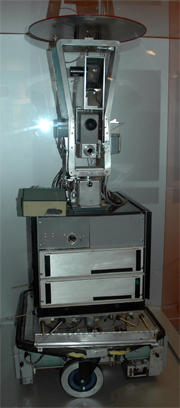
Shakey the Robot was one of the first truly successful AI robots. He could understand his own actions. If you gave Shakey a task, he would analyze it, unlike other robots that needed specific instructions.
Shakey demonstrated his ability to think and react by moving through rooms and corridors, turning lights on and off, opening and closing doors, and moving objects. The robot is currently retired and housed in a museum in Mountain View.
1989: Genghis
Have you ever wondered which robot was one of the first to learn how to walk? This is Genghis. This six-legged autonomous robot, created by the Mobile Robots Group in the laboratories of the Massachusetts Institute of Technology, was not only known for its ability to walk, but also for how quickly and cheaply it was made. However, it needs 4 microprocessors, 22 sensors and 12 servomotors to function.
His walk was called "the Genghis Gait." The first steps of the robot:
1997: NASA Mars Pathfinder and Sojourner

NASA also contributed to the development of incredible robots, but the robot that really stands out is Mars Pathfinder and Sojourner.
His main goal was to demonstrate the technologies necessary for efficiently and economically feasible sending a robot to Mars. The robot managed to enter the atmosphere of Mars and send a lot of useful data about the Red Planet to Earth for further study.
1998: Lego Mindstorms
There would be no GeekTech without a mention of LEGO. Mindstorms series kits containing programmable software and hardware were some of the cheapest and easiest ways for those who wanted to make their robot. The creation of this series was inspired by the book by Seymour Papert, “The Storm of the Mind: Children, Computers, and Fruitful Ideas,” in which the mathematician proposed a simple theory of learning in practice.
2000: ASIMO

Back in 1986, Honda announced its intention to participate in a project to create a humanoid robot that can not only exist with people, but also exceed their abilities. A little later, Honda announced ASIMO, one of the most impressive robots. It can emulate a person’s gait, use his hands, speak and listen, see and recognize people and objects. Of course, ASIMO has something to strive for before it can surpass human abilities, but Honda already has many ideas for the future development of this robot.