April 4, 2012 at 09:59
Can insects be spares?
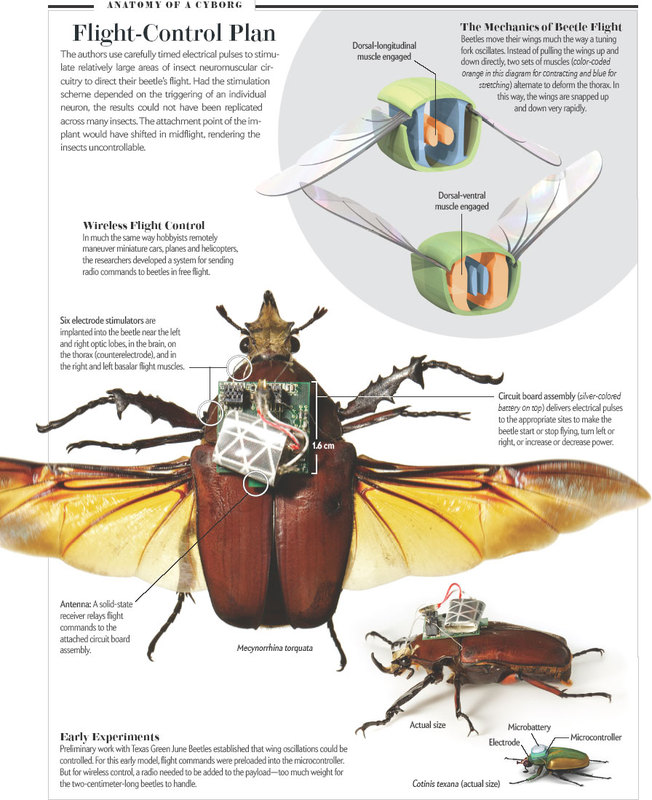
This cyber platform carries up to 9 grams of payload.
Take the caterpillar. At some point, she begins to remake herself into a butterfly. The question is simple: is it possible to give her synthetic components for assembly that will make it possible to obtain a cyborg insect ? The answer is yes, you can. And Michelle Maharbiz did it.
When this scientist from Berkeley created the first cyborg beetle, the military immediately came to him (DARPA) and asked if he was going to kill people, plus what would happen if his bug ran away and began to multiply frantically.
Maharbiz explained that he does not kill people, does not plan to do dangerous insects (yet), and is not afraid of breeding them, because the cyborg does not transmit instructions for its assembly during sex. He explained to animal rights activists that he did not torment beetles, and there were no complaints from them about ill-treatment. True, he is now just considering the ethical aspects of using insects as components for electronics, but this is the tenth thing.
Media selection
Maharbiz took the beetles as a basis. The choice is quite interesting: the fact is that the biological design of the beetle is such that it contains something like a battery pack and can carry 20% more of its weight. That is, the beetle has a reserve for upgrades and features, plus a battery that feeds it for a long time and opens up some freedom of use.
Management technology
In simple terms, beetles are controlled through certain resonant frequencies. Different events with muscles cause different stimulation of the resonance of the carapace, which, in turn, activates the actions of other specific muscle groups. By controlling the resonance, you can give commands to the bug.
Maharbiz took and inserted into the beetle optical stimulants in the brain and electrical stimulators in a pair of basic muscles. The first type of interaction is working with the brain: start and end vibrations. The second type is the stimulation of the basal muscle on each side for turns. Roughly speaking, when this muscle of a beetle strains, the beetle fully understands that it has a turn - and begins to do so. Something like an interrupt system.
Later, the system was transformed into a micro-antenna, a microcontroller that has a transmitter-receiver and a small microphone in order to listen to vibrations to synchronize the wings (the beetle flies in a very complex pattern, so this is extremely important). Wii was connected as a remote control - and began to play as a bug.
The first thing that turned out - there is some place in the beetle’s brain, which gives a 98% probability of the correct execution of the command to “start” and “stop” the beetle. Depending on the signal, the beetle biosystems adapt to the flight position, for example, and fall into a cycle where they cannot stop until the signal stops. It so happened to learn how to control a beetle through two channels: “flew-landed” and “turn right - turn left”.
Given that there are beetles that can carry 7-9 grams of payload, it is clear why at about that moment the military was vividly interested in Maharbiz and biology in general.
Limitations
It’s clear that the bug, even upgraded to the proud title of cyborg, is not a robot, so it’s impossible to calibrate the system. Control errors differ from insect to insect: the fact is that each cyborg has its own biological balancing system, plus its own nervous system, which has been built for generations to respond to different impulses from the outside world. Beetles are corny different, therefore, without an intermediate link in the control chain acting as a synchronizer-calibrator, the same reaction will not work.
Another problem stems from the same nervous system. Management is still low level, that is, it affects the basic levels of impact. In the process of fulfilling a responsible mission, a cyborg may be interested in a flower, a “bug of the opposite sex” or something else interesting and important - and this will immediately ruin the priority system, or simply cause extraneous activity. In the end, no one explained the bug about scientists and the Pentagon, so he tries to live somehow himself.
Continued research
Then the colleagues of Maharbiz found a muscle-sclerite, who alone was responsible for managing the flight. Having modeled the insect on a special installation, it was possible to increase the accuracy of control - and not at the level of direct impact, but, roughly speaking, guiding the “thoughts” of the beetle with physiological effects. Now, scientists lack feedback from insect sensory systems for precise control, but this is already being decided.
Let's make a player out of it?
Digital miniaturization is closely associated with biology. Biological systems are very widely available in nature, they are cheap and easy to reproduce. There are many organisms, plus they can be removed to the desired stage. The result - now you can use some insects as components for various equipment. For example, they already have a built-in gyroscope, a flying unit, and typical sensors.
Imagine the situation: when placed on a stream, to make a controlled platform from an insect costs, for example, about 1000 rubles, plus about 3-4 thousand is a base station for control. This very crude use of the insect may well turn out to be entertainment at first, and then industry.
Let's go further. You can start producing various strange things that will be a mixture of living and non-living chains. Synthetic control networks and biological components are already a reality, and a little scary. And this is exactly what Maharbiz is doing now in Berkeley.
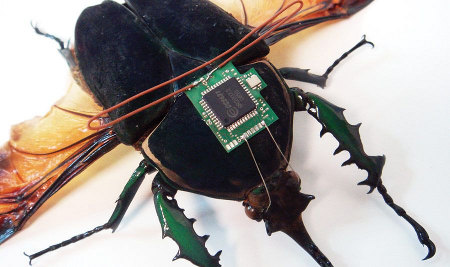
Perhaps one such one is already flying behind you.
Now get control over the neurosystems
A cyberimplant can be inserted into the chrysalis at the stage when it is formed (not too early - it will die, and not too late - it is rejected). Japanese scientists have conducted research on the implantation of microcontrollers in the head of an insect. When this thing developed, the controller became an ideal control system to which it was possible to connect all the necessary peripherals and power. The media panicked, but then there was no special practical sense in the opening.
After a year and a half in Berkeley, a way was found to embed an interface into a butterfly through which neurons passed to the eye. The hypothesis was checked: a perforated flexible polymer was implanted into the chrysalis, which gave an amazing fusion. The eye formed correctly, but so that the neurons passed through the implant - and this implant could take data from them. Simply put, it turned out to create a technology for recording images from the eye (though, while it is not clear at the input what, it is still necessary to decode the “protocol” of data transfer inside the insect).
An insect with such an implant behaves normally and normally responds to the outside world, including among its own kind. Now the Maharbiz group is recording neural events and analyzing data. It is planned to reduce the interface for recording more events. The dream is to collect all data from insect sensors and use them for automated control and other tasks.
And the batteries too
The next breakthrough is the fuel cell on the insect. Scientists modified the glucose fuel cell and installed it on a bug. The beetle delivers glucose into the body (it eats products with it), the cell produces electricity for other beetle cyber systems. Now such a cell has been working for several weeks and gives 10-20 μW. In the future - a couple of years and 100mkW. You can do more, require more advanced technology or more cells in the insect. Radio transmitters can already be assembled without too much difficulty, just expensive.
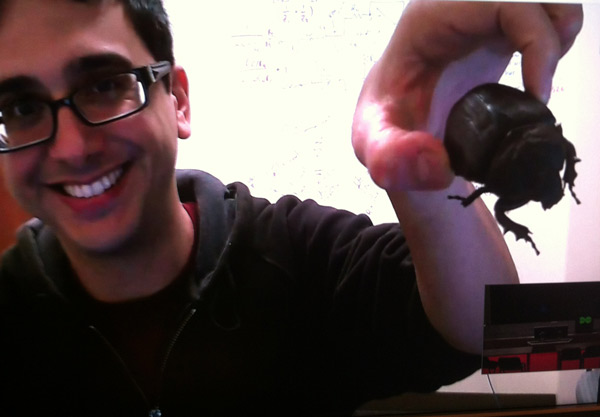
Maharbiz sends greetings to Habr on tests of a signal from Berkeley. Now he is showing a new bug from Thailand: from it you can collect something useful.
References
- A recent lecture in Russian and English in Digital October (there is a lot about the design of insects and the essence of biotechnological research);
- About Michelle on the Berkeley website;
- News about DARPA and interest in bugs;
- Video with test bug in alpha.
And finally: now in the laboratory of these wonderful people a project of a neurosystem is spinning, which will give dust as an output. It is planned to be applied to the skin to establish an interface, for example, with a cell phone. Welcome to the future.
PS The following free lectures at Digital October are the closest about what the project should be like to be invested in, and a little further about EQ .