December 2, 2011 at 16:22
Silicon Valley Islet
OLS (Ostrovok Lecture Series) is a lecture with the stars of the global web industry. Esther Dyson, Timur Artemyev, Joe Cutler have already visited our office and Skype founder Nicklas Zennstrom spoke on Skype.
 Yesterday, as part of the OLS, cool guys from Y Combinator, Virool and DST came to our office: Harj Taggar, Garry Tan, Alexander Debelov and Felix Shpilman. They came to Russia at the All-Russian Innovation Convention 2011, but we know that they are curious that what is interesting in Russia is happening in IT. And is it true that St. Basil's Cathedral is a giant petrified gingerbread.
 We showed our office and asked the guys to talk about how it turned out that they are engaged in investments at an early stage, what they did before and how they are going to develop. Then all interested employees of Ostrovka talked with them, asked questions, asked opinions about their ideas and those of their friends.
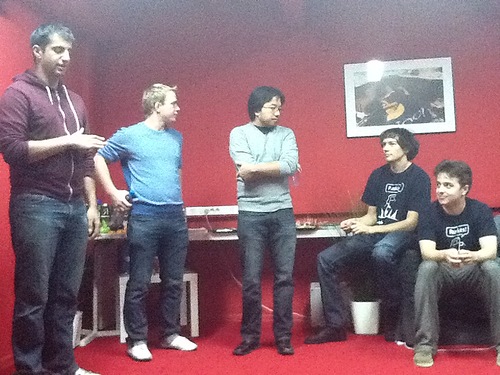
Photo taken on iPad, sorry.
From left to right: Harj Taggar, Alexander Debelov, Garry Tan, Evgeny Kuryshev, Sergey Fage
Facts
- Harge Taggar founded Auctomatic, an auction software development company, and sold it to eBay at 22.
- Harry Tan created Posterous, a very popular blogging platform.
- Felix Shpilman - one of the advisers in DST, directs their direction of investment in small companies.
- Sasha Debelov, originally from Rostov-on-Don, went to study in San Francisco, but managed not only to learn, but also to found The Kairos Society, the largest organization for student entrepreneurs, and found Virool, the largest video content distribution network. Even Sasha was recognized many times as “The Best Young Entrepreneur” by various reputable international magazines.
- Once Harry Tan worked as a manager at Microsoft, and he thought it rather silly to quit a good job and do some kind of startup there.
- Harj Taggar still has to convince his relatives that he is not unemployed. It became a little easier after the release of the film "Social Network".
- Felix did not finish his studies at a school in Moscow, but this did not stop him from investing in Ostrovok and a bunch of other companies.
- Harge Taggar and Harry Ten are partners at Y Combinator. They have invested in more than 360 startups. Over the past year - 100, the next will be 120.
- If you already have a small office and team, some sales, some profit, some partners, then you are almost not interested in Y Combinator.
- Y Combinator does not give $ 10 million for a 50% stake in the company. They give 15-20 thousand dollars at a stage when there is nothing but an idea and those who want to implement it. And, yes, they take an average of 6% of the company's share for this. Hello to Russian counterparts! =)
Silicon tips
 Harge recommends reading all the essays on Paul Graham's website to all aspiring entrepreneurs.
 There are really a lot of them, but Harry insists that this is simply the necessary knowledge for everyone who starts their own business. By the way, Paul himself works as a boss at Y Combinator.
It’s best to start your startup while there’s still enough foolishness in your head and not enough pragmatism to “clearly understand” that you will fail. The guys repeat that Y Combinator is not investors, but primarily teachers . They say: “We are a university for startups. You take exams, come to our campus and study. Well, work too. And we also pay for it. ” Dropbox - one of the best“ graduates ”of Y Combinator. A couple of students at the Massachusetts Institute of Technology in 2007 offered their idea to different smart uncles with lots of money, but they all asked the question - “Why is this needed? There are already a bunch of ways to transfer and share files on the Internet. Serious companies are doing this. ” And YCombinator invested his small funds, getting a share, which now costs much more. In 2011, Dropbox was valued at more than $ 5 billion. In Silicon Valley, many companies operate on the same principle as Y Combinator. However, the guys believe that their main competitors are large IT companies. Harry says: “Every large company in San Francisco, such as Google or Amazon, has a bunch of talented young people who, unfortunately, will never make a new cool startup ... unless we help them. Large companies are very comfortable, good and attractive. But it’s so hard to leave them - everything around convinces you to stay and give up your stupid undertakings. ”About Russia
 The main problem of the Russian startups was collectively assigned to the throbbing thought of a novice domestic entrepreneur: “Oh, it’s so complicated, these investors are so cool, they don’t take off their jackets, they’re so far away, but I ... didn’t finish Stanford, I didn’t shake Peter Till’s hand, and in general I a small and unfortunate cat, I’ll go and read the Habr. ” Top-5 of the most popular questions in Russia for start-ups and those who finance them, which convincingly show that people still do not understand how IT start-ups work and bring money:
- When do you go on self-sufficiency?
- What salary did you assign yourself after receiving funding?
- What will you do when the money runs out?
- Do investors take away all their income or stay for a living?
- Do investors allow you to do X or Y?
Hats with earflaps are very cool , but St. Basil’s Cathedral is still not gingerbread.At least, it seems that is exactly what many people in Russia think of with whom Harry Ten spoke. Actually, this is not so at all, just these examples are the most noticeable. Harry himself remembered how he worked at Palantir Technologies, a startup that wrote software for the CIA and the FBI.
Where to learn to do a startup
Contact the incubator
 “And what are the problems? Here, take a business card ... Just send us a small presentation about your project, well, a pitch elevator, then come to us for a couple of months - we’ll talk, work together, study and then come back and turn around. There are no problems, it’s even cool that you are from Russia, ”Gary said at the end of the conversation with our back-end Sergey, who shared the idea of his startup.
Get a job in a startup
The second on the list of the best ways to learn how to make startups after “stupidly take and do your own startup”, our guests recognized work in any foreign startup , especially at its early stage of development: almost unlimited responsibility, the opportunity to see with your own eyes how it is born and grows company, learn from the mistakes of others, communicate with the founders and get acquainted with investors. In addition, at the initial stage in a startup, you can often get an option (such as here, in Ostrovka), and with it a chance to get a significant amount of money, which can be very useful when starting your business.It was this phrase that the guys ultimately singled out as the most important advice to novice entrepreneurs after some discussions.
Video interview
By the way, we have a vacancy of an interface developer .