August 19, 2011 at 18:03
13-year-old schoolboy patents a solar battery "on the Fibonacci numbers"
Thirteen-year-old child prodigy Aidan Dwyer from New York State has invented a new design for high-performance solar cells .
A schoolboy investigated the natural manifestations of Fibonacci numbers . His attention was drawn to the fact that the leaves on the branches of trees are arranged in the form of a repeating spiral in a strict mathematical order .
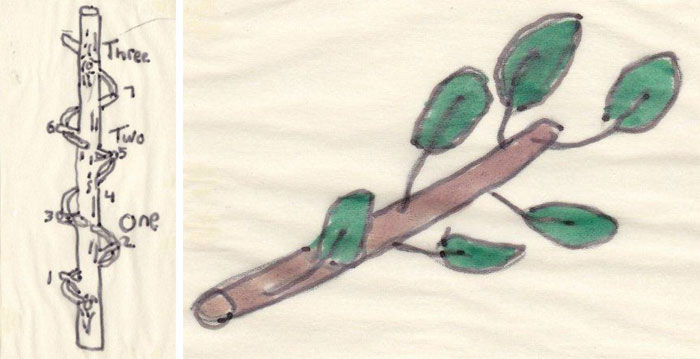
Location leaves describes the fraction in which the numerator and denominator are part of the Fibonacci sequence: 1/2, 2/5, 1/3, 3/8, 5/13 (the first time this phenomenon is described in the Swiss biologist Charles Bonnet in 1754) .
An inquisitive boy designed a device for measuring nodes on branches and collected experimental data from samples that he found near the house.

The theory was confirmed - indeed, the location of nodes is always described by a function with Fibonacci numbers.
The guy became interested in this topic and tried to find the answer why nature uses this mathematical formula in tree design. Immediately the thought of photosynthesis came to mind. Perhaps the Fibonacci sequence allows you to arrange the leaves in an optimal way to absorb the maximum amount of light in a moving light source (sun).
Aidan Dwyer decided to test this thesis with the help of photocells. He used the formula for the location of oak leaves in a computer model of a solar battery, where instead of leaves are solar cells.
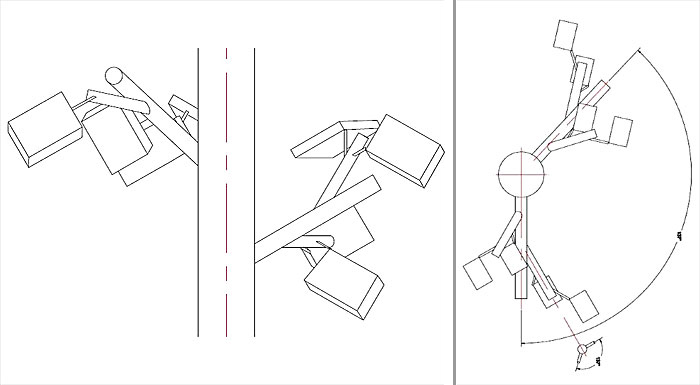
Then Dwyer constructed a real solar battery using this model. The idea was to compare the efficiency of such a battery with a conventional solar battery, where all the solar cells are parallel to each other.
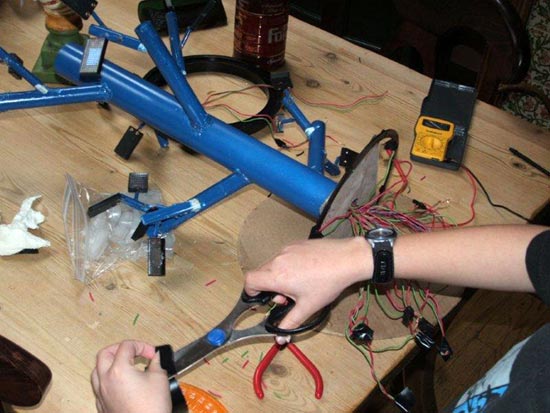
The schoolboy also made an ordinary solar battery from the same photocells.
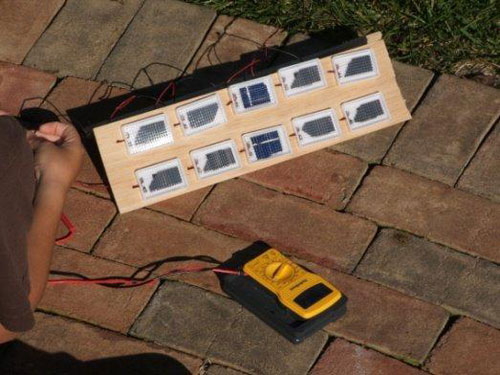
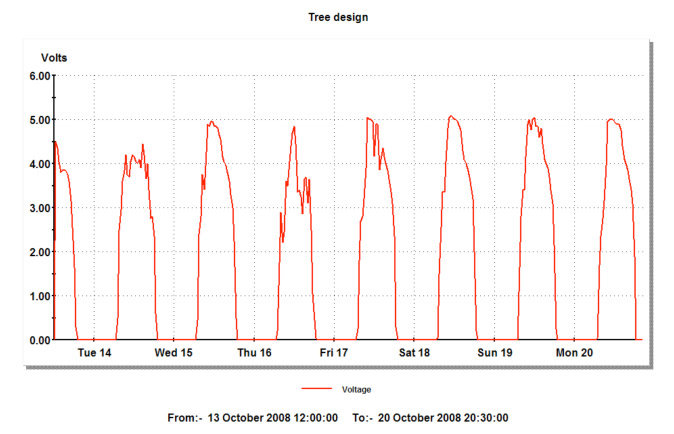
For several months, he took readings from both batteries under various conditions. Oddly enough, but the bizarre shape of the battery of elements located according to the Fibonacci formula worked more efficiently than usual - at least, according to the measurements of the guy. It supposedly generates a total of 20% more electricity, collecting solar energy an average of 2.5 hours longer each day.

The enterprising Aidan Dwyer is already filing a patent in his name. Even if his invention does not make commercial sense (judging byphotos , in his "tree" there are actually twice as many photocells as in the "ordinary" sample), but the work done is respectable. I wish all children were interested in such studies ...

A schoolboy investigated the natural manifestations of Fibonacci numbers . His attention was drawn to the fact that the leaves on the branches of trees are arranged in the form of a repeating spiral in a strict mathematical order .
Location leaves describes the fraction in which the numerator and denominator are part of the Fibonacci sequence: 1/2, 2/5, 1/3, 3/8, 5/13 (the first time this phenomenon is described in the Swiss biologist Charles Bonnet in 1754) .
An inquisitive boy designed a device for measuring nodes on branches and collected experimental data from samples that he found near the house.
The theory was confirmed - indeed, the location of nodes is always described by a function with Fibonacci numbers.
The guy became interested in this topic and tried to find the answer why nature uses this mathematical formula in tree design. Immediately the thought of photosynthesis came to mind. Perhaps the Fibonacci sequence allows you to arrange the leaves in an optimal way to absorb the maximum amount of light in a moving light source (sun).
Aidan Dwyer decided to test this thesis with the help of photocells. He used the formula for the location of oak leaves in a computer model of a solar battery, where instead of leaves are solar cells.
Then Dwyer constructed a real solar battery using this model. The idea was to compare the efficiency of such a battery with a conventional solar battery, where all the solar cells are parallel to each other.
The schoolboy also made an ordinary solar battery from the same photocells.
For several months, he took readings from both batteries under various conditions. Oddly enough, but the bizarre shape of the battery of elements located according to the Fibonacci formula worked more efficiently than usual - at least, according to the measurements of the guy. It supposedly generates a total of 20% more electricity, collecting solar energy an average of 2.5 hours longer each day.
The enterprising Aidan Dwyer is already filing a patent in his name. Even if his invention does not make commercial sense (judging byphotos , in his "tree" there are actually twice as many photocells as in the "ordinary" sample), but the work done is respectable. I wish all children were interested in such studies ...