May 25, 2011 at 10:22 pm
IR image processing revealed 17 more pyramids in Egypt

Seventeen new pyramids were discovered underground due to the analysis of satellite photographs in the infrared spectrum. The pictures even show the layout of ancient Egyptian cities and all the structures. Among them, more than 1000 tombs and 3000 residential quarters have already been recognized.
Unfortunately, the BBC article does not say specifically what technology was used to “scan” the archaeological layers and to detect seals at a depth of several meters. It can be assumed that this is infrared spectroscopy , which is already used in archeology. Infrared spectroscopy studies the absorption and reflection spectra in the wavelength range from 10 -6 to 10 -3m. Theoretically, you can put an IR filter on a satellite and take photos or even install a spectrophotometer, but what will it give us?
If you think about it, you can take pictures in the IR spectrum day and night, calculate the difference and thus identify areas of sand that heat up more slowly than others. After all, sand above massive stone structures should quickly give off heat and heat up more slowly.
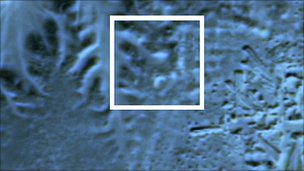 Of course, an archaeologist must work here, who is able to distinguish an artificial structure (like the pyramid in the photo on the right) from an ordinary breed.
Whatever the method used, but in Egyptian sand it is effective, as demonstrated by the author of the study, American Egyptologist Dr. Sarah Parcak. It is difficult to say whether a similar technique will work with infrared shooting of denser Russian soils, under which ancient artifacts probably also remained.