November 22, 2010 at 10:41
MeeGo 2010: Unconference, Football and the Last Word
I paused before I sat down for the last round of travel notes about the Dublin conference on MeeGo - especially since the third day was not eventful. Now everyone has parted, thoughts have subsided - and it's time to share them.
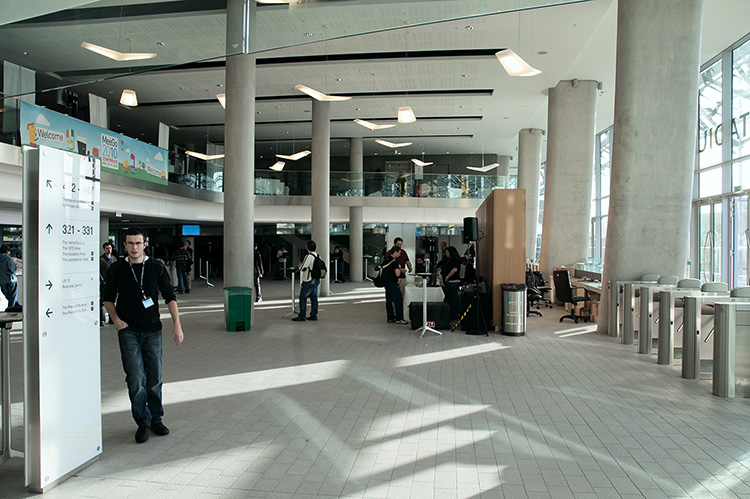
It's funny, but the main distraction of the third day was the already mentioned attraction of unprecedented generosity, when all the participants in the conference, who agreed to spend 5-7 minutes on installing MeeGo, were given a new Lenovo netbook. On the first day of the distribution of elephants, the organizers managed to bring only a small batch of netbooks, scattered in just a couple of hours, so the main blow fell on the last day of the conference - the so-called Unconference.
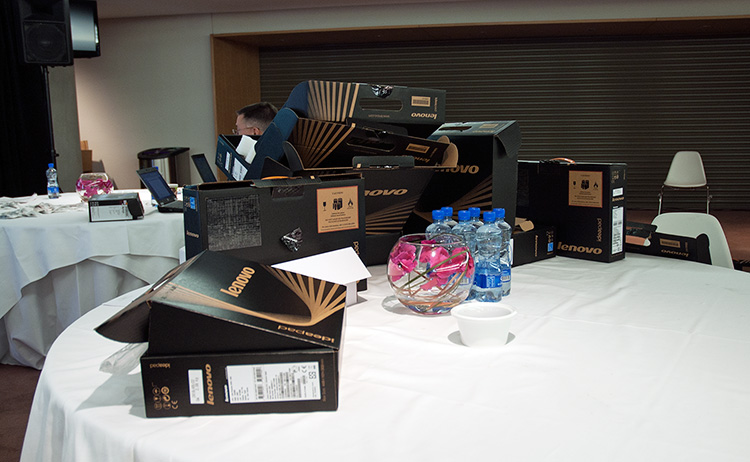
As you can see, the process of distributing netbooks was very successful.
Unconference is a relatively recent conference communication format that fits into newfangled formats like a heap oven. The bottom line is this: anyone who wants to give a lecture, meeting or discussion attaches a leaflet with the name of their event to the initially empty session grid (vertically - time slots, horizontally - platforms):
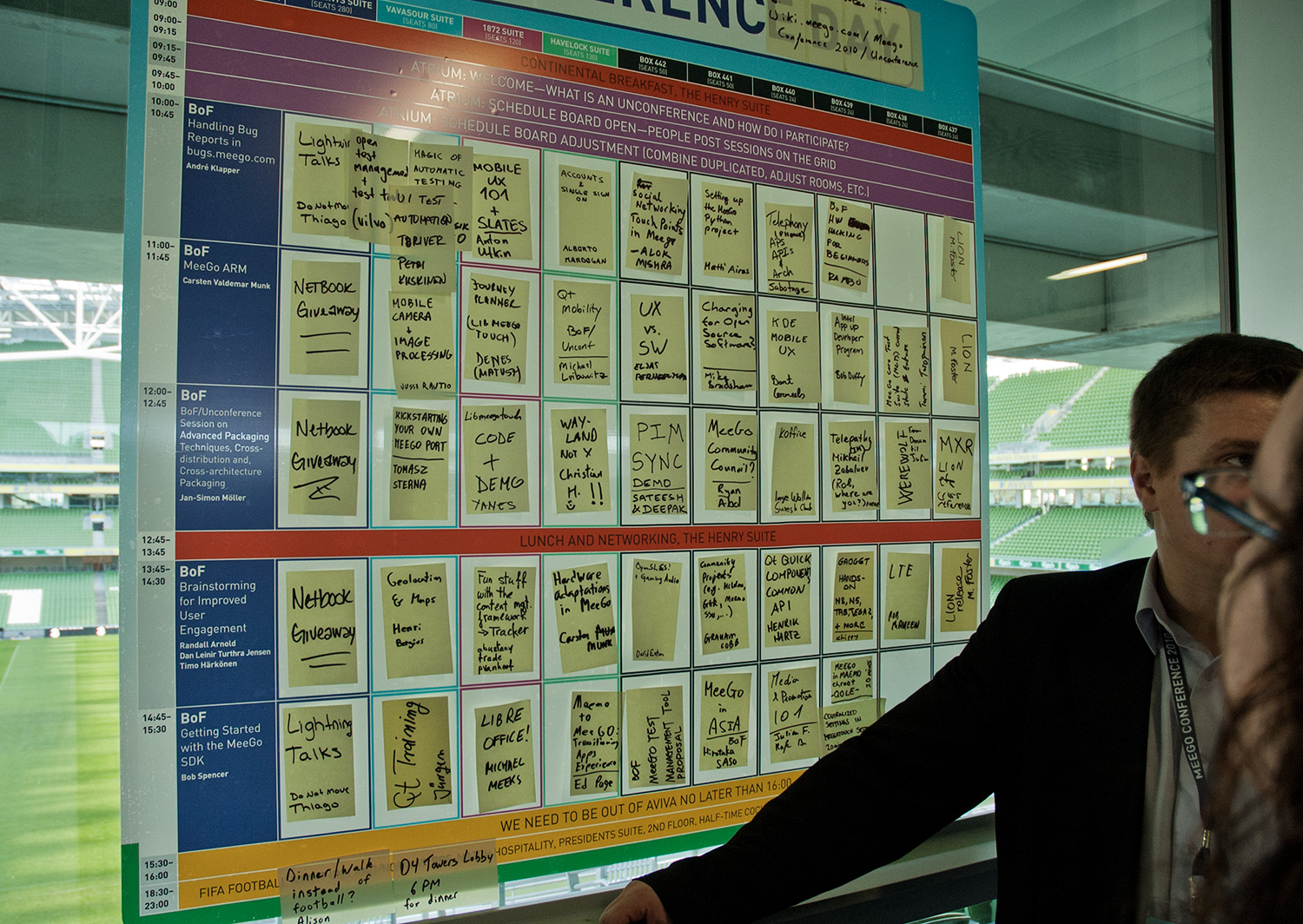
Disputed sessions move around, some moments settle down, and then the process takes place democratic choice: people attend lectures that interest them, so the more curious a topic is, the more visitors it has. My speech (first row, third column) did not have many visitors, but then, going to other sessions, I realized that this was a common problem of the day - all conference participants focused on distributing elephants.
Nevertheless, we got a pretty peppy discussion about the nuances of designing interfaces for tablet computers, and a little later the Finns had a good lecture about the importance of communication with users and user participation in development: The
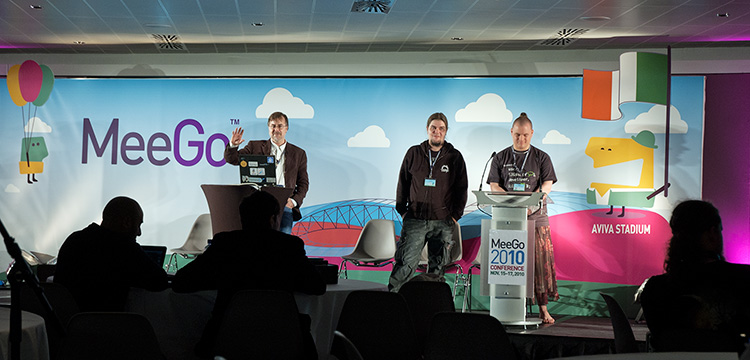
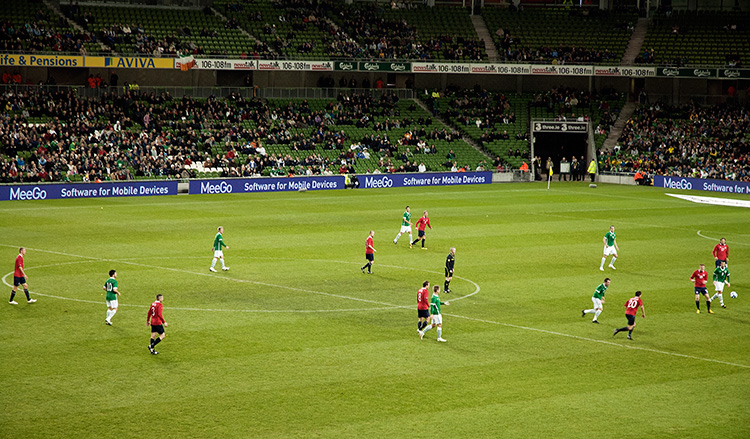
day ended with a friendly football match between Ireland and Norway (I can’t look at millionaires in shorts, carefully driving a leather ball on the lawn, so I left with a score of 1: 1 - don’t ask, I don’t know how it ended); Pay attention to the interactive advertising around the field - yes, MeeGo:
Now there are several considerations that crystallized during and after the conference.
The community has two major drivers - Nokia and Intel. These drivers are not that disconnected, but, let’s say, they pursue their specific, very clear interests. If MeeGo was a closed platform, it would mean her death soon, here the situation, on the contrary, is much more favorable - rather, these are two parallel development vectors that increase the attention of participants and expand the project itself. It's good.
Part of Nokia I will not undertake to comment in detail; almost all sessions related to handheld, N900, and other related topics were especially popular. Probably because there were a lot of people at the conference who somehow related to Nokia projects (at some point I got the impression that about half of those present were Finns). Another thing is that with handheld everything is more or less clear - there is Maemo, there will be MeeGo, Nokia has two strongest competitors in the form of iOS and Android, so further events (but not their outcome) are not so difficult to predict.

Quite another matter is, relatively speaking, embedded, Intel's interest - everything is just more curious there, because the market itself is not so densely built up, as is the case with smartphones. Look here. Netbooks are by far the most obvious (and workable) environment for MeeGo, and this is the first operating system that had netbooks in mind from the very beginning. About IVI, not much is understandable, but the technological demos are impressive, and against the background of the horror that motorists are now using, they look fantastic in general. They spoke very little about tablets at the conference, but this is generally a new topic that is unclear how to approach - the WeTab version 1.0 demonstrated at the conference was rather crude, but some separate interface solutions (such as a scrolling widget desktop) were impressive.
I think thatthe most interesting project of the conference was just at Dominic Le Voll - it is not very impressive until you start to peer into the details, and these details demonstrate several trends. The project is completely commercial (no one hides this), although it relies heavily on open source. The project returns a decent part of the code back to the community, thus, as if paying for a free ride, and the community helps the individual parts of the development move forward. And, finally, another important point - Dominic claims that waiting for stable releases is the same as waiting for weather from the sea (or teasing competitors) - you need to act here and now.
The whole story with MeeGo develops into a rather harmonious picture, which looks like this: the glands have finally fallen into the background, software development has become the cornerstone of creating new electronic products, and users who have a completely fantastic choice have stopped thinking about technical possibilities of their devices, and they choose primarily workable, livable solutions. All this will have a healthier effect on the industry, and I can only assume this: if your next project or even a startup is going to intensively develop some complex electronic consumer products, then perhaps MeeGo can become the basis of your decision today, already on this stages of your life. Amino is about to release a set-top box.Indamixx are going to roll out a tablet for musicians by spring - according to the assurance of the participants in the beta program, there will be a hit. And all this is very good news - join them.
It's funny, but the main distraction of the third day was the already mentioned attraction of unprecedented generosity, when all the participants in the conference, who agreed to spend 5-7 minutes on installing MeeGo, were given a new Lenovo netbook. On the first day of the distribution of elephants, the organizers managed to bring only a small batch of netbooks, scattered in just a couple of hours, so the main blow fell on the last day of the conference - the so-called Unconference.
As you can see, the process of distributing netbooks was very successful.
Unconference is a relatively recent conference communication format that fits into newfangled formats like a heap oven. The bottom line is this: anyone who wants to give a lecture, meeting or discussion attaches a leaflet with the name of their event to the initially empty session grid (vertically - time slots, horizontally - platforms):
Disputed sessions move around, some moments settle down, and then the process takes place democratic choice: people attend lectures that interest them, so the more curious a topic is, the more visitors it has. My speech (first row, third column) did not have many visitors, but then, going to other sessions, I realized that this was a common problem of the day - all conference participants focused on distributing elephants.
Nevertheless, we got a pretty peppy discussion about the nuances of designing interfaces for tablet computers, and a little later the Finns had a good lecture about the importance of communication with users and user participation in development: The
day ended with a friendly football match between Ireland and Norway (I can’t look at millionaires in shorts, carefully driving a leather ball on the lawn, so I left with a score of 1: 1 - don’t ask, I don’t know how it ended); Pay attention to the interactive advertising around the field - yes, MeeGo:
Now there are several considerations that crystallized during and after the conference.
The community has two major drivers - Nokia and Intel. These drivers are not that disconnected, but, let’s say, they pursue their specific, very clear interests. If MeeGo was a closed platform, it would mean her death soon, here the situation, on the contrary, is much more favorable - rather, these are two parallel development vectors that increase the attention of participants and expand the project itself. It's good.
Part of Nokia I will not undertake to comment in detail; almost all sessions related to handheld, N900, and other related topics were especially popular. Probably because there were a lot of people at the conference who somehow related to Nokia projects (at some point I got the impression that about half of those present were Finns). Another thing is that with handheld everything is more or less clear - there is Maemo, there will be MeeGo, Nokia has two strongest competitors in the form of iOS and Android, so further events (but not their outcome) are not so difficult to predict.
Quite another matter is, relatively speaking, embedded, Intel's interest - everything is just more curious there, because the market itself is not so densely built up, as is the case with smartphones. Look here. Netbooks are by far the most obvious (and workable) environment for MeeGo, and this is the first operating system that had netbooks in mind from the very beginning. About IVI, not much is understandable, but the technological demos are impressive, and against the background of the horror that motorists are now using, they look fantastic in general. They spoke very little about tablets at the conference, but this is generally a new topic that is unclear how to approach - the WeTab version 1.0 demonstrated at the conference was rather crude, but some separate interface solutions (such as a scrolling widget desktop) were impressive.
I think thatthe most interesting project of the conference was just at Dominic Le Voll - it is not very impressive until you start to peer into the details, and these details demonstrate several trends. The project is completely commercial (no one hides this), although it relies heavily on open source. The project returns a decent part of the code back to the community, thus, as if paying for a free ride, and the community helps the individual parts of the development move forward. And, finally, another important point - Dominic claims that waiting for stable releases is the same as waiting for weather from the sea (or teasing competitors) - you need to act here and now.
The whole story with MeeGo develops into a rather harmonious picture, which looks like this: the glands have finally fallen into the background, software development has become the cornerstone of creating new electronic products, and users who have a completely fantastic choice have stopped thinking about technical possibilities of their devices, and they choose primarily workable, livable solutions. All this will have a healthier effect on the industry, and I can only assume this: if your next project or even a startup is going to intensively develop some complex electronic consumer products, then perhaps MeeGo can become the basis of your decision today, already on this stages of your life. Amino is about to release a set-top box.Indamixx are going to roll out a tablet for musicians by spring - according to the assurance of the participants in the beta program, there will be a hit. And all this is very good news - join them.