
Open library of Ukrainian standard EDS (developers are invited)
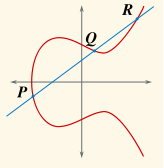 About 2 years ago, I had the idea of creating an open library of the Ukrainian standard for digital signature DSTU 4145-2002. The Ukrainian standard, like the Russian one, is based on elliptic curves, but differs in detail.
 With great difficulty, the text of the standard was found (strange, the text of the Russian standard in the public domain) and it seems like things were left behind ...
Unfortunately, over the past two years, very little has been done: the task is difficult, there are no ready-made open libraries or examples, there is little time . Therefore, it was decided to try their luck, suddenly someone wants to take part in the project. Read more about the project under the cat.
Further, the points:
1. What is the point of making a library? What's next?
Creative interest, expanding experience in cryptography. The project does not imply any commercial benefits (although it is possible).
Ideally, the code could be included in the OpenSSL and bouncycastle.org open libraries.
2. What language will the library be written in?
In C, Java, C #. This question bothers me the least - because Convert from Java / C # to C or vice versa - as a rule, it’s not difficult.
Initial development started in C # (as happened historically). The goal at the moment is to repeat the example given in the standard (roughly speaking, so that all calculations converge).
3. What do you need to take part in the development?
All that is (but for now almost nothing :)) is posted in the repository .
There are indicated developers, current tasks and e-mail for communication.
All authors, developers, are listed in the order they were added to the project (indicating the role).
UPDATE
On October 29, 2010, 8 years after the adoption of the standard, Ukraine finally acquired the first version of the working library for key generation, generation and verification of digital signatures according to the DSTU 4145-2002 standard ! Hurray comrades!
The library, of course, is loudly said. So far, there is only a 100% working example that needs to be completed. But the ice has broken, gentlemen.
While we are not making sensations, because the library has not yet reached the beta version.
UPDATE 2
November 22 published an alpha version of the library . It works both with curves in a polynomial basis and with curves in an optimal normal basis.