
 October 13, 2010 at 17:14
Bring Back the Barrel Cat, or a Reliable Way to Get to the 2010 MeeGo Conference in Dublin
 As an epigraph, I
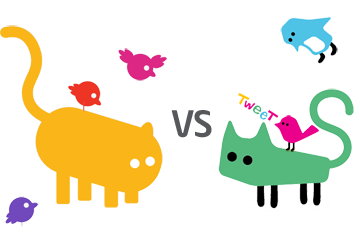
 ’ll quote a couple of quotes: “Dima, * CENSORED *, tell me when MeeGo’s normal GUI will be done, and not these scary little men with chopped heads, open mouths, black bandages, blue penguins and so on?” (From personal correspondence).
“... In addition to everything, the product is promoted by scary, angular people with a shout who have left the tabloid cartoons of the early 90s. Where is everyone’s favorite barrel cat? Why are there few birds? Round people ... ” (from public correspondence).
When asked about the "terrible angular people" respond to easier means to them and begin to ... MeeGo weird characters called "Migon" ( meegons ), and drew their British agency Airside. The barrel cat and other Moblina birds, by the way, are also their job. A large collection of vector migons lies on the MeeGo Style Guide page , it was from there that I took a green cat for a picture that attracted attention. This is completely legal *. However, the use of migons is a matter of taste. These characters are intended more for marketing, and not for the GUI. For example, in the MeeGo v1.0 build they are used with might and main, but the manufacturers of the acclaimed tablet with the non-original name WeTab changed the interface beyond recognition. In any case, application developers for MeeGo can use quite detailed recommendations on GUI design, right down to the color palette and radius of curvature of the button corners.
Under cat there is a bit of philosophy and answers to slightly more complex questions about MeeGo. As for very difficult questions, they can be asked to special people at the MeeGo Conference 2010 in Dublin ... How to get there?
Having rummaged on the irreplaceable resource ark.intel.com, I counted there already 31 ( thirty-one ) Intel® Atom ™ processor models. Starting from 1.8GHz dual-core 64-bit D525 and ending with a simple 600MGz E620 , but for $ 19.
Why do we need all this great variety of species? To cover as many different devices as possible, from nettops to cars and phones (oh!;). The Atom processor family includes five lines of application. At the risk of seeming to be a bore, I’ll list them all again: N - netbooks, D - nettops, Z - portable devices (including tablets), CE - consumer electronics, E - “Embedded” products. Thus, in the relatively near future, we will see Atom everywhere - from refrigerators to mobile phones.
It sounds pretty convincing, but ... It would be nice if the success of the products was determined only by the right processor. Alas, the harsh reality is much more complicated. As we have seen, software rules the consumer market. After all, the requirements for functionality and user interface
MeeGo was conceived to solve at least part of the existing problems. According to the official press release, this is a “ true open source project hosted at the Linux Foundation ”, therefore, any manufacturer can make the OSes for the final product to their taste and color. Fortunately, the system is built in such a way as to separate the User Experience level from Middleware and the core itself.
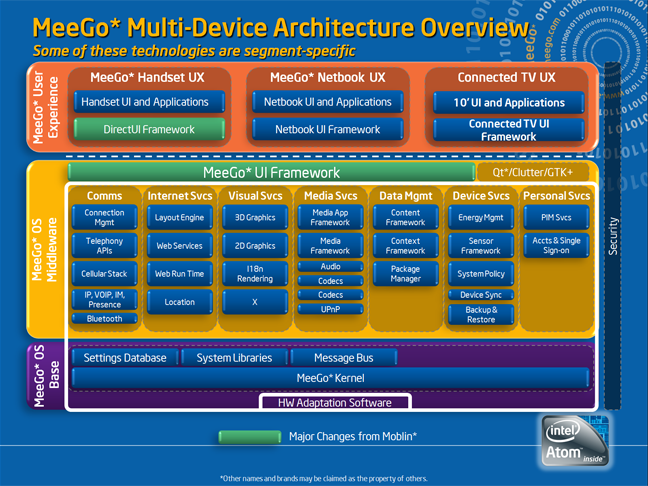
The basic architecture of MeeGo
So, the plan is this: the great and terrible organization Linux Foundation is producing basic releases with the active support of Intel and Nokia. OSV companies supplying Linux distributions to manufacturers make base releases for the specific needs of OEM and ODM. By the way, one of these OSVs was our Russian Linux Center . Then everything is as usual: software developers distribute their client applications either directly or through application stores like Intel AppUp (SM) or OVI *. If desired, on the basis of AppUp you can build a store under your own brand, as it is going to do, for example, Asus.
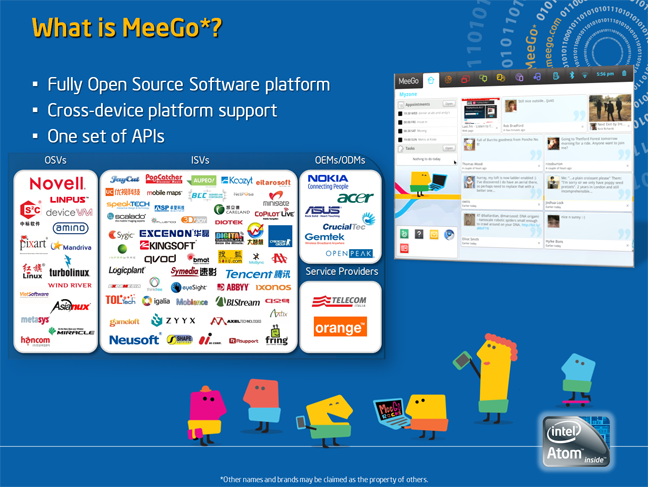
Business Idea: From Linux Foundation to OSV and OEM
I would very much like to insert the word "Profit" here, but there is a small "but." The bottleneck of this grand scheme is client software. Therefore, all its participants are extremely interested in making life easier for developers. First of all, of course, to developers using Qt * - the MeeGo API is based on this library . At the middleware level, there is a very comprehensive set of services , including communication, Internet, graphics, media, and so on - apologists for native code should not be offended. The scheme looks very promising, but, as they said in the classic film “Well, again, everything needs to be checked” (C).
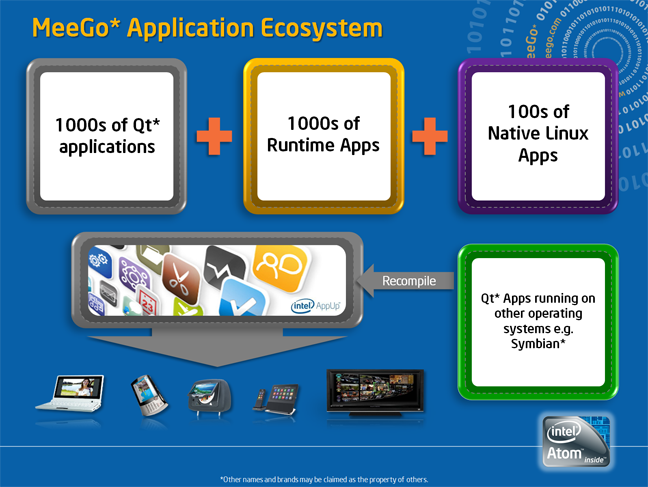
MeeGo Application Ecosystem: Qt, Runtime, and Native Applications
So we decided to check. Of course, with your help. In anticipation of version 1.1, I would very much like to hear the opinion of the habrasociety about MeeGo and how easy (or vice versa - not easy) to write (or transfer) applications for this system. Those who have already tried their hand at programming for MeeGo, as well as those who are just about to do this, we invite you to share experience and tell about your achievements. Any development phase will be interesting: designing a user interface, power management, monitoring the status of wireless networks, integrating into social networks, optimizing performance, libraries, tools, and so on.
All you need to do is write an article about your programming experience with MeeGo and publish it on the Intel® Software Network. If you already have ready-made, published copyright material - so much the better! We do not require exclusive publication rights.
The winner of the contest will go to Ireland, the country of Jameson and Guinness. In Ireland, the MeeGo Conference 2010 Developer Conference will be held in Dublin from November 15-17. This is where it will be possible to ask true experts your tricky questions. And hopefully get some decent answers. Those who don’t like Guinness are waiting for our incentive prizes - two brand new netbooks. Of course, with the preinstalled MeeGo. Good luck to all! * PS In preparing the article, the characters of the MeeGo project were used. In the process of preparation, not a single migon was injured. All trademarks belong to the one to whom they belong.