Energy in the data center
Today's post, we will devote to the features of the organization of power supply of the data center. Seen from the side, all power systems are similar to each other and have much in common. But the devil, as usual, is in the details, so a closer look at the specific implementation of a particular system will never be superfluous.
Next is a story about our energy supply system and a lot of photos.
Electricity comes to the data center through four inputs from two independent substations with a total capacity of 5630 kVA. This complexity is required to provide backup power in case of unforeseen situations or accidents. Such a practice is very expensive, but without a backup power supply, a serious data center cannot be built.
The cables are connected directly to the four automatic transfer switch (ATS) shields. Three FG Wilson diesel generators with a capacity of 2 MW each are connected to them. This ensures uninterrupted power supply.
From the ATS switchboards, electricity through the distribution board of the uninterruptible power supply system comes to battery uninterruptible power supplies. Our UPSs manufactured by the acclaimed AEG Power Supply Systems are transformer. Today, there is already a more advanced technology of thyristor UPSs, but they are more sensitive to temperature and humidity of operating conditions. Due to the fact that transformer UPSs proved to be on the good side over many years of practice, we decided to choose them for reasons of reliability. Passing through the transformers, the electricity is filtered and stabilized, high-frequency harmonics and noise are removed from it, resulting in an almost pure sine wave at the output.
In the event of a failure in the main power supply during the start of the diesel generator sets, the servers, telecommunication equipment and emergency systems are powered by battery-powered UPSs. Power supply systems (chillers, air conditioners, general lighting and other systems) are supplied from diesel UPSs. After diesel UPSs reach the required load level, all data center systems are powered by diesel UPSs.
The battery UPS system includes about 800 batteries, and their total weight reaches 20 tons. The batteries are distributed in four metal racks. The capacity is evenly distributed between 11 UPSs, and is sufficient to ensure uninterrupted operation of servers and telecommunication equipment at full load for 15 minutes. This time several times covers the time needed to start the diesel generator sets and their output to the workload.
Inside the containment zone, the task of distributing power supply is assigned to switchboards. They are the last frontier before directly connecting the power to the racks. Each rack is powered by two cables, this is one of the requirements for redundant power supply.
The panels of cabinets for automatic input of reserve (ATS) have a logic circuit that controls the parameters of the voltage in the network, the completeness and sequence of phases, as well as a strictly specified voltage range. When deviating from the set parameters, the power supply of the data center is transferred to battery and diesel UPSs.
In terms of operation, the system is unpretentious. Once launched, it requires annual measurements and tests, including wiping the contacts with alcohol and other staff-favorite events (a joke). The system architecture is such that any work, including repair, can be carried out without any interruption in the operation of equipment and auxiliary systems of the data center.
Next are photos of system elements. We hope they will be more interesting than the dry text.
UPS cabinet control panel. The load level and battery life (75 minutes) are visible.

Battery rack. Battery weight - 5 (five) tons.


UPS Enclosure Cabinets.

Fuses for the parallel cabinet. Please note that each is designed for a current of 800 amperes (this is a lot).


Switchboards of the uninterruptible power supply system.

The board is of unknown purpose, just beautiful.

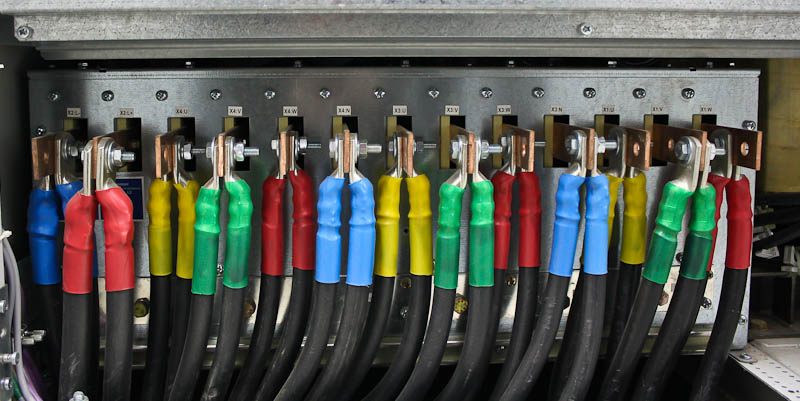
UPS power distribution cables. Beautiful.
Cabinet switches with battery fuses. Impressive.


And these are the fuses themselves. No less impressive.

Instrumentation cabinet power supply. Visible is the level of operating current in phases and voltage.

Circuit breakers for power management cabinets. Those that are designed for a current of 1600 Amperes serve server and telecommunication equipment, and more powerful ones, 2500 Amperes, carry a power load (chillers, air conditioners, work lights, etc.).


View of the control cabinet in full.

The "brain" of the power distribution board.


Switchboard power supply. "Modest" 1600 Amps.

The contents of the automation cabinet. TAC Xenta components monitor the operation of air conditioners, chillers and other power systems.


Switchboards and switches: ventilation and smoke exhaust, own needs, emergency lighting and work lighting.


Next is a story about our energy supply system and a lot of photos.
Electricity comes to the data center through four inputs from two independent substations with a total capacity of 5630 kVA. This complexity is required to provide backup power in case of unforeseen situations or accidents. Such a practice is very expensive, but without a backup power supply, a serious data center cannot be built.
The cables are connected directly to the four automatic transfer switch (ATS) shields. Three FG Wilson diesel generators with a capacity of 2 MW each are connected to them. This ensures uninterrupted power supply.
From the ATS switchboards, electricity through the distribution board of the uninterruptible power supply system comes to battery uninterruptible power supplies. Our UPSs manufactured by the acclaimed AEG Power Supply Systems are transformer. Today, there is already a more advanced technology of thyristor UPSs, but they are more sensitive to temperature and humidity of operating conditions. Due to the fact that transformer UPSs proved to be on the good side over many years of practice, we decided to choose them for reasons of reliability. Passing through the transformers, the electricity is filtered and stabilized, high-frequency harmonics and noise are removed from it, resulting in an almost pure sine wave at the output.
In the event of a failure in the main power supply during the start of the diesel generator sets, the servers, telecommunication equipment and emergency systems are powered by battery-powered UPSs. Power supply systems (chillers, air conditioners, general lighting and other systems) are supplied from diesel UPSs. After diesel UPSs reach the required load level, all data center systems are powered by diesel UPSs.
The battery UPS system includes about 800 batteries, and their total weight reaches 20 tons. The batteries are distributed in four metal racks. The capacity is evenly distributed between 11 UPSs, and is sufficient to ensure uninterrupted operation of servers and telecommunication equipment at full load for 15 minutes. This time several times covers the time needed to start the diesel generator sets and their output to the workload.
Inside the containment zone, the task of distributing power supply is assigned to switchboards. They are the last frontier before directly connecting the power to the racks. Each rack is powered by two cables, this is one of the requirements for redundant power supply.
The panels of cabinets for automatic input of reserve (ATS) have a logic circuit that controls the parameters of the voltage in the network, the completeness and sequence of phases, as well as a strictly specified voltage range. When deviating from the set parameters, the power supply of the data center is transferred to battery and diesel UPSs.
In terms of operation, the system is unpretentious. Once launched, it requires annual measurements and tests, including wiping the contacts with alcohol and other staff-favorite events (a joke). The system architecture is such that any work, including repair, can be carried out without any interruption in the operation of equipment and auxiliary systems of the data center.
Next are photos of system elements. We hope they will be more interesting than the dry text.
UPS cabinet control panel. The load level and battery life (75 minutes) are visible.
Battery rack. Battery weight - 5 (five) tons.
UPS Enclosure Cabinets.
Fuses for the parallel cabinet. Please note that each is designed for a current of 800 amperes (this is a lot).
Switchboards of the uninterruptible power supply system.
The board is of unknown purpose, just beautiful.
UPS power distribution cables. Beautiful.
Cabinet switches with battery fuses. Impressive.
And these are the fuses themselves. No less impressive.
Instrumentation cabinet power supply. Visible is the level of operating current in phases and voltage.
Circuit breakers for power management cabinets. Those that are designed for a current of 1600 Amperes serve server and telecommunication equipment, and more powerful ones, 2500 Amperes, carry a power load (chillers, air conditioners, work lights, etc.).
View of the control cabinet in full.
The "brain" of the power distribution board.
Switchboard power supply. "Modest" 1600 Amps.
The contents of the automation cabinet. TAC Xenta components monitor the operation of air conditioners, chillers and other power systems.
Switchboards and switches: ventilation and smoke exhaust, own needs, emergency lighting and work lighting.