January 21, 2010 at 12:24
The legendary seventy-seventh Akai
 Fans of the group “Nautilus Pompilius” well know the song “Just be” from the 1986 album “Separation”. She herself is very good, and I know this piece of text by heart:
 I have at home Riesling
And Tokay
New records
Seventy-seventh Akai
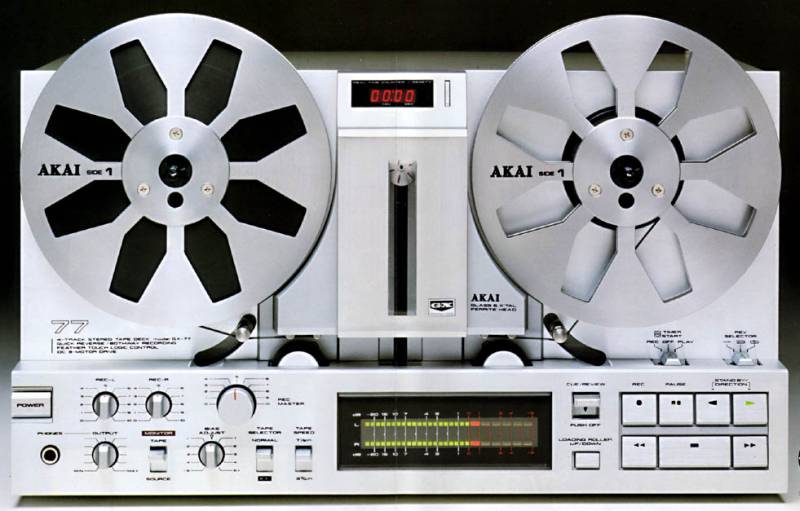
And just recently, I thought: what is this, in fact, for the 77th Akai? It turned out that the mention in the song is not the only advantage of the Akai GX-77 tape recorder. This model, albeit not the most perfect in technical terms (there were more abruptly), is incredibly good in appearance and certainly much better than its Soviet counterparts. Of course, I could not miss the chance to get acquainted with a live copy of this tape recorder, and at the same time remember what was another historical sound medium that successfully existed in parallel with vinyl and compact cassettes. In English it is called “reel-to-reel”, in our opinion - “coils”, “bobbins” or officially “magnetic tape”.
Perhaps in 2010, 15 years after vinyl, and bobbins, and compact cassettes somehow ceased to be relevant, it is worth explaining how the reel tape recorder differed from two other common carriers of the twentieth century. Unlike vinyl, a tape recorder could be used both to record your own musical works, and to rewrite branded records with foreign music. My parents, for example, did not have a single branded record, but on the reels there was all the actual music of the late 70's, neatly rewritten from vinyl. Unlike compact cassettes, the “reel” provided noticeably better recording quality. Affects how aboutlower tape speed - 9.5 or 19 centimeters per second (it was 38 cm / s, but not for home use), versus 4.76 centimeters per second on a compact cassette, and the fact that the tape itself was wider.

Released in 1981, Akai GX-77 had the following specifications:
Playback from reels up to 7 inches in diameter (tape length 525 meters)
Two sets of three heads each: for erasing, recording and playback
3 motors: 1 for rollers, two for rotation coils
Frequency range: 25-33000 Hz at a speed of 19 cm / s, 25-26000 Hz at a speed of 9.5 cm / s
Signal to noise ratio:> 63 dB at 19 cm / s
Line in and out, microphone in, optional wired control panel
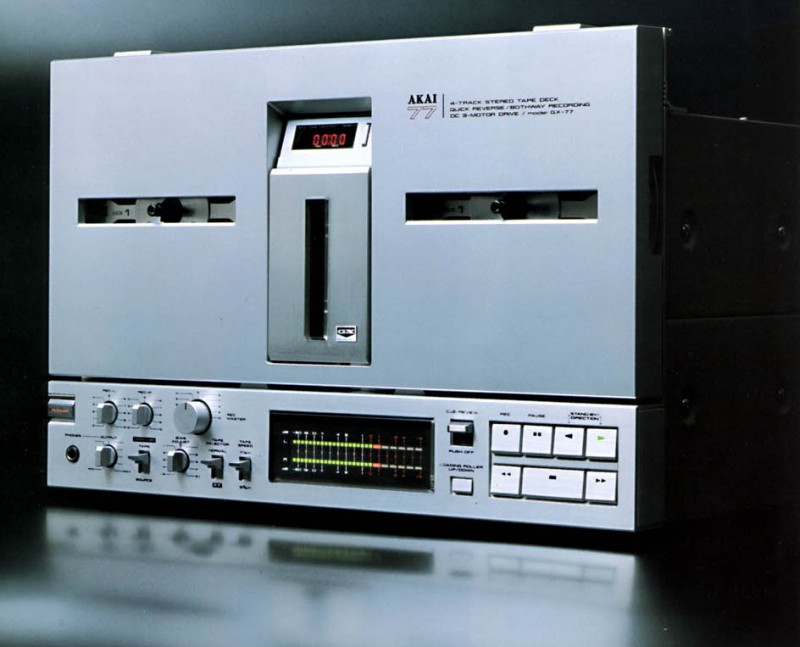
Among the features of the tape recorder, it is worth noting the system of manual and automatic reverse, as well as the unusual arrangement of the heads, at an angle to each other. The tape is brought to the heads using a special roller, and such a system is called the “lambda loading system”. This feature is unique to the GX-77; other models used the classic head layout. The tape recorder weighs 17 kilograms, but in reality it turned out to be quite compact. It depends on what to compare, of course, and I could only compare with domestic models. For example, the Rostov-102 tape recorder, well-known to me, weighs 25 kilograms.

I was interested to know how much such a “gadget” cost in 1981. In the Japanese market, the silver-colored Akai GX-77 cost 128 thousand yen, the black model was more expensive - 132 thousand. At the rate of January 1981 (29 years ago!) It is 632 American dollars with copecks, taking into account inflation - one and a half thousand. Since a resident of the USSR could not just exchange dollars for rubles at the official exchange rate, the cost and, most importantly, the value of such equipment in our country was calculated in a completely different way. Considering that the price even for the aforementioned “Rostov” was 850 rubles, you could buy yourself a “seventy-seventh akai” for no less than a thousand, and at the same time you still had to “get it”. Sometimes “getting” was an even more difficult task, although accumulating such a huge amount when 200 rubles was a good salary was almost impossible.

Despite his venerable age, a copy of the "seventy-seventh", whom I met, looks very cheerful. Coils can be closed with a special cover, which leans up. All kinds of switches and controllers invariably cause me frenzied delight, but here all this is done with considerable taste. In a word - imported goods!

Basic control buttons. The tape recorder almost instantly switches the “sides” of the tape, and can do this automatically. In general, it is extremely easy to manage, if we compare it, again, with not so perfect Soviet tape recorders of those times. There are no levers to switch with pressing, effort and rattle here.
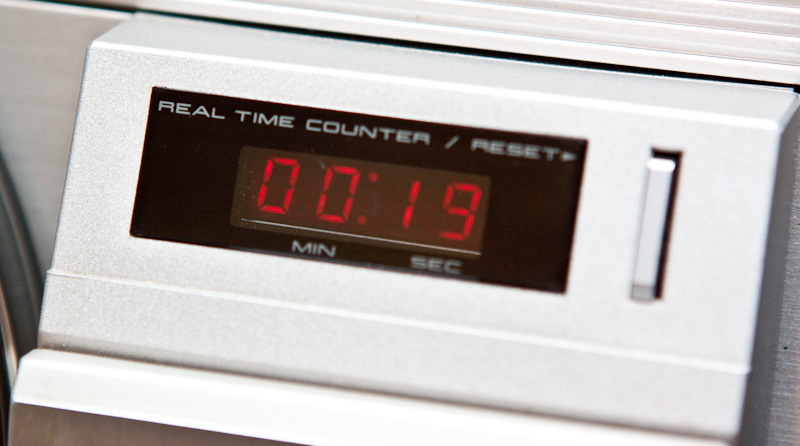
The electronic tape counter does not show “parrots,” but normal playback time. Using the button on the right, you can reset it at any time.

Indicator of the recording level or signal from the line input. Honestly, I like arrow indicators more, but it's a matter of taste.
I recorded a short video demonstrating the main modes of the tape recorder: playback, reverse and rewind. Nothing special, just a reason for nostalgia :) The look of spinning coils is still invariably mesmerizing. In modern audio devices, even in high-quality CD-players, there is no such sensation of the process , as in the case with the "reel". Another video on this link in detail shows the process of bringing the tape to the heads. Both videos are best viewed in HD.
Well, many years have passed since the Akai GX-77 was released, and, unfortunately, the “reels” are outdated more than vinyl. Magnetic tape is a less durable carrier. I still enjoy listening to records that are over 50 years old. But the collection of music on the reels, inherited from the parents, is practically unusable: the Soviet tape instantly crumbles, and after every five minutes of listening you have to clean the heads. Foreign-made magnetic tape is more durable, and the tape recorder can now be used both to listen to old recordings and to record music from vinyl: if you have a collection plate worth a thousand dollars, you hardly want to cut it to holes. The tape recorder is now either a specialized studio device or a working tool for a music lover.
But tape recorders can often be found in films, series and even cartoons (well, in songs, of course, in one absolutely for sure). In modern culture, the “bobbin” most often appears in the frame together with the special services, alluding to the fact that they use well, very serious equipment .

In Francis Ford Coppola's masterpiece Apocalypse Today, the bobbin appears in one of the most famous scenes. It is with him that Richard Wagner's “Flight of the Valkyries” is played. In 1969, during the Vietnam War, compact cassettes already existed, but the reel tape recorder certainly looks more impressive.
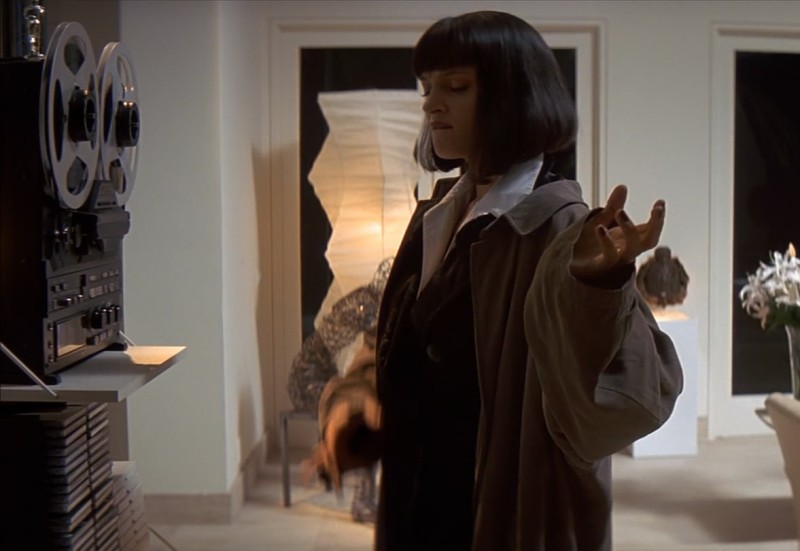
Apparently, for the same reasons, Quentin Tarantino used a tape recorder in Pulp Fiction. If Mia, the wife of Marcellus Wallace, included music from a CD player, it would have looked completely different.
I want to thank Konstantin Diloyan for the opportunity to see the vintage Akai GX-77 in action. By the way, the tape recorder is put up for sale on the Hammer. The Akai GX-77 advertising posters shown here can be viewed in high resolution on this page.