The winner of the transistor race in space
Dedicated to the
60th anniversary of the launch of the first artificial satellite of the Earth, the
70th anniversary of the Special Design Bureau of the Moscow Energy Institute (OKB MEI)
My first article on Geektimes “The first transistor in space: little-known aspects of the space race” was published less than a year agoIn which the question was discussed: on which spacecraft did semiconductor transistors (“crystal triodes”) first used — on American Explorer-1 or on one of the Soviet ones? At that time, it was impossible to give a final answer: it was possible only to “narrow the circle of suspects” to three vehicles - Sputnik-2, Sputnik-3 and Explorer-1. To my great joy, the article received a response, including from the employees of Roscosmos enterprises, and joint efforts led to the successful completion of the initiated investigation, the results of which I want to acquaint readers with.
Last year’s article ended with a link to a source of information about transistors on Sputnik-3 [1] and a quote from an American source [2]:
In the comments on the article they gave a link to the newsreel , which shows a device for measuring the intensity of cosmic rays. Unfortunately, the insides of the device are not visible so well as to see the presence or absence of transistors there.
It was clear that it was necessary to contact Roscosmos: maybe some materials on the first transistors remained in the archives of enterprises? I wrote a letter through the Roscosmos website . An official response followed from the director of the Department of automatic space complexes and systems of Roscosmos State Corporation K.V. Borisov, prepared by the Deputy General Designer of JSC "Russian Space Systems" (RCS, previously - NII-885) VB Steshenko. Vladimir Borisovich, in particular, reported [3]:
In a private conversation, V.B. he added that according to information from colleagues from RSC Energia to them. S.P. Korolev (formerly OKB-1) developed the equipment of Satellites-2 and -3 in OKB MEI, and, according to the memories of veterans, transistors were in the power supply of the transmitter of Satellite-2 .
It remained to apply to OKB MEI. I was slow with the request, because I was not sure, firstly, that someone in this organization would be ready to search for archival materials, secondly, that these archival materials were preserved, and their electronic copies were readable. For example, here is the form in which the electronic copy of the oscillating circuit circuit of the generator in the transmitter of the Avangard satellite (USA) appears to the reader [4]:
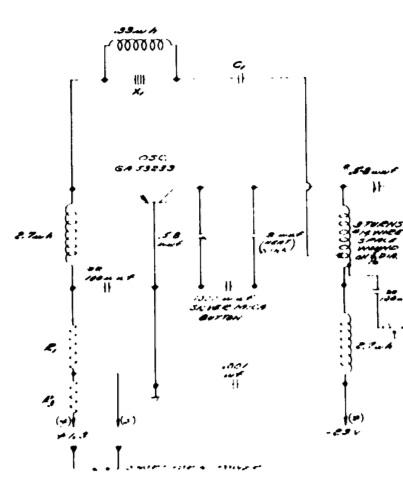
Fig. 1 Electronic copy of the oscillating circuit circuit of the generator in the transmitter of the Avangard satellite (USA) (from Project Vanguard Report no.15, 1957, pag.11)
However, having overcome doubts, I sent an email to the Director of the OKB MEI A.S. Chebotaryov. What was my surprise when, on September 9, on the day of the city of Moscow, I was called by the leading researcher of OKB MEI JSC 1 Belostotskaya Kira Konstantinovna and, firstly, confirmed the presence of transistors on Sputnik-2, secondly, she promised to send the materials!
After some time, Kira Konstantinovna clarified that the germanium triodes of the P4 series were first used in the Tral telemetry system 2 - developed by the Special Section of the Research Department of the Moscow Power Engineering Institute (now OKB MEI JSC) on the second satellite on November 4, 1957 . In confirmation of this information, an excerpt from an article published in the journal “Radio Engineering Notebooks” in 2007 [5] by Peter Zhakovich Criss , who in the late 1950s led a factory-owned instrument and system unit to the ships at the late 1950s and complex tests, etc. and, unfortunately, passed away on June 30, 2017.
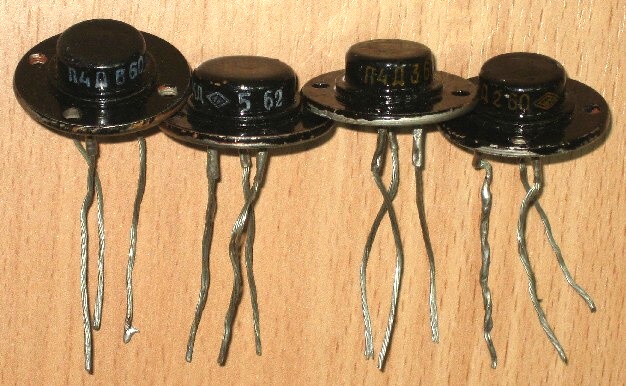
Fig. 2. The first Soviet powerful transistors P4A (E) -P4D (E), P4P, P4U, MP4B (Photo from the Museum of Electronic Rarities )
As there is no electronic version of the Radio Engineering Notebooks on the Web, I will allow myself to quote fully the above article from sent K.K. Belostotskaya:
Thus, it was proved that the winner of the transistor race in space was not the American Explorer-1, but the Soviet Sputnik-2! The first cosmic transistors were powerful germanium P4.
The above excerpt from the article indicates that the development of electronic equipment of the first satellites was no less a feat than the development of engines, launch vehicles and others. The work of domestic electronics, including "transistor builders", ensured the overall success of the Soviet space program.
Should I try to find in the archives of the basic electrical diagrams, drawings, etc.? I think not: as mentioned above, the work was sometimes carried out according to pencil sketches in the setting of a crazy rush.
On the day of the 60th anniversary of the launch of the First Artificial Satellite of the Earth, which opened the space era, let us remember with gratitude the people who stood at the origins of the national space and electronic industries!
1 Honored creator and tester of space technology, a member of the board of veterans of the preparation of the first manned space flight, the honorary radio operator of the USSR.
2 On tracking systems for the flight of the rocket, in particular, about the system "Tral", see the article on Geektimes .
60th anniversary of the launch of the first artificial satellite of the Earth, the
70th anniversary of the Special Design Bureau of the Moscow Energy Institute (OKB MEI)
My first article on Geektimes “The first transistor in space: little-known aspects of the space race” was published less than a year agoIn which the question was discussed: on which spacecraft did semiconductor transistors (“crystal triodes”) first used — on American Explorer-1 or on one of the Soviet ones? At that time, it was impossible to give a final answer: it was possible only to “narrow the circle of suspects” to three vehicles - Sputnik-2, Sputnik-3 and Explorer-1. To my great joy, the article received a response, including from the employees of Roscosmos enterprises, and joint efforts led to the successful completion of the initiated investigation, the results of which I want to acquaint readers with.
Investigation progress
Last year’s article ended with a link to a source of information about transistors on Sputnik-3 [1] and a quote from an American source [2]:
The interview curator provides a link to the 2001 publication [1], which states the following: “Sputnik-2 was a real scientific platform containing various electronic components. In addition to the radio transmitter and the cabin for the Laika, it contained detectors of solar ultraviolet radiation and X-rays, and instruments for the study of cosmic rays were mounted on the body of the rocket. ” And further: “Two identical detectors in the experiment with cosmic rays worked as recorders of scintillations caused by charged particles. The pulses were counted by a semiconductor (based on triodes) circuit ... ". Unfortunately, the article does not contain a link to the source of this information.
In the comments on the article they gave a link to the newsreel , which shows a device for measuring the intensity of cosmic rays. Unfortunately, the insides of the device are not visible so well as to see the presence or absence of transistors there.
It was clear that it was necessary to contact Roscosmos: maybe some materials on the first transistors remained in the archives of enterprises? I wrote a letter through the Roscosmos website . An official response followed from the director of the Department of automatic space complexes and systems of Roscosmos State Corporation K.V. Borisov, prepared by the Deputy General Designer of JSC "Russian Space Systems" (RCS, previously - NII-885) VB Steshenko. Vladimir Borisovich, in particular, reported [3]:
According to the declassified archival materials at our disposal, on the first Soviet artificial satellite of the Earth launched on October 4, 1957, an airborne radio station (D-200 device), developed in JSC RKS (formerly NII-885), was installed, consisting of two radio transmitters at frequencies of 20 and 40 MHz. Transmitters were made on radio tubes. There were no other radio devices of our development on the first satellite.
On the second satellite, with the dog Laika on board, the same radio transmitters were installed as on the first satellite. On the third satellite, other radio transmitters of our development (cipher "Mayak") operating at a frequency of 20 MHz were installed. The “Mayak” radio transmitters, providing a power output of 0.2 W, were performed on P-403 series germanium transistors.
The technical description of the radio transmitters of the D-200 equipment was included in the “Report on the development of the on-board radio station of the first Soviet artificial earth satellite (D-200 device.” Reprint. - M .: ID Media Publisher, 2012.
Recorded charged particle oscillations mentioned in your request RKS JSC was not animating. RKS JSC does not have any other archival materials on the second and third satellites.
In a private conversation, V.B. he added that according to information from colleagues from RSC Energia to them. S.P. Korolev (formerly OKB-1) developed the equipment of Satellites-2 and -3 in OKB MEI, and, according to the memories of veterans, transistors were in the power supply of the transmitter of Satellite-2 .
It remained to apply to OKB MEI. I was slow with the request, because I was not sure, firstly, that someone in this organization would be ready to search for archival materials, secondly, that these archival materials were preserved, and their electronic copies were readable. For example, here is the form in which the electronic copy of the oscillating circuit circuit of the generator in the transmitter of the Avangard satellite (USA) appears to the reader [4]:
Fig. 1 Electronic copy of the oscillating circuit circuit of the generator in the transmitter of the Avangard satellite (USA) (from Project Vanguard Report no.15, 1957, pag.11)
However, having overcome doubts, I sent an email to the Director of the OKB MEI A.S. Chebotaryov. What was my surprise when, on September 9, on the day of the city of Moscow, I was called by the leading researcher of OKB MEI JSC 1 Belostotskaya Kira Konstantinovna and, firstly, confirmed the presence of transistors on Sputnik-2, secondly, she promised to send the materials!
Investigation results
After some time, Kira Konstantinovna clarified that the germanium triodes of the P4 series were first used in the Tral telemetry system 2 - developed by the Special Section of the Research Department of the Moscow Power Engineering Institute (now OKB MEI JSC) on the second satellite on November 4, 1957 . In confirmation of this information, an excerpt from an article published in the journal “Radio Engineering Notebooks” in 2007 [5] by Peter Zhakovich Criss , who in the late 1950s led a factory-owned instrument and system unit to the ships at the late 1950s and complex tests, etc. and, unfortunately, passed away on June 30, 2017.
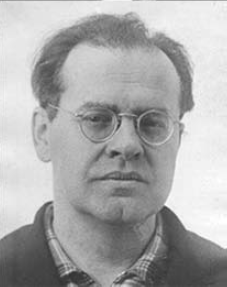 | 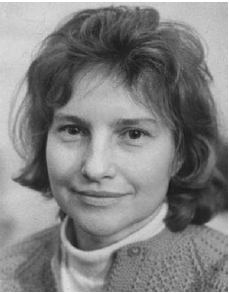 |
| Kriss Peter Zhakovich (1923-2017) | Belostotskaya Kira Konstantinovna |
Fig. 2. The first Soviet powerful transistors P4A (E) -P4D (E), P4P, P4U, MP4B (Photo from the Museum of Electronic Rarities )
As there is no electronic version of the Radio Engineering Notebooks on the Web, I will allow myself to quote fully the above article from sent K.K. Belostotskaya:
... N.S. Khrushchev was so inspired by the huge political and propaganda success of the first satellite that he wished to immediately consolidate and develop this success. He considered that the best way to do this was to launch another satellite on the 40th anniversary of the October Revolution, that is, no later than November 6-7, 1957. In this case, the satellite was supposed to have some new quality. N.S. Khrushchev appealed to M.V. Keldysh and S.P.Korolyov with such a demand. In the environment close to S.P. Korolev, an idea was born - to launch a dog into Cosmos ...
It was proposed to launch into the orbit the central block of the “Sevens”, on which the telemetry system “Tral” would stand, attached to it a container with a dog, one of those that has been used for many years since 1949, when conducting vertical launches of the first post-war missiles P1 and P2. (The works were carried out under the direction of Academician A. Blagonravov).
The container was modified to increase the supply of water and food. The devices for research and monitoring of vital parameters have been refined, taking into account the wider opportunities provided by the Tral system.
In addition to the container with the dog, another container was installed on the central unit with instruments for studying ultraviolet and X-ray radiation and radiation from the composition of those devices that had already been manufactured according to the “Object D” program.
The system “Tral” also needed to be improved. The electromechanical power converter, which was part of it, was not designed for long-term work in space, which required the development of a new converter.
The extremely short period provided for all the work (20 days from the very idea to the launch of the rocket) made it necessary to carry out all the work with absolutely unthinkable methods in rocket technology. No project, no documentation. Manufacturing of parts and assemblies went according to pencil sketches. And only tests were carried out in full, while maintaining all the most stringent requirements.
In particular, over the course of just 8 days of almost uninterrupted dedication, two sets of the onboard Tral system were refined. This urgent work was performed by a group of three heads of laboratories and two leading engineers of the Special Work Unit of the MEI. With the help of plumbing and installation tools, they themselves produced and refined all the necessary structural and electronic components of the equipment without any technical documentation for revision. In this case, for the first time, instead of an electromechanical, an electronic static power supply converter was developed based on the P4 series semiconductor power triodes that were just released in the OKB-382. These germanium triodes, without any documentation, were handed over personally to A.F. Bogomolov by the OKB-382 director.. A special device was also developed that generates a three-phase reference voltage with a frequency of 500 Hz, which is necessary for operation of a Tral system signal generator, from a square wave signal “meander” generated by a static converter.
After successful completion of continuous tests at the OKB-1 in Podlipki (now the town of Korolev), these two sets (main and backup) of the Tral system were taken to the Tyr-Tam test site and one of them was installed on the P7 rocket. On November 3, 1957, the rocket launched a new satellite into orbit, the weight of which (excluding the central rocket unit) was already 508 kg. The delight of the physicians who saw at the end of the first round on the telemetry indicators how the heart of a dog beats was indescribable ...
findings
Thus, it was proved that the winner of the transistor race in space was not the American Explorer-1, but the Soviet Sputnik-2! The first cosmic transistors were powerful germanium P4.
The above excerpt from the article indicates that the development of electronic equipment of the first satellites was no less a feat than the development of engines, launch vehicles and others. The work of domestic electronics, including "transistor builders", ensured the overall success of the Soviet space program.
Should I try to find in the archives of the basic electrical diagrams, drawings, etc.? I think not: as mentioned above, the work was sometimes carried out according to pencil sketches in the setting of a crazy rush.
On the day of the 60th anniversary of the launch of the First Artificial Satellite of the Earth, which opened the space era, let us remember with gratitude the people who stood at the origins of the national space and electronic industries!
Notes
1 Honored creator and tester of space technology, a member of the board of veterans of the preparation of the first manned space flight, the honorary radio operator of the USSR.
2 On tracking systems for the flight of the rocket, in particular, about the system "Tral", see the article on Geektimes .
Literature
[1] space-vanguard.narod.ru/apparaty-sputniki.html, accessed: 28.09.2016.
[2] M. Williamson, «The early development of spacecraft electronics, Engineering Science and Education Journal, vol. 10, no. 2, pp. 68–74, Apr 2001.
[3] Письмо от 15.02.2017 № И-243/07.
[4] www.radiomuseum.org/forum/vanguard_1_transmitter.html
[5] ПЕРВЫЕ ИСКУССТВЕННЫЕ СПУТНИКИ ЗЕМЛИ (К 50-летию запуска ИСЗ-1 и ИСЗ-2) / Крисс П.Ж. //Радиотехнические тетради, — № 35, — 2007. — С. 14 -16.
[2] M. Williamson, «The early development of spacecraft electronics, Engineering Science and Education Journal, vol. 10, no. 2, pp. 68–74, Apr 2001.
[3] Письмо от 15.02.2017 № И-243/07.
[4] www.radiomuseum.org/forum/vanguard_1_transmitter.html
[5] ПЕРВЫЕ ИСКУССТВЕННЫЕ СПУТНИКИ ЗЕМЛИ (К 50-летию запуска ИСЗ-1 и ИСЗ-2) / Крисс П.Ж. //Радиотехнические тетради, — № 35, — 2007. — С. 14 -16.