August 13, 2009 at 12:57
3D scanning in a flatbed scanner
HP programmers have developed an interesting technology for capturing 3D information using a conventional flatbed scanner. The technology does not require any hardware upgrade and works exclusively with software methods.
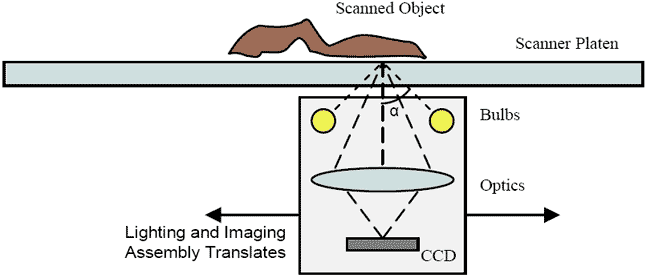
In fact, the system works quite simply. The fact is that in the latest models of flatbed scanners for better scanning, not one but two separate lamps are used (such scanners were first launched by HP in 2007). Although the initial meaning in the two lamps was to expand the color range, they can be used in another way: if the lamps are controlled separately, then for any point in the photo you can always get two separate “scans” made at different angles. This is where the initial 3D information comes from.
For perfect 3D scanning, it is advisable to do a second run by rotating the image at right angles.

The most obvious application for this technology is the elimination of 3D artifacts in paper photographs during scanning (bruises, wrinkles). That is, you put a crumpled photo in the scanner - you get a perfectly smooth, clear document on the screen. Developers from HP have implemented just such functionality, the technology is almost ready. In the near future it will begin to be implemented in drivers for scanners and other software.

For details on 3D scanning technology, see “Photo Repair and 3D Structure from Flatbed Scanners” ( PDF ).
via Crave
In fact, the system works quite simply. The fact is that in the latest models of flatbed scanners for better scanning, not one but two separate lamps are used (such scanners were first launched by HP in 2007). Although the initial meaning in the two lamps was to expand the color range, they can be used in another way: if the lamps are controlled separately, then for any point in the photo you can always get two separate “scans” made at different angles. This is where the initial 3D information comes from.
For perfect 3D scanning, it is advisable to do a second run by rotating the image at right angles.
The most obvious application for this technology is the elimination of 3D artifacts in paper photographs during scanning (bruises, wrinkles). That is, you put a crumpled photo in the scanner - you get a perfectly smooth, clear document on the screen. Developers from HP have implemented just such functionality, the technology is almost ready. In the near future it will begin to be implemented in drivers for scanners and other software.
For details on 3D scanning technology, see “Photo Repair and 3D Structure from Flatbed Scanners” ( PDF ).
via Crave