The method of "fast information transfer", or the origin of the relay
- Transfer
- Relay history
- The history of electronic computers
To study the history of the relay, we must first understand the origin of the electric telegraph. From this invention has grown the history of telecommunications, which has become an inexhaustible source of digital devices and information technology. It appeared only after many attempts, stretching for a century, on the transfer of "information" (what we now call information) using electricity.
But first, one important explanation needs to be made - the people discussed in the description imagined electricity using completely different categories and concepts from ours. Our physics textbooks have packed a motley past into a combed set of concepts and equations, excluding centuries of development and conflict between different schools of thought. For example, Om never wrote the formula V = IR, and Maxwell did not create the Maxwell equations.
I will not try to study all the twists and turns of the intellectual history of electricity, but I will try to present ideas in the form in which they existed at the time, and not in the way we look back, trying to shove them into our modern ideas.
Electric fluid
The phenomenon of electrical attraction has been known since ancient times. In the 6th century BC Thales of Miletus recorded his observations on how the friction of a piece of amber (in Greek “electron” - named after the star Electra of the Pleiades family in the Constellation of Taurus) about cat hair, noting that feathers and other light objects suddenly began to attract amber. But for many centuries this curiosity did not attract much attention.
With the growth of experimental natural philosophyin the seventeenth and eighteenth centuries, scientists began to show much more interest in the oddities of nature. According to the Aristotelian view of the world, which dominated European philosophy throughout the Renaissance Epoch, only obviously observed patterns could lead to an understanding of natural truths. New experimenters have refuted this point of view. Francis Bacon wrote the opposite of his work in the Great Recovery of Sciences of 1620:
I would like the natural philosophy offered by me to be a history of not only a free and unlimited nature (when it is left to itself and works independently), but more a history of nature, experiencing limitations and indignations. When, according to the idea and the action of man, it is ousted from its natural state, it is compressed and transformed. The nature of things betrays itself more readily under the influence of man than when she is in a free state.
English physicist William Gilbertfirst came up with a term that takes into account that “impact” on amber was part of a more general phenomenon. In his treatise of 1600, "On a magnet, magnetic bodies and a large magnet - the Earth," he called this phenomenon "electritsitus", which means "behave like amber." He described many different substances that showed the ability to attract other things after rubbing, including precious stones, glass and sulfur. Still following the ancient model of matter, consisting of four elements, fire, air, water and earth, Hilbert believed that it was the water part of these substances that gave them electrical energy [Gilbert, On the Magnet, trans. by P. Fleury Mottalay (1893), 74-85; JL Heilbron, Electricity in the 17th and 18th Centuries (1979), 169-79.]. But he could not imagine that this energy can someday be used to send messages. The force of gravity worked only at very short distances.

Hilbert conducts an electrical demonstration at the court of Queen Elizabeth (fragment of a painting of the XIX century)
By the beginning of the XVIII century, new ways of generating electricity were invented by others. It was found that by putting a hand on a rotating ball, it was possible to create a powerful electrical force and even transfer it along a thread. After a few years, Stephen Gray discovered that he could make this pass several hundred yards. Other similar electric machines were created.

Sulfur Ball Generator Otto von Guericke , approx. 1660
By that time, scientists began to form an idea of electricity as a fluid that accumulates and then consumes, flowing from one place to another. Unlike Gilbert, they did not consider that it was ordinary water, but they imagined it as a kind of non-material substance. Some believed that several different liquids were responsible for light, magnetism and electricity, and even life. Others believed that there was a single ethereal fluid that manifested itself in different ways.
The best capacity for this liquid was discovered in 1746 with the invention of the so-called. " Leiden Bank", named after the city where it first became famous. This device in its final form consisted of a glass jar wrapped inside and outside with metal foil, and with a metal pin sticking out from above, connected to the inside foil.

If you connect an electric machine to the pin, Bank can store enormous amounts of electric fluid, if poured into a jar. This fluid is discharged through a strong discharge when the output was connected to the outer foil.
by that time, there was a scientific subculture "electricians". apoluchiv electric generator and a Leyden jar, you can easily experiment with electricity, in this case does not have to deal with the intricacies of mathematical problem; and in addition, it was possible to carry out the colorful and vivid demonstration.Ben Franklin , the most famous of those electricians, even suggested that several such devices, united in a chain, be used for killing and subsequent cooking of turkey for dinner. He called this configuration of several cans “battery” (similar to a battery of cannons):
You should kill a turkey for dinner with an electric shock, and then fry it with an electric outlet in front of a fire lit by an electric bottle. For the health of all the same famous electricians in England, Holland, France and Germany need to drink from charged glasses under the volley of guns from an electric battery.
Touching the capabilities of the Leyden jar, the scientists saw that the electric fluid can be transmitted over long distances, and, it seems, instantly. Experimenters proved this by experiment, sending charges through various media, including rivers and lakes. Particularly famous were the French demonstrations of the abbot Jean-Antoine Nollet. He sent the rank through 180 soldiers of the royal guard, and then along a chain of 1.5 km long Cartesian monks. Each of the monks was connected with the next, holding a metal wire . By that time, experiments had already shown that metal wires were the best medium to transmit - that they were "conductors" for electricity.
Searchlights
Using new tools - friction-based electrostatic generators , Leyden jars and conducting wires - the scientists began to make the first attempts to transmit messages using electricity. In 1753, someone with the initials CM, whose identity was never identified, was sent to Scot's Magazine[Scottish news magazine; the oldest of the currently published, the first issue was released in 1739 - approx. transl.] your plan, "Method of fast information transfer". He described a system using one wire for each of the letters of the alphabet. At the end of each wire was a ball of spongy plant material. When transmitting on a charge wire, an electrified ball should have lifted the corresponding piece of paper with the letter shown on it. It is not known who was this S.M. and whether a similar device was built [EA Marland, Early Electrical Communication (1964), 17-19].
But in the ensuing one hundred years others followed in his footsteps. In 1774, the Swiss physicist Georges Louis LesageHe proposed a system with 26 wires, similar to that described by the mysterious S.M. 26 letters were located in it in the manner of the harpsichord [the system stood in his house and transmitted messages between two rooms - approx. trans.]. He thought about presenting this system to Frederick the Great , "so that he himself appreciated its usefulness," but even if he could do it, she was not impressed by the monarch, since nothing more was known about her.
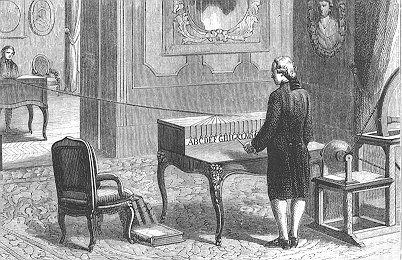
How the Lesage telegraph could look like (from the engraving of the XIX century). Pay attention to the electric car on the right.
Twenty years later, the Spaniard Don Francisco Salvaproposed a system for sending messages directly to the human body. The receiver should hold onto the wire and receive messages directly when the other end of the wire would accept the discharge of a Leyden jar. He did not explain how he could find volunteers who would hold on to the wire all day long in anticipation of an electric shock. Later, he built a more humane system that created sparks between pieces of tin foil, demonstrated to the Spanish court [John Joseph Fahie, A History of Electric Telegraphy, to the Year 1837 (1884), 89-91, 101-108].
There are many more examples of such use of electricity from the XIX century.
Such experimenters with a telegraph appeared on the periphery of electrical science. Franklin, Volt, Faraday and other scientists who have studied the deep nature of electricity have not been interested in the ways of transmitting information. It was the era of the “prospectors”, people with grandiose plans, from the founding of the Scottish colony on the Isthmus of Panama to the realization of the ancient dream of alchemical transmutation. They were ridiculed by Jonathan Swift , who filled the “Academy in Lagado” from “Gulliver's Travels” by people who tried in vain to extract the sun rays from cucumbers and were busy with other nonsense [Jonathan Swift, Gulliver's Travels (1726), pt. 3]. Projectors such as Lesage and Salva faced several obstacles to a practical and efficient system that needed:
1. Reliable source. Electric cars and Leyden jars were too fastidious and potentially dangerous devices, unable to provide a smooth flow of electric fluid (what we would call a steady current). Moreover, in modern terms, they gave too much tension, which was expressed in heavy losses on poorly insulated wire.
2. Effective ways to detect a signal and translate it into a language. The problem consisted of two parts: the construction of a sufficiently sensitive detector and the method of encoding the language in this detector. Most electricians-spotters tried to directly represent the letters of the alphabet on the other end of the wire, either using one wire per letter, or devices such as synchronized wheels or many needles pointing to the right letter.
3. A conceptual platform that directs experiments in the right direction. Om did not develop his famous law until 1827, and outside Germany it became known only in the 1840s. Until that time, it was very difficult to understand why certain combinations of wire, electrical source and detector worked remarkably, while others failed completely.
In the following sections, we learn how these obstacles were overcome in the following decades, and for the most part as a result of side effects in solving completely different problems. But first we need to consider the device with which all attempts to transmit information using electricity — the telegraph — will be compared. For before the appearance of the telegraph familiar to us, there existed such a device:

What to read:
• John Joseph Fahie, A Year of Electric Telegraphy, 1837 (1884)
• Thomas J. Hankins, Science and the Enlightenment (1985)
• JL Heilbron, 17th and 18th Centuries Electricity (1979)
• EA Marland, Early Electrical Communication (1964)