"Kiev-30": how I shot on a "spy" camera
I already wrote that I take pictures of cameras of the last century, using film format 127 (width 46 mm). To get it, you have to cut along the film of format 120 (width 62 mm), and throw out the remaining strip (16 mm). With the current price of photographic materials, this is a nobility and waste. In order not to sob over the garbage chute every time, I bought Kiev-30, a Soviet “spy” camera using a 16 mm film.
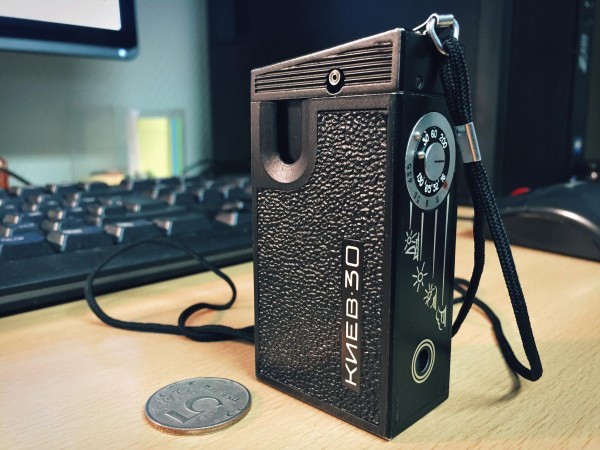
"Kiev" was found in the rain on one of the flea markets, it lay on some kind of bedspread right on the ground and had to be rescued. The price of salvation is 700 rubles, it seems. Apparatus was dried, produt-cleaned and got a chance for a second life.
To begin with about the model itself. It is no secret that many Soviet high-tech products had Western "prototypes". I had, I apologize for the rough pun, the tail and the mane - from borrowing ideas, layout, design and functionality, to complete copying one-to-one. The first model of "spy" camera "Kiev-Vega" was no exception. She was thoroughly licked with the capitalist Minolta-16; they say that even the packaging was copied.


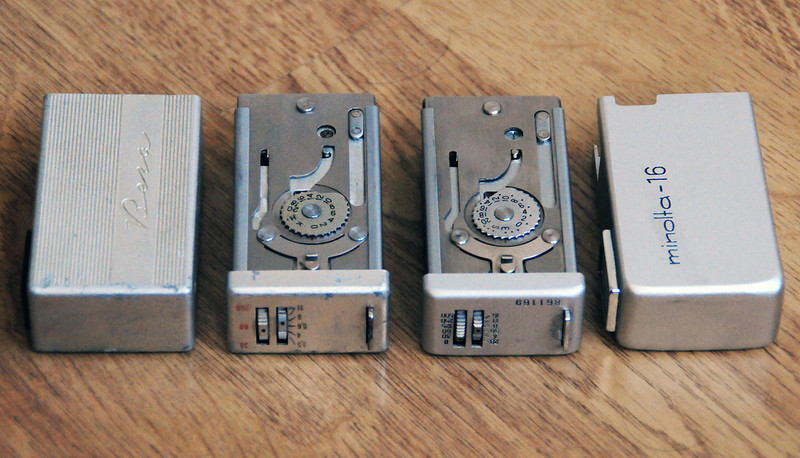

The prototype (and, accordingly, the copy) did not have the focusing capability of the lens, but Minolta had special Close-Up lenses in the kit, which allowed shooting at close distances.

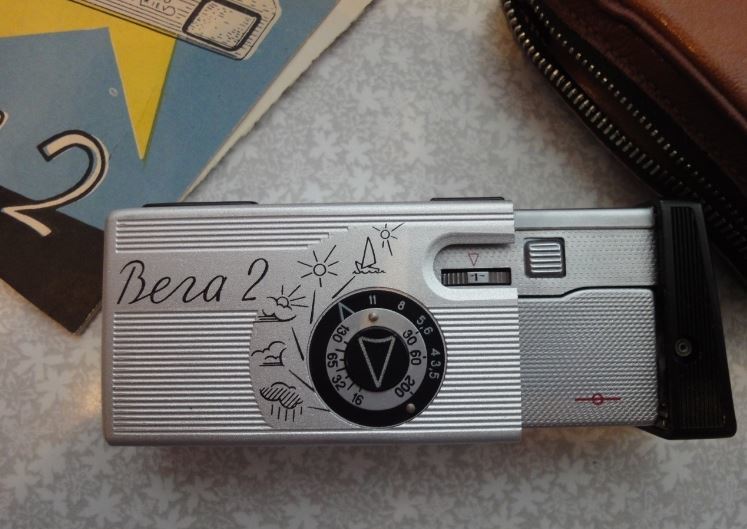
Vega didn’t have such luxury, and, frankly, it’s not very convenient to use such lenses: they are small, you constantly risk losing, and besides, it’s almost impossible to attach them to the camera and not slap your fingers. a lot of time. Therefore, by the next Vega-2 model, Soviet designers screwed up two excellent pieces: the ability to change the focus and the mechanical calculator-hint for exposure to weather symbols.
 "/>
"/>
After some time," Kiev-30 "appeared - for my taste, the best model of the line. Later, there was also" Kiev-30M "and" Kiev-303 ".

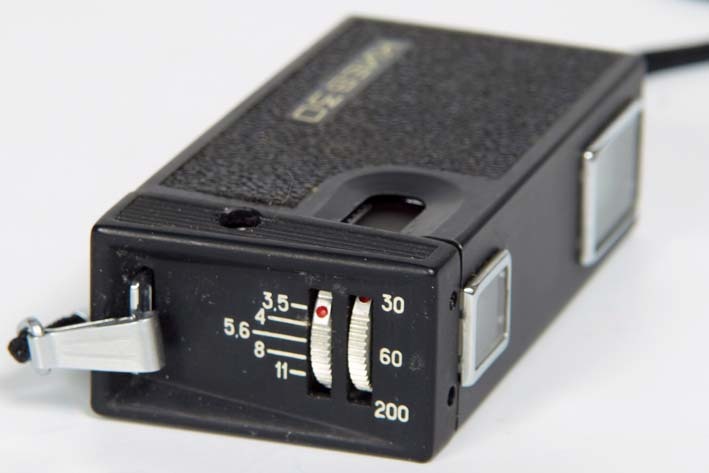
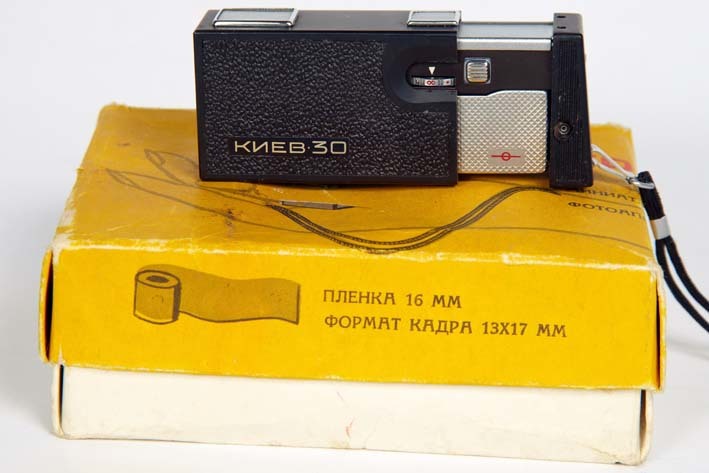
Specifications:
Honestly, the word “spy” for miniature cameras was not officially used, it is popular. The only spy in my memory, who used "Kiev-30" - Urry from the movie "The Adventures of Electronics." However, I may know too few spies.

It is difficult to imagine that in the Soviet Union massively sold spy equipment. And “Kiev” could be bought in any photo shop (if it was, of course, “delivered” there and “thrown out” on the counter). The film could be bought there; a roll packed in black paper and a cardboard box cost 10 kopecks. True, finding a film for sale was even more difficult.
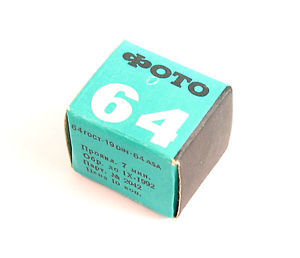
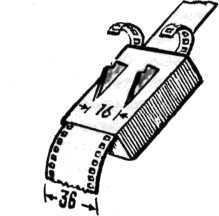
As far as I remember, the film was only black and white, color was not produced. Even less often came across a special cutter, which made 16 mm of 35 mm film. Amateurs made self-made, out of a matchbox and two halves of a razor blade - the instruction for making with a picture was published in the Science and Life magazine under the heading “Little Tricks”.
In my case, this was not required, I had long kept the film trim in the refrigerator. It was only necessary to charge one of them into the cassette and insert it into the camera.
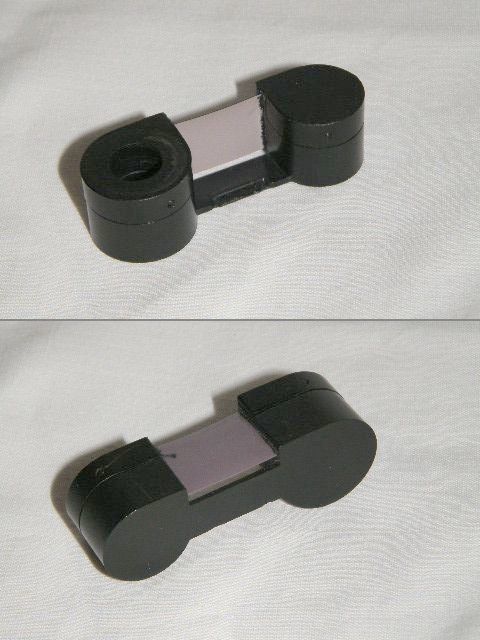
Plastic cassette, folding, consisting of two "cans" connected by a jumper. Its advantage is that it is possible at any time to remove it from the camera, having lit thus only a small site in length of couple of centimeters. True, I just can not imagine the circumstances in which this fantastic functionality someone may need.
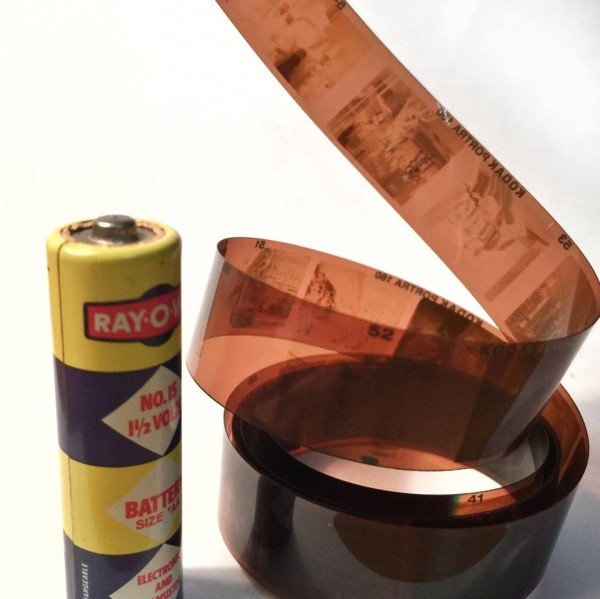
In general, I loaded the cassette with fresh Kodak Portra 160 film and threw the “Kiev” into the pocket of my backpack, with which I went on vacation to Italy. Not a single border guard was interested in him or two other film cameras that I had. With the film during repeated scanning of hand luggage (as it turned out after the return), nothing happened either. I quickly clicked off 27 frames. The standard film was designed for 24, but mine turned out longer. He didn’t count on masterpieces, shot haphazardly and everything. Returning to Moscow, he went to a photo lab - to show. At first, the guys looked at me as if they were insane, because with such a film, no one had come to them since it was founded. However, having thought it over, we decided to try: developing machines, on which they work, don't care how wide the film is - the mechanism simply pulls it through the reagent baths and the dryer. The first good news - I got something! There is something on the tape:
But to scan the film with a width of 16 mm today will not take, perhaps, no laboratory - professional scanners under it are not sharpened. Therefore, I scan myself. I have a simple Epson V550 tablet, which is far from the most sophisticated, but its quality is enough for me. To scan the film in the tablet, it must be cut into pieces and inserted into a special plastic frame. I have no frame, so, rummaging through the Internet, I found this way: to glue the film to the scanner glass with paper tape. Funny, but it works.
Here are the results:
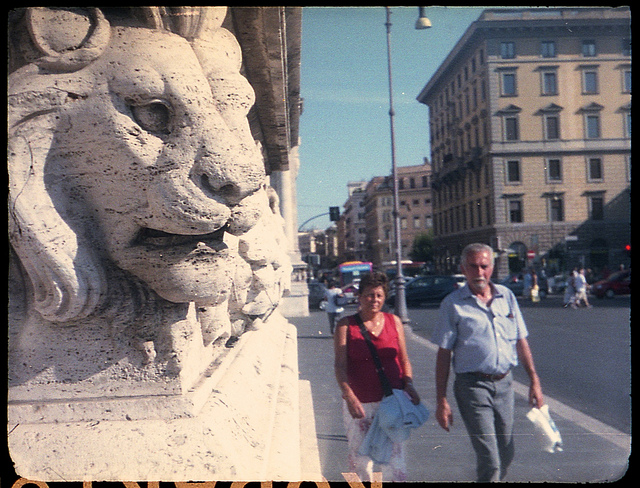
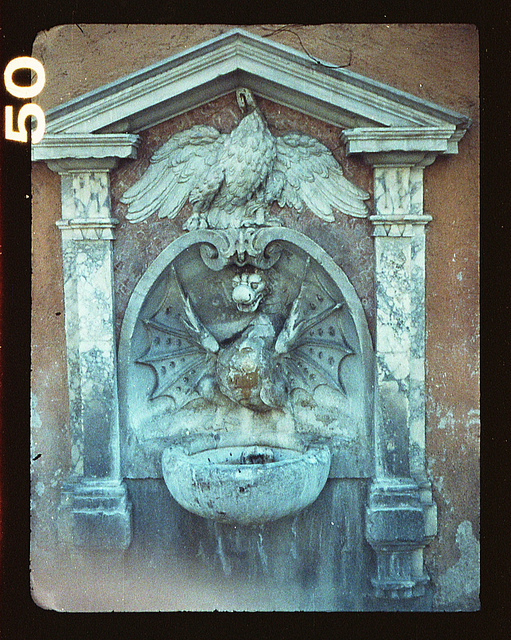
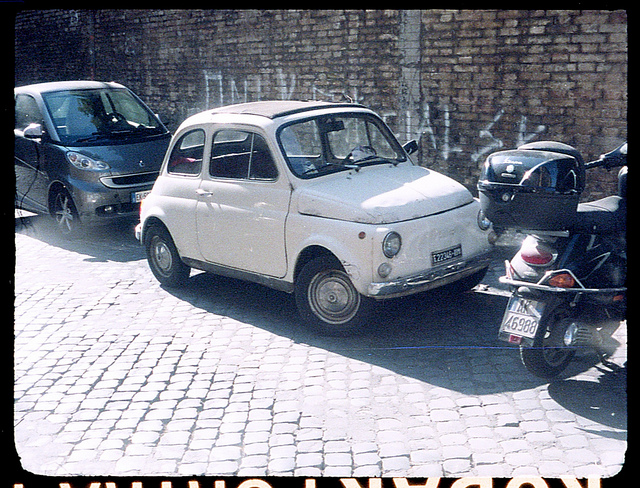

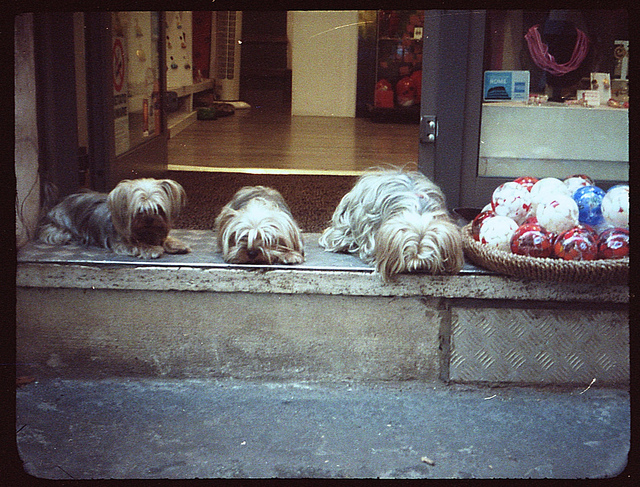
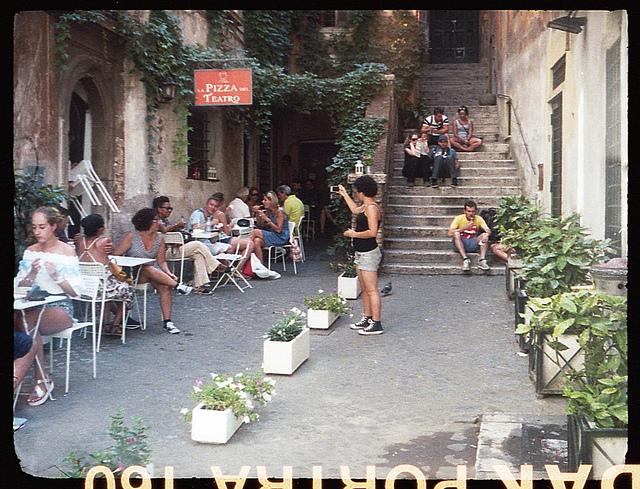

What do we have in the end? The camera is in good condition, the ex-pair works correctly, the modern fine-grained film allows you to get quite decent results even with a frame the size of a nail. However, there are tangible disadvantages: quite serious vignetting, not the sharpest picture. In addition, it turned out that the viewfinder is crooked: it is difficult to build a frame, looking at its frame - the view in it does not really correspond to the real frame. Yes, and sustain the horizon with this size of the camera is quite difficult. It also turned out that the frame is of a strange shape: two corners are sharp, two are rounded. However, this can be attributed to the "chips" of the camera, as well as the letters and numbers of the marking of non-standard film that fall into the frame.
But the story does not end there. Having tried “Kiev”, I decided to purchase a prototype - Minolta 16, judging that the quality of the original is always better than a copy. But, after wandering through online auctions and forums, I found out that there is at least one more way to use 16 mm film trimming - this is the so-called “110 format”:
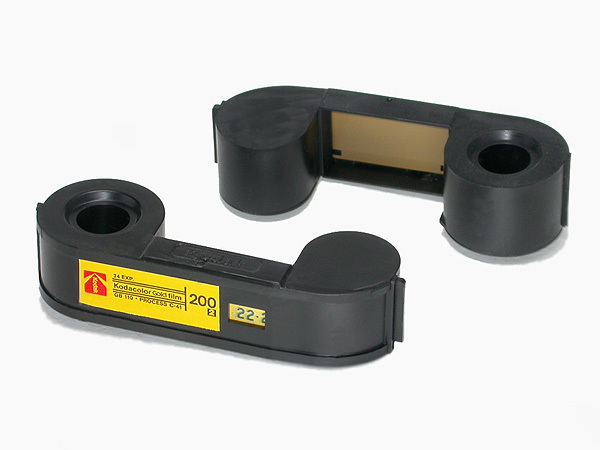
Fuss even more: disposable , non-separable cassettes ; in laboratories, they were simply broken up before, and they took out the film and threw it away. To fill the fresh film, the cassette will have to gently pick open, trying not to break. In addition, the film here was used perforated, one “hole” per frame, and not every 110-format camera can operate without perforation.
But, for example, Rollei A110 - a heavy metal apparatus the size of a curd bar - takes my pruning without problems and removes much better than “Kiev”. What I had the opportunity to verify by buying and testing it.

But this (I suspend intrigue with a banal phrase, sorry) is a completely different story .
In the publication were used: photos of the author, photos of a member of the club “Distancer” svk , photos found on the Internet
"Kiev" was found in the rain on one of the flea markets, it lay on some kind of bedspread right on the ground and had to be rescued. The price of salvation is 700 rubles, it seems. Apparatus was dried, produt-cleaned and got a chance for a second life.
To begin with about the model itself. It is no secret that many Soviet high-tech products had Western "prototypes". I had, I apologize for the rough pun, the tail and the mane - from borrowing ideas, layout, design and functionality, to complete copying one-to-one. The first model of "spy" camera "Kiev-Vega" was no exception. She was thoroughly licked with the capitalist Minolta-16; they say that even the packaging was copied.
The prototype (and, accordingly, the copy) did not have the focusing capability of the lens, but Minolta had special Close-Up lenses in the kit, which allowed shooting at close distances.
Vega didn’t have such luxury, and, frankly, it’s not very convenient to use such lenses: they are small, you constantly risk losing, and besides, it’s almost impossible to attach them to the camera and not slap your fingers. a lot of time. Therefore, by the next Vega-2 model, Soviet designers screwed up two excellent pieces: the ability to change the focus and the mechanical calculator-hint for exposure to weather symbols.
"/> After some time," Kiev-30 "appeared - for my taste, the best model of the line. Later, there was also" Kiev-30M "and" Kiev-303 ".
Specifications:
Industar-M lens, enlightened, 3.5 / 23
Focusing from 0.5 m to infinity
Two-petal aperture, with a square aperture
Shutter speed - 1/30, 1/60 and 1/200
Shutter curtain, metal, located in front of the lens
Film 16 mm, non-perforated, frame size 13x17 mm.
Sync for flash
Sizes - 28 × 46 × 86 mm
Weight - 190 g
Honestly, the word “spy” for miniature cameras was not officially used, it is popular. The only spy in my memory, who used "Kiev-30" - Urry from the movie "The Adventures of Electronics." However, I may know too few spies.
It is difficult to imagine that in the Soviet Union massively sold spy equipment. And “Kiev” could be bought in any photo shop (if it was, of course, “delivered” there and “thrown out” on the counter). The film could be bought there; a roll packed in black paper and a cardboard box cost 10 kopecks. True, finding a film for sale was even more difficult.
As far as I remember, the film was only black and white, color was not produced. Even less often came across a special cutter, which made 16 mm of 35 mm film. Amateurs made self-made, out of a matchbox and two halves of a razor blade - the instruction for making with a picture was published in the Science and Life magazine under the heading “Little Tricks”.
In my case, this was not required, I had long kept the film trim in the refrigerator. It was only necessary to charge one of them into the cassette and insert it into the camera.
Plastic cassette, folding, consisting of two "cans" connected by a jumper. Its advantage is that it is possible at any time to remove it from the camera, having lit thus only a small site in length of couple of centimeters. True, I just can not imagine the circumstances in which this fantastic functionality someone may need.
In general, I loaded the cassette with fresh Kodak Portra 160 film and threw the “Kiev” into the pocket of my backpack, with which I went on vacation to Italy. Not a single border guard was interested in him or two other film cameras that I had. With the film during repeated scanning of hand luggage (as it turned out after the return), nothing happened either. I quickly clicked off 27 frames. The standard film was designed for 24, but mine turned out longer. He didn’t count on masterpieces, shot haphazardly and everything. Returning to Moscow, he went to a photo lab - to show. At first, the guys looked at me as if they were insane, because with such a film, no one had come to them since it was founded. However, having thought it over, we decided to try: developing machines, on which they work, don't care how wide the film is - the mechanism simply pulls it through the reagent baths and the dryer. The first good news - I got something! There is something on the tape:
But to scan the film with a width of 16 mm today will not take, perhaps, no laboratory - professional scanners under it are not sharpened. Therefore, I scan myself. I have a simple Epson V550 tablet, which is far from the most sophisticated, but its quality is enough for me. To scan the film in the tablet, it must be cut into pieces and inserted into a special plastic frame. I have no frame, so, rummaging through the Internet, I found this way: to glue the film to the scanner glass with paper tape. Funny, but it works.
Here are the results:
What do we have in the end? The camera is in good condition, the ex-pair works correctly, the modern fine-grained film allows you to get quite decent results even with a frame the size of a nail. However, there are tangible disadvantages: quite serious vignetting, not the sharpest picture. In addition, it turned out that the viewfinder is crooked: it is difficult to build a frame, looking at its frame - the view in it does not really correspond to the real frame. Yes, and sustain the horizon with this size of the camera is quite difficult. It also turned out that the frame is of a strange shape: two corners are sharp, two are rounded. However, this can be attributed to the "chips" of the camera, as well as the letters and numbers of the marking of non-standard film that fall into the frame.
But the story does not end there. Having tried “Kiev”, I decided to purchase a prototype - Minolta 16, judging that the quality of the original is always better than a copy. But, after wandering through online auctions and forums, I found out that there is at least one more way to use 16 mm film trimming - this is the so-called “110 format”:
Fuss even more: disposable , non-separable cassettes ; in laboratories, they were simply broken up before, and they took out the film and threw it away. To fill the fresh film, the cassette will have to gently pick open, trying not to break. In addition, the film here was used perforated, one “hole” per frame, and not every 110-format camera can operate without perforation.
But, for example, Rollei A110 - a heavy metal apparatus the size of a curd bar - takes my pruning without problems and removes much better than “Kiev”. What I had the opportunity to verify by buying and testing it.
But this (I suspend intrigue with a banal phrase, sorry) is a completely different story .
In the publication were used: photos of the author, photos of a member of the club “Distancer” svk , photos found on the Internet