October 4, 1957 - the first artificial radio signal from space
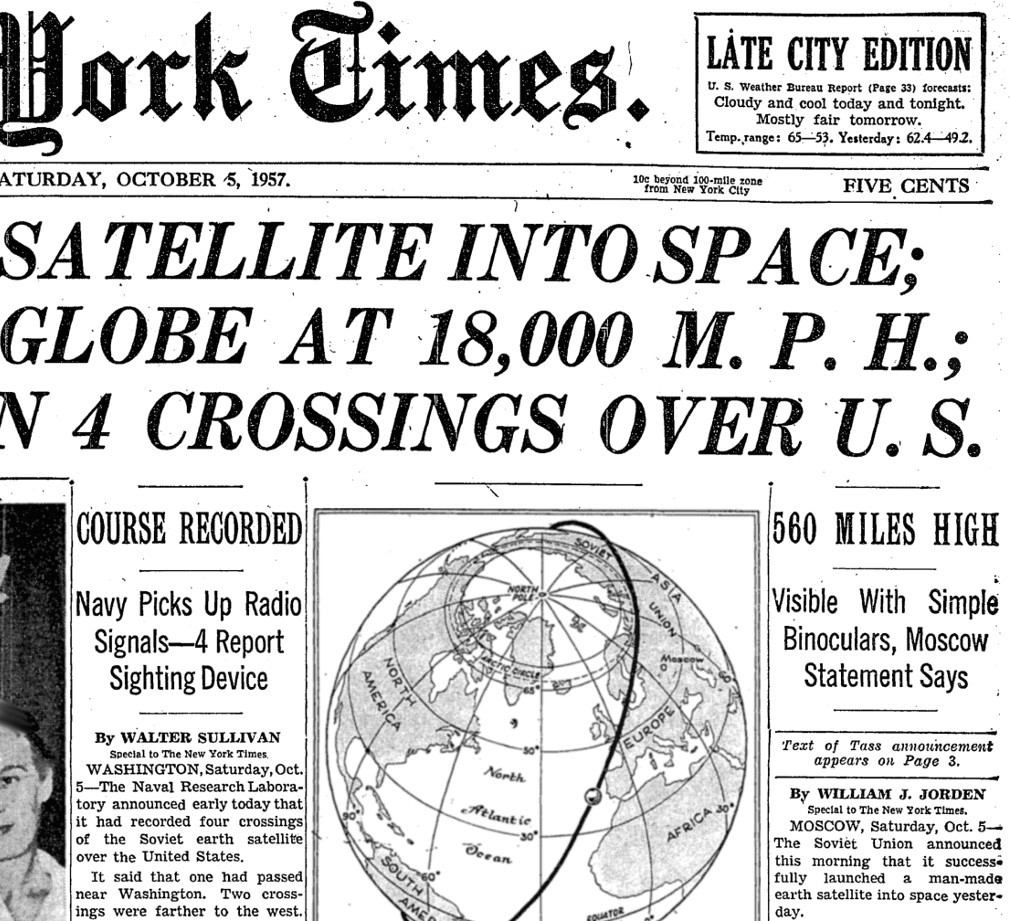
Yes, on October 4, 1957, together with the launch of the first artificial satellite, it was the first artificial radio signal from space. It was the ability to monitor the signal from space - allowed to attract the attention of radio amateurs around the world to launch a satellite.
Some details about the transmitter and the creators.
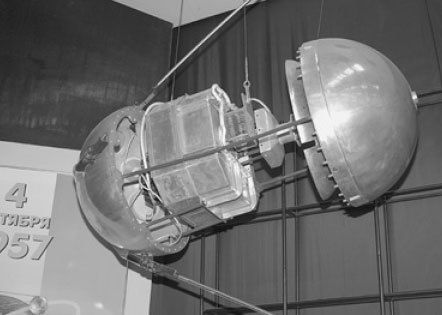 Recall that a satellite (artificial Earth satellite) was launched into orbit, which consisted of:
- two transmitters
- antennas
- batteries autonomous power
The radio equipment of the first AES was developed at the enterprise, which today bears the name of Russian Space Systems (formerly NII-885), one of the founders of the national rocket and space industry, created in 1946.
It was necessary to choose the optimal frequency for the signal, and Based on the data on the Earth’s ionosphere, at that time, two frequencies were chosen - 20 and 40 MHz. Accordingly, there was one antenna for each transmitter (two beams).
And the battery weighing about 50 kg, which ensured the continuous operation of the equipment for 14 days.
Calculations showed that with a transmitter power of 1 W, the signal can be reliably received on earth by a receiver with a sensitivity of 5 µV.
Transmitter layout:

Photo transmitters:

Transmitter and receiver development team: M.I. Borisenko, K.I. Gringauz, V.I. Lappo, A.I. Zinkovsky.
A.I. Zinkovsky collaborated with Radio magazine and was known as a competent radio engineer and accurate author. Before the war he was fascinated by short waves and had the call sign U3DH. He was one of the main performers on the creation of the onboard radio equipment of the first satellite - responsible for its debugging, design tests and delivery to the customer.
The lead developer of the radio station and ground device for receiving signals from the first AES was the head of the laboratory, Vyacheslav Ivanovich Lappo.
The head of another laboratory, Konstantin I. Gringauz, was engaged in theoretical and practical studies of the propagation of radio waves in the range in which the transmitter worked.
And the project manager was Mikhail Ivanovich Borisenko.
 If anyone is interested, later in 1960 the book of A.I. Zinkovsky “Radio Engineering and Space Flight” was published, in which many points were covered, which the team had to decide when creating radio-space communications [4]
 Including:
- choice of the wavelength of the space radio link
- antenna selection
- transmitting and receiving devices
- onboard equipment power supply
- space radio organization
- radar and radio navigation equipment
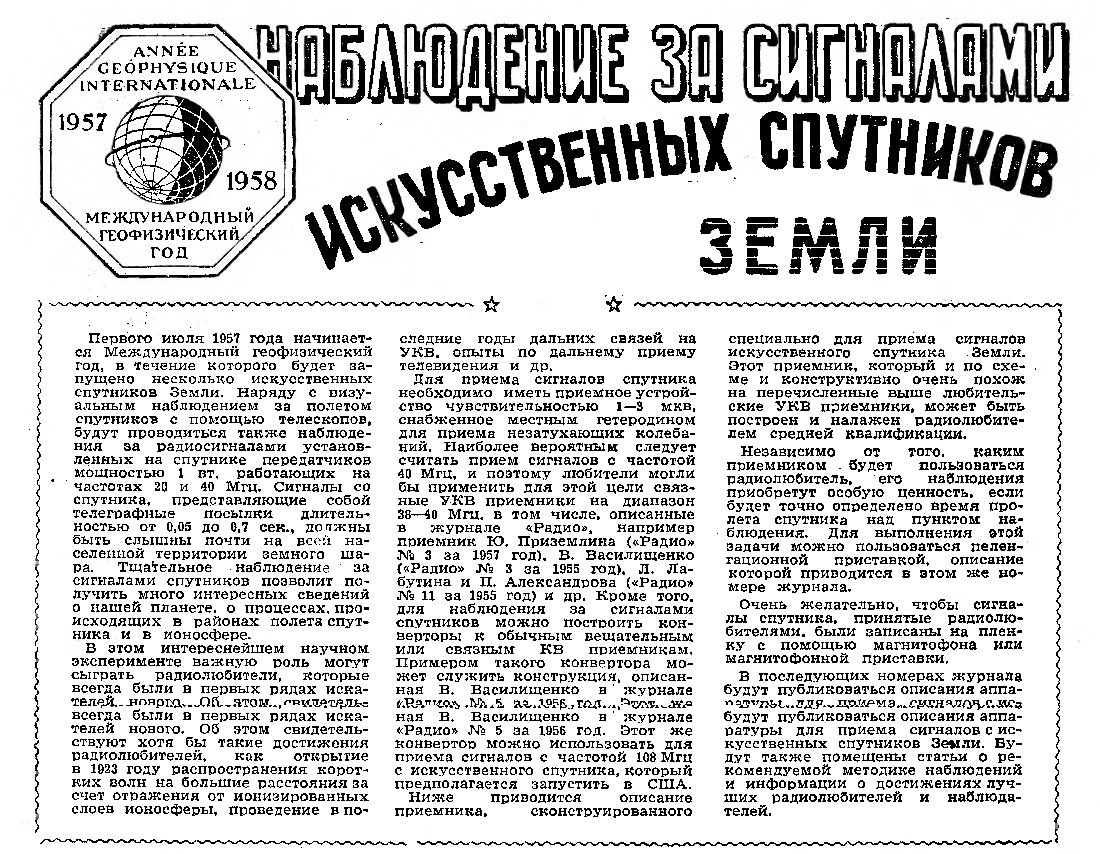
We also recall [5] that in the magazine Radio in 1957, thanks to the efforts of Rudolf Anatolyevich Svoreny, information appeared about the possible observation of an artificial satellite signal by radio amateurs.
Sources:
1. timesmachine.nytimes.com, October 5, 1957
2. Transmitter of the first AES
3. Russia, satellite. Proper name: first, second, third
4. A.I. Zinkovsky Radio engineering and space flights, 1960
5. Rudolf Svoreny - a man of legend (the author of the classic is “Electronics step by step”)