Roads to Mars go through the moon ...
... and not through asteroid operations
NASA's plans for manned space exploration were again discussed at the level of the US House of Representatives. The fact that the US parliament does not like a blurry time frame, fuzzy goals, high costs and poorly described prospects for NASA’s Martian plan is no longer news. This has already been written here .
But on June 10, 2016 , sensational information passed under the slogan in the American and Russian mass media under the slogan: “The United States was about to return to the moon .” Such information is very unexpected for those who do not closely monitor the evolution of NASA's plans for a manned flight to Mars. The funny thing is that this “
Now some believe that we should first try to return to the surface of the moon, as was previously planned. But now I have to say quite bluntly: We were already there ...
Since then, periodically, echoes of hot discussions on the topics “What to colonize first: the Moon or Mars?” (Examples: 1 , 2 , 3 , 4 ) and “Immediately to Mars or through the Moon (or through the lunar orbit)” (examples : 1 , 2 , 3 , 4 , 5 ). Indeed, the path of a manned expedition to Mars can be carried out in different ways - best of all, these options are presented in the diagram below:

For those who closely followed the space news and these discussions, the news of the return to the moon did not become a bolt from the blue - rather, the expected inevitability: common sense worked in the face of an incredibly heavy and dangerous manned mission to Mars. The fact that on the Moon it is possible to get fuel and an oxidizing agent for a flight to Mars was also said by William H. Gerstenmaier himself , who has been the chief of NASA's manned research since 2005.
There are many invented flight options, but it’s difficult to choose, since half of the technical solutions for such a mission have not yet been worked out. There is a ship "Orion" , but so far flying without people and very close. There is a project of superheavy SLS boosterand the main details for him, but will he fly, as planned, in 2018? There is an idea about an automatic tug on ion engines (the so-called Solar Electric Propulsion concept ) for delivering fuel and supplies to Mars in advance. But about landing / take-off steps for Mars, little is yet explained, there are only disappointing calculations: in order to fly from Mars it is necessary to land at least a 90-ton vehicle (or 2-4 vehicles with a total weight of 120-130 tons less for refueling or on-site fuel generation - page 27 from an official report for NASA in April 2015). Where can all this be worked out in practice, before a dangerously long flight to Mars, which does not give any right to make a mistake?
Maybe in missions to asteroids or with transporting an asteroid into orbit near the moon?
Asteroid project
Unfortunately, the original idea of flying and landing on an asteroid with a small crew quickly left NASA's plans.
Instead of this simple idea, NASA has focused on a project called on ARM ( Asteroid Redirect Mission - Mission Asteroid Redirection ), which was from the beginning linked to the Martian program .
Initially, the ARM project was estimated optimistically at just $ 2.5 billion , and now, closer to the point, NASA decided to request a tug boat and other equipment to the initial stage of designtotal 66.7 million dollars. But on June 10, the House of Representatives nullified the amount allocated by NASA for these purposes, and demanded to revise the whole project, in fact ordering to replace the ARM project with landing programs on the Moon: “ develop plans for returning to the Moon to test the capabilities that will be needed on Mars, including habitable modules, geological exploration, landing and take-off means “- p. 61 of the official document .
At first, in this ARM project, the following was proposed: to approach, capture (with some inflatable structures or a bag) and redirect (drag) using an automatic tug (with ion engines) to a lunar orbit a whole small asteroid with a diameter of about 10 meters, weighing up to 500 tons .
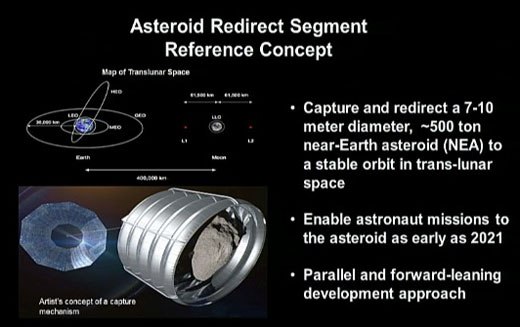
Here is a commercial for the first option, in which the issue of asteroid capture is poorly disclosed (or even not disclosed at all):
Then the developers of the project somewhat reduced their ambitions. They offer a much more modest goal: a tugboat needs to be selected, grabbed with mechanical hands and a cobblestone of a suitable size (2-3 meters in diameter) raised from the asteroid. It is easier to grab and drag it faster. The final part of the project has not changed: the cobblestones in the arms of an automatic tugboat near the moon will be studied by astronauts, having flown there on the Orion ship for only a couple of weeks. Commercial video of the second option (where frames from the first video were used):
Everything is smooth and funny in it, but it can take many years to fly a tugboat to an asteroid (the document on the first draft of the project on page 3 shows the round-trip flight time for the example with the mini-asteroid 2009 BD : 671 + 1092 days = about 5 years) and at critical moments in this part of this project, a lot can go wrong.
What will be the full cost of the entire ARM project, will it fit in with 2.5 billion dollars?
To compare the scale of costs: the private Russian company Lin Industrial offers a project to build a base on the moon with an estimated price of $ 12 billion (this was also written about here) - approximately the cost of the budget of the Russian Federation for the 2014 Olympics in Sochi plus the Adler-Krasnaya Polyana railway line with 4 stations built for it. And about the same cost was recently completed in Switzerland, the longest Gotthard base tunnel in the world , about 57 km long.
Doubts about the ARM project have been growing for a long time, in 2016 they wrote articles on the topic forget about the ARM project , about the necessary turn to the Moon , even without NASA , even with sad names NASA's mission to the asteroid has not died yet - yet (with explanations why the towing robot will not fly to an asteroid before 2023), but it was finished off by a stinging criticism from the most eminent specialist in asteroids in the USA.
Richard Binzel ( Richard Binzel) wrote and published his first scientific article on asteroids at age 15! In 2014, he bluntly called the ARM project the words : “a one-time circus trick that distracts us from the target ” - because instead of a long manned flight to a distant asteroid (which is a training for a long flight to Mars), the ARM project relies on a long flight of an automatic tugboat behind an asteroid, and a manned flight turns out to be short and not really training anything. In his ironic report with intentionally frivolous picturesRichard accused the authors of the project of creating beautiful slides and animations (with a three-fingered crane, like in a well-known gaming machine where you need to get toys from a glass cube), building sand castles, instead of working out working technical solutions and real movement, even towards such a strange goal:

About Richard Binzel also hinted at the project’s goals that, in fact, small asteroids of the right size regularly fly in the near-Earth space, between the Earth and the Moon, once a week, and one of them (even larger) in 2013 flew almost to the city of Chelyabinsk - is it worth it to study for such a huge amount of money that itself falls on our heads?
After the presentation of such a specialist , repeated in scientific and popular magazines, the project fell in andother critics . What do they offer in return? Richard Binzel instead of ARM suggested just flying to a large asteroid on the Orion (a long flight will be a training flight to Mars).
Operations of an automatic tugboat and a manned Orion near and on the surface of a normal asteroid can really help in future landings on the satellites of Mars (Phobos and Deimos). Especially if such landings are needed and clearly planned before or during a manned mission to Mars (which Richard Binzel himself strongly advises adding to the flight plan to Mars). But from the point of view of mining the landing on Mars itself, the activity around the asteroid (and especially around the delivery of cobblestones from it) is simply useless - this is a technological dead end. There is too much difference between the surface of Mars and the surface of the asteroid, a huge difference between landing and take-off from Mars and similar operations with the asteroid.
Back to the moon?
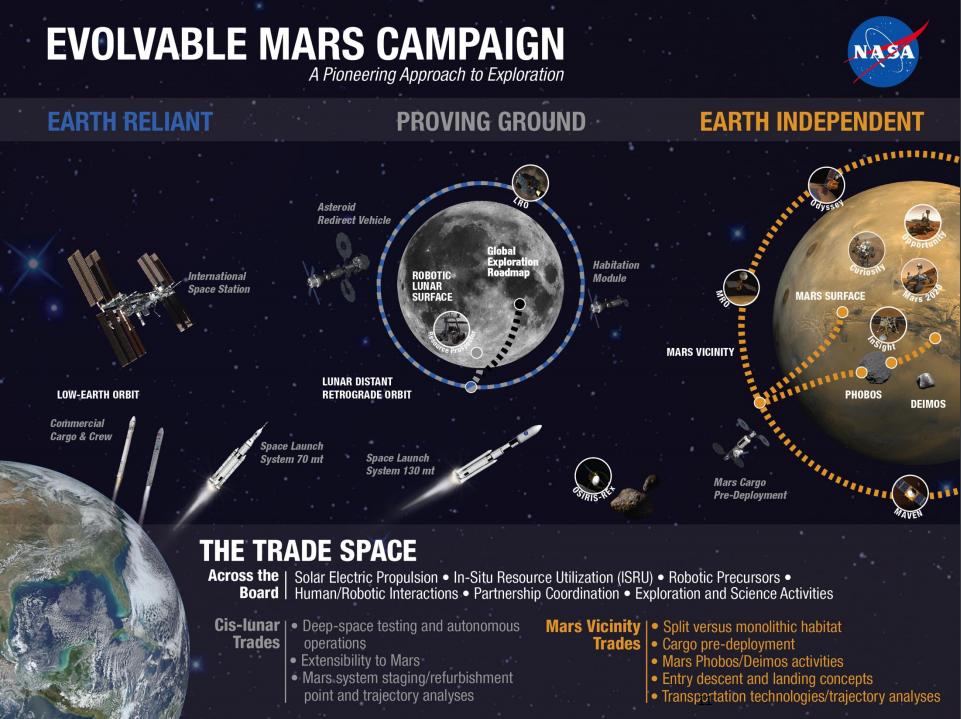
Then the Moon pops up again, as the only logical training ground for Mars, a dangerous, severe training ground, but known from the Apollo missions and only 3-4 days from Earth. So far, NASA has modestly offered only to park automatic tugs with stocks and parts of a manned complex in the distant retrograde orbit of the moon (DRO - Distant Retrograde Orbit or LDRO) before flying to Mars. This orbit around the moon is mentioned in NASA's flight programs to Mars since 2014. Allegedly, it is very convenient for grouping and staging / refurbishment of blocks in anticipation of a throw to Mars, as indicated in two sketches of NASA's Martian program 2015: 1 and 2 .
They were afraid of stuttering about the base on the Moon before in NASA, mindful of Obama’s order “We have already been there! " In April 2015, in an official NASA report, on a diagram with a retrograde orbit around the moon, mysterious letters “ROBOTIC LUNAR SURFACE” (Robotic Lunar Surface) were written on the moon itself - probably only dedicated to the course of what it is, and they painted something, timidly called “Resource Prospector” (Lunar Exploration):
Yes, because on the Moon you can also get something to supply the mission to Mars: a minimum of water and oxygen from the ground, i.e. air and fuel + oxidizer. And then already throw it from the Moon’s soil into a retrograde orbit around the Moon to start to Mars. But alas, for this you need to invest a lot long before the flight to Mars, since you can’t do without building any base on the moon. Again the cardinal question arises: what is needed earlier - a base on the moon or a flight to Mars?
Another argument for the construction of the lunar base involuntarily arises - an argument that people are ashamed to voice openly: this is a possible NASA budget cut in the middle of the program. Here again comes the new president / new parliamentary majority / new crisis and NASA's budget is shrinking. What will happen to the manned program then?
1) If this is an expensive manned flight to Mars without a lunar component, then most likely it will be cut down entirely or at the first stage: there will only be a flyby of Mars and a couple of people can land on one of the satellites of Mars. And that's it: the tried and tested technical solutions (from the Orion ship to the super heavy SLS carrier) will go to museums, as it was after the Apollo program. There will be only records, a bunch of beautiful shots, some scientific data and a flag stuck next to Mars.
2) And if this is also an expensive and longer manned flight to Mars with preliminary development of landing / take-off and building a base on the Moon, extracting fuel and other resources there, then most likely they will also cut off the most expensive and not yet completed: flight to Mars, but at least NASA (and all of humanity) will have a working base on the Moon (which can be mothballed for 10 years - this is not the ISS in orbit, it does not need to be supplied, it will not fall anywhere), new technologies for landing / take-off and processing of resources have been developed The moon is in place. And it will be incredibly stupid to lose these achievements as thoughtlessly as it was in the 70s, after the Apollo lunar program , as it was with the flightSoviet lunar rocket H1 and really unproven pilots "Buran" along with the rocket "Energy" .
What about us?
What does this all threaten with Roscosmos, which is also constantly rushing about in doubts about the future goals of the manned program. The range of these throwings is wide: to the moon or to Mars? With serious discussion, Mars can be rejected as purely ideological statements (for example, these: 1 2 ) sometimes reaching a very frivolous level: Russian macaques as pioneers of a flight to Mars (which causes protests among people who take this stupid PR seriously ).
If Roscosmos gathered on the moon, then on what: on the old “Soyuz” or on the mythical “Clippers” or on something new, unknown and expensive , such as the ship “Federation” ? What missiles and how many launches do you need (in some plans, up to 4 launches of the A5 Angara are required for one flight to the moon )? Just fly around the moon or just a pre-exploration landing? Is it pure for science or for the sake of building a base ? To build just a small base in the most valuable place of the Moon or somewhere else for the sake of the extraction of Helium-3 for the future thermonuclear energy (which no one has yet been able to create)?
Do I extend the program on the ISS or not? Can pick up Russian modules ( specially modified ) from the ISS and drag them into a new separate Russian station ? Or build your orbital station from scratch? Or not quite mine, but joint with China and India ? Orto build a new ISS after 2024 together with the USA ?
New American plans (if they finally become clear) will lead to a narrowing of the choice for Roscosmos: after all, if the Americans are going to build a base on the Moon, then most likely they will occupy the most valuable place in terms of resources (light and water deposits in the soil) - the crater mountain / rampart Malapert at the south pole of the moon. This is no longer a race for prestige and for a record as in the 60s. Who builds the first base on the moon is not so important, it is important that forever there the best place will take! Immediately there will arise (and arise already!) Questions about the registration of ownership of this developed territory and the resources extracted on it. This question has already been raised in Russia at the level of Roscosmos and the Russian Academy of Sciences .
A repeat of the story with the Soyuz and the new ISS for the moon?
The one who is the first to build an existing base will have great experience precisely in the development of cosmic bodies. If Americans on the Moon learn how to build, mine, process resources and develop without risk and failure, then they will not have much reason to share this ability with someone else.
But if you don’t get involved in the new lunar race to build the first extraterrestrial base on the ground, Roscosmos has its own unexpected, but in some way already worked out option to become its own due to part-time driver / builder for NASA or an international project. While NASA is tormented, choosing the path to Mars, gluing together existing and promising technologies every time in a new way when changing plans, trying to save money, but destroying what has already been achieved, hoping to immediately get the optimal complex for delivering manned and cargo ships to the moon and to Mars (and maybe even an asteroid) with the removal of people back, Roscosmos can take the same old reliable "Union". Thinking, taking into account the experience of the USSR ( series "Union 7K-L1") to complete the Soyuz to the lunar version with the modified Frigate booster block, to offer NASA as a trouble-free transport / lifeboat using the Angara A5 rocket (for which there is no application for now) with the KVTK booster block , proposed by Lin Industrial . Something similar has already been done in the old Soviet unmanned program “Probe” (with the help of the “Proton” rocket) and was even offered abroad under the name Lunar Express back in 2004:
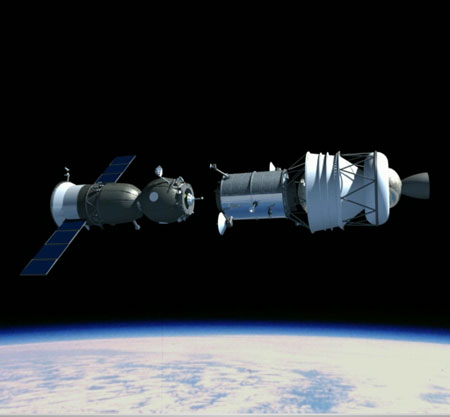
Only a place in such a new lunar "Union" will cost NASA not $ 70 million, but much more. It is better to be on the moon at least in the role of a cabman than not to be at all and not to participate in anything. Roskosmos already has experience of such a side job as a cab to the ISS, and for NASA the old partner will have more confidence.
Rumors and separate statements (with refutations) about the mutual contacts of NASA and Roscosmos on the topic of the Moon and the station in orbit of the Moon have been going on since the beginning of 2015 ( refer to the words of Charles Bolden ).
Finally, at the end of June, reports appeared in our press about the agreements of the ISS new international working group (IECST) on the lunar orbital station. Allegedly, the question of the further development of orbital stations outside the orbit of the Earth has been going on since 2011 as part of the expert working group for the ISS program (IEWG - ISS Experts Working Group). It is clear that Russia (since the USSR) has a lot of experience in orbital stations, while other countries have a desire to use it, reducing their costs and time.
In addition, in Russia there is at least a little worked out since 2010 the project of a tugboat on a nuclear engine , which is also a huge plus for saving fuel.
In general, we can say that both NASA and Roscosmos have the same problem: the abundance of fuzzy plans with a general indecision in choosing a goal.