Craig Wright continues to try to impersonate the creator of Bitcoin
Australian entrepreneur Craig Wright announced that Satosi Nakamoto’s mask belongs to him. Craig claims that it was he who created the Bitcoin crypto-anarchist payment system. To confirm this, Dr. Wright signed the messages with a digital key that only the founder of the system can access. However, published data are beginning to raise questions.
With these words, the Bitcoin Foundation's chief research officer begins blogging in his personal diary. In the post, he summarizes the events that prompted him to such a belief. Gavin communicated with Wright via e-mail and gained confidence that this is the same person with whom he corresponded in 2010-2011. In addition to communication, something that can be confirmed using cryptographic algorithms has passed. On a clean computer, Wright signed an arbitrary message given by Andresen. He made it the key that only Satoshi could possess. But even before the end of the procedure, Gavin was sure of the identity of the individual.
In a small post Gavin verification procedure allotted little text. The main space is occupied by a colorful description of the personal qualities of the new Satoshi. Andresen claims that Wright made it clear why he needed to disappear. For privacy reasons, this story is not given.
On Reddy, Gavin managed to shake out more details. Andresen chose the phrase “Gavin's favorite number is eleven. CSW ”(“ Gavin's Favorite Number is Eleven. DAC ”). Craig signed it with a private key from the first block. The signature was copied to a blank flash drive. Then the message was confirmed on the new laptop using a freshly downloaded copy of the Electrum Bitcoin client. Because of the fear of a leak, Andresen was not allowed to keep the data or the laptop. What happens in Wright’s blog entry, which describes OpenSSL scripts and procedures, cannot be explained by the Principal Researcher at the Bitcoin Foundation.
Satoshi Nakamoto used Pretty Good Privacy. It will be enough to sign any arbitrary message, and the questions will disappear. But why should Craig go down to PGP to confirm? There is a great tool that lives in cryptography - the Bitcoin network. The network architecture assumes that everyone knows the system’s transactions. It would be possible to transfer some coins from the original wallets - only Satoshi can do this. But Wright refused that. He decided to use transaction signatures.
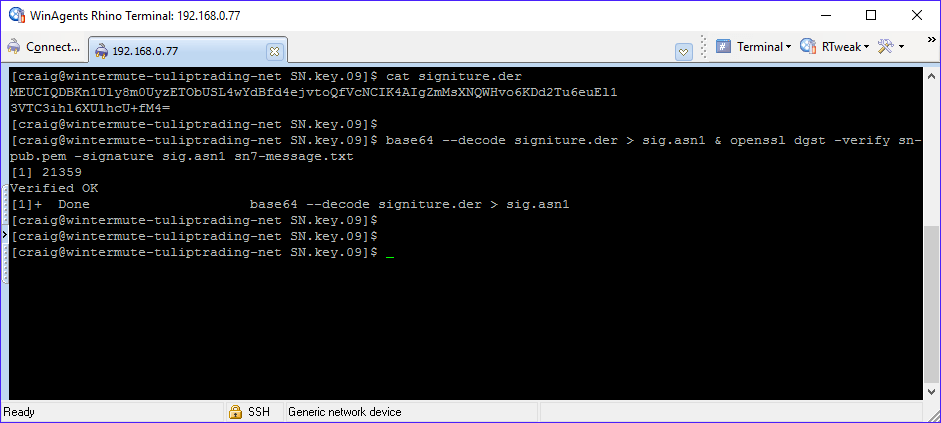
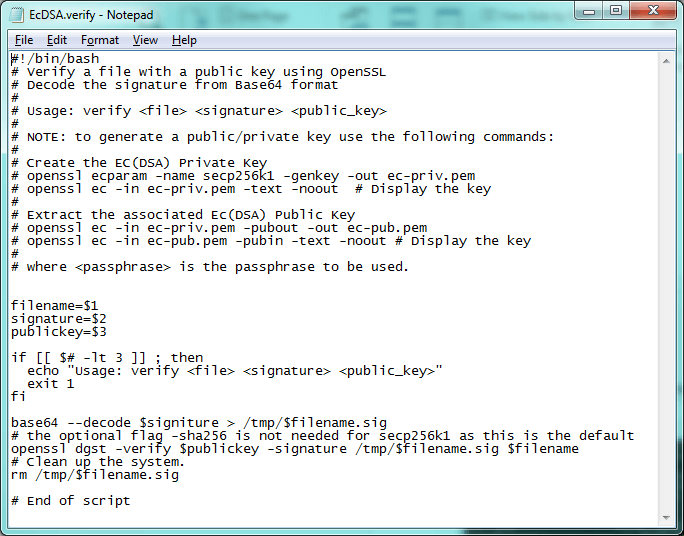
On the personal website the hero of the occasion described in detailsignature process. The text has a good introduction for non-specialists, explaining the essence of the problem, a brief excursion into the hashing algorithms and data encryption, as well as screenshots of scripts. They are made in Windows. By the way, this is the most convincing and logical part of the post - the first Bitcoin clients were available only for this OS. You can think that the real Satoshi is also sitting in the "windows".
In the above screenshots there are strange places. In some places there is a mistake in the word signature — wrong signiture is used. Or maybe it is the use of a predetermined variable
that this is the only data that Satoshi signed. It must be assumed that the owner of the private key of this transaction is the person behind the creator of Bitcoin. Wright says he can sign any message with a key that is responsible for the address 12cbQLTFMXRnSzktFkuoG3eHoMeFtpTu3S.
As a message for the signature, Craig Wright chose to refer to the relevant quotation in this context by Jean-Paul Sartre. (By the way, there is no mention of either the date or the time in the message - very imprudently.) Like any other person on the planet, Craig was able to successfully obtain the public key of the transaction. Wright gave a handful of data, which he claims is the signature of the text he signed. In fact, he encoded a bunch of data on base64 and got it
Simply put, this is a well-known transaction signature. Of course, it is being tested, but there is nothing new in it. The probability of a SHA-256 collision with a signed message is astronomically small.
For Craig, this is not the first attempt at fraud. In the past, he argued his involvement in the creation of Bitcoin with a PGP key , intentionally trying to pass it off as a real one, created in 2008. The result was a few loud headlines, because few people are familiar with these signatures. "If you want special protection, make sure that there is a random bunch of characters at the bottom of the message." XKCD, 1181 , translation xkcd.ru . In general, Wright has a weird reputation. For example, he pointed out
in his LinkedIn profile, which received his doctorate from Charles Sturt University in Sydney. In an educational institution like this refuted. Craig said he worked on supercomputers. Silicon Graphics, a well-known manufacturer of high-performance computer systems, denies any relationship with Wright's Cloudcroft Supercomputers Australia. User Hacker News claims that according to his personal sources who are familiar with Wright, the character of “Satoshi” is inherently insane and deceitful.
John Matonis , Gavin Andresen and Jan Grigg said that Craig Wright is the real Satoshi Nakamoto. All of them only express confidence, but provide no evidence. All of them suddenly became very fond of hyphens in the letter .
Andreas Antonopoulos stated that he was offered to confirm the identity of Satoshi Nakamoto on non-disclosure (NDA) terms. At the moment, Gavin Andresen closed access to the commit out of fear of hacking into the account. Some even suggest to close access for unreliability and incompetence.
Who is Craig Wright? Cheater This issue has been under discussion for several hours in the Bitcoin community. What does he want? Possibly network changes :
What are the real intentions of this person? Perhaps someone is trying to lure the real Satoshi. Perhaps Wright wants to take a material gain, make an impact, or simply attract as much attention as possible. Interestingly, Satoshi reiterates that it does not seek glory. This goes against the real level of media coverage. Most of all in this situation, it is interesting how Wright managed to fool leading developers and major news resources of the BBC and The Economist levels.
Satoshi can still appear, but how will he prove his identity? For example, PGP keys, the fact that you own a zero-key private key or a historical transaction between Satoshi and Hal Finney. Before Finney (about 70 blocks earlier) someone minil coins. The fact of possession of keys associated with them can also be evidence, although there is no longer certainty.
But even a complete coincidence of all data and the absence of questions to the technical part is only additional evidence - any data can be stolen. It is worth considering the identity of the applicant, his style of communication, ask people familiar with Satoshi to assess the situation. Craig Wright not only continues stupid cryptographic jokes. He was also caught lying about his connections with supercomputer companies and granting himself a degree. It is unlikely that this person is the real creator of the Bitcoin system.
How to evaluate the statement that someone is Satoshi Nakamoto
How does the correct proof of involvement in the creation of cryptocurrency performed by Charlie Lee look like on the example of Litecoin
Inspired by Gavin Andresen
I am sure that Craig Stephen Wright is the person who invented Bitcoin.
With these words, the Bitcoin Foundation's chief research officer begins blogging in his personal diary. In the post, he summarizes the events that prompted him to such a belief. Gavin communicated with Wright via e-mail and gained confidence that this is the same person with whom he corresponded in 2010-2011. In addition to communication, something that can be confirmed using cryptographic algorithms has passed. On a clean computer, Wright signed an arbitrary message given by Andresen. He made it the key that only Satoshi could possess. But even before the end of the procedure, Gavin was sure of the identity of the individual.
In a small post Gavin verification procedure allotted little text. The main space is occupied by a colorful description of the personal qualities of the new Satoshi. Andresen claims that Wright made it clear why he needed to disappear. For privacy reasons, this story is not given.
On Reddy, Gavin managed to shake out more details. Andresen chose the phrase “Gavin's favorite number is eleven. CSW ”(“ Gavin's Favorite Number is Eleven. DAC ”). Craig signed it with a private key from the first block. The signature was copied to a blank flash drive. Then the message was confirmed on the new laptop using a freshly downloaded copy of the Electrum Bitcoin client. Because of the fear of a leak, Andresen was not allowed to keep the data or the laptop. What happens in Wright’s blog entry, which describes OpenSSL scripts and procedures, cannot be explained by the Principal Researcher at the Bitcoin Foundation.
Craig Wright's blog
Satoshi Nakamoto used Pretty Good Privacy. It will be enough to sign any arbitrary message, and the questions will disappear. But why should Craig go down to PGP to confirm? There is a great tool that lives in cryptography - the Bitcoin network. The network architecture assumes that everyone knows the system’s transactions. It would be possible to transfer some coins from the original wallets - only Satoshi can do this. But Wright refused that. He decided to use transaction signatures.
On the personal website the hero of the occasion described in detailsignature process. The text has a good introduction for non-specialists, explaining the essence of the problem, a brief excursion into the hashing algorithms and data encryption, as well as screenshots of scripts. They are made in Windows. By the way, this is the most convincing and logical part of the post - the first Bitcoin clients were available only for this OS. You can think that the real Satoshi is also sitting in the "windows".
In the above screenshots there are strange places. In some places there is a mistake in the word signature — wrong signiture is used. Or maybe it is the use of a predetermined variable
$signiture? However, it does not matter.
So, Wright claims to be related to the legendary first transaction between Satoshi Nakamoto and Hal Finney. Consideredthat this is the only data that Satoshi signed. It must be assumed that the owner of the private key of this transaction is the person behind the creator of Bitcoin. Wright says he can sign any message with a key that is responsible for the address 12cbQLTFMXRnSzktFkuoG3eHoMeFtpTu3S.
As a message for the signature, Craig Wright chose to refer to the relevant quotation in this context by Jean-Paul Sartre. (By the way, there is no mention of either the date or the time in the message - very imprudently.) Like any other person on the planet, Craig was able to successfully obtain the public key of the transaction. Wright gave a handful of data, which he claims is the signature of the text he signed. In fact, he encoded a bunch of data on base64 and got it
MEUCIQDBKn1Uly8m0UyzETObUSL4wYdBfd4ejvtoQfVcNCIK4AIgZmMsXNQWHvo6KDd2Tu6euEl13VTC3ihl6XUlhcU+fM4=. In the form of a hexadecimal number it is 3045022100c12a7d54972f26d14cb311339b5122f8c187417dde1e8efb6841f55c34220ae0022066632c5cd4161efa3a2837764eee9eb84975dd54c2de2865e9752585c53e7cce. This is the transaction signature.Simply put, this is a well-known transaction signature. Of course, it is being tested, but there is nothing new in it. The probability of a SHA-256 collision with a signed message is astronomically small.
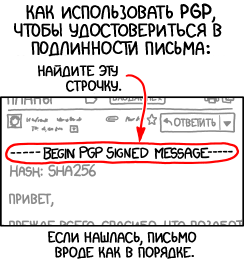
For Craig, this is not the first attempt at fraud. In the past, he argued his involvement in the creation of Bitcoin with a PGP key , intentionally trying to pass it off as a real one, created in 2008. The result was a few loud headlines, because few people are familiar with these signatures. "If you want special protection, make sure that there is a random bunch of characters at the bottom of the message." XKCD, 1181 , translation xkcd.ru . In general, Wright has a weird reputation. For example, he pointed out
in his LinkedIn profile, which received his doctorate from Charles Sturt University in Sydney. In an educational institution like this refuted. Craig said he worked on supercomputers. Silicon Graphics, a well-known manufacturer of high-performance computer systems, denies any relationship with Wright's Cloudcroft Supercomputers Australia. User Hacker News claims that according to his personal sources who are familiar with Wright, the character of “Satoshi” is inherently insane and deceitful.
Results
John Matonis , Gavin Andresen and Jan Grigg said that Craig Wright is the real Satoshi Nakamoto. All of them only express confidence, but provide no evidence. All of them suddenly became very fond of hyphens in the letter .
Andreas Antonopoulos stated that he was offered to confirm the identity of Satoshi Nakamoto on non-disclosure (NDA) terms. At the moment, Gavin Andresen closed access to the commit out of fear of hacking into the account. Some even suggest to close access for unreliability and incompetence.
Who is Craig Wright? Cheater This issue has been under discussion for several hours in the Bitcoin community. What does he want? Possibly network changes :
Mr. Wright says that he could re-invent Bitcoin, he could program a uniform increase in block size. [...] It seems that he does not have a clear understanding of the desired role. As Wright says, after proving his identity, he would like to disappear again - “just like Satoshi”. He also has close-ups on the impact on the evolution of Bitcoin. He is ready to release several studies to improve the internal operation of the system. If they are as brilliant as Mr. Nakamoto’s report was, even skeptics will accept that Wright is indeed the inventor of Bitcoin.
What are the real intentions of this person? Perhaps someone is trying to lure the real Satoshi. Perhaps Wright wants to take a material gain, make an impact, or simply attract as much attention as possible. Interestingly, Satoshi reiterates that it does not seek glory. This goes against the real level of media coverage. Most of all in this situation, it is interesting how Wright managed to fool leading developers and major news resources of the BBC and The Economist levels.
Satoshi can still appear, but how will he prove his identity? For example, PGP keys, the fact that you own a zero-key private key or a historical transaction between Satoshi and Hal Finney. Before Finney (about 70 blocks earlier) someone minil coins. The fact of possession of keys associated with them can also be evidence, although there is no longer certainty.
But even a complete coincidence of all data and the absence of questions to the technical part is only additional evidence - any data can be stolen. It is worth considering the identity of the applicant, his style of communication, ask people familiar with Satoshi to assess the situation. Craig Wright not only continues stupid cryptographic jokes. He was also caught lying about his connections with supercomputer companies and granting himself a degree. It is unlikely that this person is the real creator of the Bitcoin system.
How to evaluate the statement that someone is Satoshi Nakamoto
How does the correct proof of involvement in the creation of cryptocurrency performed by Charlie Lee look like on the example of Litecoin