Rudolf Svoren - a man of legend (the author of the classic is “Electronics step by step”)
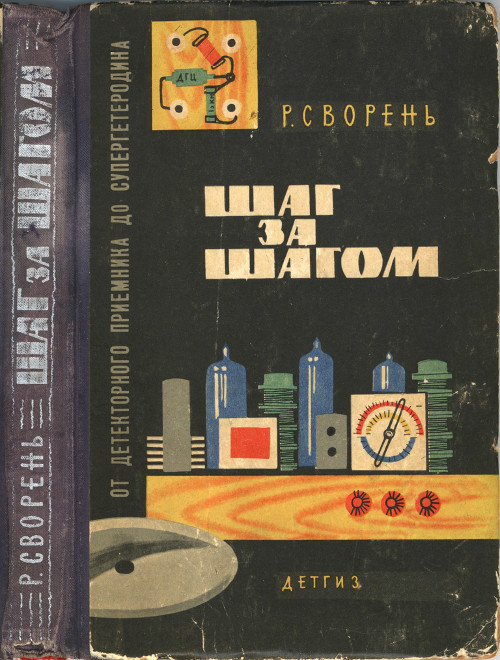 Today is Cosmonautics Day - on such days we always have pride in the country, for the people thanks to whom our country (at that time the Soviet Union) has reached such heights. Each achievement is the result of the work of many people, the work of enthusiasts - people in love with their work. And the person we want to talk about today - also contributed to the development of education, knowledge and the emergence of a love of technical creativity among young people.
 The book "Electronics step by step" - perhaps familiar to many who became interested in electronics in childhood, many note the simplicity and accessibility of the material. Its author is Rudolf Svoren , a remarkable man, but little known by his contemporaries. And we would like to publish his memories.
Thanks to this man, the world may have learned about the launch of an artificial satellite before the event itself, and hams were able to prepare and receive signals - which for many was a memorable event for life, and uniting people from many countries.
This man whose books on the basics of radio-electronics produced millions of copies in the USSR, and contributed to the emergence of enthusiastic electronics people.
Materials are published for the first time. Ruslan is a tirus - thanks to his efforts, it was possible to establish contact with Rudolf Anatolyevich (in the USA).
Dear Ruslan! I promised to tell you about how a professional journalist turned out from a radio engineer and now I will try to do it. I will start from the end - in January 1950 (at the age of 23) I graduated from the Odessa Electrotechnical Institute of Communications (OEIS) with a degree in Electrical Engineering and Radio Communications. According to the laws of that time, he was assigned to work in the city of Frunze (now Bishkek) in the Ministry of Communications of Kyrgyzstan. Before leaving Odessa, I got married with pianist Ekaterina Zaslavskaya, who lived with her brother, mother and stepfather (her father died at the front) in one room on the first floor of an old one-story house near the Odessa railway station. Katya and I have lived together for over 50 years.
The first time in Frunze, I worked as an engineer on duty at a local mid-wave broadcasting transmitter. I quickly got used to the unusual - to completely incomprehensible to me broadcasts in Kyrgyz, to powerful amplifying lamps of meter dimensions with water cooling, to a high transmitting antenna (about two hundred meters high), to strict safety rules. Let's say that a certain type of ads (for example, “People work at the antenna”) has the right to remove only the person who posted the ad. I remember it for life.
The transmitter was located on the outskirts of the city and due to the lack of transport I traveled there on foot (we were temporarily given a small room in the city in a three-room apartment) - in the morning there was an hour there, in the evening an hour was back. The first time they lived very hard and poor, to be honest, they just starved. Salary is scanty, in the shops there is nothing at all. Katya immediately went to work at a kindergarten as a music teacher, and after work I went to work as an undergraduate, mostly repairing receivers.

Once, I remember, I got caught by the broken-down SVD-9, I was busy with him for three days and still did something. But refused to pay - the owner, apparently, was even poorer than me.
A few weeks later I was transferred to the city, to a small laboratory that was engaged in servicing and improving (and at one time and building) the first, probably, radio relay communication line in our country. The fact is that the two large regions of Kyrgyzstan, Jalal-Abad and Osh, are separated from the rest of the republic and its capital by two large mountain ranges. To get from Bishkek (Frunze) to Jalal-Abad or to Osh, you need to make a huge loop and go around these mountain ranges through Tashkent. The telephone lines on the poles and the telephone connection to the “buried” areas, as a rule, have always been very bad, in the same long way. But just a few years before my appearance in Frunze, Konstantin Nikolaevich Ananiev, the chief engineer of the Kyrgyz Ministry of Communications, showed that there was no need to bypass the mountain ranges, that it was easier to step over them. A radio-relay line Frunze (Bishkek) -Osh-Jalal-Abad was built and started working with only two intermediate repeaters on the tops of two mountain ranges. At that time, our industry of radio relay stations had not yet released Ananyev and captured the captured German Rudolph and Michael transceivers. Of these, the Germans assembled relay lines operating on very short (centimeter) waves, along these lines General Paulus from Stalingrad, surrounded by our troops, spoke directly with Hitler, perplexing our radio operators. The Bishkek laboratory not only made the ranges of ultrashort radio waves habitual for me, it showed how our engineers of the Gadflies and Volchkov clearly work, solving complex or even very simple tasks. In this case, they turned the single-channel "Michael" into an eight-channel channel — one converted device allowed us to simultaneously conduct 8 different telephone conversations instead of one. I had excellent human and business relations with Konstantin Nikolayevich, I was glad to find on the Internet that after thirty years the government still appreciated him, conferring the title of Hero of Socialist Labor and appointing the head of the Radio Relay Highways and Television Department of the Ministry of Communications of the country.

Rudolf Svoren and Ekaterina Svoren (Zaslavskaya). Moscow, silver wedding. (1973)
After two years of work in Frunze, Katya and I took leave and went to Odessa, to the sea. Let's go, as usual drive - through Moscow. And there, almost all the relatives and friends of Muscovites persuaded us not to go anywhere, because there is no better city than Moscow in Russia - and in terms of lifestyle, and especially in supply. Someone even found a job for me with housing. I went, looked, talked with the local authorities and agreed. A month later, we moved to Moscow, seemingly forever.

Students and teachers (RA Svoren - third from the left in the first row) of the Radio Engineering Department of the Central School of Technical Training DOSAAF USSR (1953).
The organization to which I went to work was a five minute walk from the Rastorguevo railway station, at this station there were electric trains that went from Moscow further or returned to the city. To the city station Paveletskaya, where there were already entrances to the subway, the train from Rastorguev took about half an hour. My organization was called “Central School of Technical Training of the Central Technical Training Center DOSAAF of the USSR”. Local radio clubs, chauffeur schools and air defense groups sent their teachers to two-month refresher courses from all over the country to this school. So, all year round there were from 3 to 12 different (three varieties) training groups of 20 people each. My position was called “Senior Commander-Instructor of the Radio Course” - I spent several hours a day on the radio course on the basics of electrical and radio engineering. At the same time, it turned out that the cadets themselves helped me, in addition to the institute reserves (not too rich, by the way) to add or think up new descriptions and explanations that are simpler and more understandable to people without special training. My teaching mainly consisted of the fact that the cadets (mostly experienced military radio operators) asked me questions, and I thought of how to answer them. Has anyone ever asked such a question that I would sit at home until midnight in search of the right and, most importantly, clear answer. In a word, I don’t know what I taught my listeners (although they themselves said they did a lot), but for six months the CSTP radio course taught me that they only need to speak something to a group of listeners in a language that they understand well . It turned out that only in this language, on its developed varieties,

By the way, the further active study and use of this language for me is connected with the transfer in 4 years to work at Radio magazine, which at that time was published by DOSAAF Publishing House. I was transferred to the journal at the request of its editorial board in connection with the growing problems in the letters department. An employee of the department regularly fulfilled the plan, responding to 8 letters a day, and the mountain of unread letters at the same time grew and grew. On my first working day, I responded to 100 letters, and this figure is not related to any of my personal talents — just by opening a letter written in a familiar language, I immediately understood that it asked and knew what to answer. I think that a high-class specialist with an absolute knowledge of mathematics most of the letters would immediately be thrown into the waste basket, as an incomprehensible to him nonsense. It ended the matter that in a couple of weeks I was assigned to form and edit a large department (50 journal pages out of 64), which published amateur schemes and designs, as well as a description of new industrial models. The first 14 pages of each issue were given, so to speak, to the political department - he mainly wrote about the work of radio clubs and about amateurs working on the air.
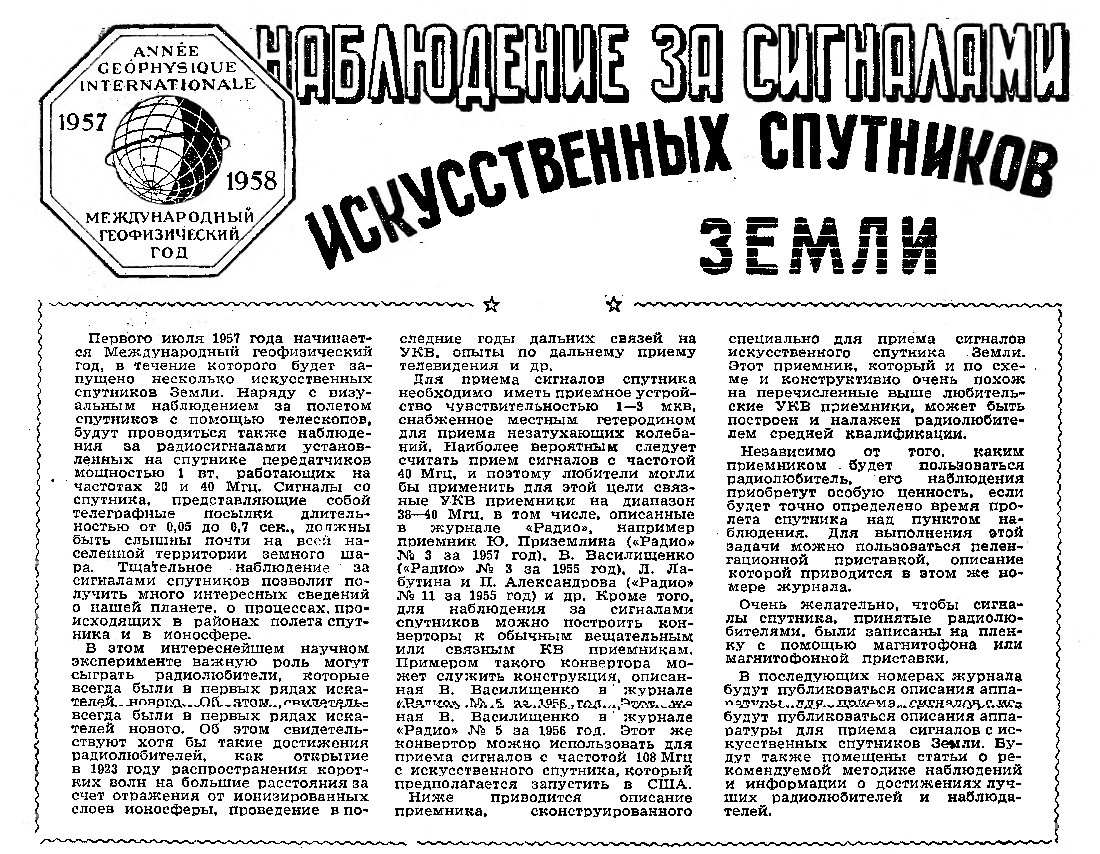
Newspapers often reminded that Americans are preparing in the near future to launch an artificial satellite of the Earth, the world's first apparatus for moving in outer space. Nowhere has it been reported that work is being done in this area in our country, obviously it was thought that first you need to do something, and then talk about it. We, with our senior editor, Elena Petrovna Ovcharenko, wrote a letter “to the very top,” proving that we need to tell you about the upcoming launch of a satellite in our country. Moreover, in this case, the magazine "Radio" will be able to form a large group of radio amateurs receiving satellite signals. I don’t know in which ways our letter moved

We, of course, immediately published these articles, adding our fast developments to them - the simplest receivers and quite simple prefixes to the factory broadcast receivers for receiving radio signals from the satellite.

The Soviet satellite was launched on October 4, 1957, it was the first in the world and opened, as they say, a new space age in the life of mankind. And if someone from foreigners began to remember the secrecy of this Russian project, then a foreign researcher was advised to read Radio magazine, which can be bought at any newsstand.
R. A. Svoren, 2016
end of the first part, continued in the article " Rudolf Svoren - a man of legend (the author of the book" Electronics step by step "). Part 2 ".