July 14, 2019 at 15:42
Photo Tour: ITMO University Optics Museum
Last time we had a tour of the laboratory of optoelectronic devices. ITMO University Optics Museum - its exhibits and installations are the subject of today's story.
Attention: there are a lot of photos under the cut.

Museum of Optics is the first interactive museum based on ITMO University . It is located in a building on Vasilievsky Island, where the State Optical Institute was previously located. The history of the museum dates back to 2007, when the restoration of buildings on the Exchange line was underway. The university staff had a question: what to place in the premises on the ground floors.
At that time, the direction of edutainment and Sergei Stafeev developed, professor of the Faculty of Physics and Technology, suggested that Rector Vladimir Vasiliev create an exhibition that would show children that optics is interesting. Initially, the museum helped the University solve the issue of career guidance and attracted students to specialized faculties. At first, only group excursions by appointment were held, mainly for grades 8–11.
Later, the museum team decided to organize a large popular science exhibition Magic of Light for everyone. It was first opened in 2015 on an area of more than a thousand square meters. meters.
The first part of the exposition acquaints visitors with the history of optics and talks about the development of modern holographic technologies. Holography is a technology that allows you to reproduce three-dimensional images of various objects. At the exposition you can watch a short informative film telling about the physical essence of the phenomenon.
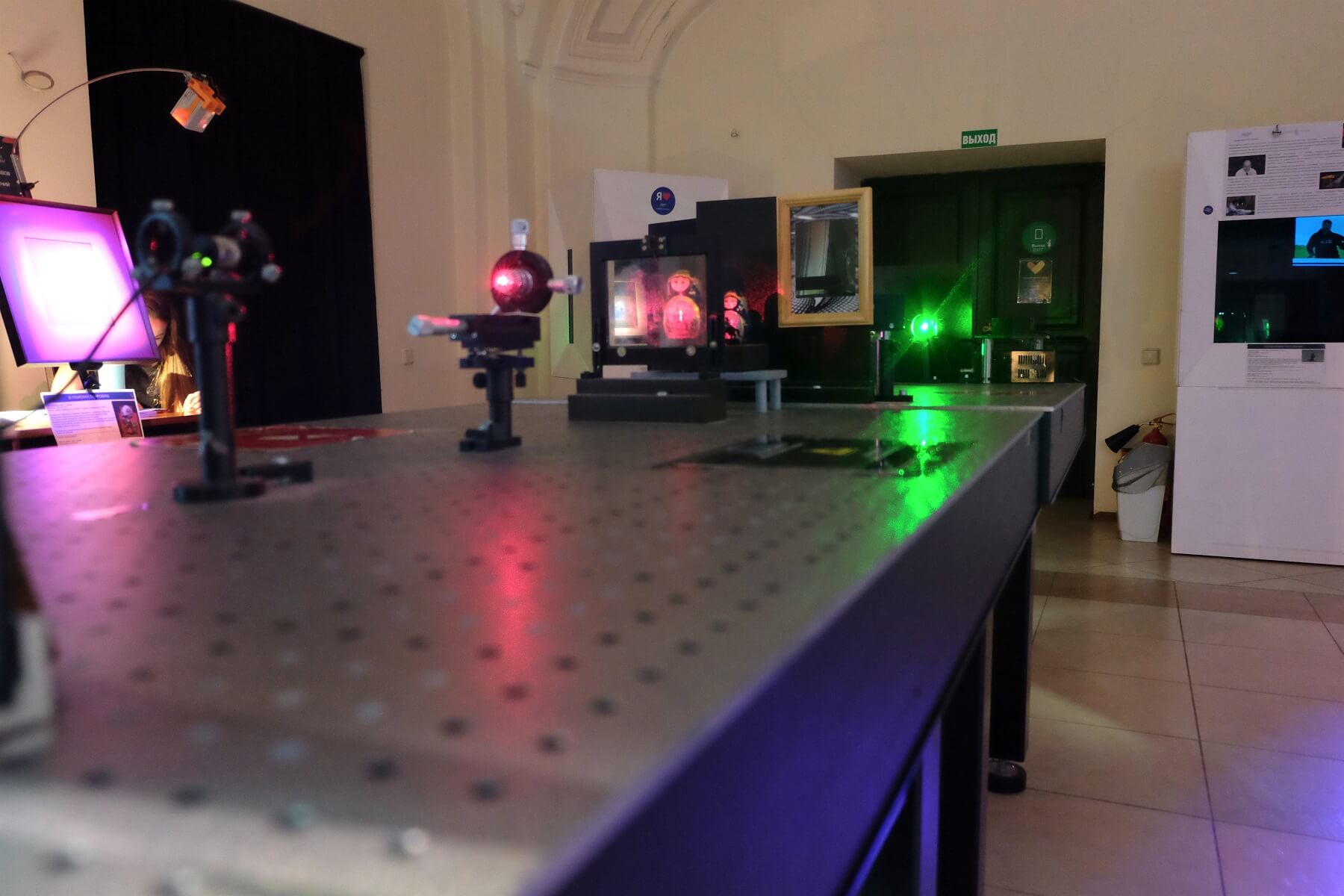
The first thing that visitors see is two tables on which mock-ups of a hologram recording scheme are located. As examples, a miniature of the monument to Peter I on a horse and a matryoshka were selected.

With a green laser - a classic recording scheme of Leith and Upatnieks , with which scientists received the first transmission volumetric hologram in 1962.
With a red laser - a diagram of the Russian scientist Yuri Nikolaevich Denisyuk. A laser is not required to view such holograms. They are visible in ordinary white light. The holographic part is devoted to a significant part of the exhibition. Indeed, it was in this building that Yu. N. Denisyuk made his discovery and assembled his first installation for recording holograms.
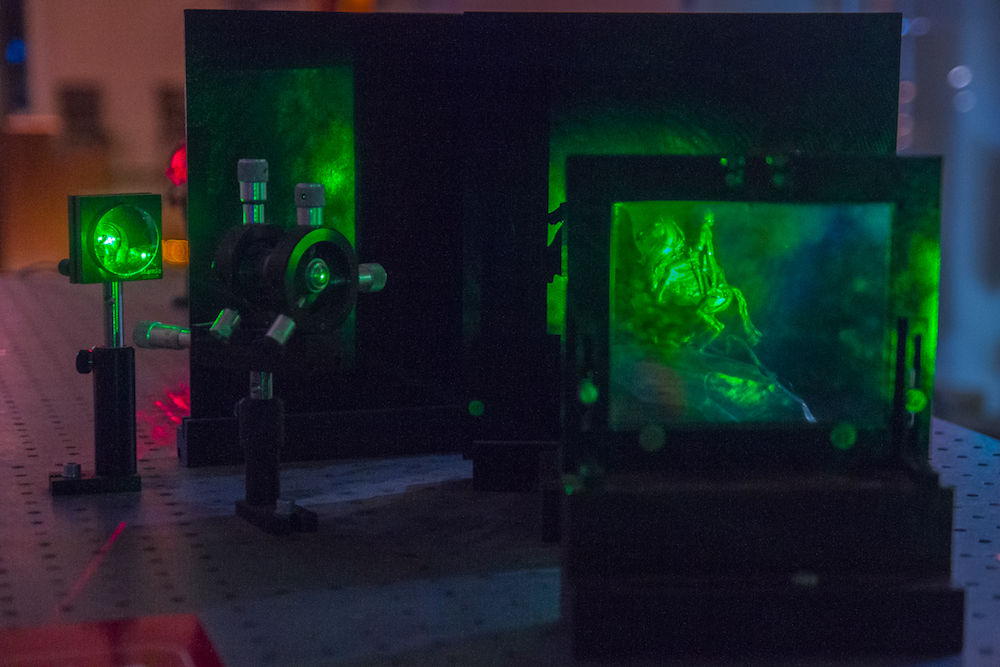
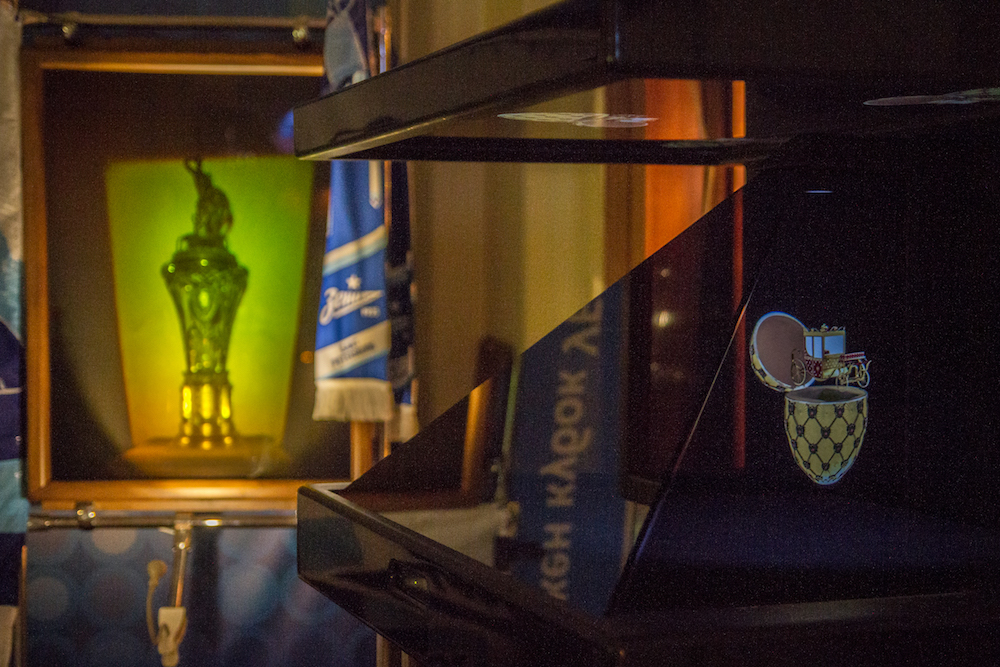
Today Denisyuk's scheme is used all over the world. With its help, analog holograms are recorded that are indistinguishable from real objects - “optoclones”. In the first hall of the museum there are boxes with holograms of the famous Easter eggs of Carl Faberge and the treasures of the Diamond Fund.
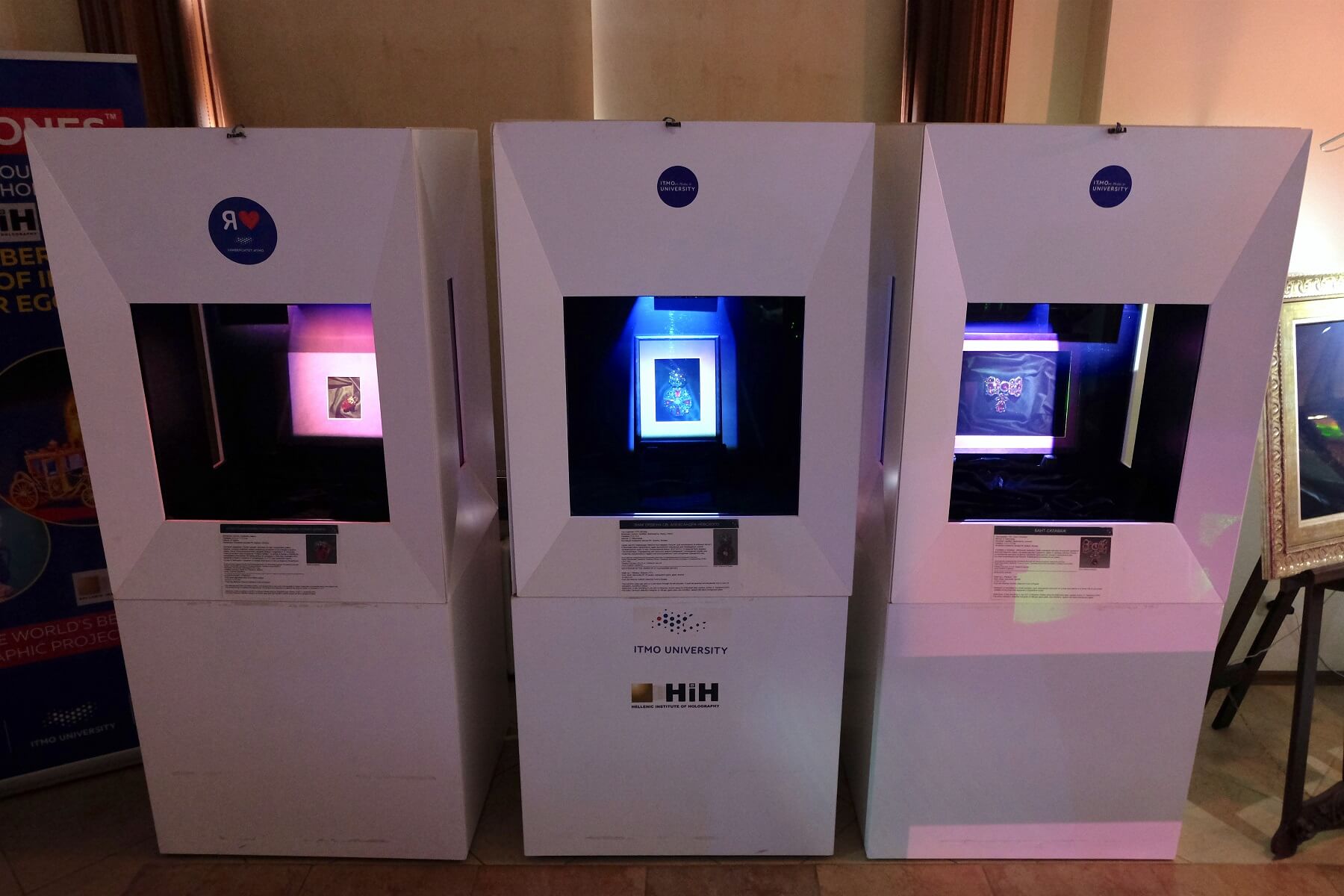
In the photo: holographic copies of “ Ruby Caesar ”, “ Badge of the Order of St. Alexander Nevsky "and jewelry" Bow-Sklavazh "
In addition to analog, in our museum there are also digital holograms. They are created using 3D modeling programs and laser technologies. Using photographs of an object or video (which can be done with the help of drones), its model is worked out on a computer. Then, it is counted into the interference pattern and transferred to a polymer film using a laser.
Such holograms are printed using special holoprinters using blue, red and green lasers (there is a little bit about their work in this short video ).
Digital holograms are also four-way - they consist of four different pictures. If you go around such a hologram, then the images will begin to change.
So far, this method of recording holograms has not found wide application due to the cost of equipment for printing. There are no holoprinters in Russia, therefore, our Museum presents holograms of American and Latvian production, for example, a map of Mount Athos.
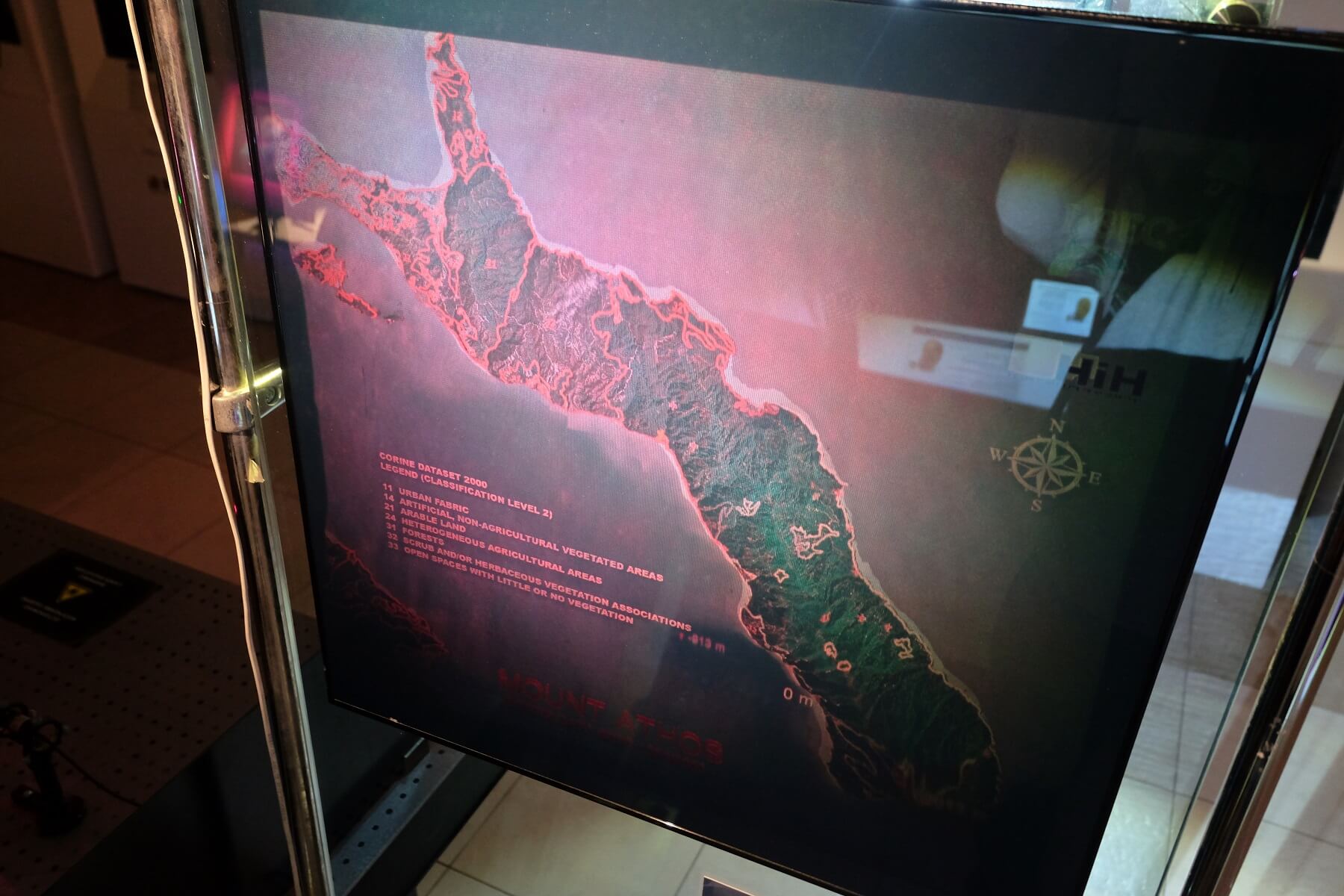
In the photo: Map of Mount Athos. The
second hall of the museum is also partially dedicated to holography. Its general appearance is in the photo below.
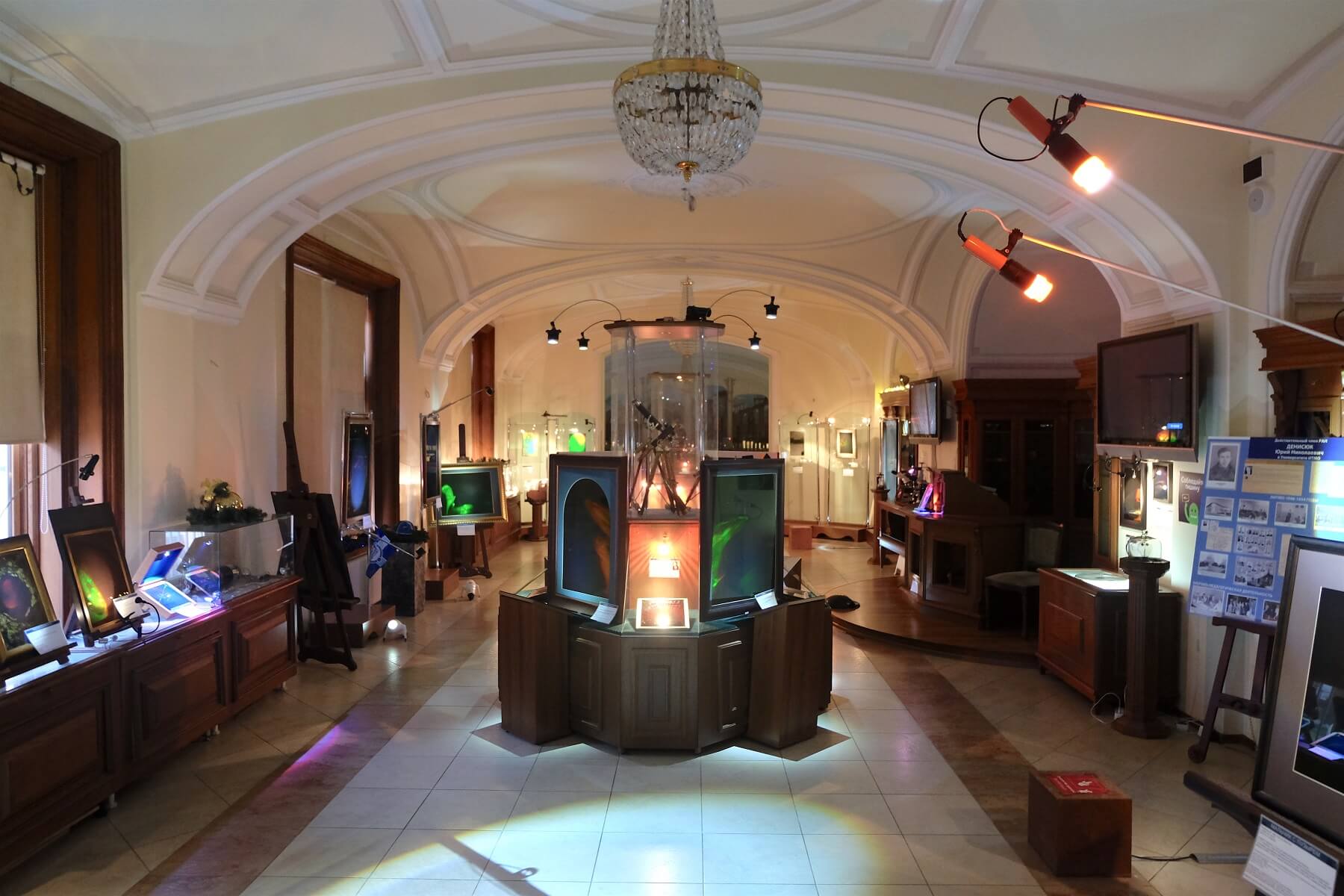
In the photo: Hall with holograms
. This hall presents a "holographic portrait" of Alexander Sergeyevich Pushkin. This is one of the largest holograms on glass, and in terms of scale it is a leader among analog holograms.
There was also a stand with a holographic portrait of Yu.N. Denisyuk with a story about the life of a scientist and his discovery. There is a hologram with frames of the poster for the film "I am a legend."
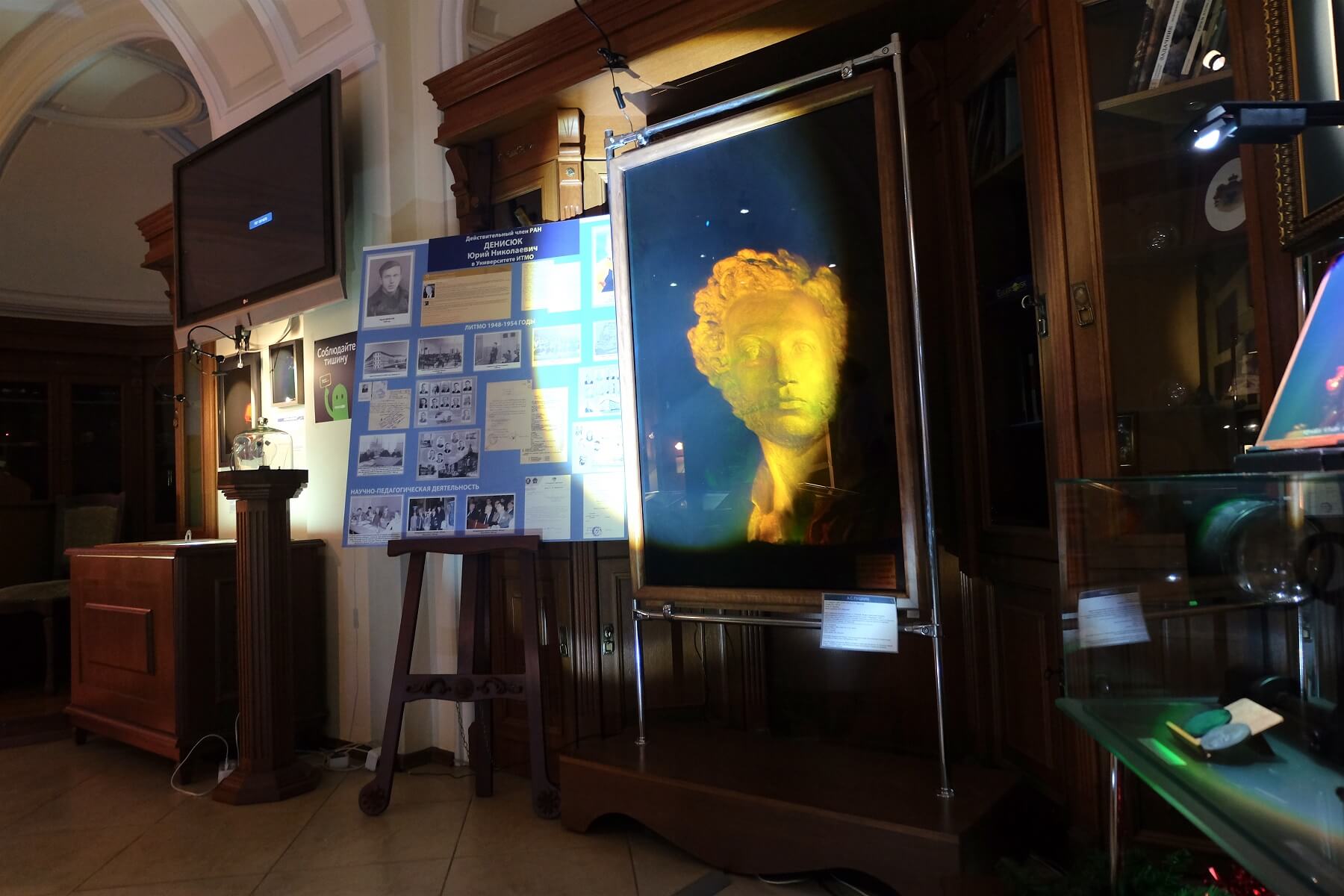
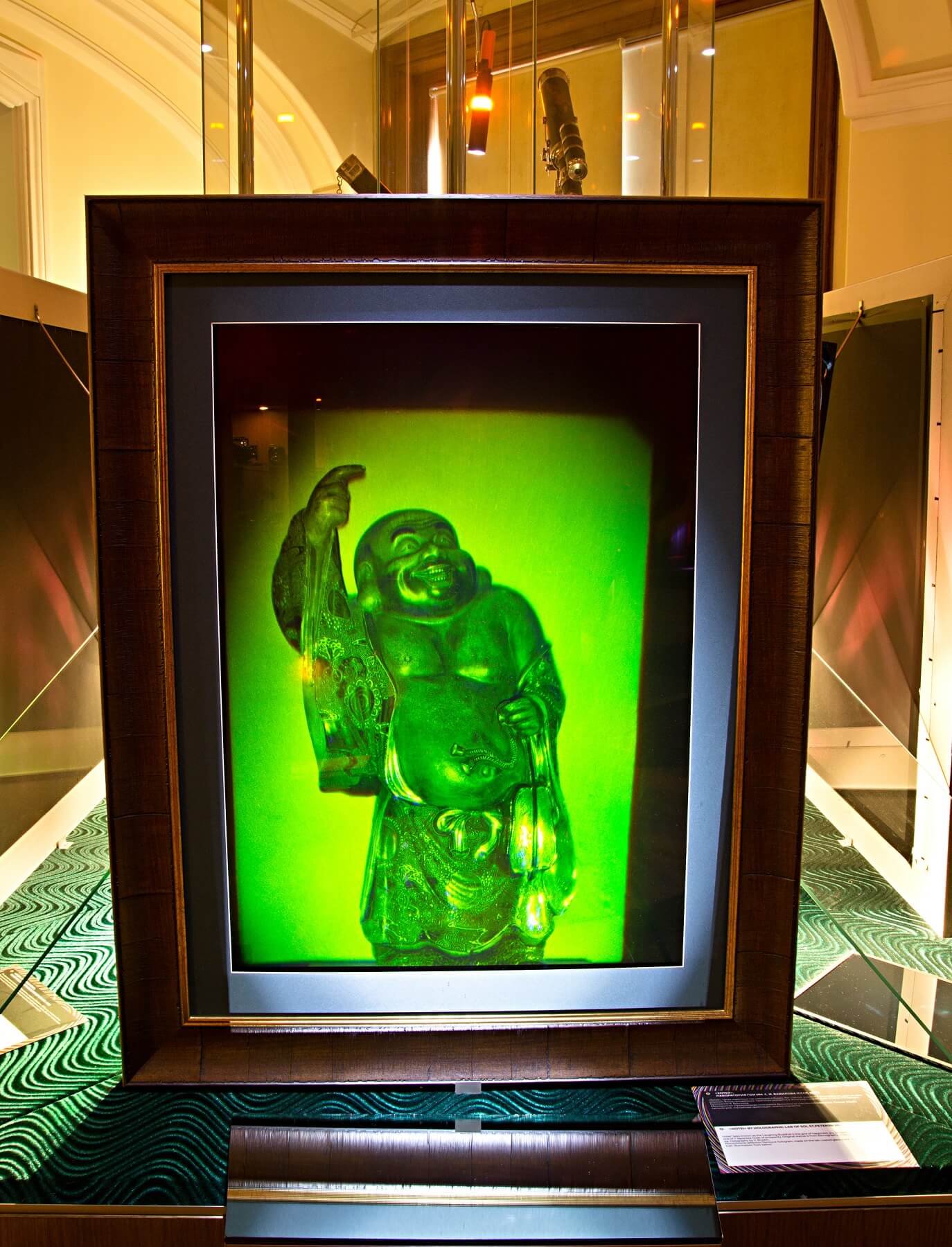
Holograms of objects from different museums of the world are installed in this room, for example, Hotei from the Russian Museum of Ethnography.
To the left of Pushkin’s bust is a lamp placed in a transparent case. Although this exhibit seems to be a lamp only at first glance. Inside it is an impeller with white and black blades. If you turn on the spotlight and shine on the impeller, it will begin to rotate.
The exhibit is called the Crookes Radiometer.
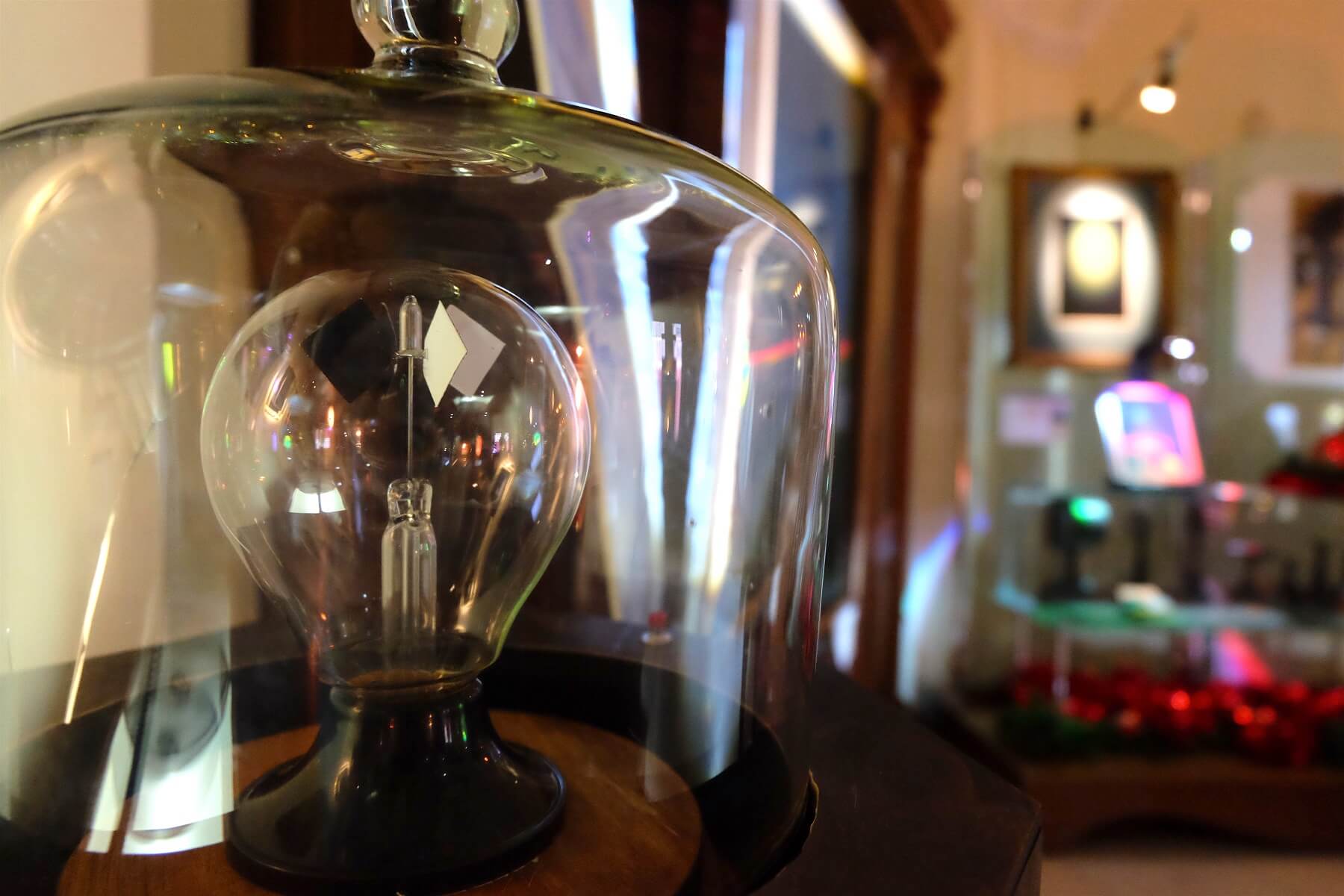
Each of the four blades has a dark and bright side. Dark - heats up more than light (due to the characteristics of light absorption). Therefore, the molecules of the gas in the flask bounce off the dark side of the blade at a faster rate than on the light side. Because of this, the blade, turned to the light source with the dark side, receives a greater momentum.
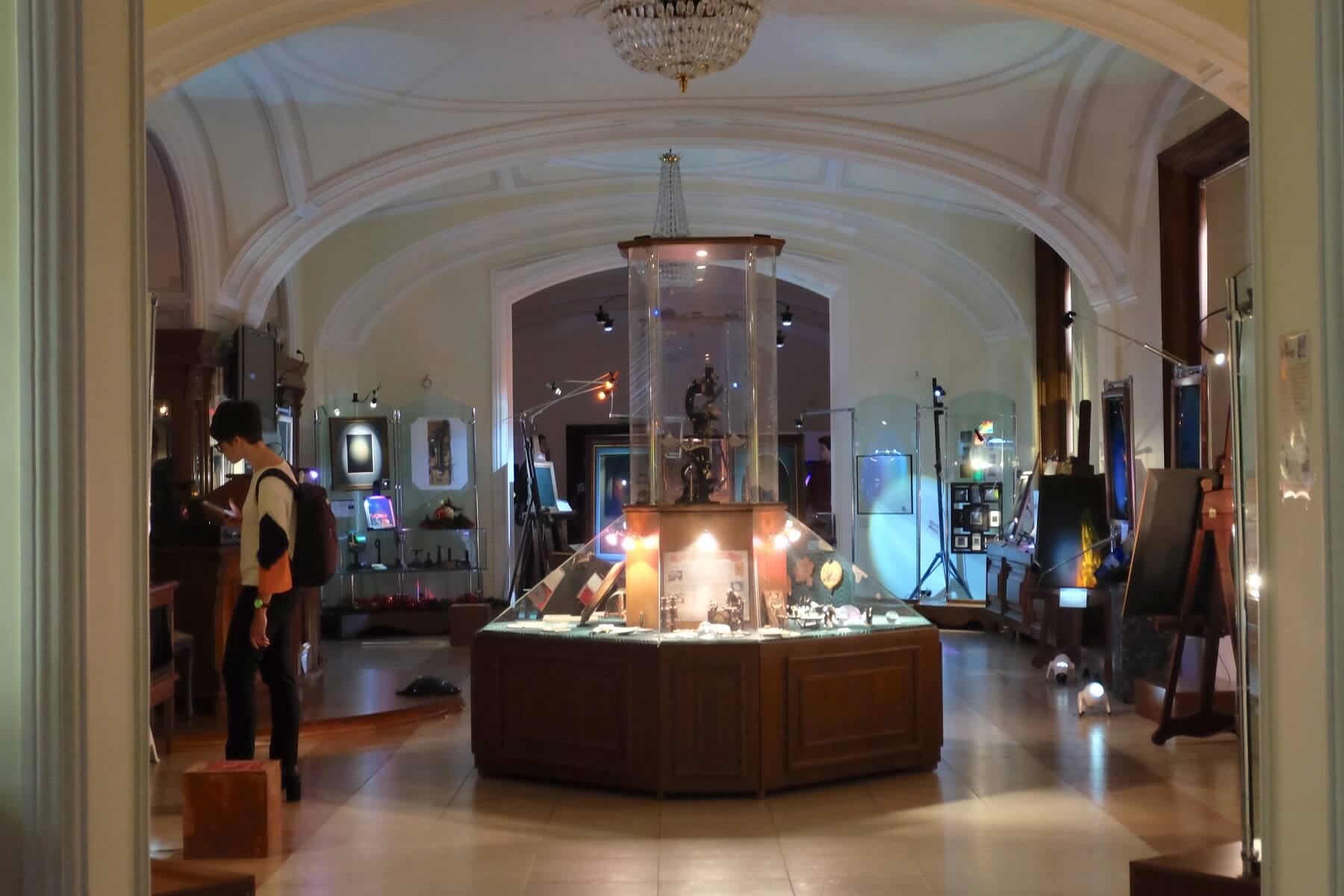
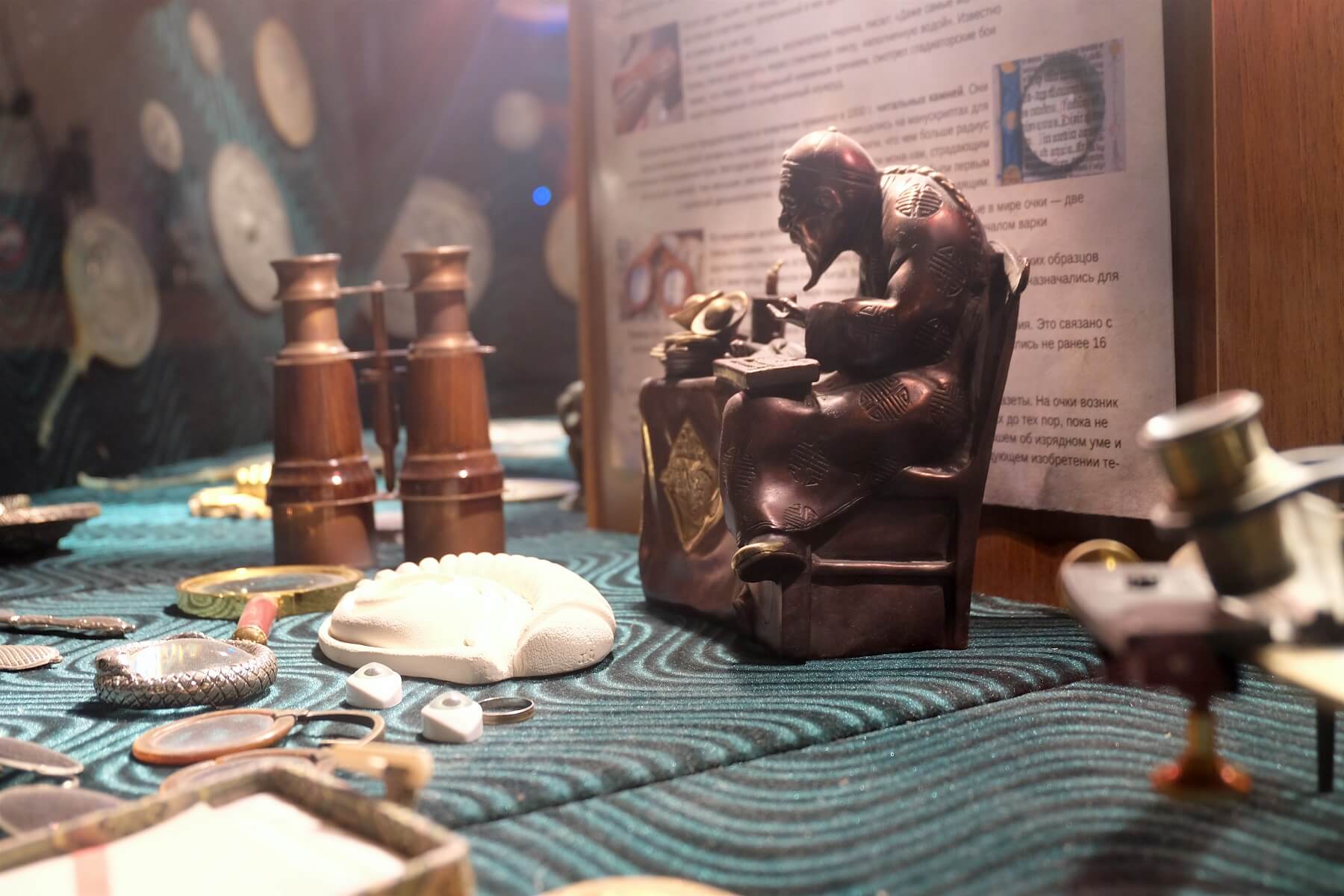
At the stands you can find a large number of various optical instruments: microscopes, reading stones , vintage cameras and antique glasses. During the tour, you can find out the history of the appearance of the first mirrors from obsidian, bronze and, finally, glass. The showcase presents a real Venetian convex mirror, created using technology of the XVII century. And the bronze “magic mirror” (if you direct it to the sun, and the reflected “bunny” - to the white wall, then an image from the back of the mirror will appear on it).
In the same room there is a collection of cameras. The exposition makes it possible to trace their development from the pinhole camera - the progenitor of the camera - to the present.
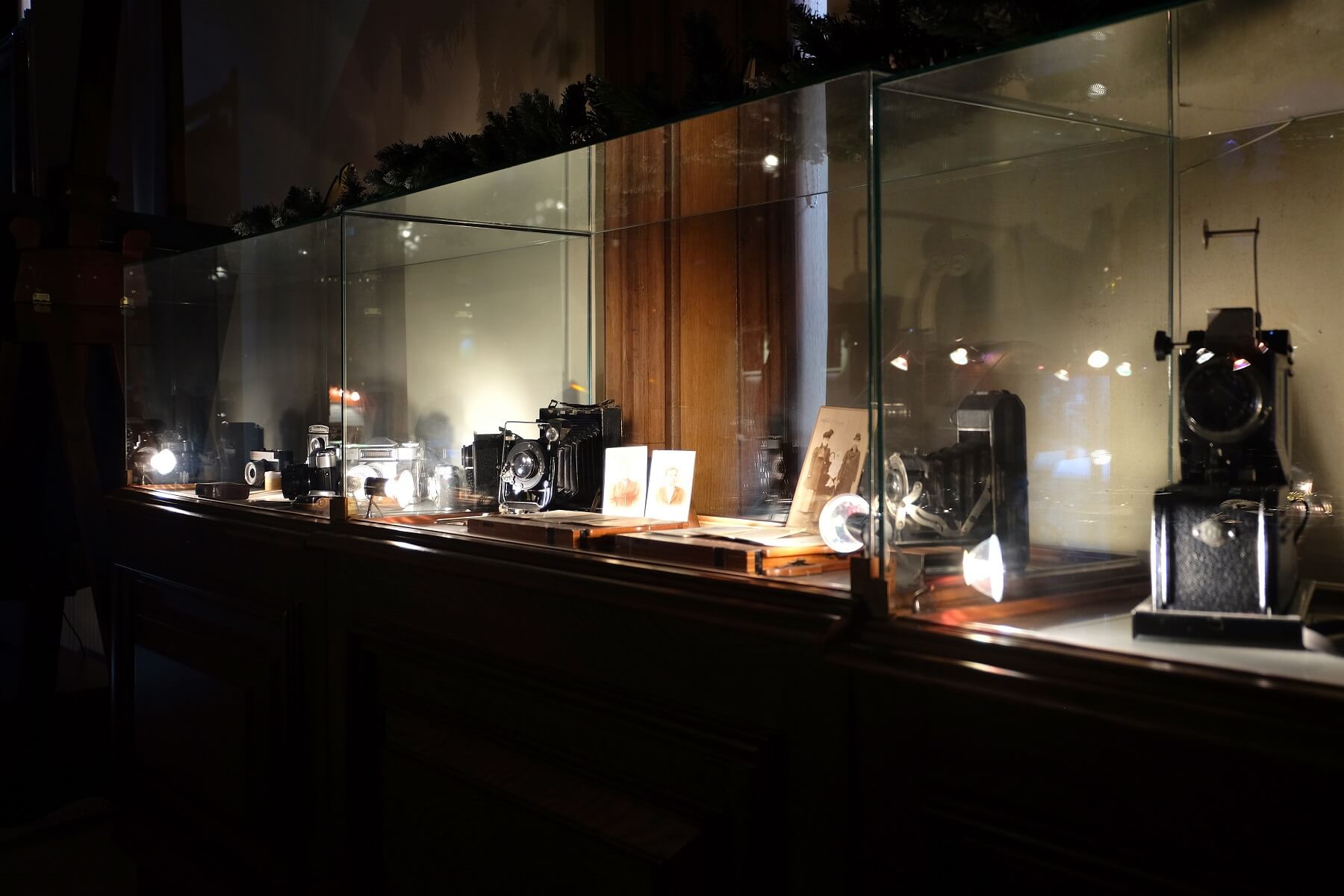
In the photo: A collection of cameras
On the windows were cameras with folding fur and copies of the Pontiac MFAP, produced from 1941 to 1948, and the AGFA BILLY from 1928. Among the presented devices, one can find Photocor , the first Soviet large-scale camera, created on the basis of the most successful Western models. In the USSR, it was released until 1941.
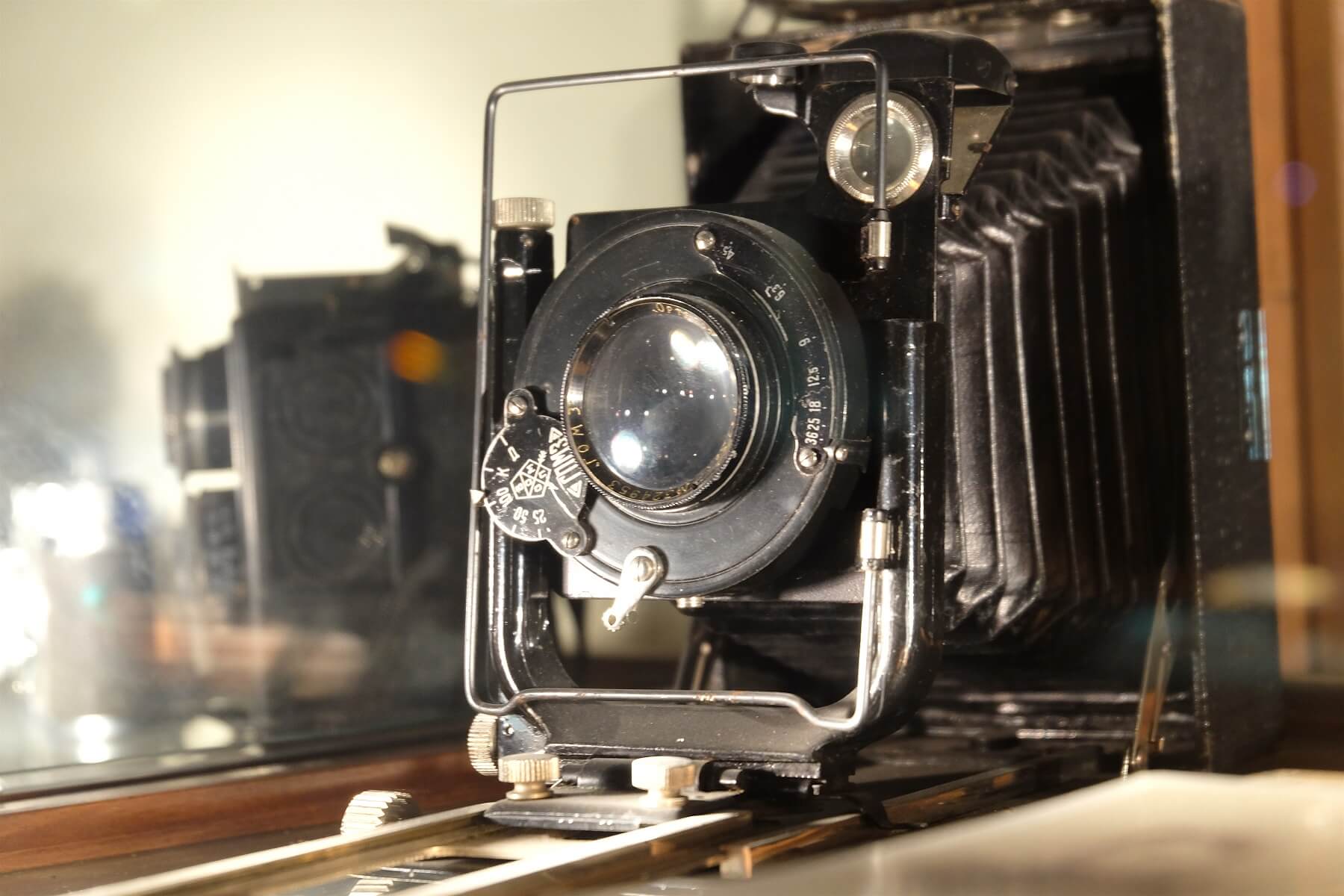
In the photo: Folding Camera " Photocor "
If you go to the next room of the museum, then it is possible to see a monumental body of light and music. "Instrument" consists of 144 special optical glasses of various grades and brands - Abbe catalog. Similar in size of glass blocks and the completeness of the collection is not anywhere in the world. They began to collect it back in the USSR in order to perpetuate the achievement of scientists from the State Optical Institute who developed the technology for the production of radiation-resistant glass.
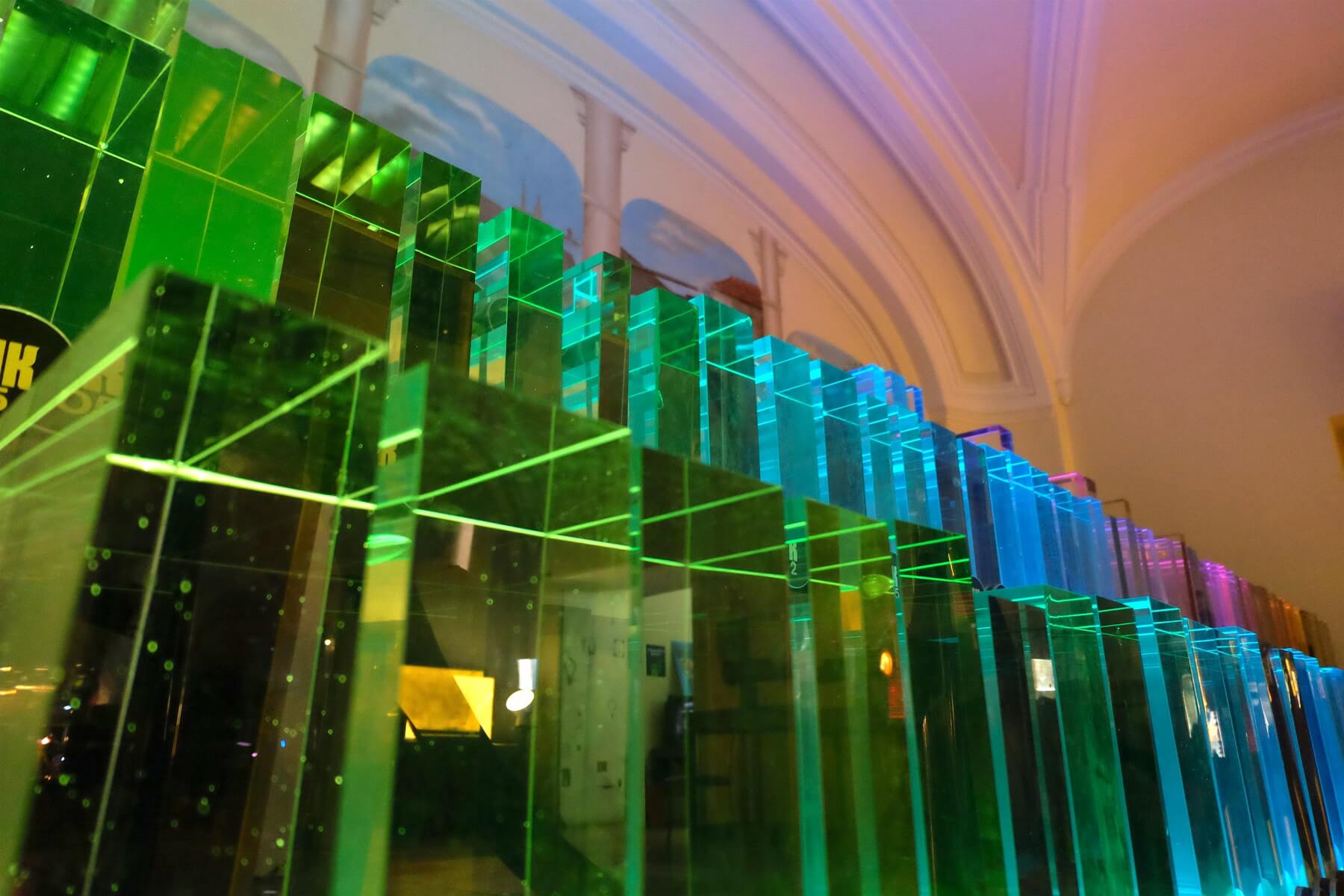
Now under each bar of glass is an LED line. These lines are controlled by controllers and a hub connected to a personal computer. If you play a melody on your PC, then the organ will begin to flicker in different colors, depending on the tonality and pitch. The program has eight algorithms for converting sound into color. You can evaluate the system in this video on YouTube .
After the collection of optical glass, the second part of the exposition - interactive. Most of the exhibits here can and should be touched. The interactive part begins with a study of the history of cinema and 3D vision.
Zoetrope , phenakistoscope , fonotropy - give an idea of how scientists studied the mechanisms of vision and information processing. An example of a phonotope you can see in the photo below. The principle of operation is based on inertia of vision. What we do not see with the eye, as the picture is blurred, is clearly visible through the smartphone’s camera.
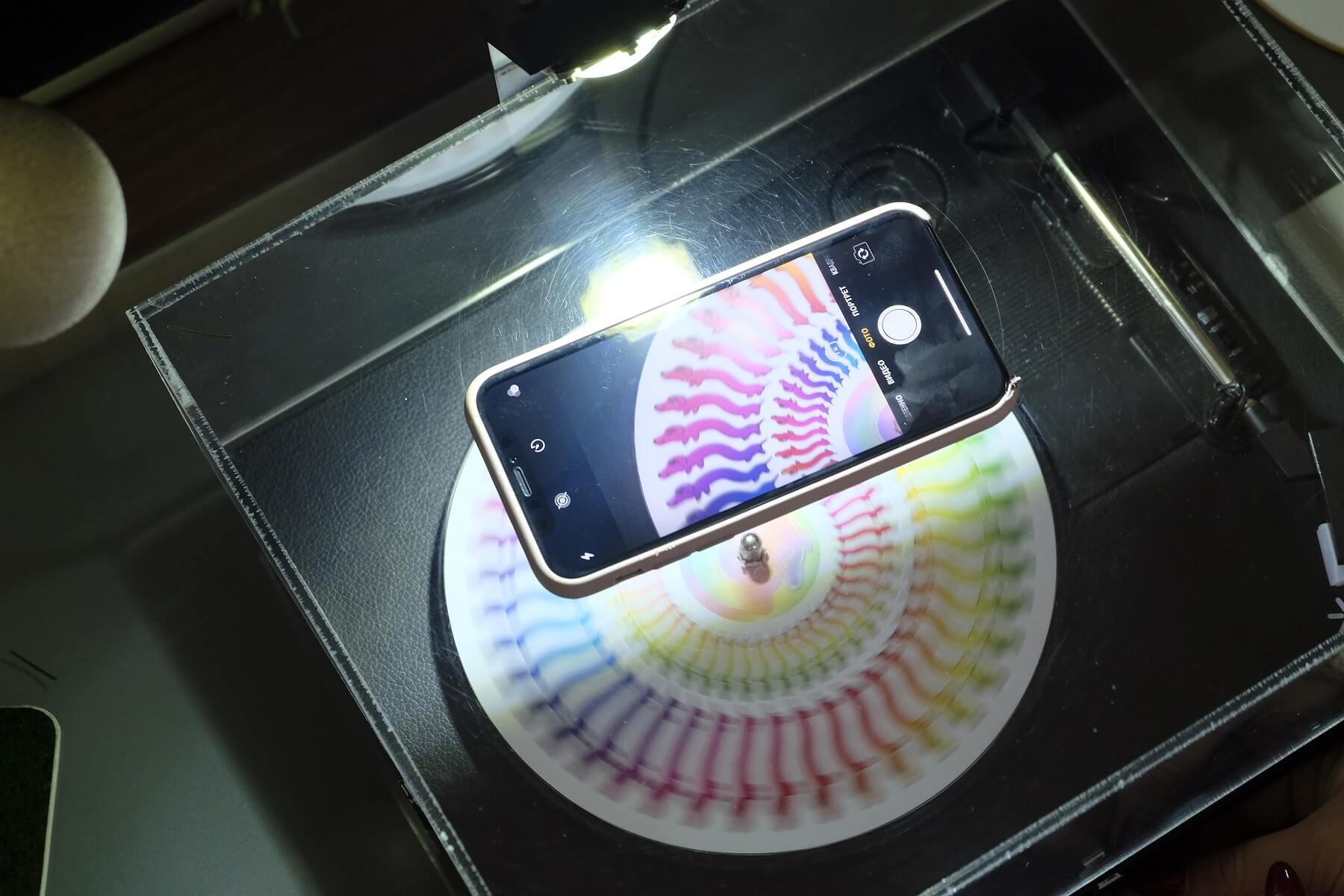
In the photo: phonotropic - a modern analogue of the zootrop
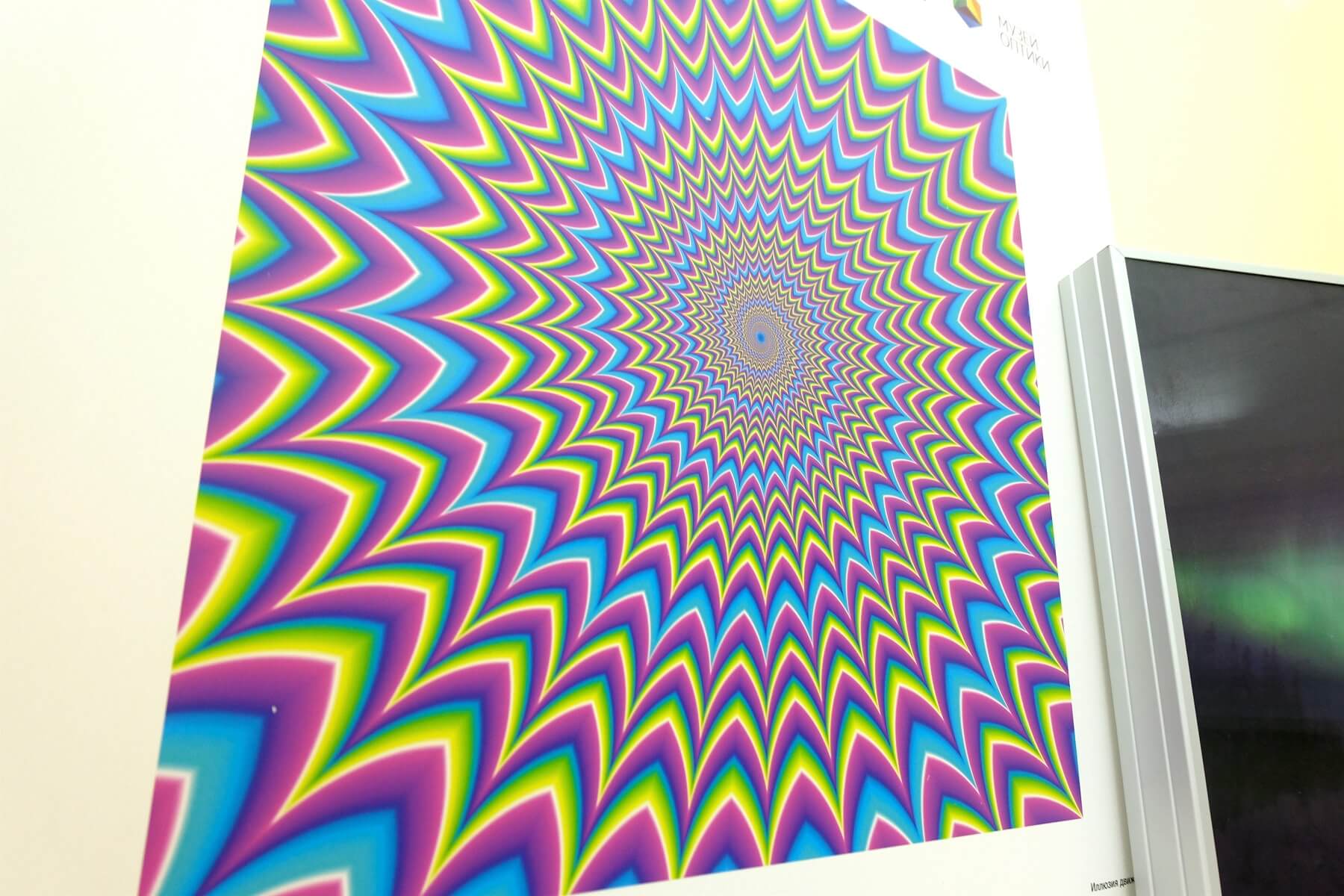
In the photo: Optical illusion
Modern 3D cinema is rooted in the 19th century - a stereoscope with pre-revolutionary cards helps to make sure of this. A 3D screen is also installed there, to view the image on which special glasses are not required.
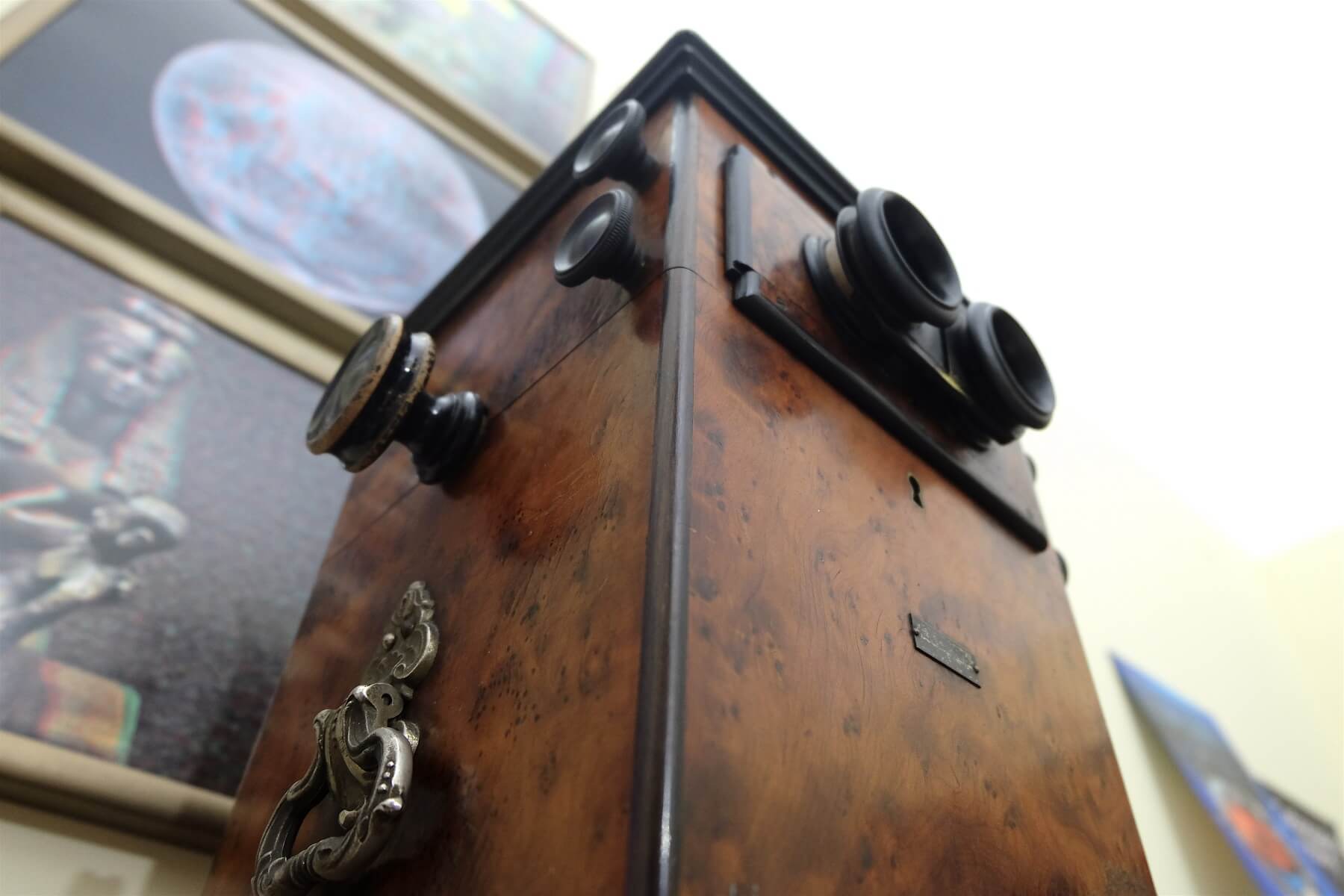
In the photo: an old stereoscope of 1901.
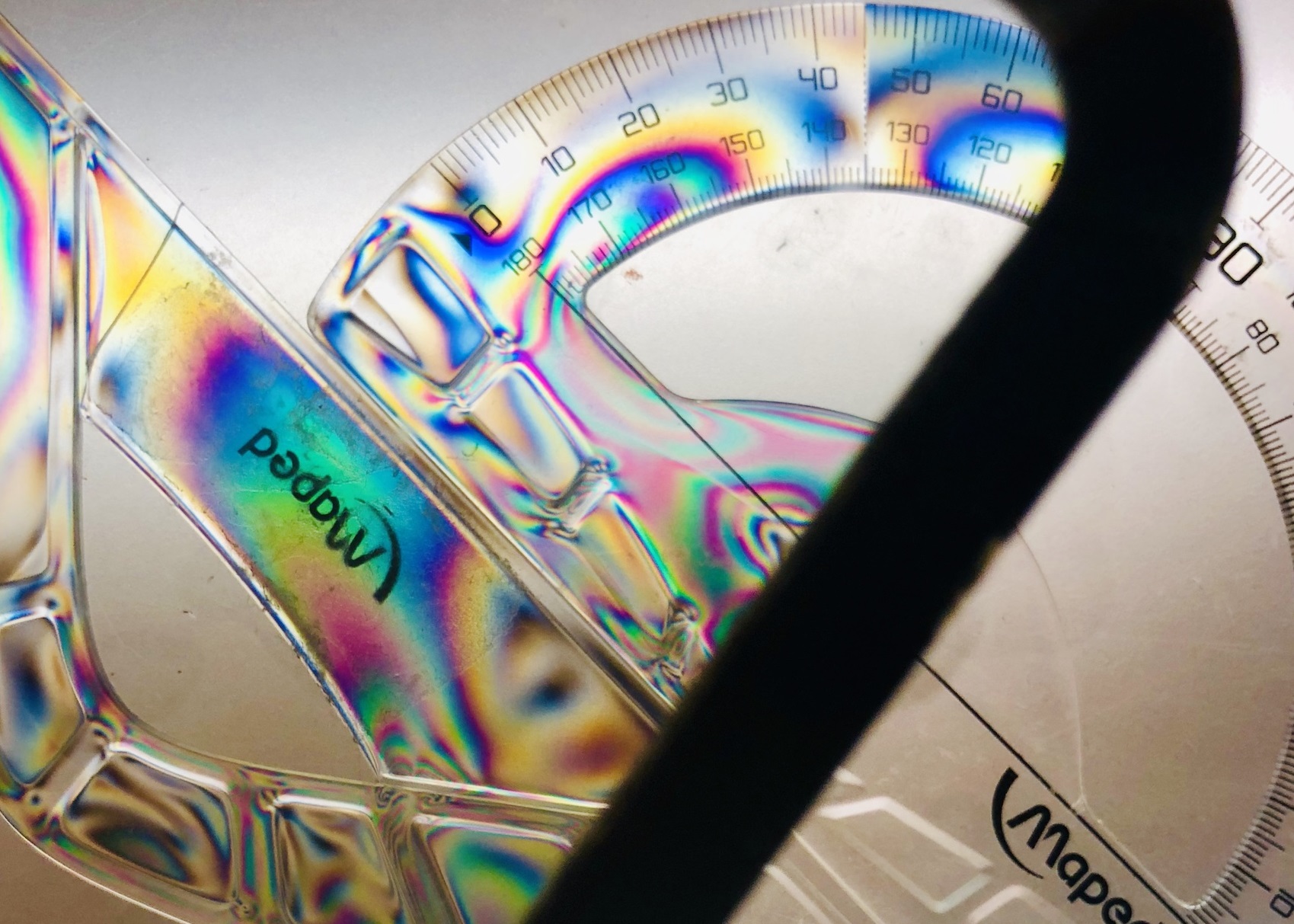
In the exhibition hall there is a table with stationery rulers and other transparent objects. If you look at them through special filters, then they will bloom with all the colors of the rainbow. This phenomenon is called photoelasticity .
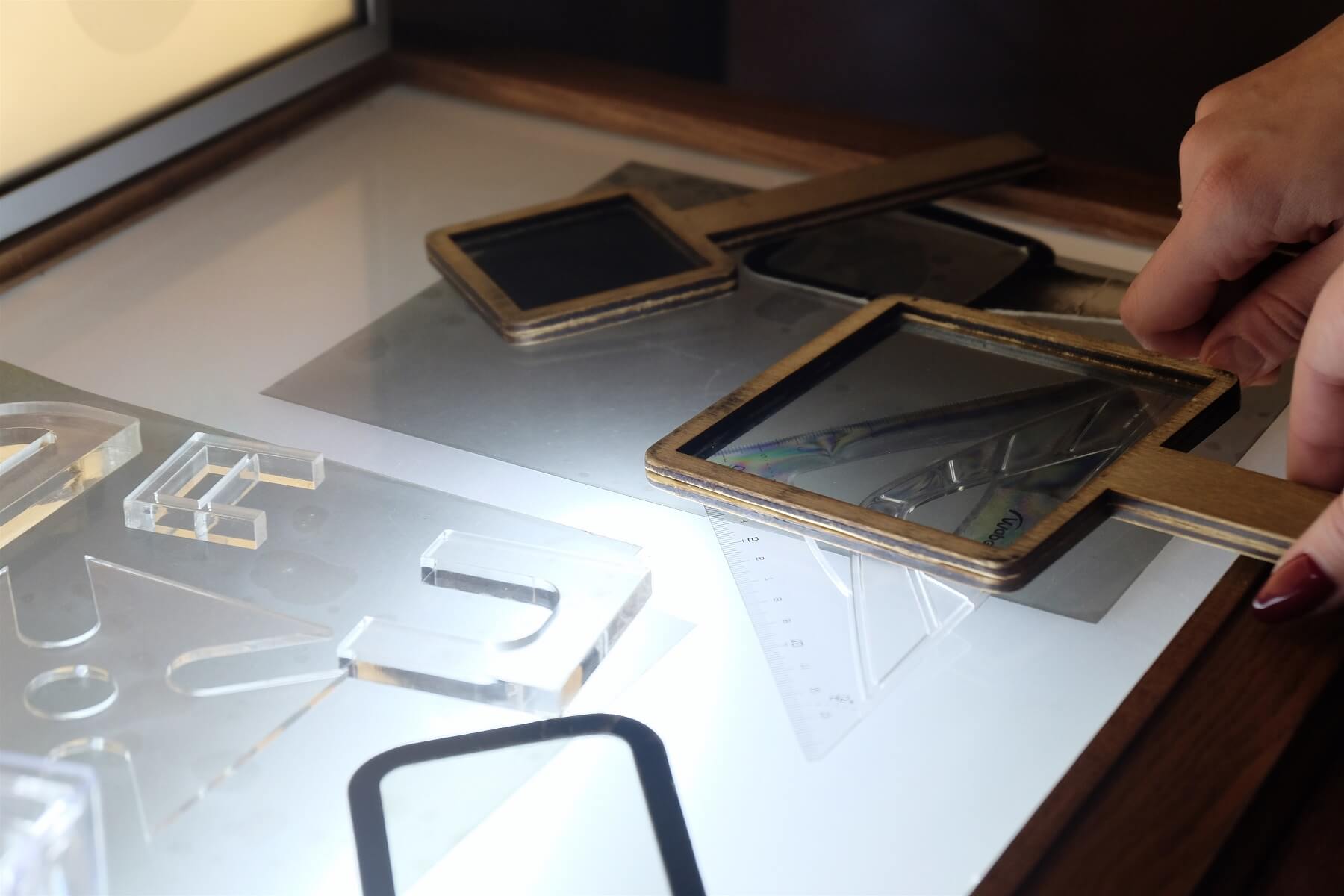
This is an effect when under the influence of mechanical stresses the bodies acquire double refraction (due to the different refractive index for light). Therefore, there are rainbow patterns. By this method, by the way, the loads in the construction of bridges and implants are checked.
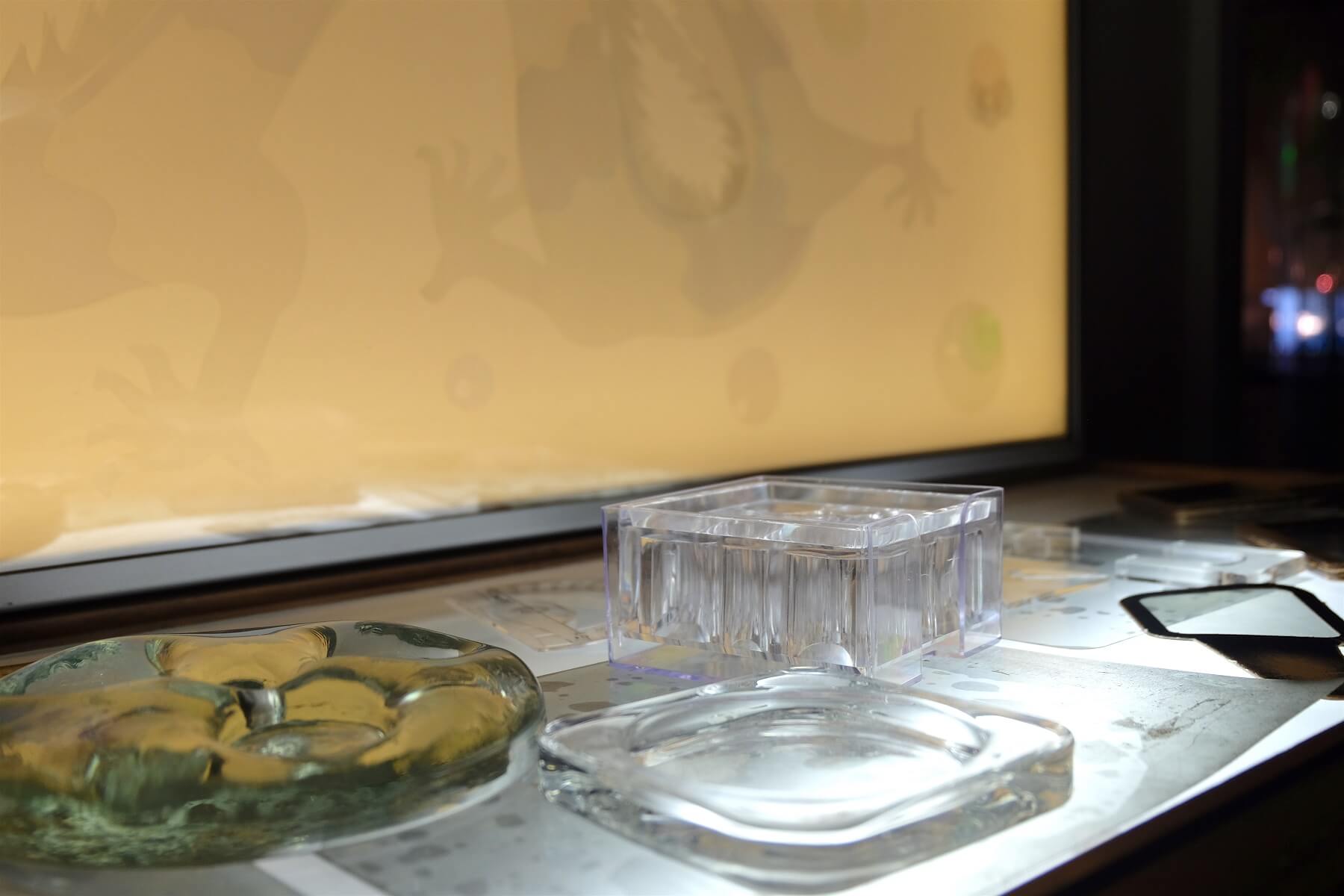
In the photo below - another white glowing screen. If you look at it through special filters, the image of a colored dragon will appear on it.
ITMO University often implements joint projects with artists who exhibit their work in the museum. For example, in one of the interactive halls the LED installation “ Wave ” is installed - the result of a “collaboration” of university specialists and the Sonicology project team. The project’s ideologist was media artist and composer Taras Mashtalir.
The Wave art object is a two-meter sculpture that, with the help of motion sensors, “reads” the behavior of the audience and generates light and musical reactions.
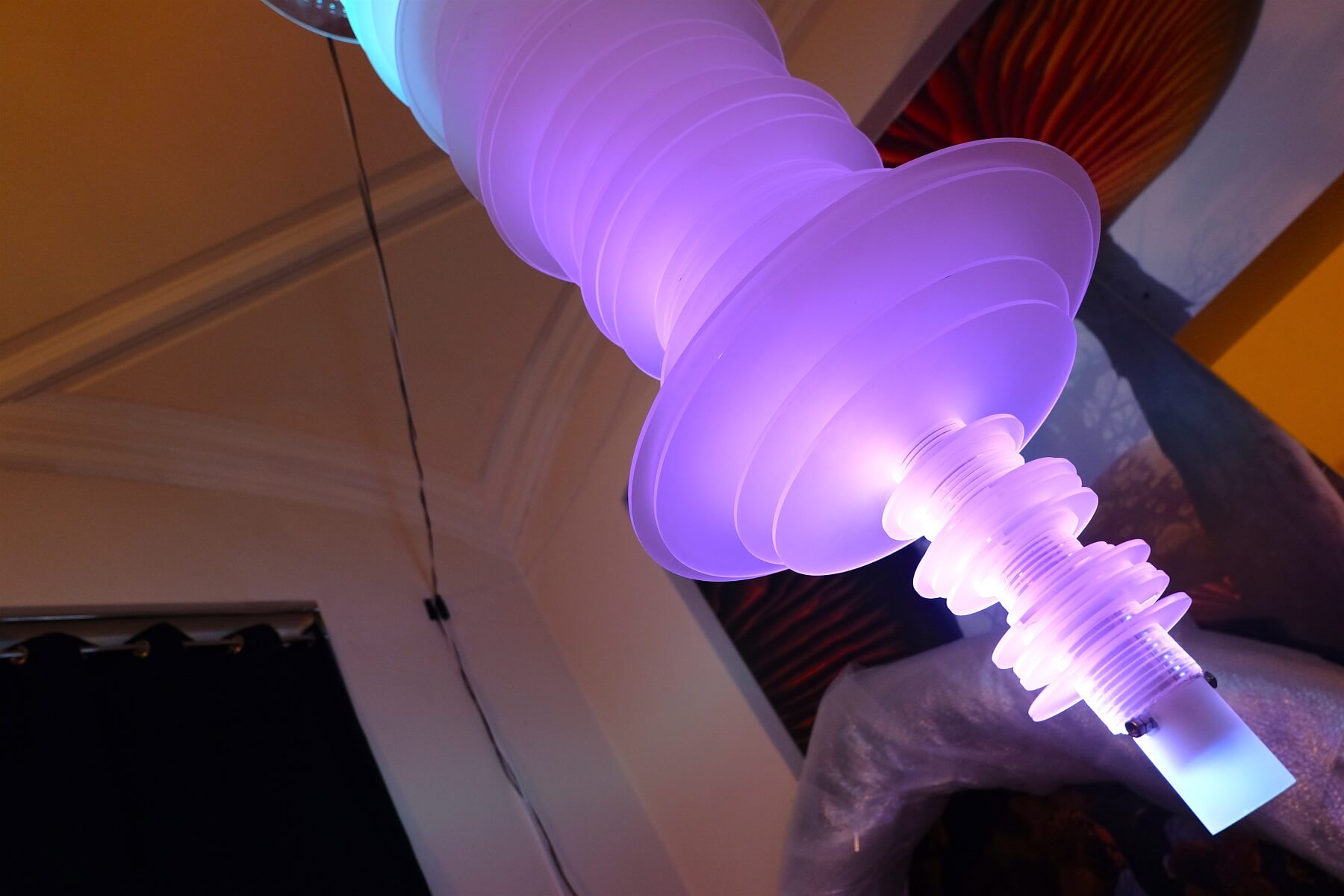
In the photo: Wave LED installation
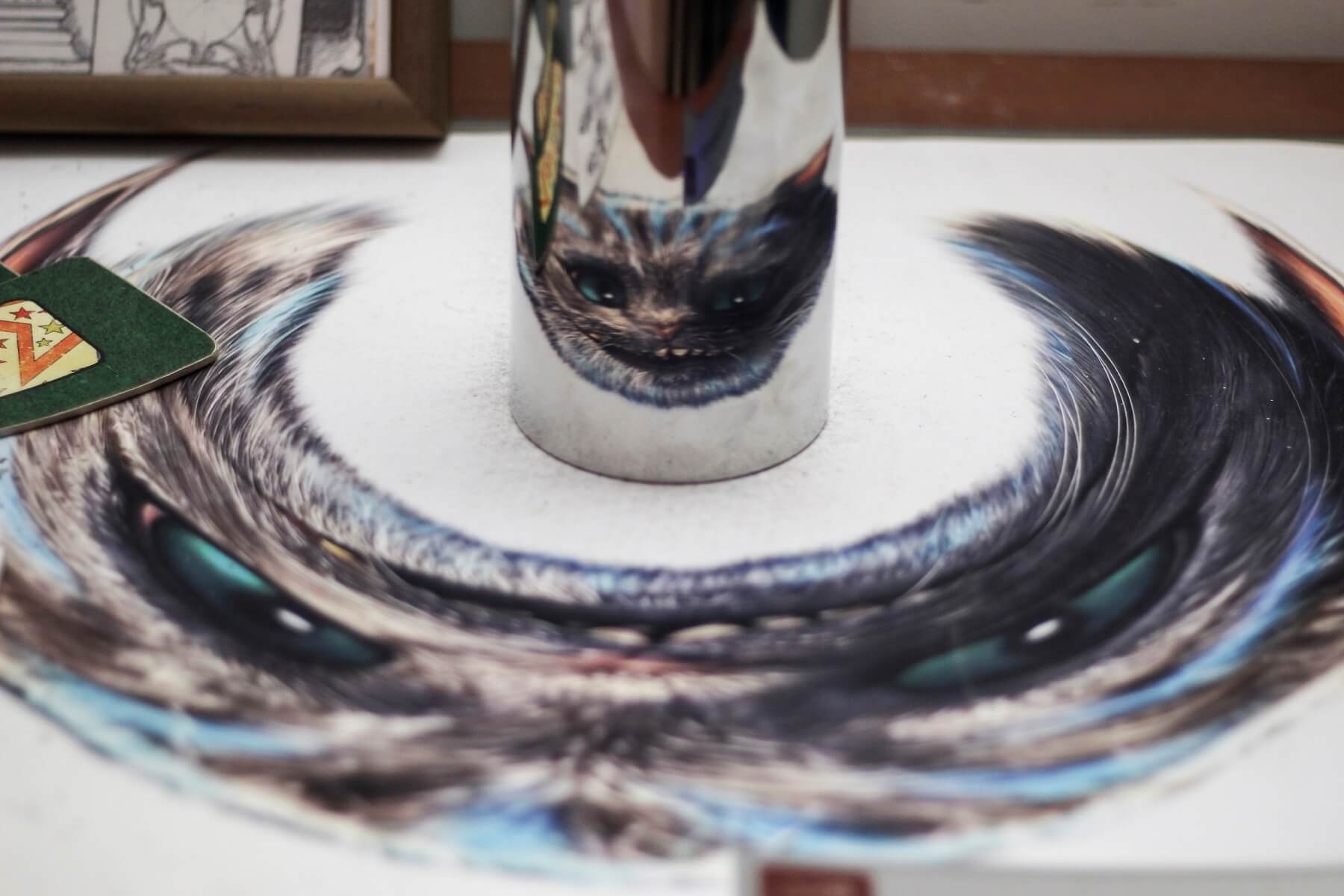
The next hall of the exposition contains mirror illusions. Anamorphoses “decode” strange images and turn them into understandable images.
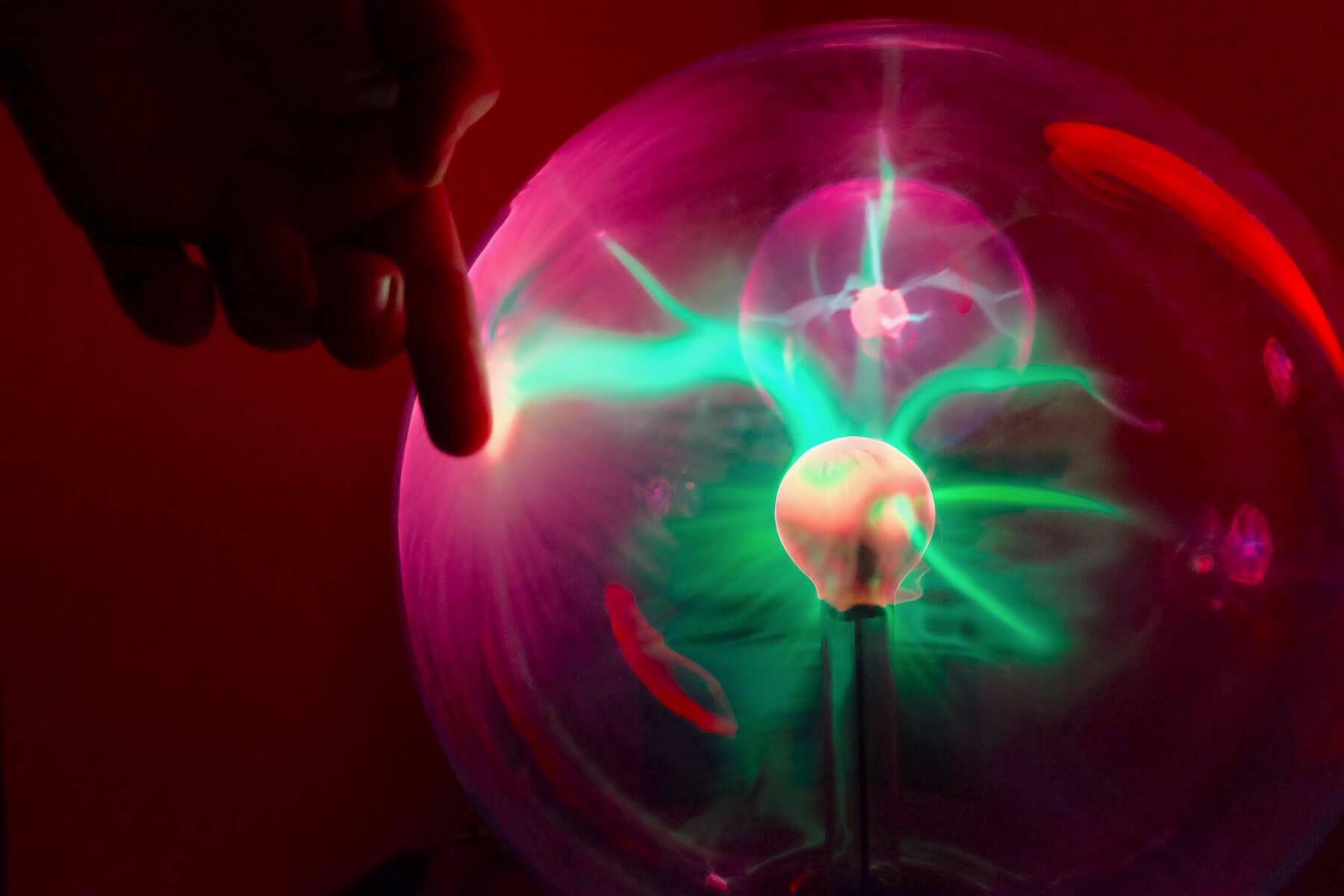
Next is a dark room in which there are plasma lamps. You can touch them.
On the wall to the right of the lamps you can draw a flashlight, it has a special coating. And the wall, on the contrary, does not absorb light, but reflects. If you take a picture against its background with a flash, then on the camera screen we get only a shadow.
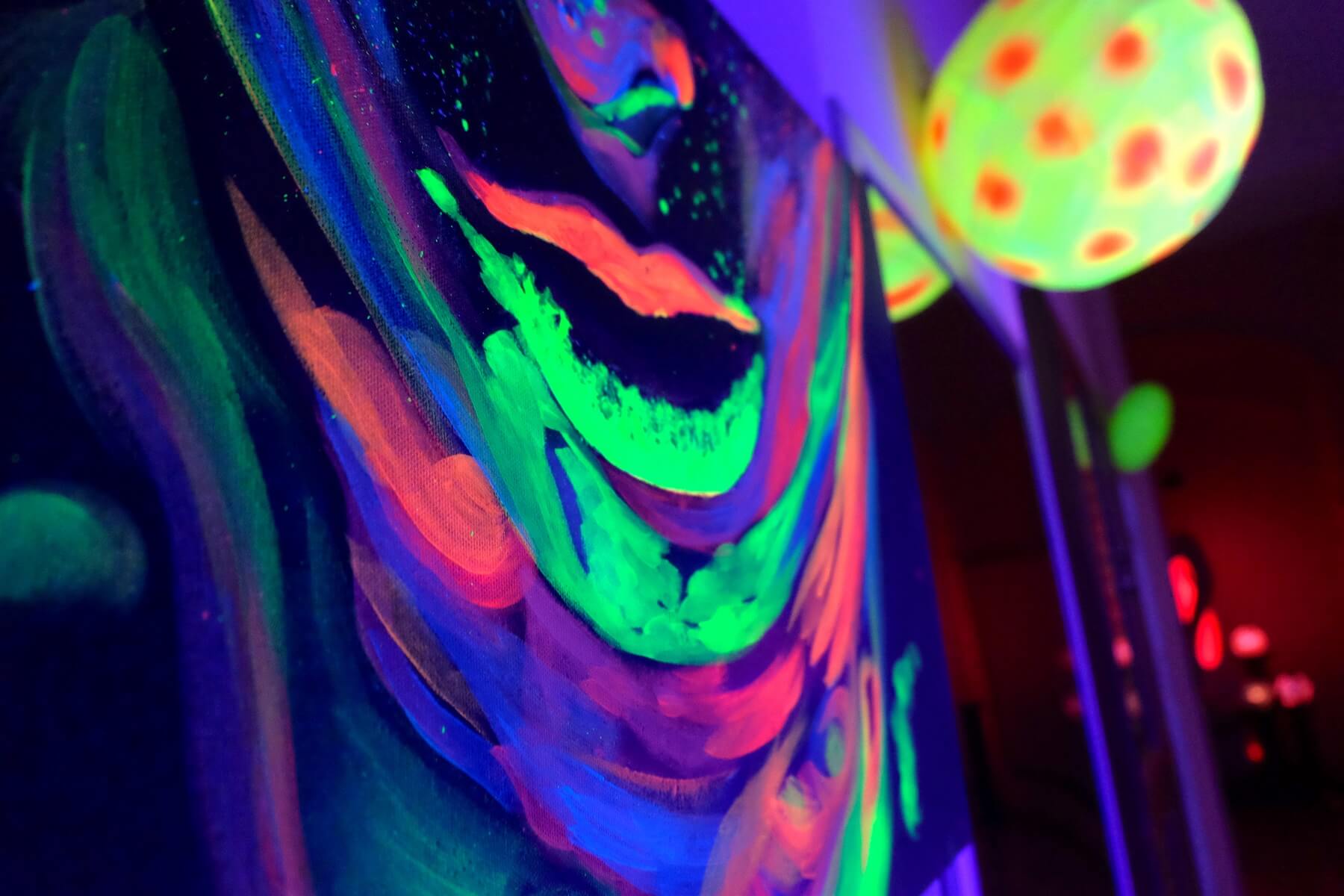
The penultimate hall of the exposition is an ultraviolet room. It is dark in it, and it is filled with a large number of luminescent objects. For example, there is a “luminous” map of Russia.
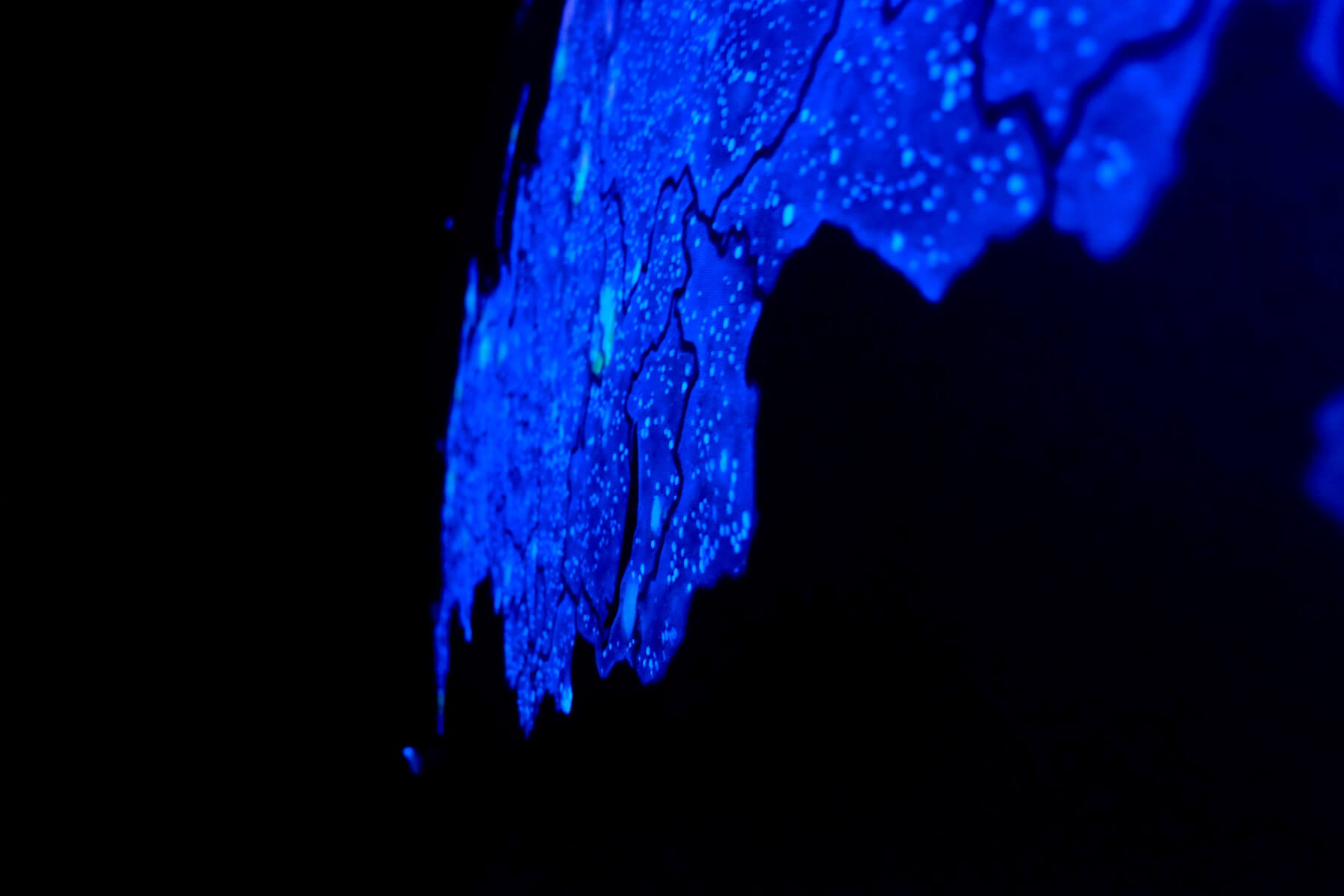
In the photo: Map of Russia, painted with fluorescent colors
The last exhibit is “The Magic Forest”. This is a mirror room with luminescent threads.
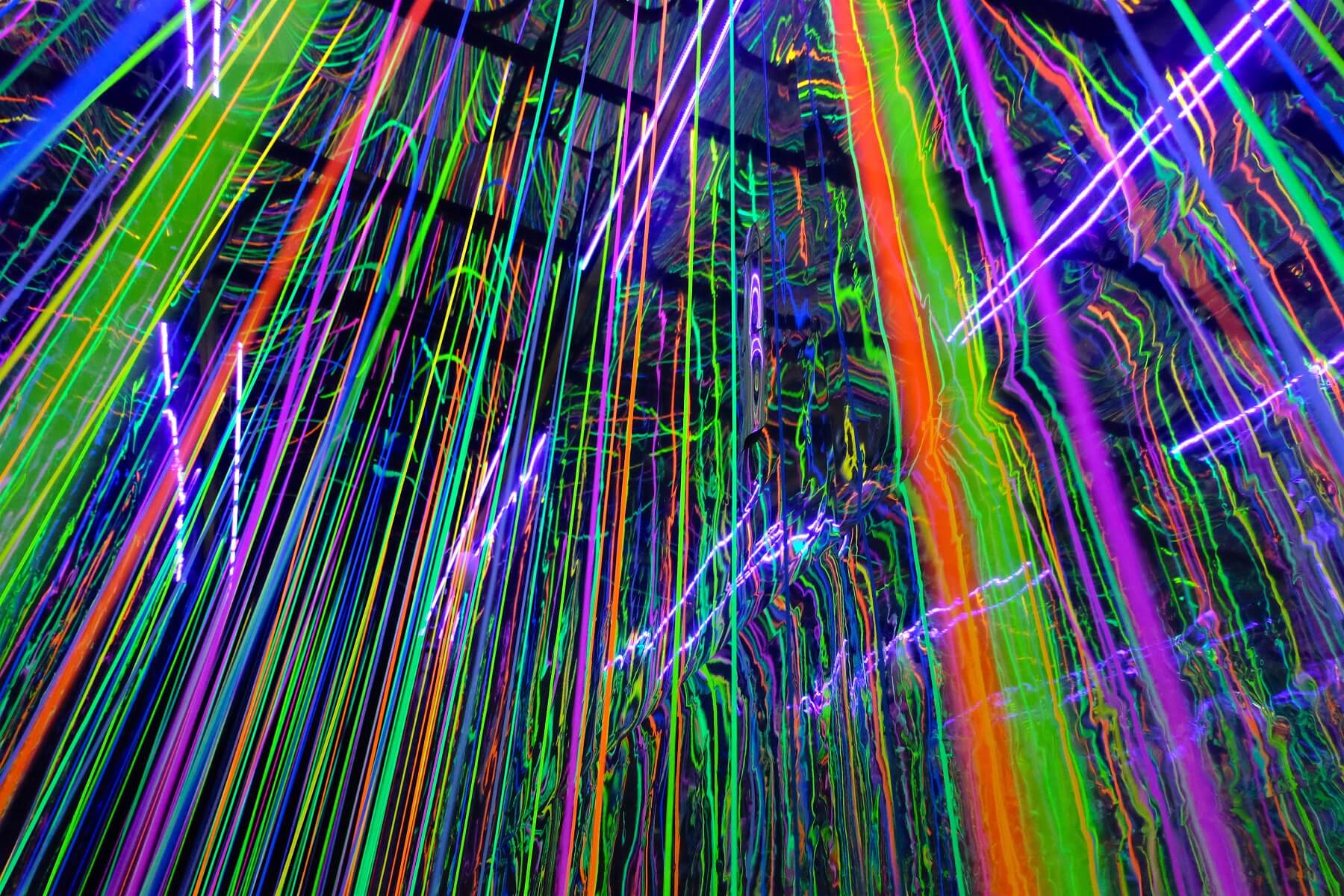
In the photo: "Magic Forest"

Every day, museum employees work on new exhibits and improve existing ones. Tours begin every twenty minutes. A series of master classes for students also allows you to master the school optics course in a fun and understandable format.
In the future we plan to increase the number of interactive art objects in the museum, as well as conduct more lectures and workshops on its basis. There will also be a VR zone with the development of the project of ITMO University “ Video 360 ”.
We hope that there will be more such interactive educational projects, and the Optics Museum of ITMO University will become an exhibition center for media artists from around the world.
Other articles from our blog on Habré:
Attention: there are a lot of photos under the cut.
The museum was not immediately built
Museum of Optics is the first interactive museum based on ITMO University . It is located in a building on Vasilievsky Island, where the State Optical Institute was previously located. The history of the museum dates back to 2007, when the restoration of buildings on the Exchange line was underway. The university staff had a question: what to place in the premises on the ground floors.
At that time, the direction of edutainment and Sergei Stafeev developed, professor of the Faculty of Physics and Technology, suggested that Rector Vladimir Vasiliev create an exhibition that would show children that optics is interesting. Initially, the museum helped the University solve the issue of career guidance and attracted students to specialized faculties. At first, only group excursions by appointment were held, mainly for grades 8–11.
Later, the museum team decided to organize a large popular science exhibition Magic of Light for everyone. It was first opened in 2015 on an area of more than a thousand square meters. meters.
Museum exposition: historical-informative
The first part of the exposition acquaints visitors with the history of optics and talks about the development of modern holographic technologies. Holography is a technology that allows you to reproduce three-dimensional images of various objects. At the exposition you can watch a short informative film telling about the physical essence of the phenomenon.
The first thing that visitors see is two tables on which mock-ups of a hologram recording scheme are located. As examples, a miniature of the monument to Peter I on a horse and a matryoshka were selected.
With a green laser - a classic recording scheme of Leith and Upatnieks , with which scientists received the first transmission volumetric hologram in 1962.
With a red laser - a diagram of the Russian scientist Yuri Nikolaevich Denisyuk. A laser is not required to view such holograms. They are visible in ordinary white light. The holographic part is devoted to a significant part of the exhibition. Indeed, it was in this building that Yu. N. Denisyuk made his discovery and assembled his first installation for recording holograms.
Today Denisyuk's scheme is used all over the world. With its help, analog holograms are recorded that are indistinguishable from real objects - “optoclones”. In the first hall of the museum there are boxes with holograms of the famous Easter eggs of Carl Faberge and the treasures of the Diamond Fund.
In the photo: holographic copies of “ Ruby Caesar ”, “ Badge of the Order of St. Alexander Nevsky "and jewelry" Bow-Sklavazh "
In addition to analog, in our museum there are also digital holograms. They are created using 3D modeling programs and laser technologies. Using photographs of an object or video (which can be done with the help of drones), its model is worked out on a computer. Then, it is counted into the interference pattern and transferred to a polymer film using a laser.
Such holograms are printed using special holoprinters using blue, red and green lasers (there is a little bit about their work in this short video ).
Among the digital holograms of the museum created by the University team, models of the Alexander Nevsky Lavra and the Naval Cathedral in Kronstadt can be noted.
Digital holograms are also four-way - they consist of four different pictures. If you go around such a hologram, then the images will begin to change.
So far, this method of recording holograms has not found wide application due to the cost of equipment for printing. There are no holoprinters in Russia, therefore, our Museum presents holograms of American and Latvian production, for example, a map of Mount Athos.
In the photo: Map of Mount Athos. The
second hall of the museum is also partially dedicated to holography. Its general appearance is in the photo below.
In the photo: Hall with holograms
. This hall presents a "holographic portrait" of Alexander Sergeyevich Pushkin. This is one of the largest holograms on glass, and in terms of scale it is a leader among analog holograms.
There was also a stand with a holographic portrait of Yu.N. Denisyuk with a story about the life of a scientist and his discovery. There is a hologram with frames of the poster for the film "I am a legend."
Holograms of objects from different museums of the world are installed in this room, for example, Hotei from the Russian Museum of Ethnography.
To the left of Pushkin’s bust is a lamp placed in a transparent case. Although this exhibit seems to be a lamp only at first glance. Inside it is an impeller with white and black blades. If you turn on the spotlight and shine on the impeller, it will begin to rotate.
The exhibit is called the Crookes Radiometer.
Each of the four blades has a dark and bright side. Dark - heats up more than light (due to the characteristics of light absorption). Therefore, the molecules of the gas in the flask bounce off the dark side of the blade at a faster rate than on the light side. Because of this, the blade, turned to the light source with the dark side, receives a greater momentum.
The second part of the hall is devoted to the history of optics: the development of photography and the invention of glasses, the history of the appearance of mirrors and lamps.
At the stands you can find a large number of various optical instruments: microscopes, reading stones , vintage cameras and antique glasses. During the tour, you can find out the history of the appearance of the first mirrors from obsidian, bronze and, finally, glass. The showcase presents a real Venetian convex mirror, created using technology of the XVII century. And the bronze “magic mirror” (if you direct it to the sun, and the reflected “bunny” - to the white wall, then an image from the back of the mirror will appear on it).
In the same room there is a collection of cameras. The exposition makes it possible to trace their development from the pinhole camera - the progenitor of the camera - to the present.
In the photo: A collection of cameras
On the windows were cameras with folding fur and copies of the Pontiac MFAP, produced from 1941 to 1948, and the AGFA BILLY from 1928. Among the presented devices, one can find Photocor , the first Soviet large-scale camera, created on the basis of the most successful Western models. In the USSR, it was released until 1941.
In the photo: Folding Camera " Photocor "
If you go to the next room of the museum, then it is possible to see a monumental body of light and music. "Instrument" consists of 144 special optical glasses of various grades and brands - Abbe catalog. Similar in size of glass blocks and the completeness of the collection is not anywhere in the world. They began to collect it back in the USSR in order to perpetuate the achievement of scientists from the State Optical Institute who developed the technology for the production of radiation-resistant glass.
Now under each bar of glass is an LED line. These lines are controlled by controllers and a hub connected to a personal computer. If you play a melody on your PC, then the organ will begin to flicker in different colors, depending on the tonality and pitch. The program has eight algorithms for converting sound into color. You can evaluate the system in this video on YouTube .
Continuation of the exposure: interactive part
After the collection of optical glass, the second part of the exposition - interactive. Most of the exhibits here can and should be touched. The interactive part begins with a study of the history of cinema and 3D vision.
Zoetrope , phenakistoscope , fonotropy - give an idea of how scientists studied the mechanisms of vision and information processing. An example of a phonotope you can see in the photo below. The principle of operation is based on inertia of vision. What we do not see with the eye, as the picture is blurred, is clearly visible through the smartphone’s camera.
In the photo: phonotropic - a modern analogue of the zootrop
In the photo: Optical illusion
Modern 3D cinema is rooted in the 19th century - a stereoscope with pre-revolutionary cards helps to make sure of this. A 3D screen is also installed there, to view the image on which special glasses are not required.
In the photo: an old stereoscope of 1901.
In the exhibition hall there is a table with stationery rulers and other transparent objects. If you look at them through special filters, then they will bloom with all the colors of the rainbow. This phenomenon is called photoelasticity .
This is an effect when under the influence of mechanical stresses the bodies acquire double refraction (due to the different refractive index for light). Therefore, there are rainbow patterns. By this method, by the way, the loads in the construction of bridges and implants are checked.
In the photo below - another white glowing screen. If you look at it through special filters, the image of a colored dragon will appear on it.
ITMO University often implements joint projects with artists who exhibit their work in the museum. For example, in one of the interactive halls the LED installation “ Wave ” is installed - the result of a “collaboration” of university specialists and the Sonicology project team. The project’s ideologist was media artist and composer Taras Mashtalir.
The Wave art object is a two-meter sculpture that, with the help of motion sensors, “reads” the behavior of the audience and generates light and musical reactions.
In the photo: Wave LED installation
The next hall of the exposition contains mirror illusions. Anamorphoses “decode” strange images and turn them into understandable images.
Next is a dark room in which there are plasma lamps. You can touch them.
On the wall to the right of the lamps you can draw a flashlight, it has a special coating. And the wall, on the contrary, does not absorb light, but reflects. If you take a picture against its background with a flash, then on the camera screen we get only a shadow.
The penultimate hall of the exposition is an ultraviolet room. It is dark in it, and it is filled with a large number of luminescent objects. For example, there is a “luminous” map of Russia.
In the photo: Map of Russia, painted with fluorescent colors
The last exhibit is “The Magic Forest”. This is a mirror room with luminescent threads.
In the photo: "Magic Forest"
"To infinity and beyond"
Every day, museum employees work on new exhibits and improve existing ones. Tours begin every twenty minutes. A series of master classes for students also allows you to master the school optics course in a fun and understandable format.
In the future we plan to increase the number of interactive art objects in the museum, as well as conduct more lectures and workshops on its basis. There will also be a VR zone with the development of the project of ITMO University “ Video 360 ”.
We hope that there will be more such interactive educational projects, and the Optics Museum of ITMO University will become an exhibition center for media artists from around the world.
Other articles from our blog on Habré: