LED dimmers
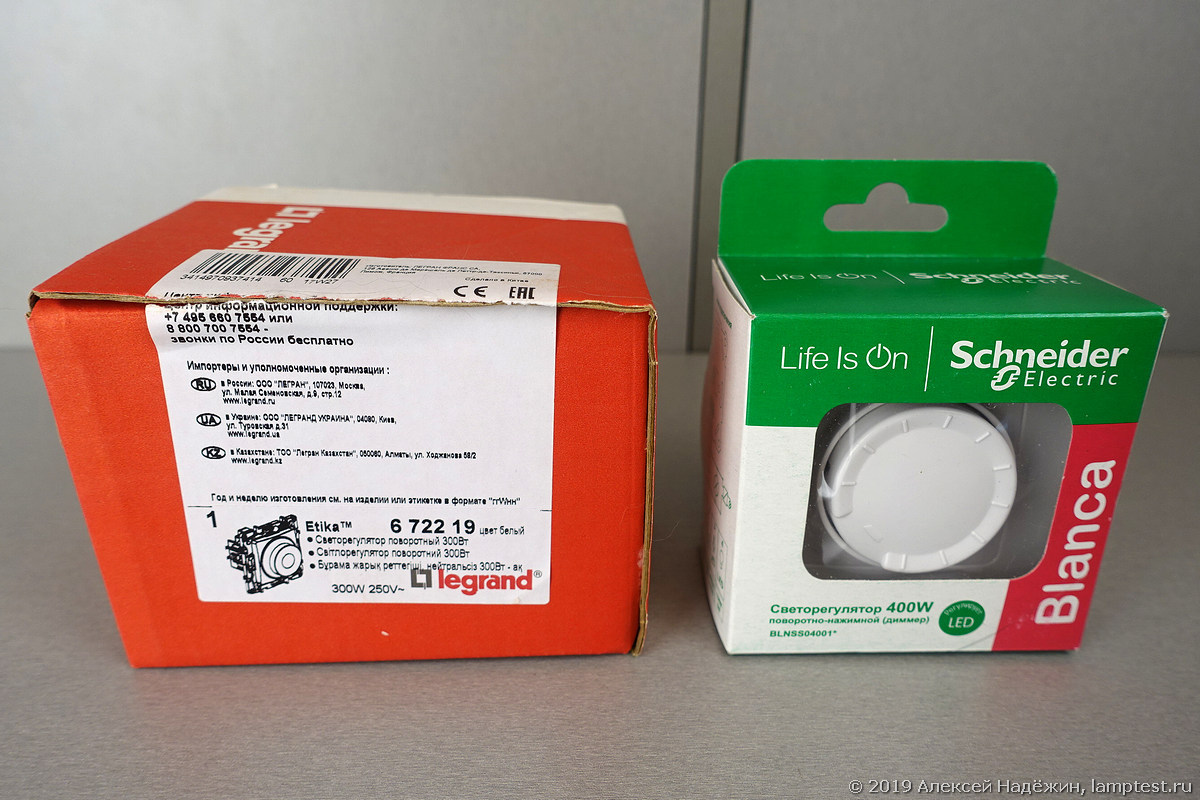
On sale, dimmers specifically designed for LED lamps begin to appear. I bought and tested two models: Legrand Etika 672219 and Schneider Blanca BLNSS04001.
Most LED lamps do not support brightness control, but there are dimmable lamps, the brightness of which, in theory, can be adjusted with a conventional dimmer for incandescent lamps.
Many are faced with the fact that dimmable lamps do not work well: either they shine too brightly at the minimum level, or at some levels their light starts to tremble, or hum when dimming, or even flash and blink. It turned out that almost every lamp model in its own way works with each dimmer model. First of all, the reason for this is that ordinary dimmers are not designed for LED lamps, many of them have a minimum load of 40-60 watts and often this is less than the consumption of the entire chandelier with LED lamps.
Last year, I tested how ten different dimmers work with fifteen LED lamp models (habr.com/ru/company/lamptest/blog/430678 ). Only one out of ten dimmers worked flawlessly with all the lamps, but it was a radio-controlled dimmer specifically designed for LED lamps.
Among hundreds of ordinary rotary knob dimmers on sale, you can find several models designed for LED lamps. On their packaging it is indicated that they work with LED lamps, but most sellers and online stores do not indicate this by illiteracy.
Such dimmers can be distinguished by several signs:
Different lamps work differently when dimming on a rising or falling edge. It happens that when dimming on the leading edge of the lamp, they buzz loudly, but there is almost no sound on the trailing edge. Others, when dimming on a trailing edge, "go crazy" - flash, blink. Still others, when dimming along a rising edge, shine too brightly even at the very minimum of dimming, and when dimming along a falling edge, they can go out almost to zero. That is why the ability to switch the dimming method is important for LED lamps.
All the signs listed above are in two dimmers, which I found and bought for the experiment.
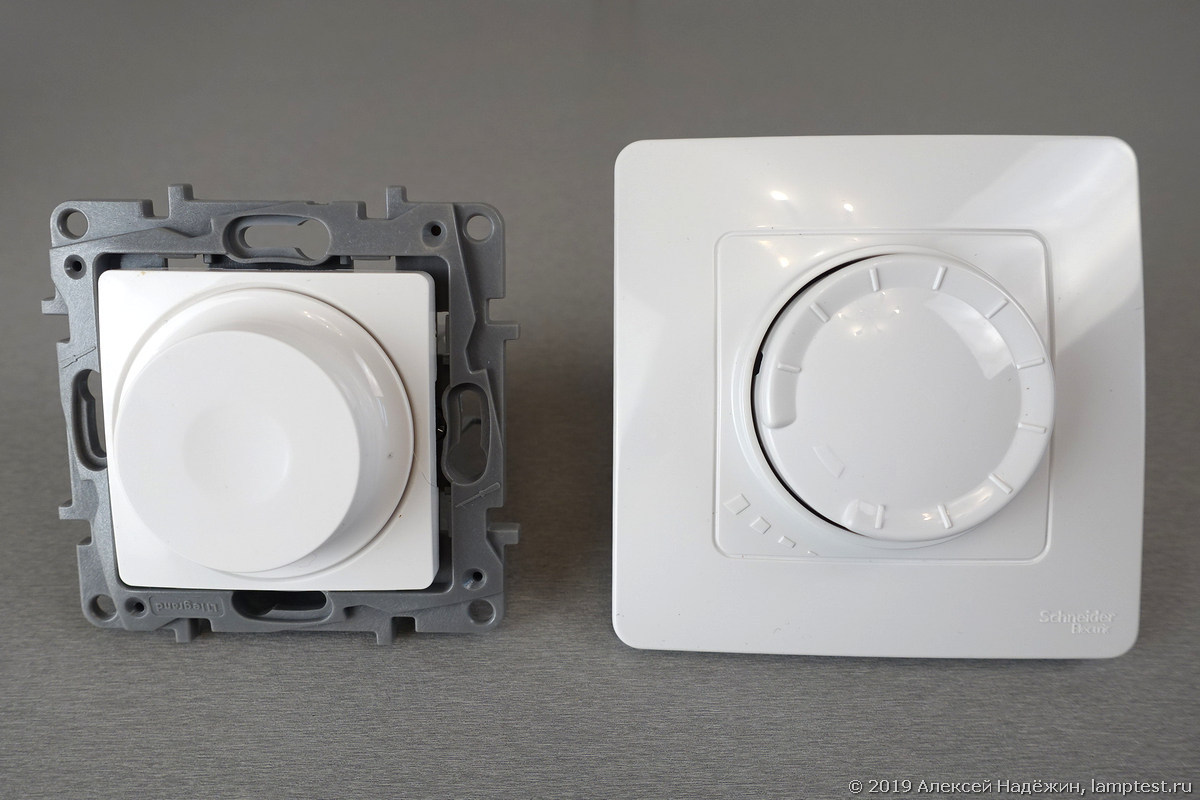
Legrand Etika 672219 costs 1475 rubles and you need to buy an additional frame for it. Schneider Blanca BLNSS040011 (the last digit means color) costs from 1425 rubles and it already has a frame.
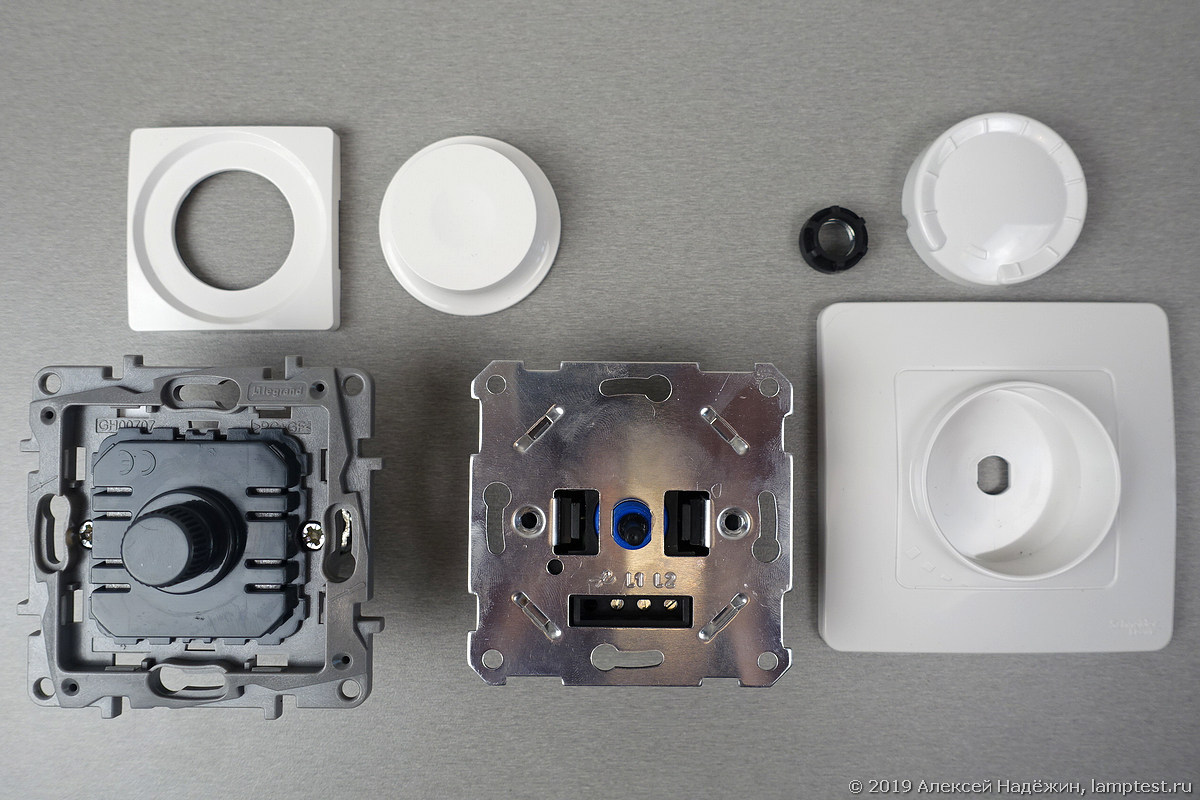
Legrand Etika 672219 can work with conventional incandescent or halogen lamps with a total power of up to 300 W or dimmable LED lamps from 5 to 75 W (maximum 10 lamps). It is controlled by an endlessly rotating encoder knob (adjustment from minimum to maximum - 1.5-2 turns). Pressing the handle turns the light on and off.
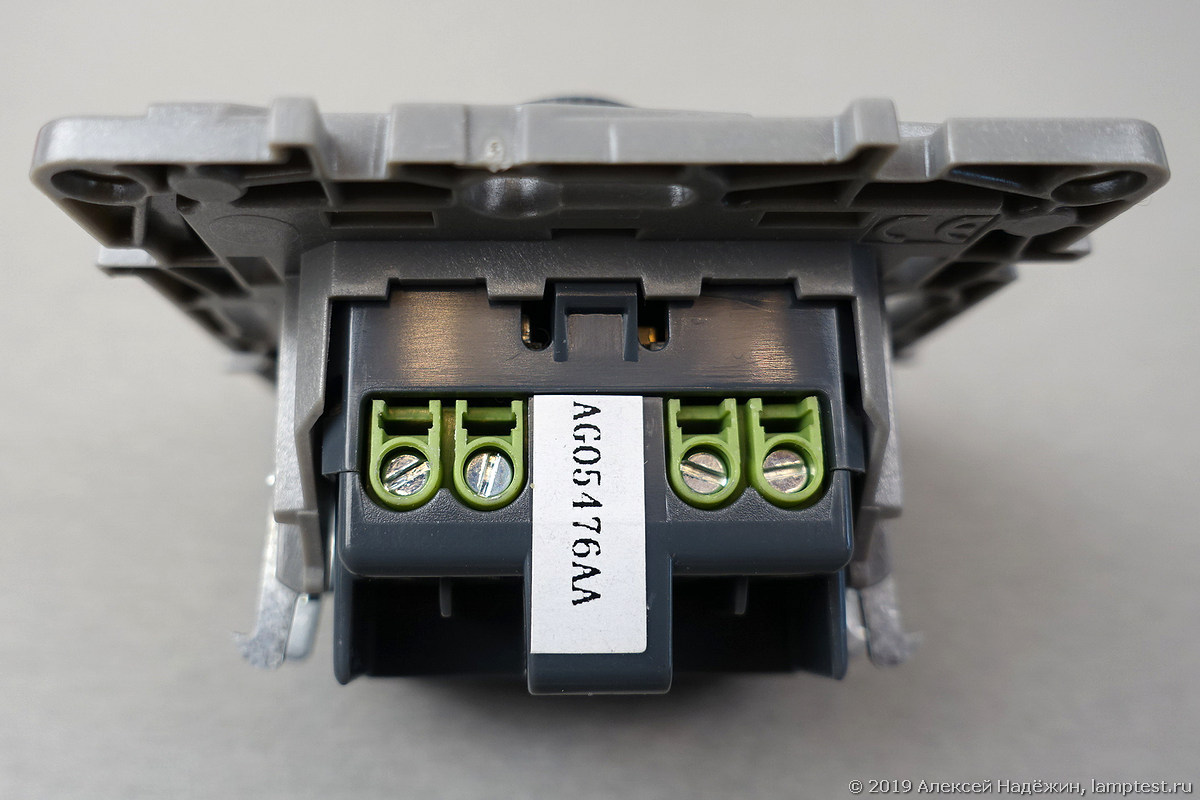
It is possible to connect additional control buttons with which you can both turn the light on and off (short press) and adjust its brightness (long press).
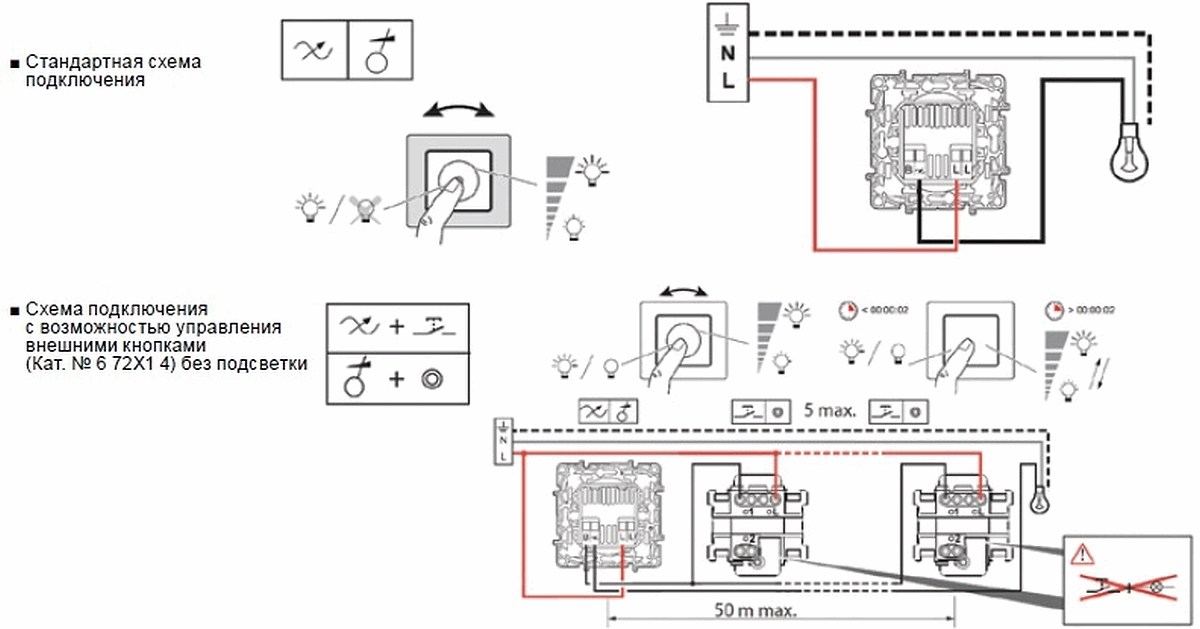
To connect the buttons there is an additional contact, two contacts L are interconnected.
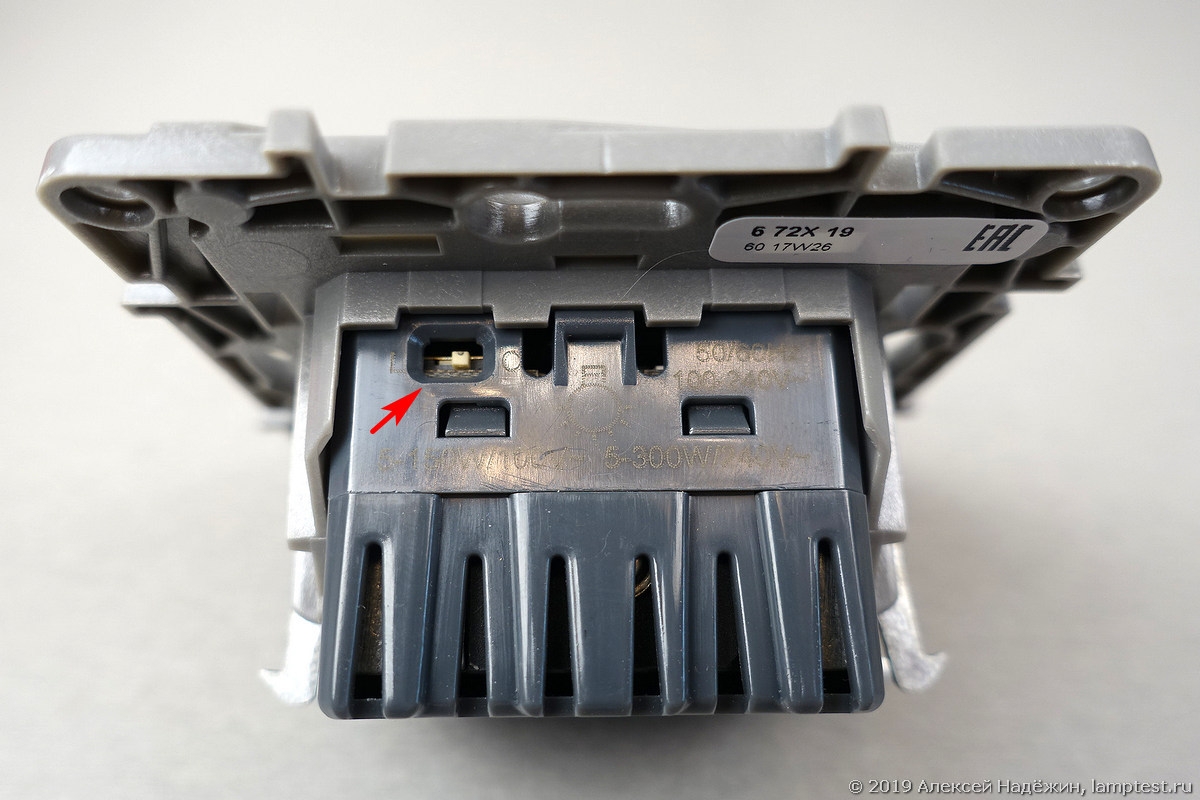
The dimming method is changed by a microswitch on the side wall.
The minimum brightness level is adjusted after a long press on the handle.
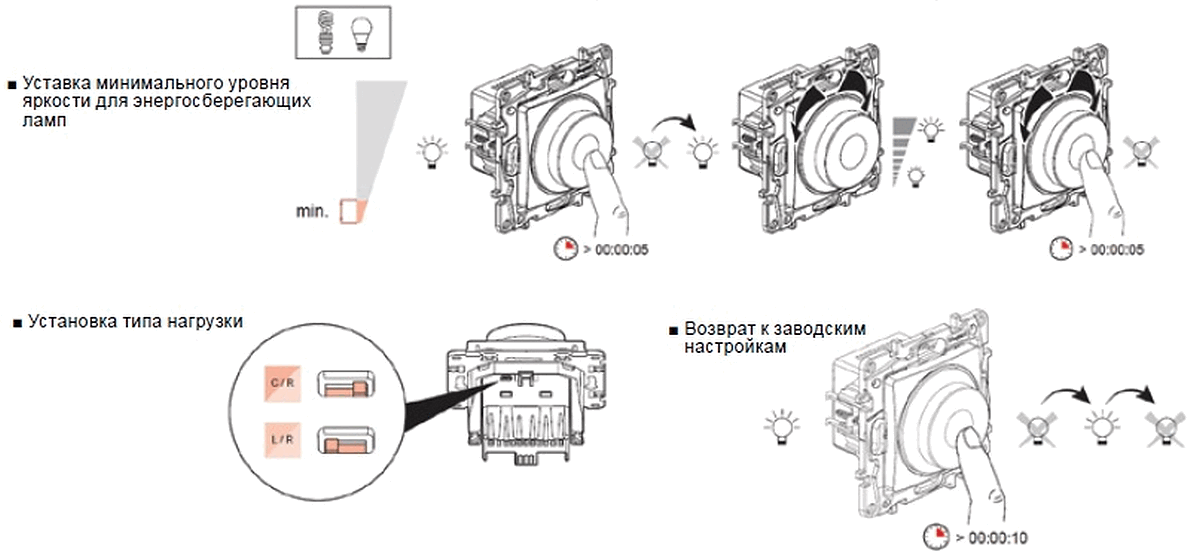
The dimmer remembers the state and when turned on, sets the brightness that was before turning off.
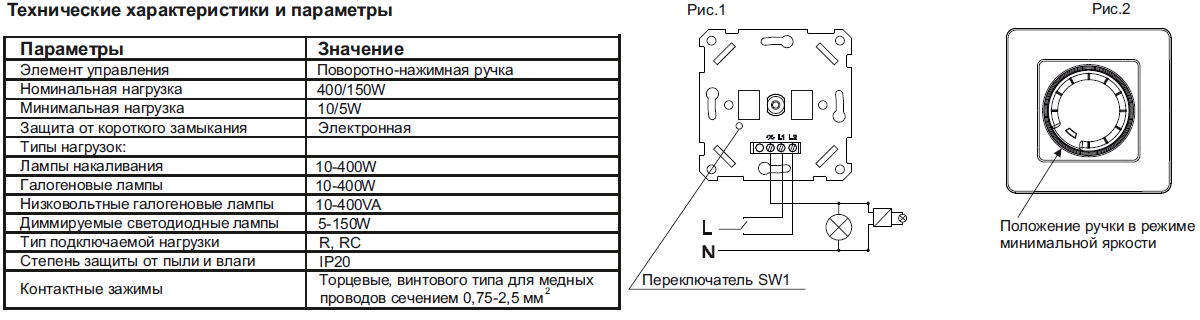
Schneider Blanca BLNSS04001 works with incandescent and halogen lamps up to 400 watts or dimmable LED lamps from 5 to 150 watts. It is controlled by a step encoder with 16 positions and an emphasis in extreme positions, respectively, only 16 levels of brightness are possible. Pressing the handle turns the light on and off. The brightness level and status (on or off) is remembered even when the power is turned off.
The dimmer has three pins.
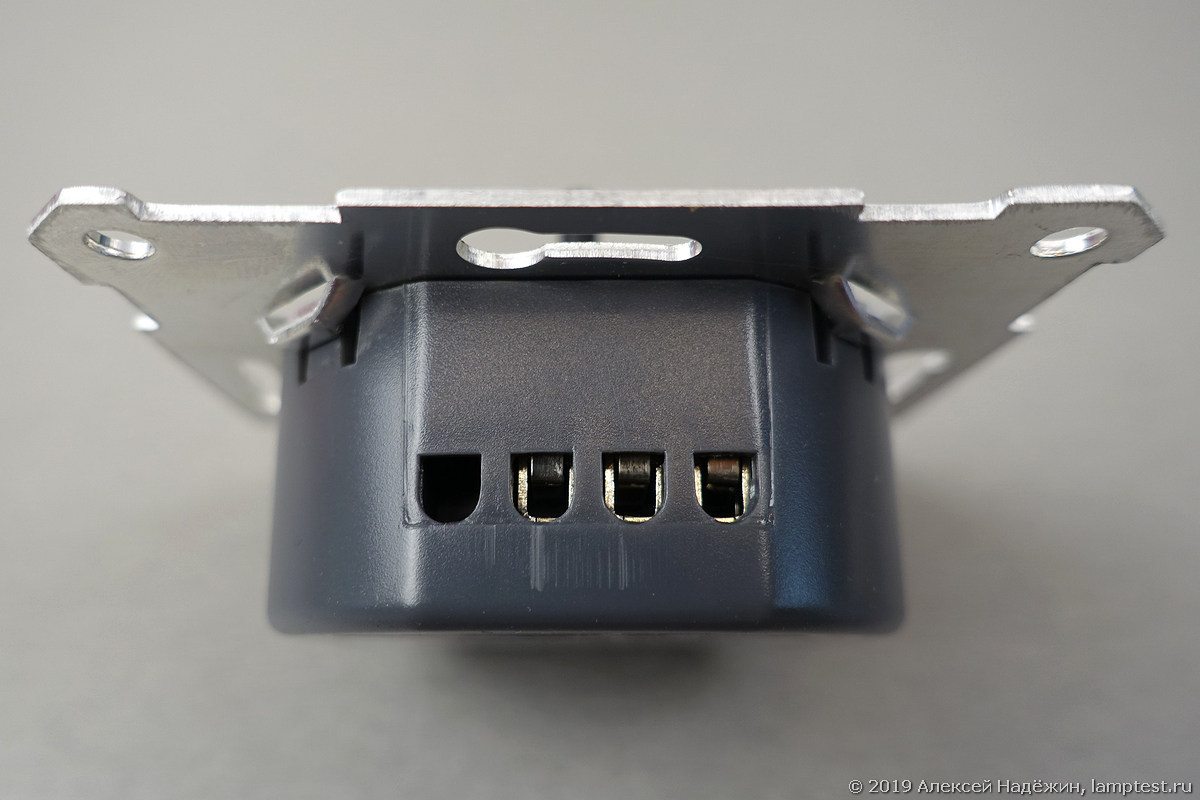
Two inputs L1 and L2 allow you to implement external light control: if you connect a switch to them, it will turn on and off the light (if the dimmer was on, when the switch is switched on, the light will turn off, if it was turned off, it will turn on). When this function is not needed, electricity can be connected to any of the inputs.
On the front panel there is a hole under which the service button is located.
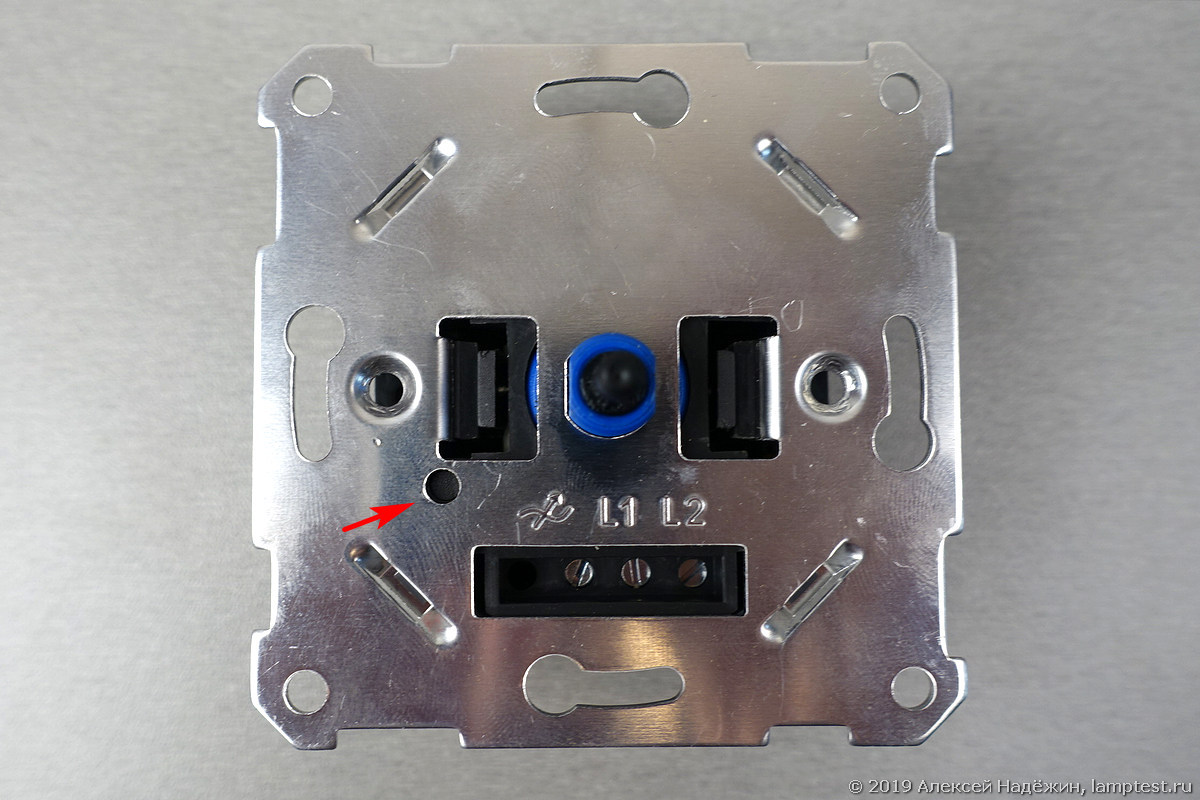
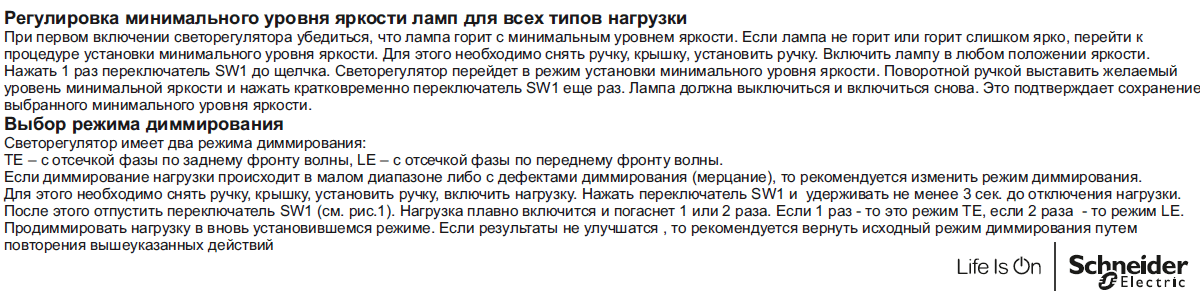
Using this button and the main knob, the minimum brightness level is set and the dimming method is selected.
Sometimes dimmable LED lamps behave differently when one or more lamps are connected to the dimmer, so I tested dimmers with 4-6 lamps connected in parallel, because this is how it will be in a real chandelier.
Both dimmers work quite well with different lamps and in one mode or another, each of them worked normally with each set of lamps. Due to the fact that the dimmers are turned on in a two-wire circuit, not all lamps burn at full brightness with a maximum of adjustment (they give 95-99%, which is almost indistinguishable from full brightness).
All lamps manage to reduce the brightness to levels less than 1% of the full brightness, but in some cases the lamps do not light up at such low brightness and after turning on you have to turn the knob to the right so that the lamps light up, and then lower the brightness if necessary. However, you can set the minimum brightness at 3-5%, at which the lamps will be guaranteed to turn on (there are also those that turn on even at the level of 0.1%).
A strange thing happened with the Legrand dimmer. At first, it always turned on at a brightness of 100% and smoothly, in 5 seconds, reduced the brightness to a remembered one, and then suddenly stopped doing this and immediately started to turn on a stored brightness. Most likely he has different switching modes, which are somehow configured by manipulating the pen and clicking on it, but not a word in the instructions about it.
There were oddities with Schneider: the instructions say that he switches the control method on the rising or falling edges by long pressing the service button, while the light flashes once or twice. In fact, it turned out that work on the leading edge is switched on by long pressing the service button when the brightness is set to maximum (the light blinks three times). Work on the trailing edge is activated by a long press of the service button when the brightness is not maximum (the light flashes once).
Advantages of the Schneider Blanca BLNSS04001 dimmer:
- Works with all LED lamps;
- It is convenient that the handle has extreme positions;
- To switch the type of regulation do not need to remove the dimmer from the wall;
- You can control the light with an external switch.
Cons of the Schneider Blanca BLNSS04001 dimmer:
- For settings you need to remove the front panel;
- Tight enough pressing.
Advantages of the Legrand Etika 672219 dimmer:
- Works with all LED lamps;
- Smooth adjustment due to the fact that the handle spins endlessly;
- Support for additional light control buttons;
- To adjust the minimum brightness, you do not need to remove the front panel.
Cons of the dimmer Legrand Etika 672219:
- In the adjustment mode on the trailing edge, with some lamps it buzzes, some start to blink;
- To switch the adjustment method, you need to remove the dimmer from the wall.
Both dimmers are not ideal, but for LED lamps they are much better than ordinary ones - with each of these two dimmers I managed to achieve stable brightness control of the lamps in a wide range.
PS If you need one of these two dimmers, please contact. I bought them only for study and this article. I am in Moscow. I will give a little cheaper than the market value.
© 2019, Alexey Nadezhin
Most LED lamps do not support brightness control, but there are dimmable lamps, the brightness of which, in theory, can be adjusted with a conventional dimmer for incandescent lamps.
Many are faced with the fact that dimmable lamps do not work well: either they shine too brightly at the minimum level, or at some levels their light starts to tremble, or hum when dimming, or even flash and blink. It turned out that almost every lamp model in its own way works with each dimmer model. First of all, the reason for this is that ordinary dimmers are not designed for LED lamps, many of them have a minimum load of 40-60 watts and often this is less than the consumption of the entire chandelier with LED lamps.
Last year, I tested how ten different dimmers work with fifteen LED lamp models (habr.com/ru/company/lamptest/blog/430678 ). Only one out of ten dimmers worked flawlessly with all the lamps, but it was a radio-controlled dimmer specifically designed for LED lamps.
Among hundreds of ordinary rotary knob dimmers on sale, you can find several models designed for LED lamps. On their packaging it is indicated that they work with LED lamps, but most sellers and online stores do not indicate this by illiteracy.
Such dimmers can be distinguished by several signs:
- an explicit indication on the packaging and in the instructions that the dimmer works with LED lamps;
- low level of minimum power (usually from 5 watts) and a low level of maximum power (100-400 watts);
- the presence of adjustments to the minimum dimming level;
- the ability to switch the dimming method on the leading or trailing edge.
Different lamps work differently when dimming on a rising or falling edge. It happens that when dimming on the leading edge of the lamp, they buzz loudly, but there is almost no sound on the trailing edge. Others, when dimming on a trailing edge, "go crazy" - flash, blink. Still others, when dimming along a rising edge, shine too brightly even at the very minimum of dimming, and when dimming along a falling edge, they can go out almost to zero. That is why the ability to switch the dimming method is important for LED lamps.
All the signs listed above are in two dimmers, which I found and bought for the experiment.
Legrand Etika 672219 costs 1475 rubles and you need to buy an additional frame for it. Schneider Blanca BLNSS040011 (the last digit means color) costs from 1425 rubles and it already has a frame.
Legrand Etika 672219 can work with conventional incandescent or halogen lamps with a total power of up to 300 W or dimmable LED lamps from 5 to 75 W (maximum 10 lamps). It is controlled by an endlessly rotating encoder knob (adjustment from minimum to maximum - 1.5-2 turns). Pressing the handle turns the light on and off.
It is possible to connect additional control buttons with which you can both turn the light on and off (short press) and adjust its brightness (long press).
To connect the buttons there is an additional contact, two contacts L are interconnected.
The dimming method is changed by a microswitch on the side wall.
The minimum brightness level is adjusted after a long press on the handle.
The dimmer remembers the state and when turned on, sets the brightness that was before turning off.
Schneider Blanca BLNSS04001 works with incandescent and halogen lamps up to 400 watts or dimmable LED lamps from 5 to 150 watts. It is controlled by a step encoder with 16 positions and an emphasis in extreme positions, respectively, only 16 levels of brightness are possible. Pressing the handle turns the light on and off. The brightness level and status (on or off) is remembered even when the power is turned off.
The dimmer has three pins.
Two inputs L1 and L2 allow you to implement external light control: if you connect a switch to them, it will turn on and off the light (if the dimmer was on, when the switch is switched on, the light will turn off, if it was turned off, it will turn on). When this function is not needed, electricity can be connected to any of the inputs.
On the front panel there is a hole under which the service button is located.
Using this button and the main knob, the minimum brightness level is set and the dimming method is selected.
Sometimes dimmable LED lamps behave differently when one or more lamps are connected to the dimmer, so I tested dimmers with 4-6 lamps connected in parallel, because this is how it will be in a real chandelier.
Both dimmers work quite well with different lamps and in one mode or another, each of them worked normally with each set of lamps. Due to the fact that the dimmers are turned on in a two-wire circuit, not all lamps burn at full brightness with a maximum of adjustment (they give 95-99%, which is almost indistinguishable from full brightness).
All lamps manage to reduce the brightness to levels less than 1% of the full brightness, but in some cases the lamps do not light up at such low brightness and after turning on you have to turn the knob to the right so that the lamps light up, and then lower the brightness if necessary. However, you can set the minimum brightness at 3-5%, at which the lamps will be guaranteed to turn on (there are also those that turn on even at the level of 0.1%).
A strange thing happened with the Legrand dimmer. At first, it always turned on at a brightness of 100% and smoothly, in 5 seconds, reduced the brightness to a remembered one, and then suddenly stopped doing this and immediately started to turn on a stored brightness. Most likely he has different switching modes, which are somehow configured by manipulating the pen and clicking on it, but not a word in the instructions about it.
There were oddities with Schneider: the instructions say that he switches the control method on the rising or falling edges by long pressing the service button, while the light flashes once or twice. In fact, it turned out that work on the leading edge is switched on by long pressing the service button when the brightness is set to maximum (the light blinks three times). Work on the trailing edge is activated by a long press of the service button when the brightness is not maximum (the light flashes once).
Advantages of the Schneider Blanca BLNSS04001 dimmer:
- Works with all LED lamps;
- It is convenient that the handle has extreme positions;
- To switch the type of regulation do not need to remove the dimmer from the wall;
- You can control the light with an external switch.
Cons of the Schneider Blanca BLNSS04001 dimmer:
- For settings you need to remove the front panel;
- Tight enough pressing.
Advantages of the Legrand Etika 672219 dimmer:
- Works with all LED lamps;
- Smooth adjustment due to the fact that the handle spins endlessly;
- Support for additional light control buttons;
- To adjust the minimum brightness, you do not need to remove the front panel.
Cons of the dimmer Legrand Etika 672219:
- In the adjustment mode on the trailing edge, with some lamps it buzzes, some start to blink;
- To switch the adjustment method, you need to remove the dimmer from the wall.
Both dimmers are not ideal, but for LED lamps they are much better than ordinary ones - with each of these two dimmers I managed to achieve stable brightness control of the lamps in a wide range.
PS If you need one of these two dimmers, please contact. I bought them only for study and this article. I am in Moscow. I will give a little cheaper than the market value.
© 2019, Alexey Nadezhin