April 11, 2019 at 20:31
A very important parameter of LED lamps, which few people know about
On the packaging of LED lamps, you can find many parameters: power, light output, power equivalent, color rendering index. But manufacturers indicate one very important parameter extremely rarely. This is a type of driver.
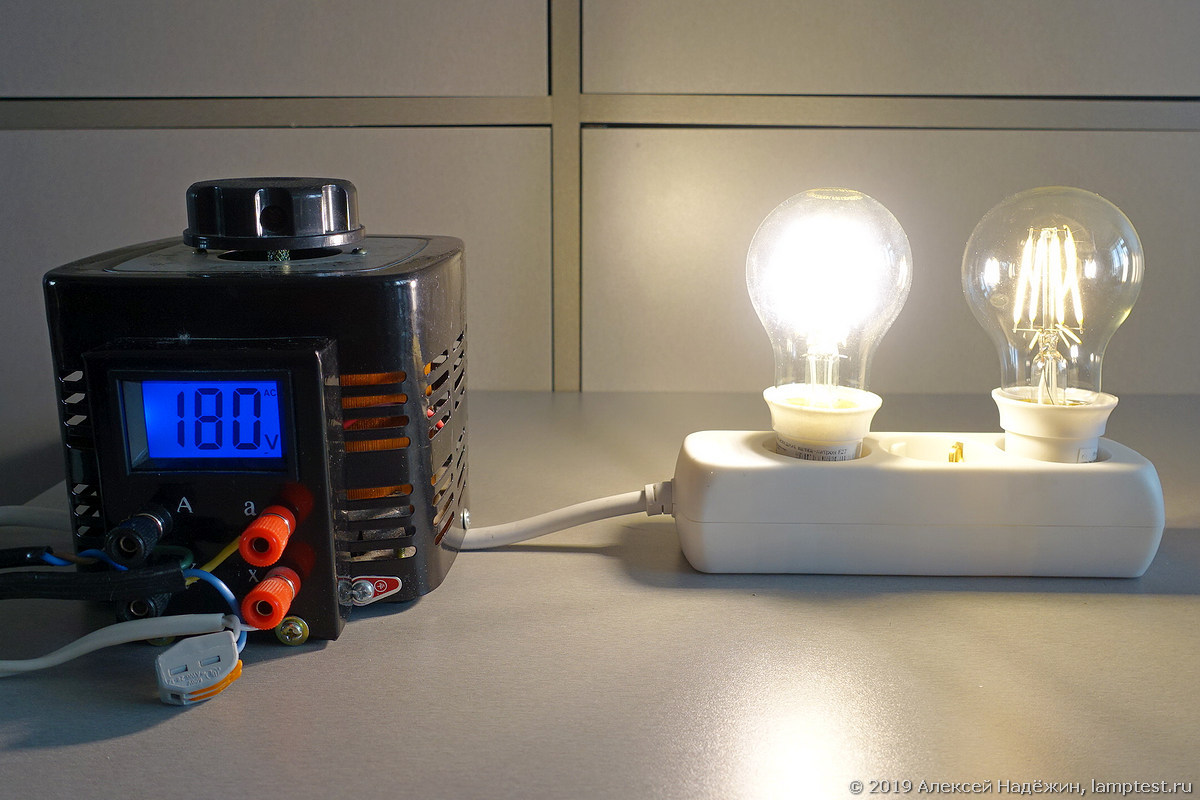
According to GOST 29322-92 , the network must have a voltage of 230 volts, however, the same GOST allows a deviation of the mains voltage of ± 10%, that is, a voltage of 207 to 253 volts is permissible. However, in many areas (especially rural), the voltage sometimes drops to 180 volts or lower.
Under reduced voltage, the usual “Ilyich bulbs” shine much dimmer. At the lower threshold of the permissible voltage of 207 volts, a 60-watt incandescent lamp rated for 230 V shines like a 40-watt rated voltage ( habr.com/ru/company/lamptest/blog/386513/ ).
The operation of LED lamps at reduced voltage depends on the type of electronic circuit (driver) used.
If the lamp uses the simplest RC-driver or a linear driver on a microcircuit, the lamp behaves almost the same as an incandescent lamp (it dims dimmer when the voltage is reduced, and when the voltage surges in the network, its light “twitches”).
If the IC driver is used, the lamp brightness does not change when the supply voltage changes over a very wide range. In fact, such lamps have a built-in stabilizer.
If you look at all the LED lamps that I tested in the Lamptest.ru project, determining the type of driver, it turns out that 3/4 of all lamps have an IC driver and only a quarter have a linear or RC driver. If you look only at filament lamps, the picture changes dramatically: out of 321 lamps tested, only 131 (40%) have IC drivers.
In most lamps with a linear driver, the brightness drops by 5% of the nominal when the voltage drops to 210-220 V and 10% when the voltage is 200-210V.
Some lamps with an IC driver do not reduce brightness when the voltage drops even to 50 volts, but most work stably at voltages from 150 volts.
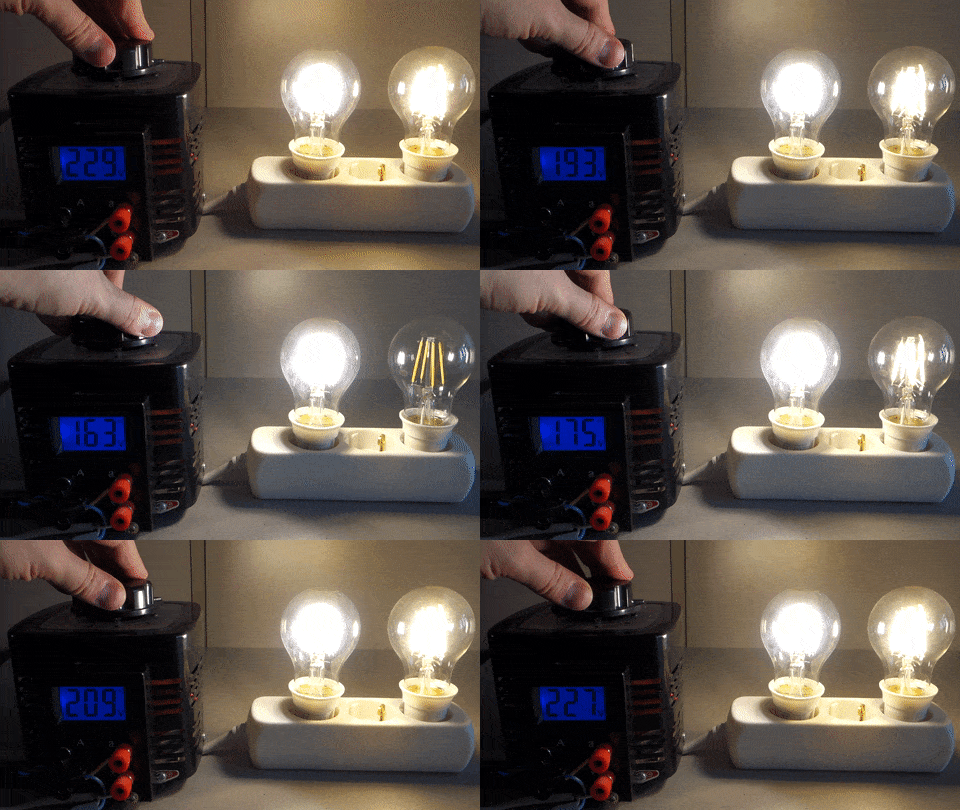
This is how two filament lamps (the left with the IC driver, the right with the linear) behave when the voltage changes from 230 to 160 volts.
I measure the minimum voltage at which the luminous flux of the lamp drops by no more than 5% of the nominal. In the Lamptest results table, this voltage is indicated in the Vmin column. If, when the voltage decreases, the luminous flux begins to fall immediately, I indicate the linear (LIN) type of driver (column “drv”), if the luminous flux is stable when the voltage decreases, then it starts to decrease, type of driver IC1, if the lamp turns off when the voltage decreases, - IC2, if it starts to flash - IC3.
Unfortunately, it is almost impossible to find out the type of driver for lamp packaging and the parameters provided by manufacturers on the sites. Some manufacturers write on the package "IC driver". More often they write a wide voltage range, for example, "170-260V", but this is not always true. There are a lot of lamps on Lamptest, which have wide voltage ranges, but in fact they have a linear driver installed and on the lower border of the indicated range they burn "completely." Specifying a narrow range of “220-240 V” or simply “230 V” also does not mean anything: many of these lamps are built on an IC driver and actually operate at significantly lower voltages without reducing brightness.
All I can advise to determine the type of driver is to look at the results on Lamptest for a lamp or its analogues (same manufacturer, same type, same base), if a specific lamp model has not yet been tested.
Of course, lamps with an IC driver are better. They do not change brightness when the voltage in the network decreases and their light does not “twitch” during voltage drops. In addition, such a driver is certainly better protected from any voltage drops and is generally more reliable.
I recommend that you consider the type of driver when choosing LED lamps and, if possible, buy lamps with an IC driver.
© 2019, Alexey Nadezhin
According to GOST 29322-92 , the network must have a voltage of 230 volts, however, the same GOST allows a deviation of the mains voltage of ± 10%, that is, a voltage of 207 to 253 volts is permissible. However, in many areas (especially rural), the voltage sometimes drops to 180 volts or lower.
Under reduced voltage, the usual “Ilyich bulbs” shine much dimmer. At the lower threshold of the permissible voltage of 207 volts, a 60-watt incandescent lamp rated for 230 V shines like a 40-watt rated voltage ( habr.com/ru/company/lamptest/blog/386513/ ).
The operation of LED lamps at reduced voltage depends on the type of electronic circuit (driver) used.
If the lamp uses the simplest RC-driver or a linear driver on a microcircuit, the lamp behaves almost the same as an incandescent lamp (it dims dimmer when the voltage is reduced, and when the voltage surges in the network, its light “twitches”).
If the IC driver is used, the lamp brightness does not change when the supply voltage changes over a very wide range. In fact, such lamps have a built-in stabilizer.
If you look at all the LED lamps that I tested in the Lamptest.ru project, determining the type of driver, it turns out that 3/4 of all lamps have an IC driver and only a quarter have a linear or RC driver. If you look only at filament lamps, the picture changes dramatically: out of 321 lamps tested, only 131 (40%) have IC drivers.
In most lamps with a linear driver, the brightness drops by 5% of the nominal when the voltage drops to 210-220 V and 10% when the voltage is 200-210V.
Some lamps with an IC driver do not reduce brightness when the voltage drops even to 50 volts, but most work stably at voltages from 150 volts.
This is how two filament lamps (the left with the IC driver, the right with the linear) behave when the voltage changes from 230 to 160 volts.
I measure the minimum voltage at which the luminous flux of the lamp drops by no more than 5% of the nominal. In the Lamptest results table, this voltage is indicated in the Vmin column. If, when the voltage decreases, the luminous flux begins to fall immediately, I indicate the linear (LIN) type of driver (column “drv”), if the luminous flux is stable when the voltage decreases, then it starts to decrease, type of driver IC1, if the lamp turns off when the voltage decreases, - IC2, if it starts to flash - IC3.
Unfortunately, it is almost impossible to find out the type of driver for lamp packaging and the parameters provided by manufacturers on the sites. Some manufacturers write on the package "IC driver". More often they write a wide voltage range, for example, "170-260V", but this is not always true. There are a lot of lamps on Lamptest, which have wide voltage ranges, but in fact they have a linear driver installed and on the lower border of the indicated range they burn "completely." Specifying a narrow range of “220-240 V” or simply “230 V” also does not mean anything: many of these lamps are built on an IC driver and actually operate at significantly lower voltages without reducing brightness.
All I can advise to determine the type of driver is to look at the results on Lamptest for a lamp or its analogues (same manufacturer, same type, same base), if a specific lamp model has not yet been tested.
Of course, lamps with an IC driver are better. They do not change brightness when the voltage in the network decreases and their light does not “twitch” during voltage drops. In addition, such a driver is certainly better protected from any voltage drops and is generally more reliable.
I recommend that you consider the type of driver when choosing LED lamps and, if possible, buy lamps with an IC driver.
© 2019, Alexey Nadezhin