February 24, 2019 at 10:01
Impossible pan and other Penrose tile wins
- Transfer
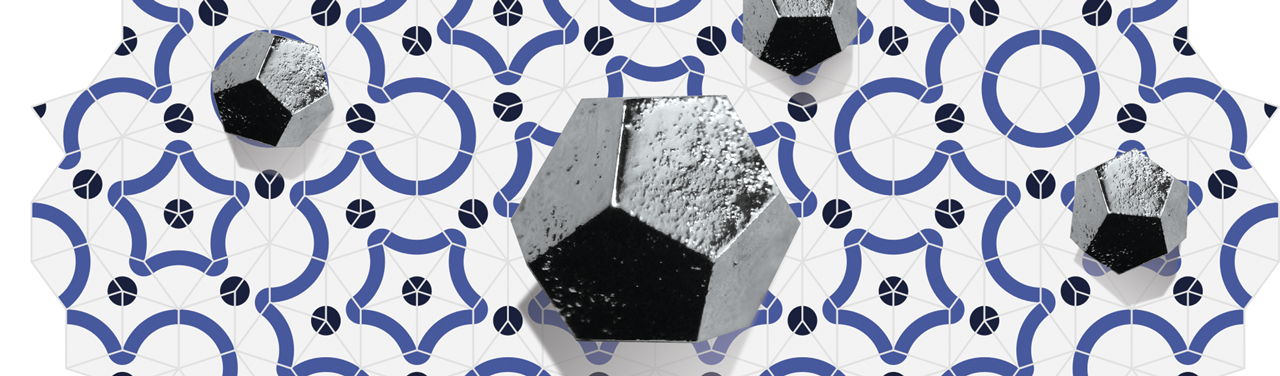
In 1974, British mathematician Roger Penrose created a revolutionary set of tiles that can be used to fill an infinite plane with a never repeating pattern. In 1982, Israeli crystallographer Daniel Shekhtman discovered a metal alloy whose atoms were arranged in an order never before encountered in materials science. Penrose achieved massive public recognition, rarely given to mathematicians. Shekhtman received the Nobel Prize. Both scientists challenged human intuition and changed the basics of understanding the structure of nature, finding that infinite variability can occur even in a highly ordered environment.
At the core of their discoveries lies a “forbidden symmetry,” called so because it contradicts the deep-rooted connection between symmetry and repeatability. Symmetry is based on the axes of reflection - everything that is on one side of the line is duplicated on the other. In mathematics, this connection is expressed by patterns of tiling space. Symmetric shapes, such as rectangles and triangles, can fill the plane without gaps and overlays, creating a constantly repeating pattern. Repeating patterns are called “periodic” and they are said to have “transfer symmetry”. If you move the pattern (pattern) from place to place, it will look the same.
As a bold and ambitious scientist, Penrose was more interested not in the same patterns and repeatability, but in infinite variability. More specifically, he was interested in “aperiodic” tiling, that is, sets of figures that can fill an infinite plane without gaps and overlays, and the tiling pattern is never repeated. This was a difficult task because he could not use figures (tiles) with two, three, four or six axes of symmetry - rectangles, triangles, squares or hexagons - because on an infinite plane they would create periodic or repeating patterns. That is, he needed to use figures that were thought to leave gaps when filling the plane — figures that have forbidden symmetry.
To create his own plane of non-repeating patterns, Penrose turned to five-axis symmetry - to pentagons, in particular because, according to him, it is “just nice to look at pentagons”. The remarkable thing about Penrose's figures was that although he got these figures from the lines and corners of the rectangles, they did not leave ugly gaps. They fit tightly against each other, bending and turning on the plane, always being close to repeatability, but never reaching it.
Penrose's mosaic has captured public attention for two main reasons. First, he found a way to generate infinitely changing patterns from just two types of shapes. Secondly, his tiles were simple, symmetrical figures, which in themselves did not show any signs of unusual properties.

Penrose created several varieties of his aperiodic sets of figures. One of the most famous is called "snake" and "dart." The “kite” looks like a children's kite, and the “dart” looks like a simplified outline of a stealth bomber. Both are clearly divided along the axes of symmetry and each of them has simple symmetrical arcs on the surface. Penrose defined one rule for placing shapes: for the "proper" placement of tiles, these arcs must match, creating inextricable curves. Without this rule, “snakes” and “darts” can be arranged in repeating patterns. If you follow this rule, then repetition never occurs. “Snake” and “dart” infinitely fill the plane, dancing around their five axes, creating stars and decagons, curving curves, butterflies and flowers. The figures are repeated, but new variations appear in them.
Clinical professor of mathematics Edmund Harriss of the University of Arkansas, who wrote a doctorate about Penrose tiles, offers such a comparison. “Imagine that you live in a world of squares. You start walking, and when you get to the end of the square, the next one is exactly the same, and you know what you will see if you continue to move endlessly. " Penrose tiles have exactly the opposite nature. “Whatever information you have, whatever part of the pattern you see, you can never predict what will happen next. There will always be something you have not seen before. ”
One of the curious aspects of aperiodic splitting of a plane is that positioning information is somehow transmitted over long distances - the Penrose tile, laid in one place, interferes with the placement of other tiles in the hundreds (and also thousands and millions) of tiles from it. “A local constraint somehow creates a global constraint,” says Harriss. "This suggests that on no scale will these tiles create anything periodic." You may have the choice to place, say, a “snake” in one area, or a “dart” in some remote place. Any of the tiles will do, but not both.
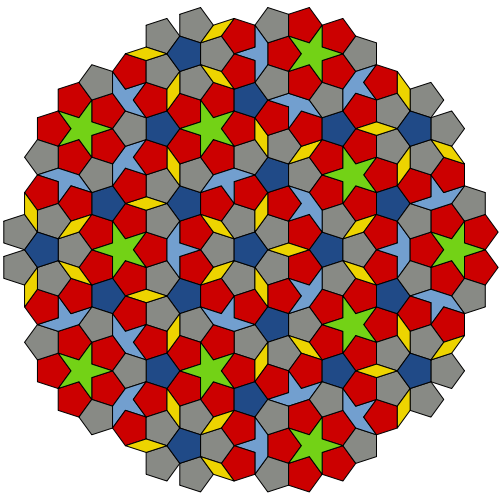
These tiles, forming an endless, non-repeating pattern, express the Fibonacci ratio, also known as the "golden ratio". Two numbers are said to have a golden ratio if the ratio of a smaller number to a larger one is the same as the ratio of a larger number to the sum of two numbers. In this case, the ratio of the area of the "snake" to the area of the "dart" is the golden ratio. The ratio of the long side of the "snake" to its short side is also the golden ratio.
Penrose tiles can also be subdivided into smaller versions of themselves. A “snake” consists of two smaller “snakes” and two halves of a “dart”. The “dart” consists of a smaller “snake” and two “dart” rugs. (In any proper tiling of Penrose, these halves of the “darts” are aligned with each other. From the point of view of mathematics, this allows them to be considered as whole “darts.”) “Suppose we have a piece of the Penrose mosaic consisting of A “ snakes ”and B “ darts ” “” Says Harriss. “If I subdivide them, I will get 2 A + B “ snakes “, and A + B “ darts “”.
If you do this substitution an infinite number of times, then you can calculate the total share of each type of tile, as if laid out on an infinite plane. In such calculations, a repeating pattern always leads to a rational number. If the proportion is an irrational number, then this means that the pattern will never actually repeat completely. In the calculations for Penrose tiles, not only is the irrational number obtained, their ratio is the Fibonacci ratio - the ratio of “darts” to “snakes” is equal to the ratio of “snakes” to the total number of tiles.
Given that the Fibonacci proportion is ubiquitous in nature - from pineapples to rabbit populations - it is even more strange that this proportion is fundamental to the tiling system, which, it would seem, has nothing to do with the physical world. Penrose created something new in science, intriguing precisely there that it should not work as nature does. It was like Penrose wrote a science fiction story about a new species of animal, and then the zoologist discovered this species living on Earth. In fact, Penrose tiles are associated with the golden ratio, with the mathematics we invented, and the mathematics of the world around us.
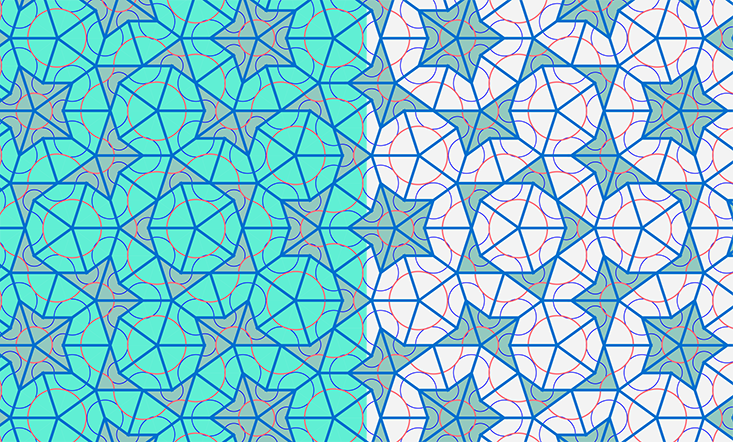
Taking up the study of forbidden symmetry, Penrose could not have guessed that he had become part of the shift in thinking that led to the discovery of a new field of mathematical science. After all, symmetry is fundamental to both pure mathematics and the natural world. Astrophysicist Mario Livio called symmetry "one of the most necessary tools for deciphering the structure of nature." Nature uses squares and hexagons for the same reason as humans: they are simple, efficient, and ordered. If pentagons seemed impractical even for such a simple task as filling floor tiles in interior design, then, of course, it was believed that they could not be used to create atoms in solid materials like crystals.
Crystals consist of three-dimensional lattices of atoms. Crystals grow by adding new atoms and expanding the lattices. This happens most efficiently when atoms line up in repeating patterns. For decades, history ended there: crystals were repeating structures. Point.
But then, in 1982, Shekhtman went on creative leave from Technion University in Haifa and began working at the National Bureau of Standards. He fumbled in an aluminum-manganese alloy lab. The diffraction patterns created by its crystalline structures did not seem to resemble any of the standard symmetries known to crystallographers. In fact, the atoms lined up in the very pentagons, rhombuses, “snakes” and “darts” that Penrose discovered in the world of mathematics.
“Of course, I was familiar with Penrose tiles,” says Schechtman. But he had no reason to suspect their connection with this alloy. “I did not understand what it is. Over the next months, I repeated my experiments over and over again. By the end of my creative vacation, I knew exactly what it was not, but I still had no idea what it was. ”
To understand what he discovered, Schechtman, like Penrose, had to question his usual intuitive ideas. He had to accept the forbidden symmetry and its pentagonal confusion with a lack of repeatability. While in Israel, he was reluctant to recognize that he had discovered a non-repeating crystalline atomic structure. However, no one in the world of materials science could at first attribute this discovery to crystals. Therefore, they were called "quasicrystals."
Penrose's bizarre math seemed to have broken out into the natural world. “For 80 years, crystals have been defined as“ ordered and periodic ”structures, because all the crystals that we studied since 1912 were periodic,” explains Schechtman. “It was only in 1992 that the International Union of Crystallographers organized a committee to select a new definition for the word crystal. This new definition is a paradigm shift for crystallography. ”
It was not only the simple inertia of thinking that prevented Shekhtman from understanding and accepting the discovery. Aperiodic crystalline structures were not just unfamiliar - they were considered unnatural. Recall that the location of one Penrose tile can affect the shapes in the thousands of tiles from it - local restrictions create global ones. But if a crystal is formed atom by atom, then there should not be a law of nature that creates the restrictions inherent in Penrose tiles.
It turned out that crystals do not always form atom by atom. “In very complex intermetallic compounds, the elements are huge. They are not local, ”says Schechtman. When large crystal fragments are formed at the same time, rather than by the gradual growth of atoms, atoms located very far from each other can influence the mutual position, just like in Penrose tiles.
As is the case with many taboos, forbidden symmetry has been recognized as one of the acceptable forms of existence in nature. Quasicrystals not only became an object of study in a new field of scientific research: it turned out that they have many useful properties that arise due to their unusual structure. For example, their asymmetric configuration of atoms provides them with low surface energy, that is, little can stick to them. Thus, quasicrystalline coatings began to be used in non-stick kitchen utensils. (When Penrose created his new tiles, he could not imagine that they would be used in crystallography, not to mention egg frying.) In addition, quasicrystals usually have low friction and wear, so they are ideal coatings for razors and surgical tools
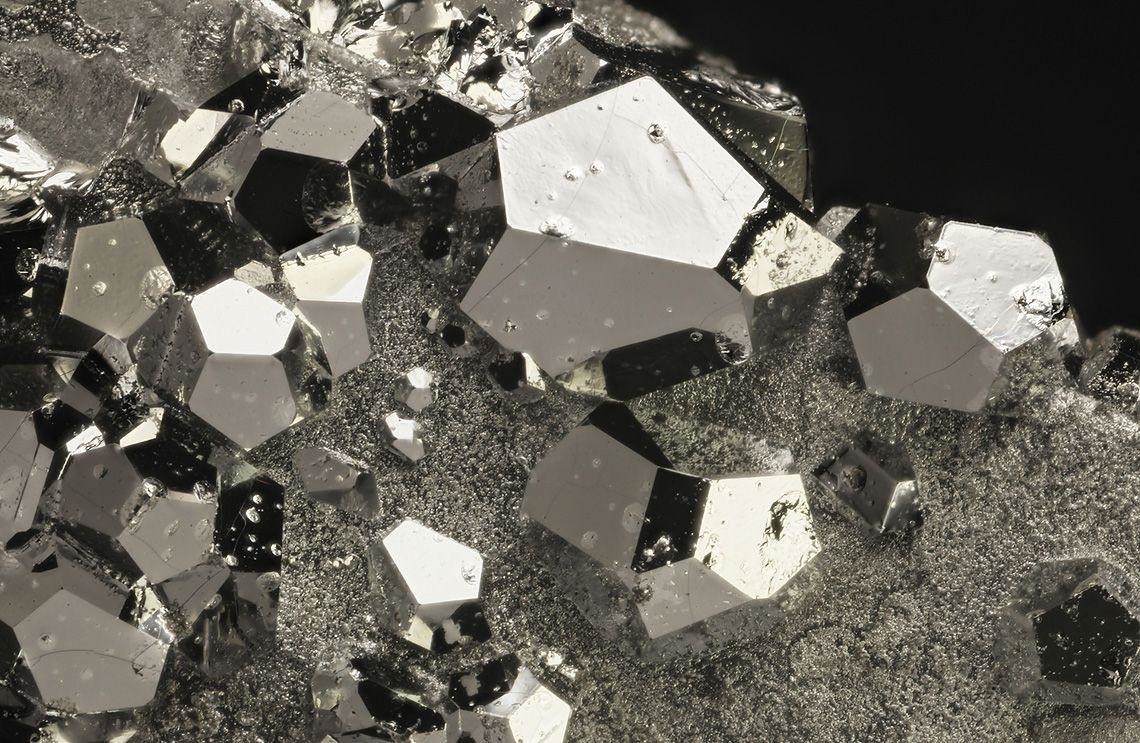
Since quasicrystal structures are never repeated, they create unique diffraction patterns of electromagnetic radiation. Photonics researchers are interested in how they affect light transmission, reflectivity, and photoluminescence. If they are cooled, then their electrical resistance drops to almost zero level. But they also absorb infrared radiation, so they heat up very quickly to high temperatures. Because of this, they turn out to be a very useful addition to 3D printers, in which plastic powder is used as the starting material. Shekhtman explains: if a quasiperiodic powder is mixed with it and exposed to infrared radiation, then the quasiperiodic powder "heats up extremely quickly and melts the surrounding plastic particles, which makes them stick together."
No one knows how the story of forbidden symmetry ends. Mathematicians continue to explore the properties of Penrose tiles. Quasicrystals remain the subject of study in both fundamental and applied research. But so far this journey has been incredible. Over the past 40 years, five-axis symmetry has turned from impractical to valuable, from unnatural to completely natural, from forbidden to dominant. And for this transformation, we must thank two scientists who abandoned their usual ideas in order to discover a remarkable new form of endless variations in nature.
About the Author: Patchen Bars is a Toronto-based journalist and author. He is currently working on a book on the relationship between pure mathematics and the natural world.