
 March 2, 2016 at 11:47
Dell at Mobile World Congress: IoT preparations, modular data centers, OEM solutions and rugged tablet
Watching visitors to the Dell booth at the Mobile World Congress, one could easily determine who knows the real situation in modern IT and who lives on old ideas about it. The latter turned their heads perplexedly: where are the gadgets? Experts, in turn, studied solutions for the Internet of things (IoT), next-generation data centers, tools for virtualizing network functions (NFV) and servers for telecom operators already thinking about switching to 5G. Although there were gadgets, of course.
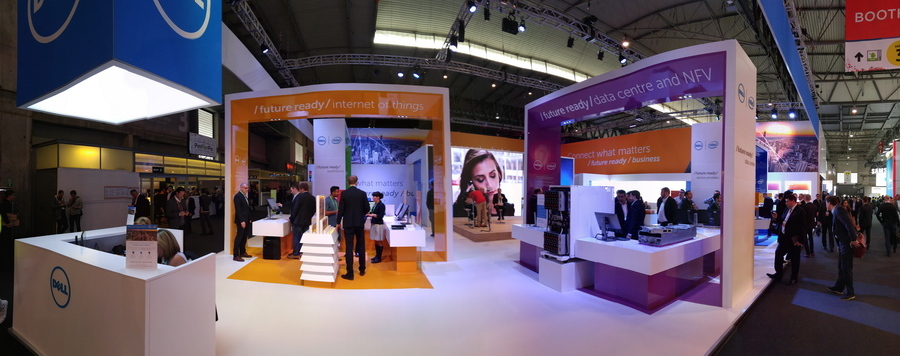
A few years ago, the description of a variety of complex solutions from Dell - from hardware and software systems for telecom operators to means of creating special effects for Hollywood movie studios - made a strong impression. Today, despite a very wide range of business and entertainment equipment, Dell is a real service company. Perhaps even more service than some business colleagues officially calling themselves as such.

Mobile World Congress is also not just an exhibition of interesting pieces of iron. Smartphones, smart watches, fitness trackers - all this, of course, is, although this year the number of tablets has sharply decreased. They say that they are no longer in demand because smartphones with a large screen support them from below and 2-in-1 devices and light laptops from above. But much more participants and guests were worried about something completely different. For example, the Internet of things, the standards associated with it, and the necessary infrastructure. Fifth generation (5G) networks that will surprise us not so much with speed as with the ability to provide communications with an order of magnitude more diverse devices. The fashionable topic of virtual reality will increase the volume of content transmitted over networks, and although at this stage VR takes only timid steps to the masses, Already, you need to think about ways to quickly pump the increased amount of data with minimal cost. There is no way to get away from the topic of information security, because with the digitization of financial services, the number of attacks is growing, and each new device in your home or office network is a potential breach. After all, even a very secure door by default is less resistant to burglary than a monolithic wall.
Dell at MWC 2016 helped find answers to the challenges of the near future.

So, Dell showed the gateway Dell Edge Gateway 5000 Series, specially tailored to work with IoT. There are many gateways of various levels in the Dell portfolio, and they help to collect, secure and process sensor data at the network edge. The company says its solution is an alternative to today's expensive proprietary solutions. The Edge Gateway 5000 Series is based on the Intel platform and can run any operating system of your choice: Ubuntu Snappy, Wind River Linux or Windows 10 IoT Enterprise. Remote management can be done using Dell Command | Monitor for Linux and / or Dell Cloud Client Manager. Third-party tools can be used to analyze the collected data, including SAP, OSIsoft, Eigen Innovations, and Lucid. Considering the use of the energy-efficient Intel Atom E3800 processor, it is a truly practical and flexible solution. The Internet of Things does not generate much traffic. But the sheer number of devices easily “stacks” the unprepared infrastructure.
Of course, an Internet gateway is only one element of a network upgrade. At different stages: data acquisition, transportation, aggregation, analysis and use - Dell offers its technologies and solutions. Among them, the Dell Boomi cloud service plays a special role, allowing you to transfer various business applications to the cloud, and the scale of the business itself does not play a special role, everyone will find their own benefit. Also worth mentioning are the smart Dell Sonicwall firewalls, Dell Force 10 network platforms, Dell Storage NAS and many (really many!) Other products and services native to Texas.
The IoT era has not yet begun, but there are almost no doubts about its onset. When the surveillance cameras begin to “talk” with the gate directly, and the refrigerator starts conversations with the electric furnace and the online store, it will not seem to everyone: offices, homeowners, and operators. It’s better not to wait.
Another important topic raised by Dell at Mobile World Congress is modular solutions for data centers. Centers and before built, as they say, not for centuries. Data volumes grew too fast, which required constant modernization. But today, not only volumes are growing, but, let's say, quality data requirements. It’s not enough to just accept and transmit / save them, more and more real-time analysis is required, and no one, frankly, knows what requirements will appear in a couple of years. Therefore, equipment for data centers should be not only powerful, reliable and energy efficient (these are quite obvious things), but also easily replaceable, based on current tasks.


At MWC, Dell showed off the DSS 9000, a platform for telecom operators, where modules with storage devices can easily be replaced by computing. And vice versa. Actually, the number of modules and their proportion can be determined by the user. Computing modules use dual-socket Intel-based motherboards with 16 RAM slots on each.
In some cases, Dell is ready to refuse to place on the products of its own brand, having ceded this honor to its partner. The company's OEM division offers an almost complete range of Dell products without a logo, but with proprietary support. Dell has extensive experience working with OEMs in different countries, and now it is ready to act as such. Offering not only experience, but also responsibility.

And, of course, consumer products were not complete. Fans of extreme travel, as well as parents with young children, studied the Latitude 12 Rugged Tablet, an Intel Core M tablet in a protected case, with interest. It can be dropped, used in cold and heat, and, judging by the strength of the structure, it is quite possible to fight off small predators with a tablet.


The Latitude 14 7000 family switched to the 6th generation Intel Core processors, which added battery life and performance. It used to be one of the most successful business ultrabooks on the market, but there is no limit to perfection. Interestingly, the new Latitude 14 7000 can be delivered with a Windows 7 Professional license, and the user will decide for himself whether to use the classics or upgrade to Windows 10.

Prettier with the transition to the 6th generation Intel Core and the smallest 13-inch ultrabook Dell XPS 13 in the world. Now the battery life (in a gentle, but working mode) has grown to 18 hours. By the way, a number of modern Dell laptops acquired USB-C ports, without losing the more familiar versions along the way.

This year's Mobile World Congress was almost entirely about the future. Everyone tried to find out exactly how it would be. On what it will be possible to earn money, where to lay straws.
Dell is ready to help in all areas.
A few years ago, the description of a variety of complex solutions from Dell - from hardware and software systems for telecom operators to means of creating special effects for Hollywood movie studios - made a strong impression. Today, despite a very wide range of business and entertainment equipment, Dell is a real service company. Perhaps even more service than some business colleagues officially calling themselves as such.
Mobile World Congress is also not just an exhibition of interesting pieces of iron. Smartphones, smart watches, fitness trackers - all this, of course, is, although this year the number of tablets has sharply decreased. They say that they are no longer in demand because smartphones with a large screen support them from below and 2-in-1 devices and light laptops from above. But much more participants and guests were worried about something completely different. For example, the Internet of things, the standards associated with it, and the necessary infrastructure. Fifth generation (5G) networks that will surprise us not so much with speed as with the ability to provide communications with an order of magnitude more diverse devices. The fashionable topic of virtual reality will increase the volume of content transmitted over networks, and although at this stage VR takes only timid steps to the masses, Already, you need to think about ways to quickly pump the increased amount of data with minimal cost. There is no way to get away from the topic of information security, because with the digitization of financial services, the number of attacks is growing, and each new device in your home or office network is a potential breach. After all, even a very secure door by default is less resistant to burglary than a monolithic wall.
Dell at MWC 2016 helped find answers to the challenges of the near future.
So, Dell showed the gateway Dell Edge Gateway 5000 Series, specially tailored to work with IoT. There are many gateways of various levels in the Dell portfolio, and they help to collect, secure and process sensor data at the network edge. The company says its solution is an alternative to today's expensive proprietary solutions. The Edge Gateway 5000 Series is based on the Intel platform and can run any operating system of your choice: Ubuntu Snappy, Wind River Linux or Windows 10 IoT Enterprise. Remote management can be done using Dell Command | Monitor for Linux and / or Dell Cloud Client Manager. Third-party tools can be used to analyze the collected data, including SAP, OSIsoft, Eigen Innovations, and Lucid. Considering the use of the energy-efficient Intel Atom E3800 processor, it is a truly practical and flexible solution. The Internet of Things does not generate much traffic. But the sheer number of devices easily “stacks” the unprepared infrastructure.
Of course, an Internet gateway is only one element of a network upgrade. At different stages: data acquisition, transportation, aggregation, analysis and use - Dell offers its technologies and solutions. Among them, the Dell Boomi cloud service plays a special role, allowing you to transfer various business applications to the cloud, and the scale of the business itself does not play a special role, everyone will find their own benefit. Also worth mentioning are the smart Dell Sonicwall firewalls, Dell Force 10 network platforms, Dell Storage NAS and many (really many!) Other products and services native to Texas.
The IoT era has not yet begun, but there are almost no doubts about its onset. When the surveillance cameras begin to “talk” with the gate directly, and the refrigerator starts conversations with the electric furnace and the online store, it will not seem to everyone: offices, homeowners, and operators. It’s better not to wait.
Another important topic raised by Dell at Mobile World Congress is modular solutions for data centers. Centers and before built, as they say, not for centuries. Data volumes grew too fast, which required constant modernization. But today, not only volumes are growing, but, let's say, quality data requirements. It’s not enough to just accept and transmit / save them, more and more real-time analysis is required, and no one, frankly, knows what requirements will appear in a couple of years. Therefore, equipment for data centers should be not only powerful, reliable and energy efficient (these are quite obvious things), but also easily replaceable, based on current tasks.
At MWC, Dell showed off the DSS 9000, a platform for telecom operators, where modules with storage devices can easily be replaced by computing. And vice versa. Actually, the number of modules and their proportion can be determined by the user. Computing modules use dual-socket Intel-based motherboards with 16 RAM slots on each.
In some cases, Dell is ready to refuse to place on the products of its own brand, having ceded this honor to its partner. The company's OEM division offers an almost complete range of Dell products without a logo, but with proprietary support. Dell has extensive experience working with OEMs in different countries, and now it is ready to act as such. Offering not only experience, but also responsibility.
And, of course, consumer products were not complete. Fans of extreme travel, as well as parents with young children, studied the Latitude 12 Rugged Tablet, an Intel Core M tablet in a protected case, with interest. It can be dropped, used in cold and heat, and, judging by the strength of the structure, it is quite possible to fight off small predators with a tablet.
The Latitude 14 7000 family switched to the 6th generation Intel Core processors, which added battery life and performance. It used to be one of the most successful business ultrabooks on the market, but there is no limit to perfection. Interestingly, the new Latitude 14 7000 can be delivered with a Windows 7 Professional license, and the user will decide for himself whether to use the classics or upgrade to Windows 10.
Prettier with the transition to the 6th generation Intel Core and the smallest 13-inch ultrabook Dell XPS 13 in the world. Now the battery life (in a gentle, but working mode) has grown to 18 hours. By the way, a number of modern Dell laptops acquired USB-C ports, without losing the more familiar versions along the way.
This year's Mobile World Congress was almost entirely about the future. Everyone tried to find out exactly how it would be. On what it will be possible to earn money, where to lay straws.
Dell is ready to help in all areas.