
 December 24, 2015 at 19:52
Why do stars explode
- Transfer
A star can die in many ways, but usually people think that stars explode.
The term “supernova” describes explosions with the release of a large amount of energy at a time when certain stars reach a certain stage of development. Supernovae can shine brighter than entire galaxies, and destroy everything that is a hundred light-years from them. But supernovae are not just an amazing natural phenomenon. These are the most important phenomena necessary for the development of complex matter, including life.
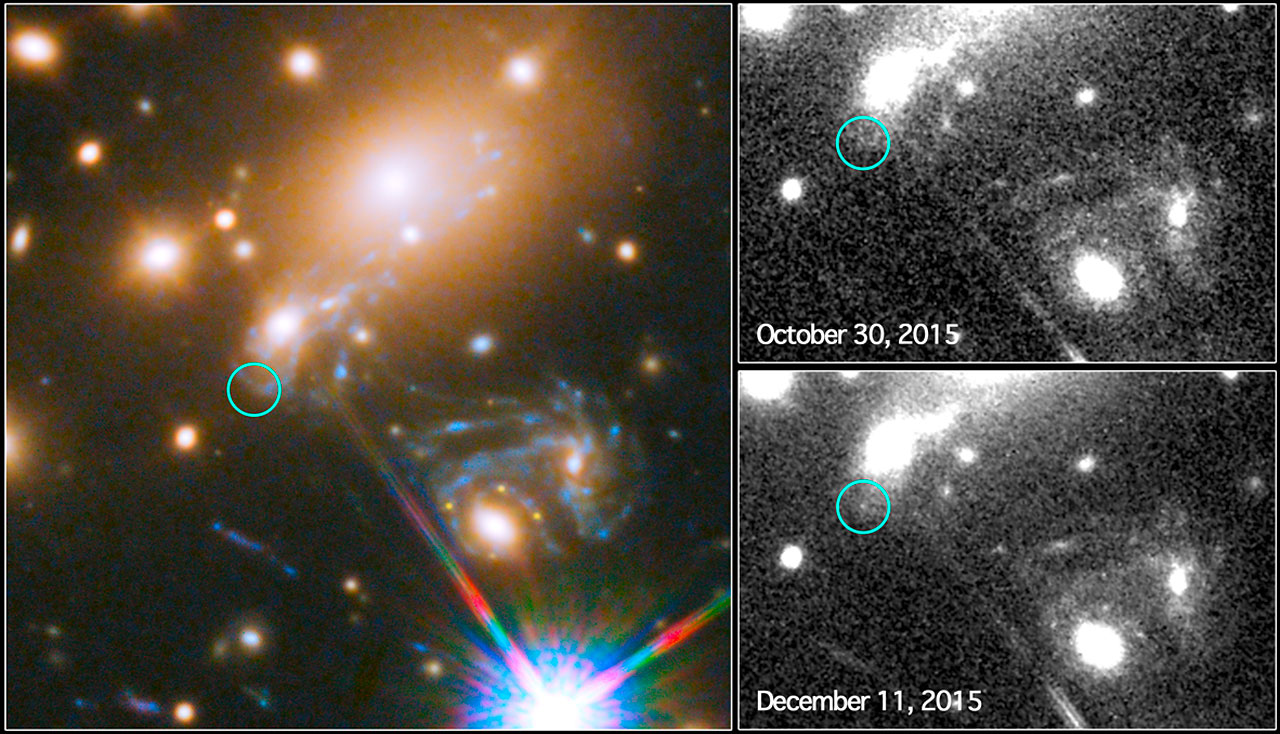
Search for supernovae by astronomers
Let's start with how supernovae come about. When enough gas is collected in one place, its mass begins to exert a gravitational effect, focused in the center of the cloud. When the pressure exceeds a certain limit, the hydrogen atoms in the center of the sphere begin to undergo synthesis, igniting the gas and turning it into a star. But throughout the life of a star and its burning, there is a reaction between the pressure of the temperature reaction directed outward and gravitational compression directed inward.
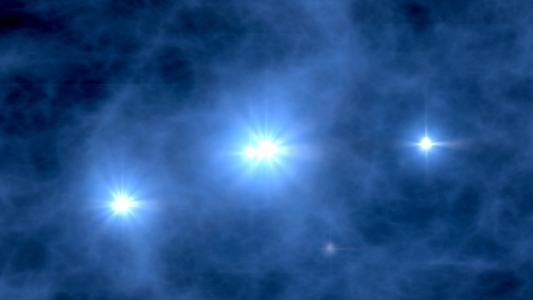
The artist's idea of the first stars
Over billions of years of burning, the outward pressure decreases, and the gravitational force remains approximately the same. Therefore, when cooling small and medium stars, gravity begins to win in them - but since these stars are not very large, gravity does not lead to anything else but to hold matter together. Such a safely cooled star is called a white dwarf. The mass limit, which is necessary for the appearance of a supernova, is called the Chandrasekhar limit, and is equal to approximately 1.4 solar masses. If the star is smaller, then it will go out peacefully.
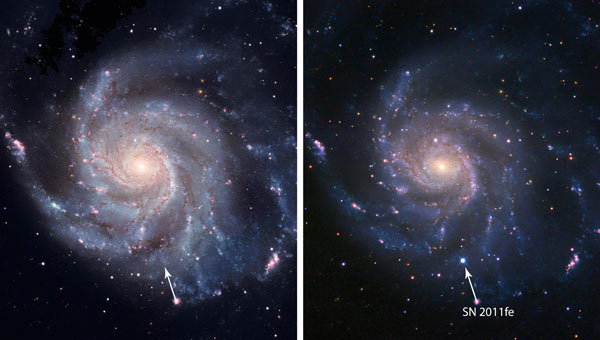
Supernovae are so bright that they stand out even against the background of galaxies.
At the same time, the white dwarf can still be lit at the end of life. In principle, such stars can be re-ignited. It can attract enough mass to itself so that the pressure in the center increases significantly and carbon synthesis begins. Then an unstable synthesis reaction will begin, which will lead to an explosion.
Or, if the core of the white dwarf will consist mainly of neon, its core will collapse, which will also lead to an explosion - but only after it will a neutron star remain. This almost always happens in binary systems in which one star approaches the limit of Chandrasekhar, sucking matter from its partner. Since astronomers cannot examine the contents of the star’s core, they don’t know which of the two paths its development will take.
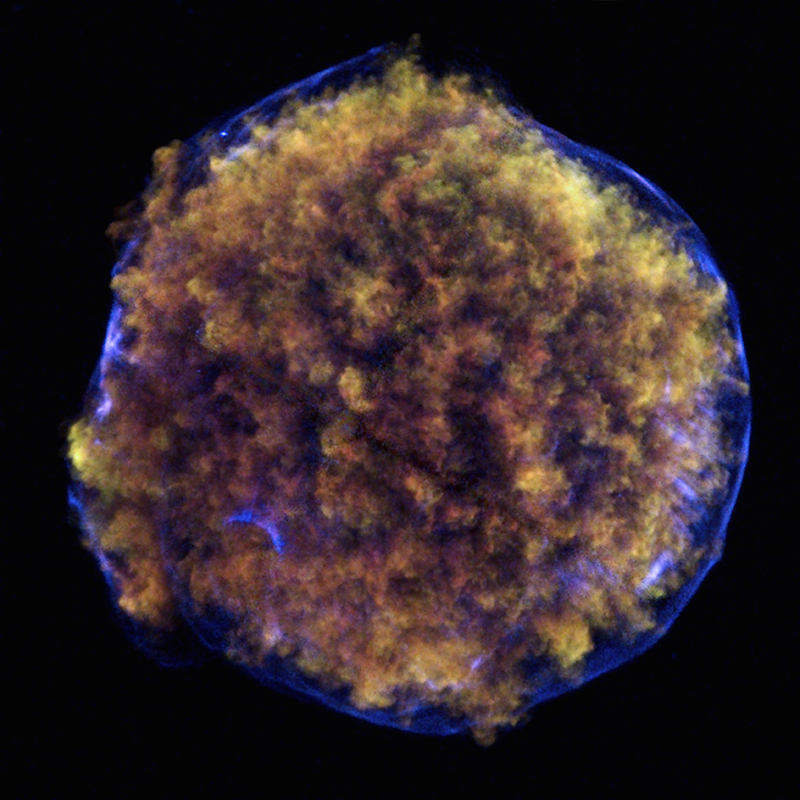
Remains of a supernova Tycho
Stars are more massive than 1.4 solar masses, the life cycle is different. The red giant slowly burns out, while its gravity is strong enough to cause a nuclear collapse and a supernova explosion. Stars weighing from 1.4 to 3 solar collapse into neutron stars.
Heavier stars also collapse, but they do not stop until they turn into a black hole. This is a rather rare event. Although there are a lot of black holes in the Universe, they are much smaller than other types of remnants of stars.
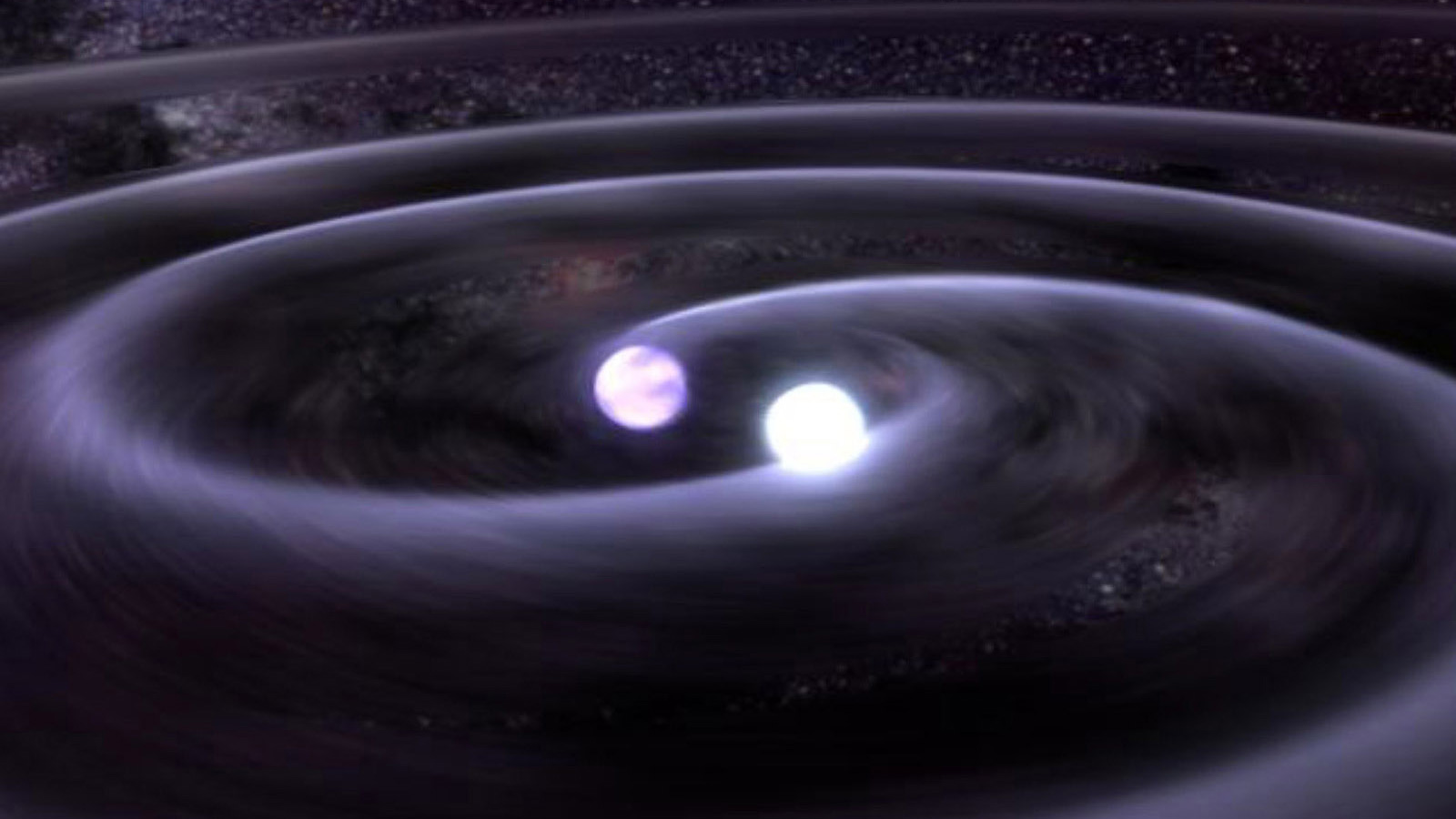
How an artist sees a binary system
Supernovae may appear in other ways. For example, although most white dwarfs are slowly gaining mass, some stars can gain rapid mass growth (for example, from a collision with another star) and quickly overcome the Chandrasekhar limit - so quickly that they do not have time to start collapsing.
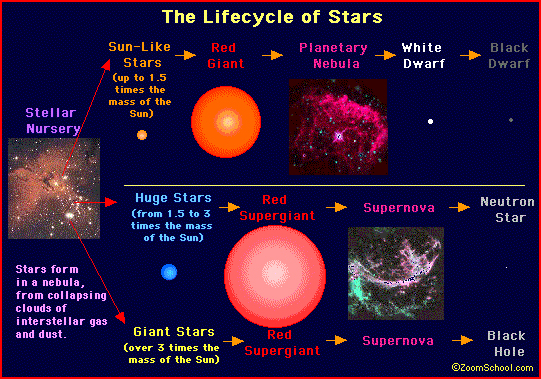
Supernovae have several uses for astronomy. For example, type Ia supernovae (a white dwarf that has carried out carbon synthesis) send uniform signals to space. Therefore, they were dubbed “standard candles”, since they serve as scientific standards for optical measurements. True, recent studies suggest that these candles are not so standard as previously thought.
But it was a question of the fact that supernovae are not only cool and useful phenomena. To produce elements heavier than carbon and neon, ordinary stars are not suitable. Only supernova, dying stars can handle this.
Almost everything we deal with was at some point ejected by the star in the last moments of her life. Earth is a rocky set of remains thrown by a supernova. And also all comets, asteroids and everything else, consisting of heavier matter. And we ourselves, consisting of matter taken on Earth, are created from the debris of a supernova.
The term “supernova” describes explosions with the release of a large amount of energy at a time when certain stars reach a certain stage of development. Supernovae can shine brighter than entire galaxies, and destroy everything that is a hundred light-years from them. But supernovae are not just an amazing natural phenomenon. These are the most important phenomena necessary for the development of complex matter, including life.
Search for supernovae by astronomers
Let's start with how supernovae come about. When enough gas is collected in one place, its mass begins to exert a gravitational effect, focused in the center of the cloud. When the pressure exceeds a certain limit, the hydrogen atoms in the center of the sphere begin to undergo synthesis, igniting the gas and turning it into a star. But throughout the life of a star and its burning, there is a reaction between the pressure of the temperature reaction directed outward and gravitational compression directed inward.
The artist's idea of the first stars
Over billions of years of burning, the outward pressure decreases, and the gravitational force remains approximately the same. Therefore, when cooling small and medium stars, gravity begins to win in them - but since these stars are not very large, gravity does not lead to anything else but to hold matter together. Such a safely cooled star is called a white dwarf. The mass limit, which is necessary for the appearance of a supernova, is called the Chandrasekhar limit, and is equal to approximately 1.4 solar masses. If the star is smaller, then it will go out peacefully.
Supernovae are so bright that they stand out even against the background of galaxies.
At the same time, the white dwarf can still be lit at the end of life. In principle, such stars can be re-ignited. It can attract enough mass to itself so that the pressure in the center increases significantly and carbon synthesis begins. Then an unstable synthesis reaction will begin, which will lead to an explosion.
Or, if the core of the white dwarf will consist mainly of neon, its core will collapse, which will also lead to an explosion - but only after it will a neutron star remain. This almost always happens in binary systems in which one star approaches the limit of Chandrasekhar, sucking matter from its partner. Since astronomers cannot examine the contents of the star’s core, they don’t know which of the two paths its development will take.
Remains of a supernova Tycho
Stars are more massive than 1.4 solar masses, the life cycle is different. The red giant slowly burns out, while its gravity is strong enough to cause a nuclear collapse and a supernova explosion. Stars weighing from 1.4 to 3 solar collapse into neutron stars.
Heavier stars also collapse, but they do not stop until they turn into a black hole. This is a rather rare event. Although there are a lot of black holes in the Universe, they are much smaller than other types of remnants of stars.
How an artist sees a binary system
Supernovae may appear in other ways. For example, although most white dwarfs are slowly gaining mass, some stars can gain rapid mass growth (for example, from a collision with another star) and quickly overcome the Chandrasekhar limit - so quickly that they do not have time to start collapsing.
Supernovae have several uses for astronomy. For example, type Ia supernovae (a white dwarf that has carried out carbon synthesis) send uniform signals to space. Therefore, they were dubbed “standard candles”, since they serve as scientific standards for optical measurements. True, recent studies suggest that these candles are not so standard as previously thought.
But it was a question of the fact that supernovae are not only cool and useful phenomena. To produce elements heavier than carbon and neon, ordinary stars are not suitable. Only supernova, dying stars can handle this.
Almost everything we deal with was at some point ejected by the star in the last moments of her life. Earth is a rocky set of remains thrown by a supernova. And also all comets, asteroids and everything else, consisting of heavier matter. And we ourselves, consisting of matter taken on Earth, are created from the debris of a supernova.