
 September 15, 2015 at 01:29
Translucent Li-Ion battery is charged by light
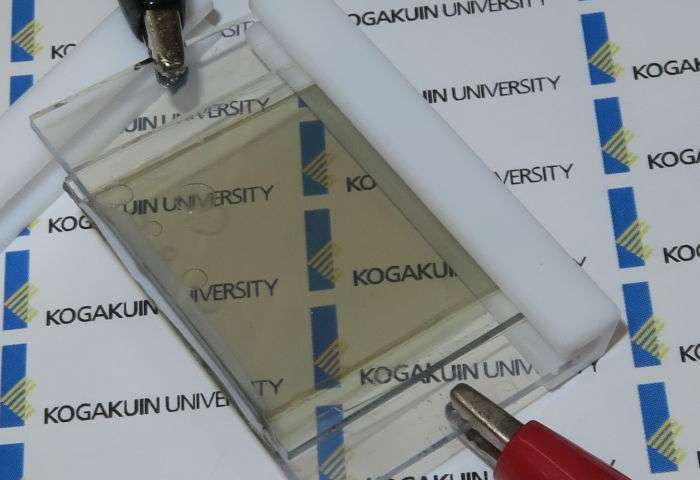
Japanese inventors have shown a translucent lithium-ion battery with a very thin film of electrodes that charge the battery. In the future, such material can cover the windows of buildings, car windows as a tint, and other translucent surfaces that will generate electric current.
The development of a light-transmitting battery began in 2013 ( pdf ), and on August 27, 2015, a working prototype was presented at Innovation Japan 2015 .
The inventors are a group of researchers led by Mitsunobu Sato, president of Kogakuin University, Tokyo, and professor in the Department of Applied Physics at the School of Advanced Engineering at this university.
In the absence of sunlight, the material transmits light quite well: for example, at a wavelength of 550 nm corresponding to green light, the transparency of a discharged battery is 60% ... In the presence of sunlight, the battery begins to accumulate charge, the lithium density on the electrodes increases, and the valency of the material changes, so the level transparency is reduced to 30%.

In 2013, the main electrolyte component for the positive electrode was Li 3 Fe 2 (PO 4 ) 3 (LFP), and for the negative electrode, Li 4 Ti 5 O 12 (LTO) and LiPF 6(lithium hexafluorophosphate). These materials are widely used in the manufacture of conventional lithium-ion batteries.
The achievement of the inventors is that they were able to reduce the thickness of the electrodes to 80-90 nanometers and make almost transparent films: cathode 80 nm, anode 90 nm. The graph shows the transparency of the LFP and LTO films for waves of different lengths.

The following graph shows the transparency of an entire battery before and after a charge.

Batteries are charged by sunlight or another bright source of light. The output voltage was fixed at 3.6V. In laboratory conditions, the battery withstood twenty cycles of charge / discharge with virtually no loss of performance.

The new version of the battery in 2015 is modified in comparison with the sample two years ago. It is reported that some chemicals have been replaced by others, but a scientific paper describing the new design has not yet been published. At Innovation Japan 2015, the inventors showed how a battery is discharged five times and charged from near UV with an energy flux density of 10 mW / cm 2 , which is about a tenth of sunlight.