
How to assemble a hi-fi movie theater at home
As promised , I am posting an article on assembling and setting up a Hi-Fi class home theater at home. All tips are based on personal experience installing this equipment in various unprepared rooms.
So, you decided to build a good movie theater with DolbyAtmos. What will be needed to build and configure it?
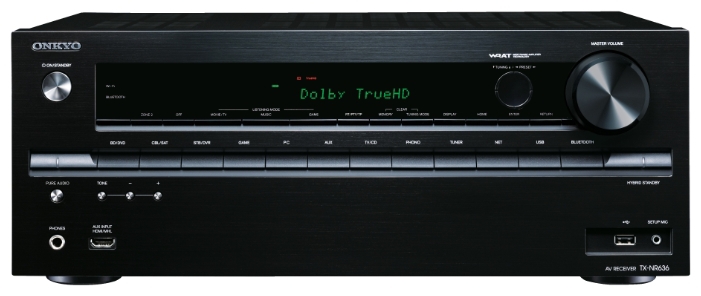
In the picture Onkyo TX-NR636
As the Wikipedia tells us, the AV receiver is a multi-channel amplifier with digital audio stream decoders (DAC - digital-to-analog converter), a tuner and a switch for audio and video signals for domestic use in home theater systems. Can convert audio and video formats.
The receiver is the brain center of our home theater. It is through it that the entire switching of our system passes. As a rule, they are equipped with a large number of digital and analog inputs, for the possibility of connecting all home multimedia, from a Blu-ray player to a game console.
How to choose a receiver for DolbyAtmos?At the moment, support for DolbyAtmos is present in all manufacturers of receivers, usually in the high-end segment. Separately, you can distinguish the company Onkyo, which relied on a wider range of customers, releasing a line of receivers of the middle price segment with Atmos. The most budget receiver currently costs about 36-37 tr. But, of course, the presence of Atmos is far from an indicator that the receiver suits you.

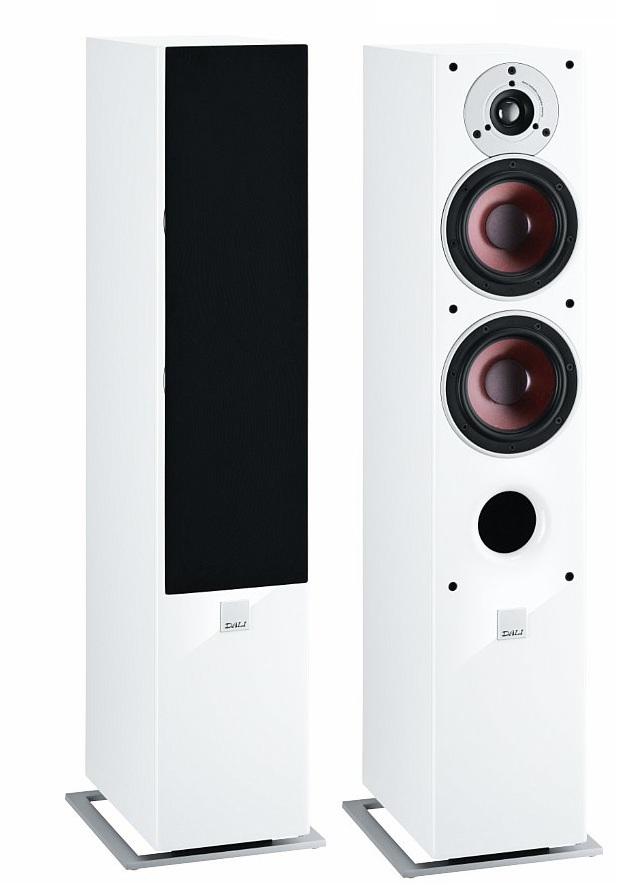
In the picture Dali Zensor 5
Actually, this is your sound. At the moment, there are a huge number of manufacturers on the market who can offer acoustics of any shape and size. In the classical system 5.1, as a rule, 2 floor front speakers are used, which are responsible for reproducing the main sound, 2 rear shelf speakers, which as a rule serve only for special effects and the central channel. The subwoofer connected to the receiver must be active, that is, with its own built-in amplifier, passive subwoofers cannot be connected to AV receivers. To play the DolbyAtmos signal, we need either DolbyAtmos speakers, for example, Onkyo SKH-410 , or ceiling mounted speakers.
What to look for

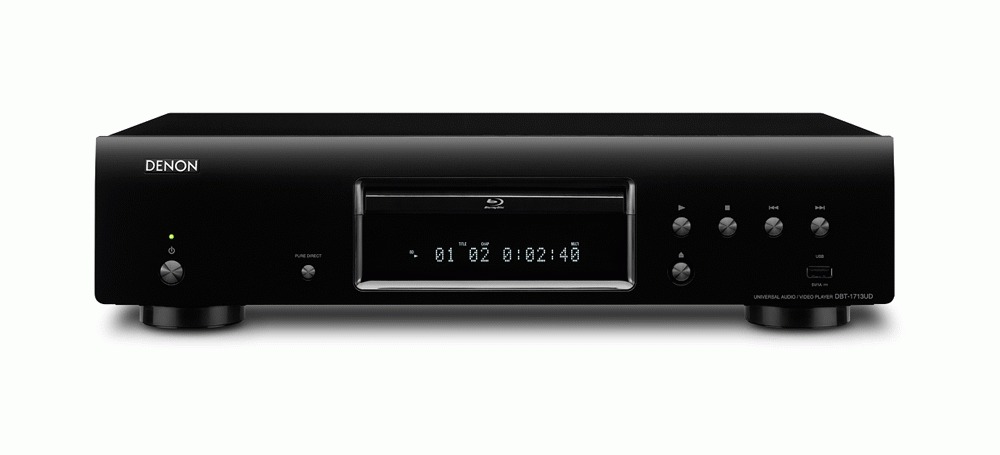
In the picture Denon DBT-1713 BL
For watching movies, of course, we need a player that will give this signal. Suitable for both Blu-ray and media player.
What to look for

In the picture of AudioQuest King Cobra XLR Stereo
There is a popular opinion that expensive cables for connecting the entire system is an audiophile whim for “bitten by a silver cable”. This is not so, the higher the quality of your system, the higher its sensitivity to external factors, including EMW distortions. Of course, you should not buy a cable for $ 25,000, but it’s also not worth saving at all.
What to look for
So, we chose everything we need for a home theater and brought it home. The most interesting thing remained - connection and configuration.
Preparing the room

Let's start with the acoustics of the room, the more soft sound-absorbing objects in your room, the better. It does not have to be specially purchased and placed items. Sofas, curtains, chairs are also noise absorbers.
How to position a frontal pair

The distance between the front speakers and the distance between each speaker and listener should be an isosceles triangle. From the same triangle, you can calculate the angle of rotation of the speaker to the listener, roughly speaking, if you imagine that your hands are the sides of the triangle, forming an angle of 90 degrees, then they visually should rest against the front of the speaker. But in the case of speakers with a wide dispersion of signal propagation, the speakers do not need to be rotated. You can choose the distance between the speakers by ear, using stereo sound, preferably with vocals.
How to arrange the rear speakers The
rear speakers are best placed a little further than the listening area at the level of the listener's head (there are special stands or wall mounts for this), opposite the front channel.
How to arrange the central channel
Here, in fact, everything is very logical and simple, the central channel is located in the center of the screen, which serves for viewing. Naturally, you can’t put it on the floor, as this violates the picture of the sound of a human voice.
How to position the subwoofer It is
better to place the subwoofer in the front listening area, close to the wall, in order to achieve more loud effects due to the reflection of sound from the wall.
How to arrange speakers for Atmos

If the speakers for Atmos are integrated in the front pair, then there will be no difficulties with their installation. The same can be said about additional speakers that are installed on the front pair. But these speakers will not be able to work adequately if you use suspended or suspended ceilings in your apartment (room), in which case it is better to use ceiling speakers.
Connection to the receiver

Advice from my personal practice, first connect all the speaker and video cables to the receiver first, then it’s very difficult to connect the wires while digging into a heap of connectors. I recommend using a banana connector as connectors to the speaker cable, this will greatly facilitate all connections. Pay attention to the fact that the speaker and network cables do not intersect, in the case of a conventional network cable, it can give strong distortion to the signal passing through the speaker cable.
Auto tuning

Now almost every receiver has an auto tuning function. I recommend using it, as it makes a large number of settings for you. This system works like a sonar, checking the location of the volume and acoustics of the room. In the future, you can already tune the sound for yourself.
Conclusion
So we have assembled and set up a home theater. Naturally described here is not 100% universal recipe, yet each setting is made for the listener. But the nuances indicated here must be taken into account at each setting. Naturally, this is not an ideal system configuration option, but not everyone wants to make repairs because of good sound.
In the future, I plan to consider AV receivers in more detail.
So, you decided to build a good movie theater with DolbyAtmos. What will be needed to build and configure it?
Home Theater Components
AV Receiver
In the picture Onkyo TX-NR636
As the Wikipedia tells us, the AV receiver is a multi-channel amplifier with digital audio stream decoders (DAC - digital-to-analog converter), a tuner and a switch for audio and video signals for domestic use in home theater systems. Can convert audio and video formats.
The receiver is the brain center of our home theater. It is through it that the entire switching of our system passes. As a rule, they are equipped with a large number of digital and analog inputs, for the possibility of connecting all home multimedia, from a Blu-ray player to a game console.
How to choose a receiver for DolbyAtmos?At the moment, support for DolbyAtmos is present in all manufacturers of receivers, usually in the high-end segment. Separately, you can distinguish the company Onkyo, which relied on a wider range of customers, releasing a line of receivers of the middle price segment with Atmos. The most budget receiver currently costs about 36-37 tr. But, of course, the presence of Atmos is far from an indicator that the receiver suits you.
What else to look for when choosing a receiver
- Power. The signal to the device does not come amplified, but only in a few milliwatts, which is not enough to reproduce this signal by the speaker system. The signal amplification system is used for this, but power is not only an indicator of the volume that you can get. Please note that almost all manufacturers in the characteristics of the devices indicate something like - 100W power per channel, 1 channel is loaded. This means that the device can supply this power only if only ONE column is connected. Naturally, when you connect all the speakers, the power will be lower in proportion to their number.
- Switching Capabilities. Before buying a receiver, it is better to decide what you will connect to it, whether you need Wi-Fi and Bluetooth, whether you want to put extra. an amplifier for the front pair or to connect vinyl. At the moment, most receivers are universal devices that themselves can serve as a source of audio signal without additional external devices, such as CD or NP players. Also pay attention to the possibility of connecting speakers via Bi-amping> why I need to tell you below.
- DAC The quality of the digital-to-analog converter directly affects the quality of sound received from digital sources.
- Current strength. Very important and not all indicated parameter. It affects the ability to reproduce the low frequency signal at the same level for a long time. For example, the sound of a jackhammer - if the capacitors cannot accumulate the desired charge, then this sound will decay regardless of the volume, while the sound will also begin to merge into a general hum, although as we know the jackhammer is still a repeated low-frequency beat.
- Wiretap. Since the receiver is only 40% of your final sound, it is better to listen to it with the acoustics you have chosen. Moreover, each person has individual hearing characteristics, it is best to listen not in the refined conditions of a specially prepared room, since in order to achieve such a sound at home the easiest option would be to build a room for a recreation center.
acoustic systems
In the picture Dali Zensor 5
Actually, this is your sound. At the moment, there are a huge number of manufacturers on the market who can offer acoustics of any shape and size. In the classical system 5.1, as a rule, 2 floor front speakers are used, which are responsible for reproducing the main sound, 2 rear shelf speakers, which as a rule serve only for special effects and the central channel. The subwoofer connected to the receiver must be active, that is, with its own built-in amplifier, passive subwoofers cannot be connected to AV receivers. To play the DolbyAtmos signal, we need either DolbyAtmos speakers, for example, Onkyo SKH-410 , or ceiling mounted speakers.
What to look for
- Power. The speaker power is not an indicator of its volume, but an indicator of its reliability, that is, what signal it can digest. When choosing acoustics, it is very important to consider that the acoustics power is higher than the maximum power of the amplifier. It is also important that the resistance parameter is either the same or higher than that of the amplifying part of the signal source.
- Dispersion of the sound distribution of the speaker system. At the moment, in acoustic systems, the angle of propagation of a sound wave varies from 90 to 160 degrees. The higher this indicator, the more convenient the speaker is in installation, since it does not require turning to the listener. Some speakers have a selfish character designed for only one listener, some, on the contrary, are more friendly.
- The location of the bass reflex. The phase inverter provides the extension of the woofer range of the speaker due to the resonance of its pipe at a frequency lower than that of the woofer. Its location can be either on the front or on the rear of the speaker, and it affects its installation. With the front phase inverter, the speakers can be installed close to the wall, which facilitates the task when installing in a limited space, in the case of the rear location, the closer the speakers are to the wall, the more the LF signal and the noise appears in the sound. If you still have to place the speakers close to the wall, it is recommended to place noise-attenuating material behind.
- The number of stripes. Since one speaker will not be able to adequately reproduce the sound of the entire audible range, for the bass, treble and midrange frequencies, manufacturers use different reproducing speakers, that is, 3-way speakers have separate speakers for reproducing the signal of each range. In 2-way speakers, as a rule, there is a separate speaker for the low range and midrange, tweeter.
- Bi-amping. This function allows you to connect the bass and midrange, RF stage to individual amplifiers. What does it give? In this case, we neutralize the negative influence of the LF and MF signal on each other.
- Wiretap. Each speaker has its own nuances of reproduction, each of them in its own way decorates the sound. Therefore, as I said when choosing a kit, it will be best to listen to it live.
Signal source
In the picture Denon DBT-1713 BL
For watching movies, of course, we need a player that will give this signal. Suitable for both Blu-ray and media player.
What to look for
- Support for the right decoders. This is perhaps the main thing that we need from the player, whether he can give us a DolbyAtmos signal or not.
- Connections. As a rule, all players are now equipped with an HDMI input, but it is also important to know if there is Wi-Fi, for example, in order to transfer control of your devices to a smartphone.
Wires for connection and add. accessories
In the picture of AudioQuest King Cobra XLR Stereo
There is a popular opinion that expensive cables for connecting the entire system is an audiophile whim for “bitten by a silver cable”. This is not so, the higher the quality of your system, the higher its sensitivity to external factors, including EMW distortions. Of course, you should not buy a cable for $ 25,000, but it’s also not worth saving at all.
What to look for
- Cross section of the speaker cable. The speaker cable must be at least 2.5 mm ^ 2 in order to level out distortions in the signal. The cable is now almost all made of OFHC copper with a different number of nines after the decimal point.
- The material of the connectors. The gold-plated connectors on your cable is not only an indication that you can buy a gold-plated cable for yourself. Oxidation of contacts leads to a negative effect on sound quality, creating additional distortion.
- Cable braid. As already mentioned, the higher the quality of your equipment, the higher its sensitivity to external factors, high-quality cable shielding will get rid of signal distortion due to external EM distortion.
- Dampers. When compiling how to install your equipment, pay attention to vibration protection. Many manufacturers spend a lot of money on damping, sometimes in the price of the receiver most of it lies in the protection against vibration. Now on the market you can find many different dampers for every taste. Once I damped an amplifier with cut rubber from an old drum pad.
- Length of cable. It is better to take the cable with a margin, because the chance that you need to move the speakers and components is very high.
Setup and installation
So, we chose everything we need for a home theater and brought it home. The most interesting thing remained - connection and configuration.
Preparing the room
Let's start with the acoustics of the room, the more soft sound-absorbing objects in your room, the better. It does not have to be specially purchased and placed items. Sofas, curtains, chairs are also noise absorbers.
How to position a frontal pair
The distance between the front speakers and the distance between each speaker and listener should be an isosceles triangle. From the same triangle, you can calculate the angle of rotation of the speaker to the listener, roughly speaking, if you imagine that your hands are the sides of the triangle, forming an angle of 90 degrees, then they visually should rest against the front of the speaker. But in the case of speakers with a wide dispersion of signal propagation, the speakers do not need to be rotated. You can choose the distance between the speakers by ear, using stereo sound, preferably with vocals.
How to arrange the rear speakers The
rear speakers are best placed a little further than the listening area at the level of the listener's head (there are special stands or wall mounts for this), opposite the front channel.
How to arrange the central channel
Here, in fact, everything is very logical and simple, the central channel is located in the center of the screen, which serves for viewing. Naturally, you can’t put it on the floor, as this violates the picture of the sound of a human voice.
How to position the subwoofer It is
better to place the subwoofer in the front listening area, close to the wall, in order to achieve more loud effects due to the reflection of sound from the wall.
How to arrange speakers for Atmos
If the speakers for Atmos are integrated in the front pair, then there will be no difficulties with their installation. The same can be said about additional speakers that are installed on the front pair. But these speakers will not be able to work adequately if you use suspended or suspended ceilings in your apartment (room), in which case it is better to use ceiling speakers.
Connection to the receiver
Advice from my personal practice, first connect all the speaker and video cables to the receiver first, then it’s very difficult to connect the wires while digging into a heap of connectors. I recommend using a banana connector as connectors to the speaker cable, this will greatly facilitate all connections. Pay attention to the fact that the speaker and network cables do not intersect, in the case of a conventional network cable, it can give strong distortion to the signal passing through the speaker cable.
Auto tuning
Now almost every receiver has an auto tuning function. I recommend using it, as it makes a large number of settings for you. This system works like a sonar, checking the location of the volume and acoustics of the room. In the future, you can already tune the sound for yourself.
Conclusion
So we have assembled and set up a home theater. Naturally described here is not 100% universal recipe, yet each setting is made for the listener. But the nuances indicated here must be taken into account at each setting. Naturally, this is not an ideal system configuration option, but not everyone wants to make repairs because of good sound.
In the future, I plan to consider AV receivers in more detail.