July 20, 2015 at 06:21
So similar and so different “Union” and “Apollo”
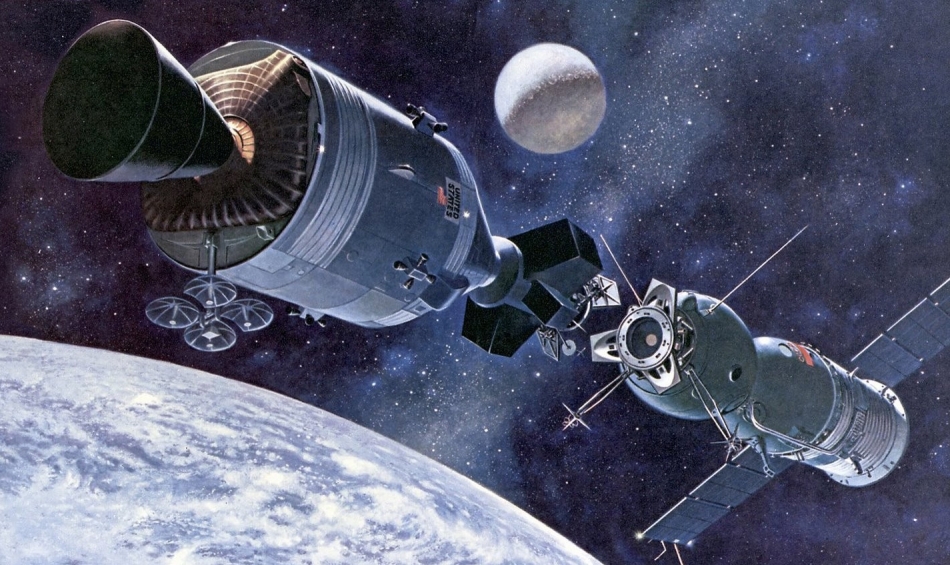
July 15 marked the 40th anniversary of the Soyuz Apollo mission, a historic flight that is often considered the end of the space race. For the first time, two ships built on opposite hemispheres met and docked in space. Soyuz and Apollo were already the third generation of spacecraft. By this moment, design teams had already “gotten bumps” in the first experiments, and new ships had to be in space for a long time and carry out new complex tasks. I think it will be interesting to see what technical solutions the design teams have come to.
Introduction
It is curious, but in the initial plans both the Unions and the Apollo were to become second-generation apparatuses. But in the US, they quickly realized that between the last flight of Mercury and the first flight of Apollo, several years would pass, and in order for this time not to be wasted, the Gemini program was launched. And the USSR responded to Gemini with its Sunrises .
Also, for both devices, the main goal was the moon. The USA did not spare money for the lunar race, because until 1966 the USSR had priority in all significant space achievements. The first satellite, the first lunar stations, the first man in orbit and the first man in outer space - all these achievements were Soviet. The Americans struggled to “catch up and overtake” the Soviet Union. And in the USSR, the task of a manned lunar program against the background of space victories was overshadowed by other urgent tasks, for example, it was necessary to catch up with the United States in the number of ballistic missiles. Manned lunar programs are a separate big conversation, but here we will talk about the devices in orbital configuration, such as they met in orbit on July 17, 1975. Also, since the Soyuz spacecraft has been flying for many years and has undergone many modifications, speaking of the Soyuz,
Withdrawal Means
A booster rocket, which is usually rarely remembered, puts the spacecraft into orbit and determines many of its parameters, the main of which will be the maximum weight and the maximum possible diameter.
In the USSR, to launch a new spacecraft into low Earth orbit, it was decided to use a new modification of the R-7 family rocket. The Voskhod launch vehicle replaced the third-stage engine with a more powerful one, which increased the carrying capacity from 6 to 7 tons. The ship could not have a diameter of more than 3 meters, because in the 60s, analog control systems could not stabilize the caliber fairings.

On the left is the Soyuz rocket diagram, on the right is the launch of the Soyuz-19 spacecraft of the Soyuz-Apollon mission
In the United States, the Saturn-I LV, specially designed for the Apollo, was used for orbital flights. In modification -I, it could put 18 tons into orbit, and in modification -IB, 21 tons. The diameter of Saturn exceeded 6 meters, so restrictions on the size of the spacecraft were minimal.

To the left is Saturn-IB in the section, to the right is the launch of the Apollo spacecraft of the Soyuz-Apollo mission.
In size and weight, the Soyuz is lighter, thinner and smaller than the Apollo. The Soyuz weighed 6.5-6.8 tons and had a maximum diameter of 2.72 m. The Apollo had a maximum weight of 28 tons (in the lunar version, fuel tanks were not completely filled for near-earth missions) and a maximum diameter of 3, 9 m
Appearance
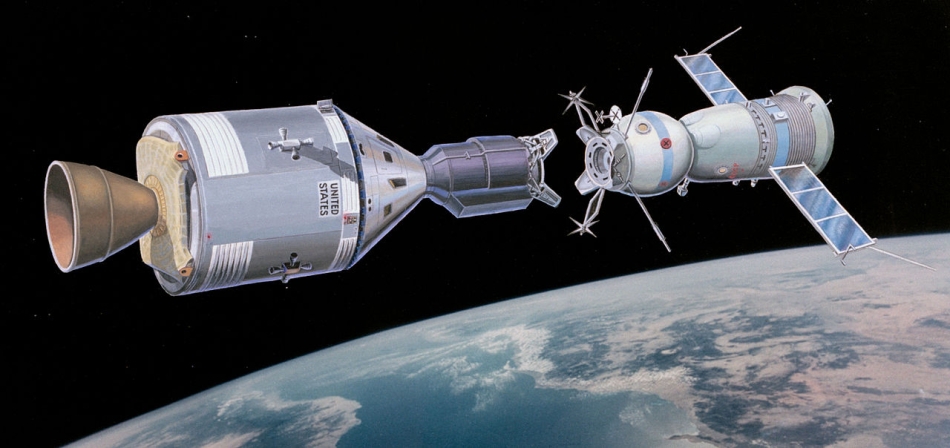
Soyuz and Apollo implemented a standard scheme for dividing a ship into compartments. Both ships had an instrument-aggregate compartment (in the USA it is called a service module), a descent vehicle (command module). The Soyuz descent vehicle turned out to be very cramped, so a household compartment was added to the ship, which could also be used as a lock chamber for access to outer space. In the Soyuz Apollo mission, the American ship also had a third module, a special lock chamber for the passage between the ships.
According to Soviet tradition, the Soyuz was launched entirely under the cowl. This made it possible not to care about the aerodynamics of the ship at launch and to place fragile antennas, sensors, solar panels, and other elements on the outer surface. Also, the household compartment and the lander are covered with a layer of space thermal insulation. The Apollo continued the American tradition - the launch vehicle was only partially closed, the nose was covered by a ballistic lid made structurally together with the rescue system, and the ship was covered by a cowl adapter from the rear.

Soyuz 19 in flight, shot from the Apollo. Dark green coating -

Apollo insulation , shot from the Soyuz. On the marching engine, it seems that the Soyuz paint of
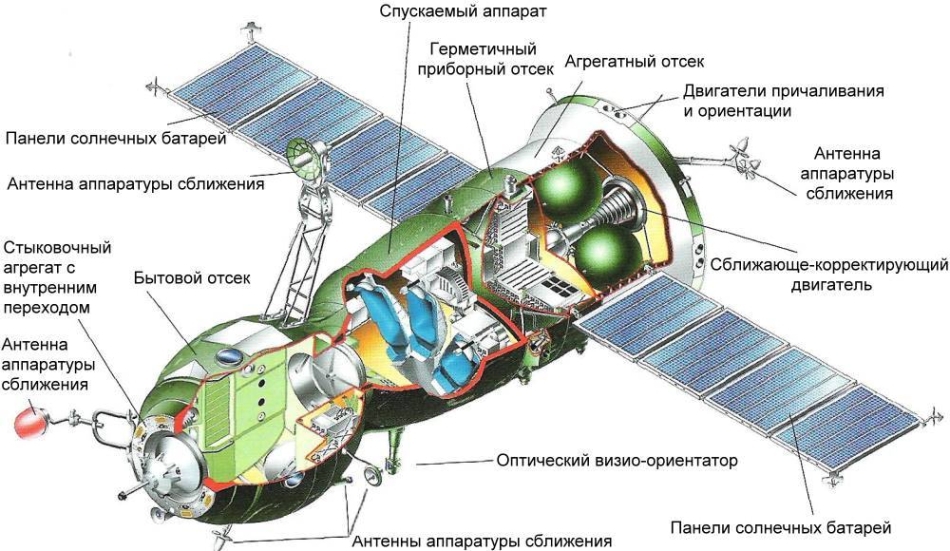
a later modification in sections

"Apollo" in the context
The form of the descent vehicle and thermal protection

Descent of the Soyuz spacecraft in the atmosphere, view from the ground
The descent vehicles of the Soyuz and Apollo are more alike than they were in previous generations of spacecraft. In the USSR, designers abandoned a spherical descent vehicle - upon returning from the moon, he would require a very narrow entrance corridor (maximum and minimum altitude, which must be reached between them for a successful landing), would create an overload of more than 12 g, and the landing area would be measured in dozens if not hundreds of kilometers. The conical lander created a lifting force during braking in the atmosphere and, turning, changed its direction, controlling the flight. On returning from the Earth's orbit, the overload decreased from 9 to 3-5 g, and on returning from the moon, from 12 to 7-8 g. Guided descent seriously expanded the entrance corridor, increasing the reliability of the landing, and very seriously reduced the size of the landing area,
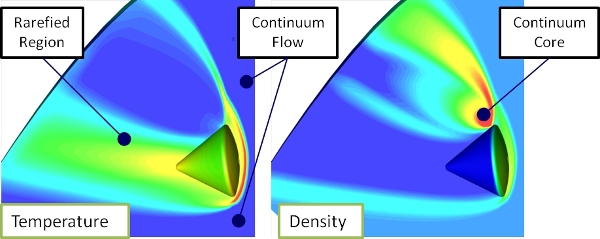
Calculation of asymmetric flow around a cone during braking in the atmosphere.

Soyuz and Apollo descent vehicles
The diameter of 4 m, selected for Apollo, made it possible to make a cone with a half-angle of 33 °. Such a descent vehicle has an aerodynamic quality of the order of 0.45, and its side walls practically do not heat up when braking. But its drawback was two points of stable equilibrium - the Apollo had to enter the atmosphere with an oriented bottom in the direction of flight, because if it entered the atmosphere sideways, it could roll over into the "nose forward" position and destroy the astronauts. The diameter of 2.7 m for Soyuz made such a cone irrational - too much space was wasted. Therefore, a “headlamp” -type descent vehicle with a half-angle of only 7 ° was created. It effectively uses space, has only one point of stable equilibrium, but its aerodynamic quality is lower, of the order of 0.3, and thermal protection is required for the side walls.
Already mastered materials were used as a heat-shielding coating. In the USSR, phenol-formaldehyde resins on a fabric basis were used, and in the USA, an epoxy resin on a fiberglass matrix was used. The mechanism of operation was the same - thermal protection burned out and collapsed, creating an additional layer between the ship and the atmosphere, and the burnt particles took over and carried away thermal energy.

Thermal insulation material “Apollo” before and after the flight
Propulsion system
Both the Apollo and the Unions had marching engines for correcting the orbit and orientation engines for changing the position of the ship in space and performing precise maneuvers at the dock. At Soyuz, an orbital maneuvering system was installed for the first time for Soviet spacecraft. For some reason, the designers chose a not very successful layout, when the main engine ran on one fuel (UDMH + AT), and the mooring and orientation engines on the other (hydrogen peroxide). In combination with the fact that the tanks contained 500 kg of fuel on the Soyuz and 18 tons on the Apollon, this led to an order of magnitude difference in the characteristic speed - Apollo could change its speed by 2800 m / s, and the Soyuz »Only at 215 m / s.

Soyuz-19 feed, engine nozzles are clearly visible
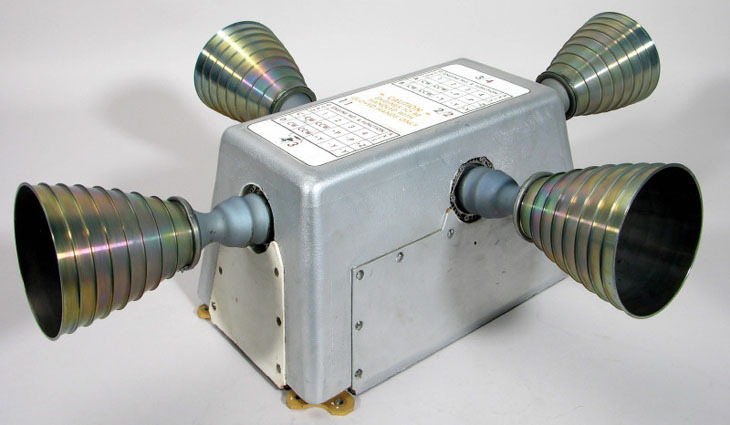
Apollo orientation engines close-up
Landing system
Landing systems developed the achievements and traditions of the respective countries. The United States continued to land ships. After experimenting with the Mercury and Gemini landing systems, a simple and reliable option was chosen - the ship had two braking and three main parachutes. The main parachutes were reserved, and a safe landing was provided in case of failure of one of them. Such a failure occurred during the landing of Apollo 15, and nothing bad happened. Reservation of parachutes made it possible to abandon the individual parachutes of the Mercury astronauts and the Gemini ejection seats.

Apollo landing pattern
In the USSR, the ship was traditionally put on land. Ideologically, the landing system develops a parachute-jet landing of the “Sunrises”. After resetting the lids of the parachute container, the exhaust, brake and main parachutes are triggered sequentially (in case of system failure, a spare is installed). The ship descends with one parachute, at 5.8 km altitude the heat shield is dropped, and at ~ 1 m, soft-landing jet engines (DMF) are triggered. The system turned out to be interesting - the work of the DMF creates spectacular frames, but the comfort of landing varies in a very wide range. If the astronauts are lucky, then a blow to the ground is almost imperceptible. If not, then the ship can hit the ground sensitively, and if not lucky, it will also tip over on its side.

Landing pattern

Absolutely normal operation of the DMP

The bottom of the descent vehicle. Three circles on top - DMP, three more - on the opposite side
Emergency rescue system
It is curious, but, walking in different ways, the USSR and the USA came to the same system of salvation. In the event of an accident, a special solid-fuel engine, standing at the very top of the launch vehicle, tore off the lander with astronauts and carried it to the side. Landing was carried out by regular means of the descent vehicle. Such a rescue system turned out to be the best of all the options used - it is simple, reliable and ensures the rescue of astronauts at all stages of the launch. In a real accident, it was used once and saved the lives of Vladimir Titov and Gennady Strekalov, taking the descent vehicle from a rocket burning in the launch pad.
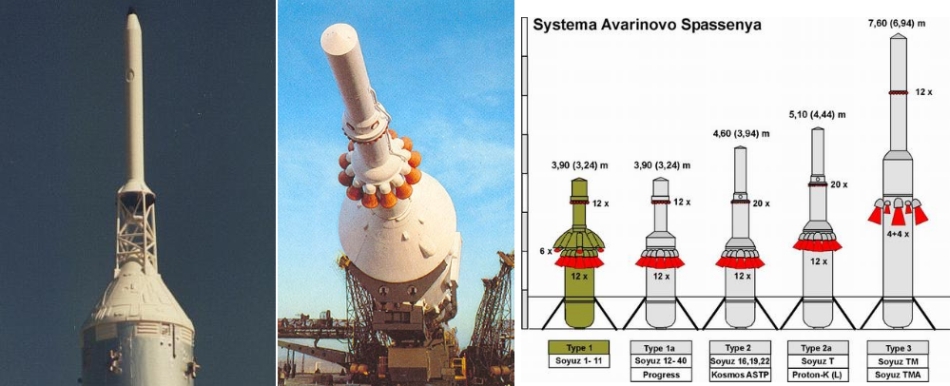
From left to right, SAS Apollo, SAS Soyuz, various versions of SAS Soyuz
Thermoregulation system
In both ships, a thermoregulation system with a coolant and radiators was used. Painted in white for better heat radiation, the radiators stood on the service modules and even looked the same:

VKD funds
Both the Apollo and the Unions designed taking into account the possible need for extra-ship activity (spacewalks). Design decisions were also traditional for countries - the United States depressurized the entire command module and went outside through a standard hatch, and the USSR used the household compartment as a lock chamber.

VKD "Apollo 9"
Docking system
Both Soyuz and Apollo used a pin-cone type docking device. Since the ship was actively maneuvering when docking, both pins were installed on the Soyuz and Apollo. And for the Soyuz-Apollon program, so as not to offend anyone, they developed a universal androgynous docking unit. Androgyny meant that any two ships could dock with such nodes (and not just paired, one with a pin, the other with a cone).

Docking mechanism "Apollo". Incidentally, it was also used in the Soyuz-Apollon program. With its help, the command module docked with a lock chamber

. Soyuz docking mechanism diagram, the first version

of Soyuz-19, front view. The docking station is clearly visible
Cabin and equipment
In terms of equipment, Apollo was noticeably superior to Soyuz. First of all, the designers were able to add a full-fledged gyro-stabilized platform to the Apollo equipment, which stored the position and speed of the ship with high accuracy. Further, the command module had a powerful and flexible computer for its time, which, if necessary, could be reprogrammed directly in flight (and such cases are known). An interesting feature of Apollo was also a separate workstation for astronavigation. It was used only in space and was located under the feet of astronauts.

Control panel, view from the left seat

Control Panel. On the left are the flight controls, in the center are the orientation engines, above are the emergency indicators, and below are the communications. On the right side are indicators of fuel, hydrogen and oxygen and power management.
Although the equipment of the Soyuz was simpler, it was the most advanced for Soviet ships. The on-board digital computer first appeared on the ship, and the ship's systems included equipment for automatic docking. For the first time in space, multifunction indicators on a cathode ray tube were used.

The control panel of the Soyuz spacecraft.
Panorama of the Soyuz-35 spacecraft descent vehicle
Life supporting system
The life support system was traditional for countries. In the USA, an oxygen atmosphere was used at reduced pressure, in the USSR, an oxygen-nitrogen mixture was used at atmospheric pressure. This situation made it impossible for the ships to dock directly. I had to make a special lock compartment. Moreover, if it was possible to move from Apollo to Soyuz very quickly, then for the return transition it took three hours to sit in the airlock, breathing pure oxygen in order to remove nitrogen from the blood. Even Soviet overalls became flammable in the atmosphere of the Apollo, and it was necessary to develop a special fabric in which the Soviet cosmonauts could visit the Apollo. As practice has shown, the inconvenience of the oxygen atmosphere outweighed its merits, already on the Space Shuttles the atmosphere was close to Earth, and now no one flies on a purely oxygen atmosphere.
The specifics of the atmosphere meant that at the start of Apollo astronauts should have been in spacesuits. On Soyuz, they flew in tracksuits before the Soyuz-11 disaster, after which, for safety, start and landing began to take place only in spacesuits.
From the point of view of convenience, the cabin of the Soyuz is small and cramped, but this is compensated by the household compartment.
The amenities at Soyuz were noticeably better - the Apollo had a very uncomfortable toilet .
Power system
Apollo used a fuel cell system, which was very convenient for flights lasting 2-3 weeks. Hydrogen and oxygen, when combined, generated energy, and the resulting water was used by the crew. On the “Soyuz” in different versions were different sources of energy. There were options with fuel cells, and for the Soyuz-Apollo flight, solar panels were installed on the ship.
Conclusion
Both the Unions and the Apollo turned out to be very successful ships in their own way. The Apollo successfully flew to the Moon and Skylab Station. And the Unions received an extremely long and successful life, becoming the main ship for flights to orbital stations, since 2011 they will carry American astronauts to the ISS and will carry them at least until 2018.
But a very expensive price was paid for this success. Both Soyuz and Apollo were the first ships in which people died. What is even sadder if designers, engineers and workers were in no hurry and after their first successes would not have ceased to be afraid of space, Komarov, Dobrovolsky, Volkov, Patsaev, Grissom, White and Cheffy would be alive .
Additional materials
The plot of the program "Soyuz-Apollon" TV Roskosmos
NASA Movie
PS> A small ad. This Saturday, July 25, in Ufa, my lecture "The Moon and Lunar Programs" will be held. VK meeting .