
 April 16, 2015 at 00:06
The world's first battery-free camcorder

Engineers from Columbia University intend to make a real revolution in photo and video. They developed the world's first camera that does not require external power sources. The camera feeds itself with energy, which enters the photosensitive sensor!
The design is simple : each photodiode in the sensor alternately operates in two modes: first it records the number of photons, and then it generates current in the photoelectric mode. Current flows into the ionistor (supercapacitor), which feeds the electronic circuit.
In this mode, the camera can work forever, under the condition of illumination of more than 300 lux.
Circuit

Sensor Architecture
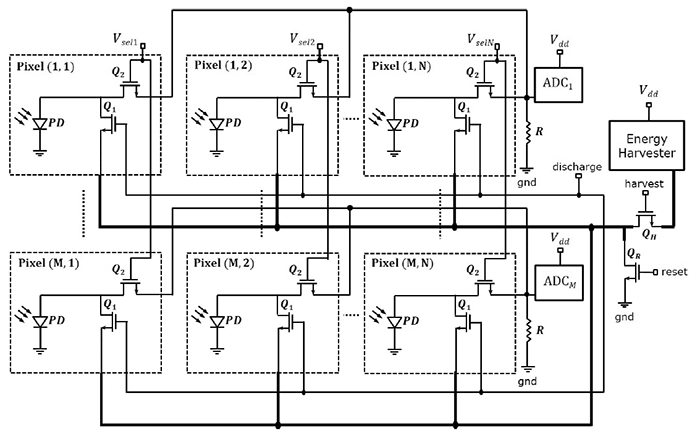
There is enough energy to take an image with a frequency of 30 frames / s and transfer it via cable to a computer. The camera does not yet have its own recording device, but they plan to add it in the future.
The first experimental sensor has a low resolution: only 40x30 pixels.
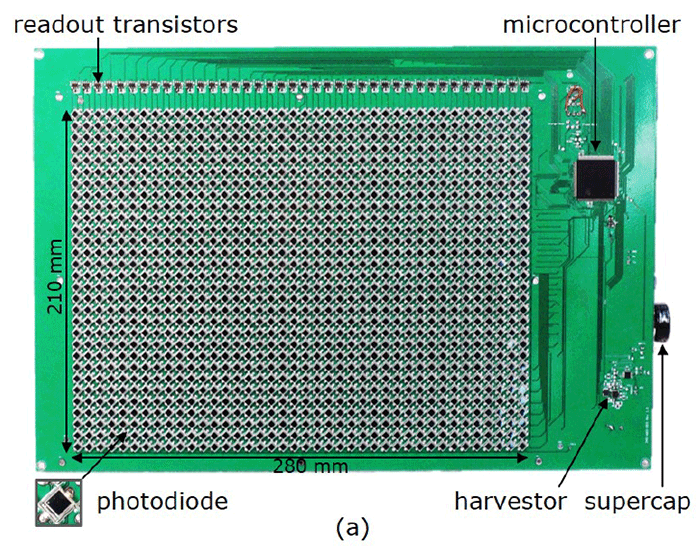
But these are already technical details. Scientists have proven the viability of the concept and made a workable prototype. Probably, a more advanced sensor can simply be composed of a large number of such modules - the resolution will increase purely mechanically.
Here's what a video made with a fully standalone camera looks like.
The sensor will not be able to work in conditions of zero illumination, but with an increase in the amount of light, the voltage in the circuit increases sharply. The graph shows the voltage from one photodiode.

The study is funded by the United States Department of the Navy. The official presentation of the scientific work will take place at the International Conference on Computational Photography on April 24-26 in Houston.
Now there are about 2 billion digital cameras and camera modules in the world. But if they begin to work without additional power, then this figure can be safely increased several times. Fully autonomous cameras will find application in wearable electronics, sensors and other devices. Ideally, gadgets of various functionality can be combined into a global network that does not require external power, extracting all the necessary energy from the environment.