March 31, 2015 at 16:10
Are there any advantages to balanced headphone amplifiers?
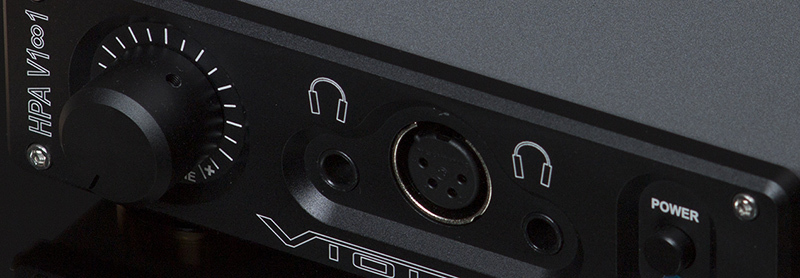
Recently, in expensive players and amplifiers, you can increasingly see a specialized headphone output called “balanced”, designed for “balanced” headphones. Why is it needed and what is it for?
Balanced or symmetric is usually called such circuitry (or the principle of transmission), in which one channel is transmitted simultaneously by two streams, where the second stream relative to the first is transmitted in antiphase.
Workers in the music industry are constantly confronted with switching components with balanced cables, which allows them to effectively deal with interference and cable interference.

It works quite simply. The signal is bifurcated and one of them is inverted. Crosstalk and interference equally accumulate. At the receiver, one of the signals is inverted back and then added. The useful signal is added up and simply doubles its amplitude, and the interference is subtracted. The benefit of such data transfer is obvious - you can use long cables and even with a low signal level we do not get noticeable interference. Balanced cables are widely used at distances above 2-5 meters.
At home, balanced cables are rarely needed, because there are practically no pickups at small distances, but the operation of separation, double inversion and addition can give more distortion from an increase in the active elements in the signal path.
A balanced cable is always at least 3 conductors for one channel (with three contacts, one wire is common).
The name “balanced amplifier” originated in the world of personal audio as an attempt to sell an amplifier in a bridge connection without association with a concert amplifier (mostly of mediocre quality).
Formally, the amplifier circuit looks like this:

The signal symmetry is visually visible. Hence the first beautiful “selling” name is “symmetrical”, and then the picked up term from Pro Audio is balanced. For technically savvy people, this is how it was, and it remains - bridge switching on the amplifier, when two amplifiers work on the same channel, doubling the voltage.
The need for bridging is rooted in especially the operation of transistors and integrated circuits. In the good old "tube" times, the main problem of obtaining high power was the output current - the lamp could give out a high voltage, but the output was a relatively small current. Accordingly, the resistance of the first emitters was high for the best agreement. For low-impedance speakers, step-down transformers were required to be installed, converting the voltage-current ratio at the same output power. To increase the power with increasing output current, the inclusion of several amplifiers in parallel was actively practiced. The voltage level remained the same, and the current margin was higher.
The properties of the transistor were opposite, the current level could be large, but the voltage range (in which the circuit operates linearly) is limited. If you raise the datasheets to most integrated circuits, you can see that the maximum voltage levels are limited to 12 or 25 V. Substituting the common resistances in the form of 4 and 8 Ohms, the maximum power values of the amplifier are automatically obtained taking into account the power supply to the amplifier.
With widespread speakers at 4 and 8 ohms, the power of transistor amplifiers was enough for most tasks. Stand out concert acoustics, where higher power is required, which can be obtained only by increasing the voltage. To get away from the 12/25 V limit, bridge switching is used. Those who are familiar with concert equipment know that usually two modes are available in the amplifier - stereo and the more powerful mono “Brige”.
In bridge mode, the amplifier has its own characteristics of connecting headphones. When connecting headphones, you cannot use the common wire from the right and left channels and the minimum number of contacts must be at least four. This is very important because when connected to an amplifier, you cannot use a conventional cable with a three-pin plug (including an adapter).

Oppo HA-1 balanced amplifier jack
Since headphones do not use thick finger cables, XLR connectors are usually used instead of screw terminals: four pin (the most common today) or two three-pin. Hi-FiMan and Astel & Kern portable players use a four-pin plug (and each manufacturer has its own wiring).

Two three-pin balanced connectors on the Abyss AB-1266
Since wire connectors with XLR connectors are called “balanced” in Pro Audio, it is not surprising that the name “balanced amplifier” was firmly established in personal audio.
Back to the headphone amplifiers - why is this high power mode needed?
Volume
There are a number of headphone models that need an amplifier with a high output voltage, like amplifiers for speakers. But amplifiers for speakers are far from always possible to use for headphones - from an aesthetic point of view, there is no headphone jack with direct output and the background noise level, which is not perceptible from the speakers, can be clearly heard in the headphones.
Quality
From the standpoint of quality, there is also a gain, although in relation to cost it is not always adequate. If we take two amplifiers, for example, in class A, where distortions at low amplitudes are minimal, then in a balanced connection we can get similar quality at a high volume level than from the same amplifier, but in normal mode. Or at the same volume in balanced mode, the amplifier will have lower distortion than usual (after all, no one needs to listen to the amplifier in maximum power mode?).
In addition, in a balanced connection, the signal is averaged and this allows to slightly reduce the differences in characteristics between the right and left channels.
Here you can argue a lot on the topic of whether it is better to use two amplifiers in bridge mode, or at the same cost, choose another circuitry solution in the “normal” mode (for example, on more expensive components or with more details).
Where it is exclusively about budget devices, bridge amplifiers are actively used only in concert technology (the priority of volume without regard to quality). In headphone amplifiers, separate budget bridge amplifiers for the sake of high volume in most cases are meaningless.
In the middle class, balanced amplifiers are a controversial decision because strong competition with conventional amplifiers. For example, which is better, Violectric V200 or V181? With different models of headphones, one model will be pulled forward.

The Violectric V181 circuit (two stereo amplifiers, one works in antiphase)
But in expensive solutions, bridge amplifiers are justified, where the developer concludes that the amplifier in the usual circuit has already exhausted its reserve for increasing quality and you can only go further by making a “double” (bridge ) amplifier for use in light mode. And of course, expensive solutions do not scrupulously calculate every penny per component, and the developer can focus solely on sound quality, rather than saving production.

Balanced amplifier Violectric V281
Do not underestimate the enterprising marketers who can play on the established opinion “a balanced amplifier is the pinnacle of quality” and roll out budget models to the market, where each amplifier should be evaluated as critically as possible.
conclusions

Balanced amplifier Violectric V181 and Audeze LCD-X Balanced
amplifiers have advantages.
Benefits:
- The ability to get a high level output signal for low-sensitivity headphones
- Increase in sound quality due to operation in light mode
Economic feasibility depends on each specific case.
Author Kuznetsov Roman romanrex
Only registered users can participate in the survey. Please come in.
Headphone amplifier is an important part of the audio system.
- 11.8% yes, without a high-quality amplifier it is impossible to listen to music 56
- 4.8% yes, and different amplifiers are needed for different headphones 23
- 46.9% depends on the headphones, sometimes there are enough built-in amplifiers in sound cards 222
- 26.6% no, I have super headphones for 100 rubles and no amplifier changes anything 126
- 9.7% correct tube amplifier only 46