
 January 28, 2015 at 18:33
NASA proposes to hook spacecraft to comets for entry into deep space
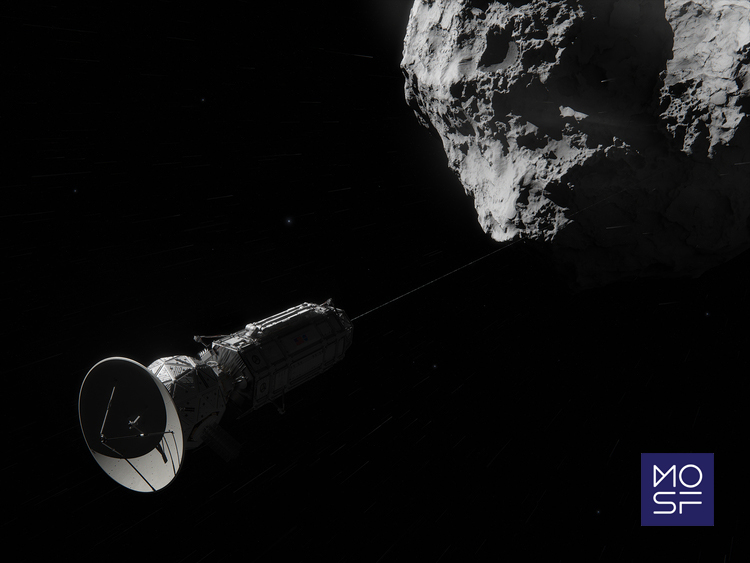
NASA has come up with a lot of great ideas over the past few months. These are submarines on Titan, and drones on Mars, and a device that melts ice on Europe. Now another idea has appeared - to use comets to transport spaceships attached to such an object over long distances.
So far this is just an idea, but Masahiro Ono of the Jet Propulsion Laboratory believes that this method of transportation can be very effective. Moreover, the implementation of the idea, according to It, should not be too difficult a task. But the "comet hitchhiking" would allow spacecraft and vehicles to travel throughout the solar system with low resource costs and at high speed.
The author of the idea compares this method of transportation with fishing, in which the fisherman catches a very large fish. She begins to run away from the boat, and pulls the vessel behind her, with ever increasing speed. A similar scheme is proposed by Masahiro Ono for traveling on comets: a ship flies up to such an object, harpoons it (a particularly strong nanofiber serves as a rope here), and flies with a comet to the desired point in space. Of course, not every comet is suitable for "hitchhiking", but here it is already necessary to carry out work to refine the trajectories of comets (and the trajectories of a large number are already known) in order to have a good idea of where you can fly using such an object.

It calculated the possible trajectories of travel to various objects of the solar system, and here’s what he did: it will be possible to reach Pluto in just 5.5 years,Haumey in just 9 years. This is almost twice as fast as in the case of the New Horizons, a probe launched to Pluto back in 2006.
So far, no one has expressed interest in financing such an original project, and it is unclear whether such a concept as a real proposal will be used at all. But there really is a rational grain here, and, probably, in the near future several specialists will work on the project (albeit in their free time), and not just one.
With an accurate calculation, a ship traveling in such an original way will not require a large amount of fuel. And cosmonauts, if the ship is with the crew, will be able to study the comet in "free" time, of which they will have a huge amount. With the help of some technologies, perhaps the ship’s team will even be able to get energy using the “tied” ship and comet.

Naturally, a very accurate calculation is needed here - after all, approaching a comet is a difficult task, and even if the connection between the ship and the comet is broken, the ship with the crew (or just a spacecraft) will be lost and it will have practically no chance of returning to Earth.