June 15, 2017 at 00:29
Retro-electric therapist "Cherry". Story 1 - From Design to Test Drive
Greetings dear Giktayms! I offer you the experience of finding a two-wheeled friend for unhurried walks on rough terrain.
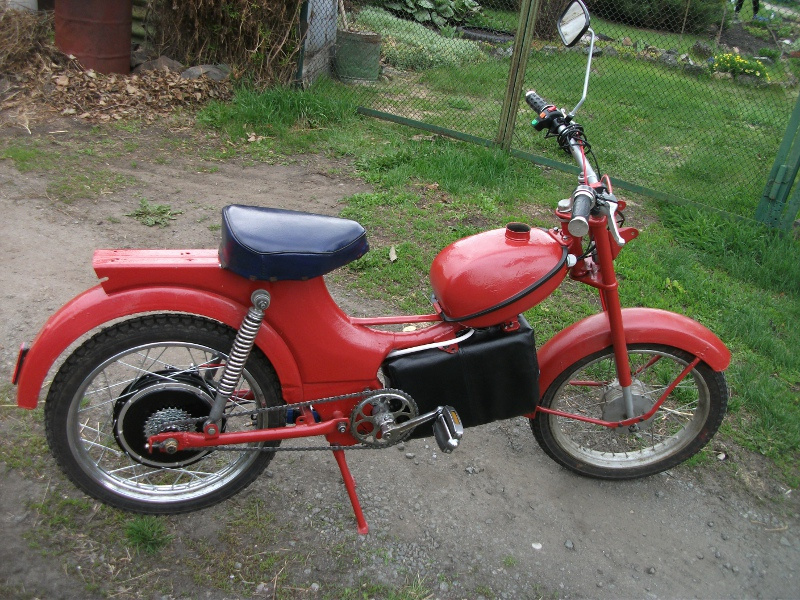
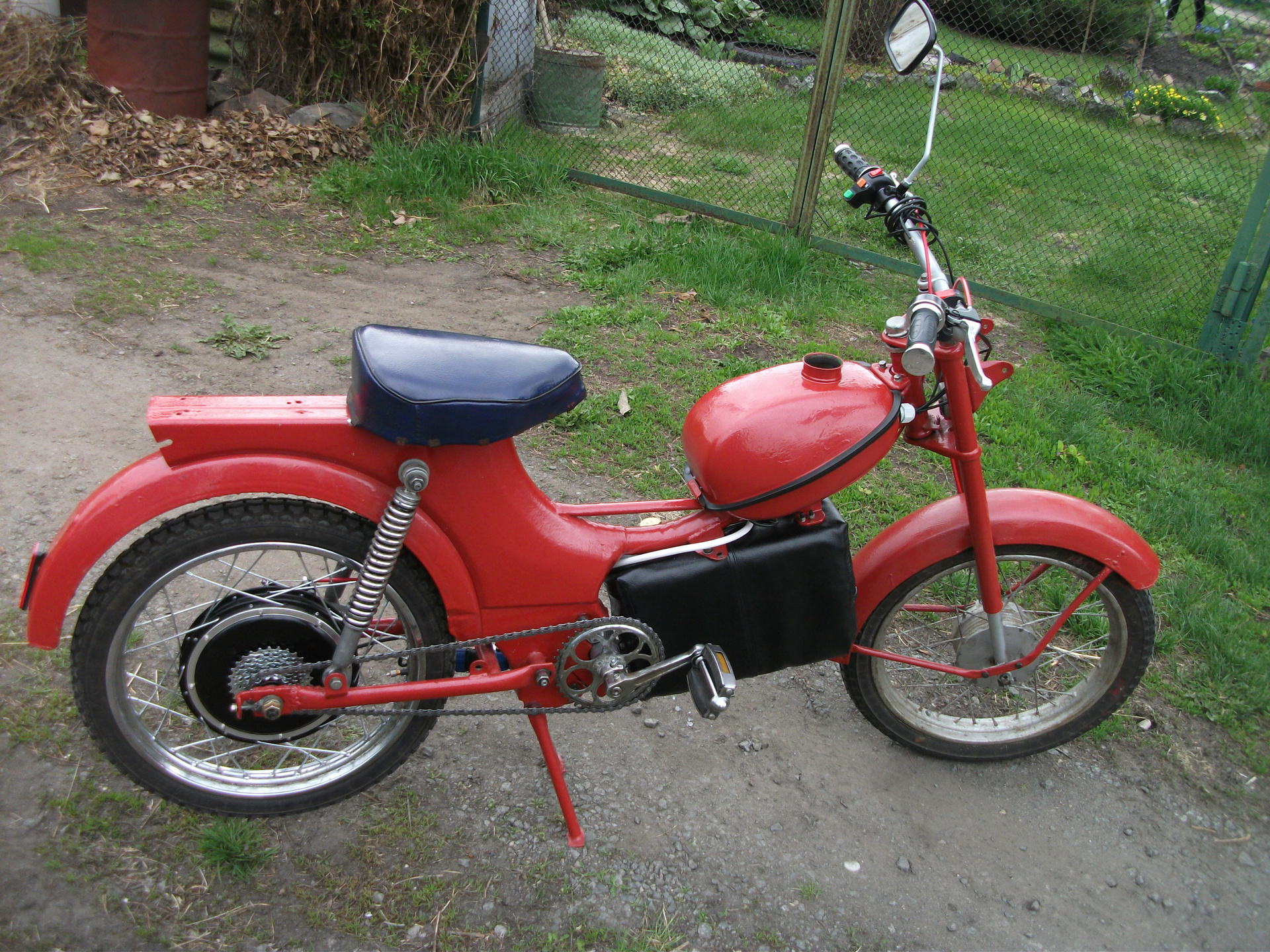
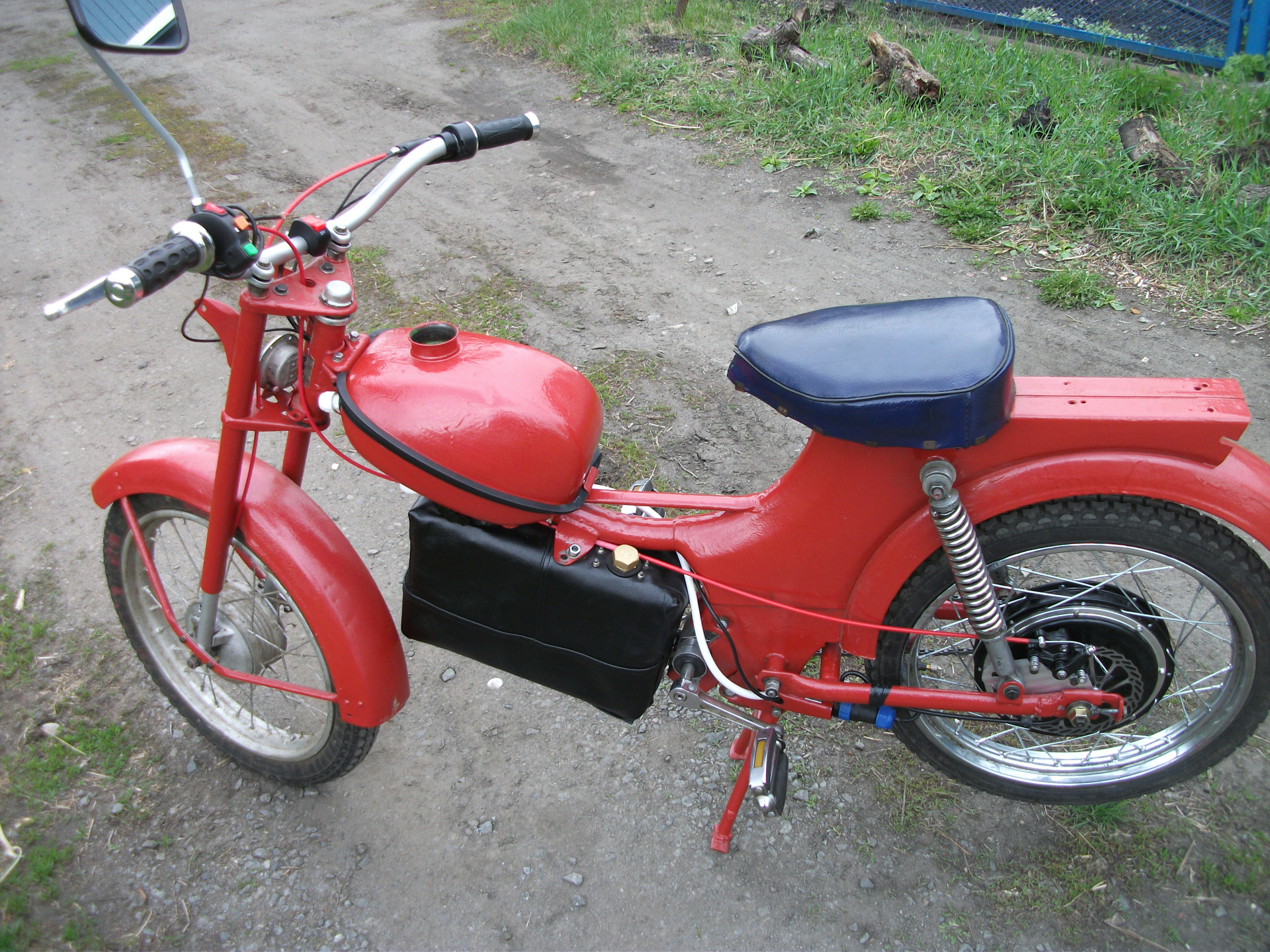
A gift from the past looking to the future
In early 2014, I was fortunate enough to save a childhood dream from a scrap metal - a two-speed Riga-12 moped in 1975. Over the course of several months, the miracle of Soviet technology was taken apart to a screw, stripped, slightly tampered with (the upper beam of the steering column and the hoof of the stand fell off, the seat frame cracked), repainted with hammer enamel, assembled, equipped with electronic ignition, and finally started up and drove off. Yes, this bike deserved to be restored! Relatively light, with a low center of gravity, stable, manageable, predictably and comfortably behaving on the bumps in the village and forest - the area of our habitat with it - the routes are more than abundant. Only one thing let down and upset - the noisy, dirty and unreliable two-stroke engine S-57.
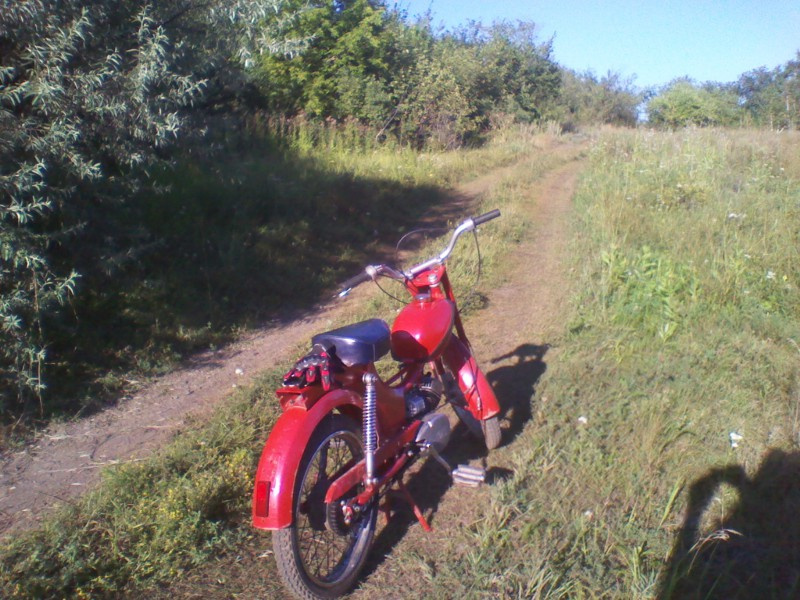
Amateur mopedists will object, they say, you just need to be able to handle such a motor, and then it will mainly not fail, but please. I do not argue, antique engines still faithfully serve the orange grandfathers, being wonderful representatives of living history. How lucky they once gave them the first real motor vehicle in their life, the feeling of flying on a two-wheeled vehicle, the freedom of magical skating in nature and in the city, which was then spacious and green, the invaluable basics of handling the equipment and understanding it!
The spirit of technology of the 20th century that educated me and many respected colleagues deserves mention, feeling and reflection. Vehicles, scientific equipment, industrial and household appliances were perceived by the people who created them, maintained them, purchased and used them not as consumables, and commodity units that cost a certain amount of money (and, more precisely, which could and should bring them, and which are nothing more ), and even with the planned aging and proprietary bondage, but as wonderful complex systems that embodied the achievements of science and design genius. Cars, motorbikes, tape recorders and the pinnacle of progress — computers — consisted for us, children of the era of scientific and technological progress, not of rubles, rupees, bitcoins and promotional marketing points, but of technological details, and it was not the vulgar amount of rupees that mattered, and the sacred quality of the elements and the mystery of their interaction. We worshiped the priesthood of the Master, who was able to fix the TV - a wonderful window into the world of youth films and programs, informative and inspiring. And to learn how to independently service your bike, moped, electrical appliance, even just repair furniture or clothes, was a great pride for every son and daughter of the time of the Masters, a system-forming aspect of self-determination. And even more so to assemble or even construct a home-made, acting, real thing! I can, therefore, exist, live, develop, learn and create, use the existing culture and create my own things on its basis that I can use! able to fix the TV - a wonderful window into the world of youth films and programs, informative and inspiring. And to learn how to independently service your bike, moped, electrical appliance, even just repair furniture or clothes, was a great pride for every son and daughter of the time of the Masters, a system-forming aspect of self-determination. And even more so to assemble or even construct a home-made, acting, real thing! I can, therefore, exist, live, develop, learn and create, use the existing culture and create my own things on its basis that I can use! able to fix the TV - a wonderful window into the world of youth films and programs, informative and inspiring. And to learn how to independently service your bike, moped, electrical appliance, even just repair furniture or clothes, was a great pride for every son and daughter of the time of the Masters, a system-forming aspect of self-determination. And even more so to assemble or even construct a home-made, acting, real thing! I can, therefore, exist, live, develop, learn and create, use the existing culture and create my own things on its basis that I can use! it was a great pride for every son and daughter of the time of the Masters, a system-forming aspect of self-determination. And even more so to assemble or even construct a home-made, acting, real thing! I can, therefore, exist, live, develop, learn and create, use the existing culture and create my own things on its basis that I can use! it was a great pride for every son and daughter of the time of the Masters, a system-forming aspect of self-determination. And even more so to assemble or even construct a home-made, acting, real thing! I can, therefore, exist, live, develop, learn and create, use the existing culture and create my own things on its basis that I can use!
Things then were not temporary houses for earning, but really things, weighty, proprietary and durable. Even when it came to an inexpensive mass moped, designed only to satisfy the need of the state and population for an affordable two-wheeled car for teenagers and retirees, in order to fulfill utilitarian tasks and form basic knowledge, skills, driving skills of vehicles and servicing mechanisms. Two-speed Riga turned out to be very beautiful and solid. Fine frame steel, slightly susceptible to corrosion, solid margin of safety, good layout, decent design.
Space flights, electronics, computers and robots were what rapidly developed and inspired. By this we lived then, by this we can live now. Therefore, the vintage base of Riga-12 with its retro-futuristic appearance in the spirit of robots, aviation and space is so perfectly suited for a steel skate. And therefore, I will replace its simplified clone of the antediluvian Czech three-speed motor with an electric motor. Cute vintage mopeds, such as Riga and their ancestors Java, the now rare Lviv women and the unsurpassed in their beauty Triumph Fips, like many other representatives of technology from the second half of the 20th century, looked not into the past, but into the future. An environmentally friendly brushless motor with digital electronic control on a single-chip microcomputer - is this not a dream? Nothing needs to be poured anywhere, wound up with tricks, it’s difficult to manage, so that it does not die out, does not overheat, does not seize. Charged from the mains, solar panel, windmill, turned on and - go!
It’s like, but for me, biker happiness is not in the motor from the past, ambiguous romance is fussing with it, specific strong smells and sounds, but in the unity of the rider, bike and terrain, the ability to hear and smell nature, to go out at dawn to pick mushrooms without waking the neighbors , do not disturb the delicate balance of life in the forest or the steppe. The appearance of the electric motorcycle, in my opinion, remains vintage harmonious, and its full-time filling is replaced with the one that was only dreamed of at the time of its production. And this is not the destruction of the monument of technical antiquity, which could be restored, mothballed and put into the museum, but the extension of the full-fledged life of a solid machine at a new level.
For me personally, the main interest in the project was testing lead-acid batteries in hard operating conditions, which was completely successful, and even more. Therefore, soon after construction, the electric bike was handed over to a good friend who was fond of two-wheeled personal transport, steampunk and retro-futurism, who very much asked to create something similar for her. And I continue to outline the prospects for acquiring a modification or building a lighter and more minimalistic projectile for movement, recovery and joy.
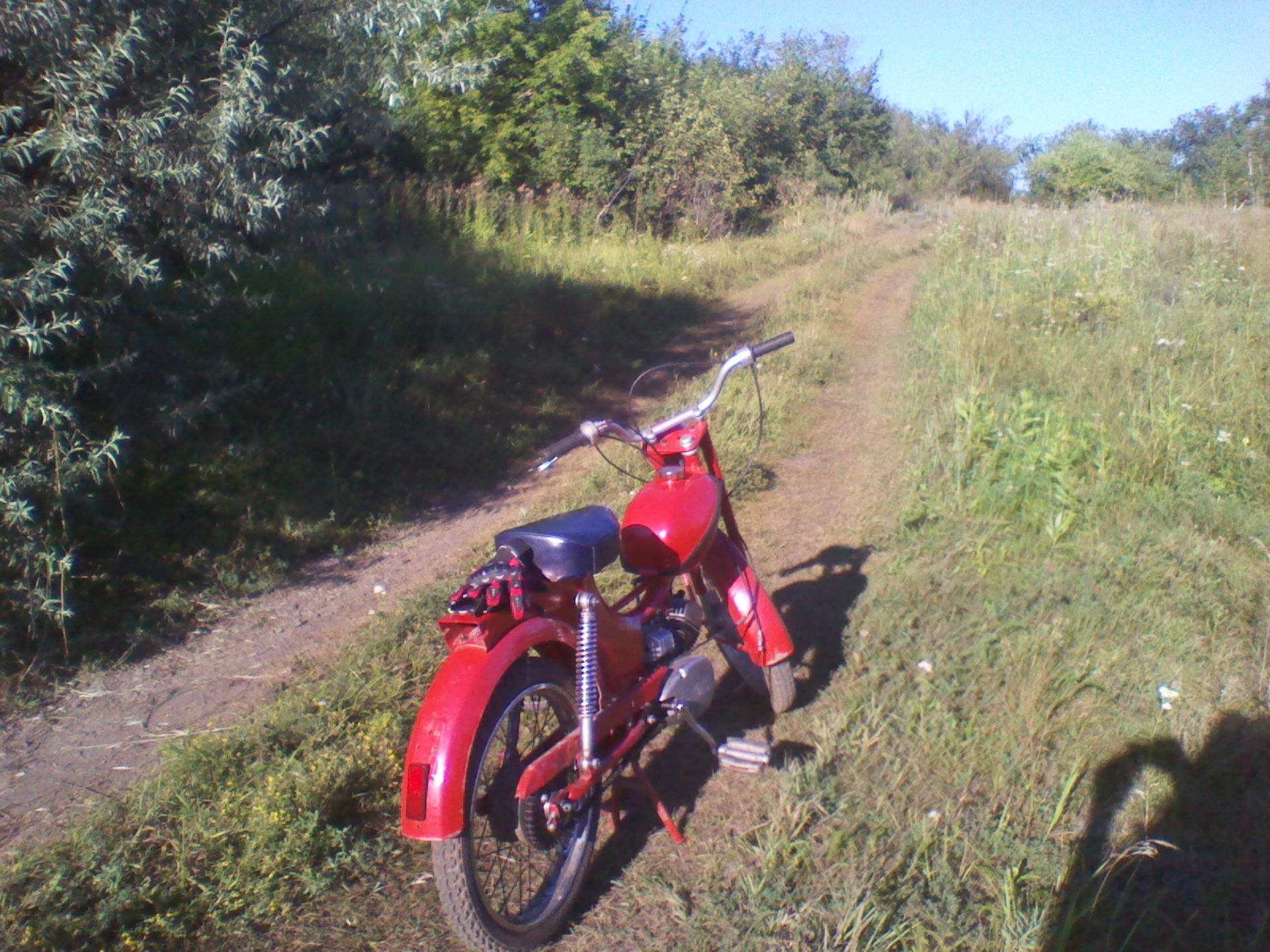
Amateur mopedists will object, they say, you just need to be able to handle such a motor, and then it will mainly not fail, but please. I do not argue, antique engines still faithfully serve the orange grandfathers, being wonderful representatives of living history. How lucky they once gave them the first real motor vehicle in their life, the feeling of flying on a two-wheeled vehicle, the freedom of magical skating in nature and in the city, which was then spacious and green, the invaluable basics of handling the equipment and understanding it!
The spirit of technology of the 20th century that educated me and many respected colleagues deserves mention, feeling and reflection. Vehicles, scientific equipment, industrial and household appliances were perceived by the people who created them, maintained them, purchased and used them not as consumables, and commodity units that cost a certain amount of money (and, more precisely, which could and should bring them, and which are nothing more ), and even with the planned aging and proprietary bondage, but as wonderful complex systems that embodied the achievements of science and design genius. Cars, motorbikes, tape recorders and the pinnacle of progress — computers — consisted for us, children of the era of scientific and technological progress, not of rubles, rupees, bitcoins and promotional marketing points, but of technological details, and it was not the vulgar amount of rupees that mattered, and the sacred quality of the elements and the mystery of their interaction. We worshiped the priesthood of the Master, who was able to fix the TV - a wonderful window into the world of youth films and programs, informative and inspiring. And to learn how to independently service your bike, moped, electrical appliance, even just repair furniture or clothes, was a great pride for every son and daughter of the time of the Masters, a system-forming aspect of self-determination. And even more so to assemble or even construct a home-made, acting, real thing! I can, therefore, exist, live, develop, learn and create, use the existing culture and create my own things on its basis that I can use! able to fix the TV - a wonderful window into the world of youth films and programs, informative and inspiring. And to learn how to independently service your bike, moped, electrical appliance, even just repair furniture or clothes, was a great pride for every son and daughter of the time of the Masters, a system-forming aspect of self-determination. And even more so to assemble or even construct a home-made, acting, real thing! I can, therefore, exist, live, develop, learn and create, use the existing culture and create my own things on its basis that I can use! able to fix the TV - a wonderful window into the world of youth films and programs, informative and inspiring. And to learn how to independently service your bike, moped, electrical appliance, even just repair furniture or clothes, was a great pride for every son and daughter of the time of the Masters, a system-forming aspect of self-determination. And even more so to assemble or even construct a home-made, acting, real thing! I can, therefore, exist, live, develop, learn and create, use the existing culture and create my own things on its basis that I can use! it was a great pride for every son and daughter of the time of the Masters, a system-forming aspect of self-determination. And even more so to assemble or even construct a home-made, acting, real thing! I can, therefore, exist, live, develop, learn and create, use the existing culture and create my own things on its basis that I can use! it was a great pride for every son and daughter of the time of the Masters, a system-forming aspect of self-determination. And even more so to assemble or even construct a home-made, acting, real thing! I can, therefore, exist, live, develop, learn and create, use the existing culture and create my own things on its basis that I can use!
Things then were not temporary houses for earning, but really things, weighty, proprietary and durable. Even when it came to an inexpensive mass moped, designed only to satisfy the need of the state and population for an affordable two-wheeled car for teenagers and retirees, in order to fulfill utilitarian tasks and form basic knowledge, skills, driving skills of vehicles and servicing mechanisms. Two-speed Riga turned out to be very beautiful and solid. Fine frame steel, slightly susceptible to corrosion, solid margin of safety, good layout, decent design.
Space flights, electronics, computers and robots were what rapidly developed and inspired. By this we lived then, by this we can live now. Therefore, the vintage base of Riga-12 with its retro-futuristic appearance in the spirit of robots, aviation and space is so perfectly suited for a steel skate. And therefore, I will replace its simplified clone of the antediluvian Czech three-speed motor with an electric motor. Cute vintage mopeds, such as Riga and their ancestors Java, the now rare Lviv women and the unsurpassed in their beauty Triumph Fips, like many other representatives of technology from the second half of the 20th century, looked not into the past, but into the future. An environmentally friendly brushless motor with digital electronic control on a single-chip microcomputer - is this not a dream? Nothing needs to be poured anywhere, wound up with tricks, it’s difficult to manage, so that it does not die out, does not overheat, does not seize. Charged from the mains, solar panel, windmill, turned on and - go!
It’s like, but for me, biker happiness is not in the motor from the past, ambiguous romance is fussing with it, specific strong smells and sounds, but in the unity of the rider, bike and terrain, the ability to hear and smell nature, to go out at dawn to pick mushrooms without waking the neighbors , do not disturb the delicate balance of life in the forest or the steppe. The appearance of the electric motorcycle, in my opinion, remains vintage harmonious, and its full-time filling is replaced with the one that was only dreamed of at the time of its production. And this is not the destruction of the monument of technical antiquity, which could be restored, mothballed and put into the museum, but the extension of the full-fledged life of a solid machine at a new level.
For me personally, the main interest in the project was testing lead-acid batteries in hard operating conditions, which was completely successful, and even more. Therefore, soon after construction, the electric bike was handed over to a good friend who was fond of two-wheeled personal transport, steampunk and retro-futurism, who very much asked to create something similar for her. And I continue to outline the prospects for acquiring a modification or building a lighter and more minimalistic projectile for movement, recovery and joy.
Selection and installation of an electric motor
So, we are building an electrocast on the basis of Riga-12. First, let's decide on the drive. The options are as follows.
The carriage motor is a specialized solution for a bicycle frame and gear changes with asterisks. It is expensive, power is usually small, more likely to help pedaling, transfers traction through a bicycle-type chain. And Cherry is a rather heavy apparatus, even in comparison with Soviet bicycles, not to mention modern ones, and the transfer of all power for a thin chain is an excessive load. Not good.
An electric motor in the trunk, in place of a gasoline engine, or even a cylinder or crank chamber, while maintaining the standard gearbox. Craftsmen created many options, one more extravagant. Screwdrivers, angle grinders (“grinders”), commutator motors from fans of automobile heaters, motors from the arsenal of modellers are used… All this is noisy, not very reliable and aesthetically pleasing, often has a small resource, requires a complicated transmission, and when using a standard motorcycle in it loses a lot of energy, which is critical for an electric bike. Finally, a car generator has become a classic in certain circles as an engine, with or without rewind, preservation of the field winding or its replacement with permanent magnets. A good, reliable, powerful AC machine, but there are questions about cooling and dust and moisture protection, and for a small moped it is cumbersome. With such an engine in my craft there will be little room for a traction battery and it will be difficult to put the pedals.
Yes, it’s the pedals! The cherry will remain a moped, only an electric one, or, in other words, it will become a heavy electric bike, and instead of a pedal trigger, it will receive a full-fledged single-speed pedal drive - a carriage, a drive and a driven sprocket, a roller-chain. This will help to overcome difficult areas, keep yourself in physical shape, and also with relative, given the severity of the apparatus, comfortably reach your home in the event of a discharge or a malfunction of the electric drive.
Therefore, we choose a motor wheel. But which gearbox, with its noise and wear of plastic gears, or direct drive? The moped’s rim is just 16 motorcycle inches, it’s 20 "by bicycle count. With the same torque and speed, the traction is higher, and the lower the speed, the smaller the wheel diameter, and vice versa. Our wheels do not need a gearbox, because a direct-drive hub motor is clearly suitable, and a rated power of 1 kW is quite enough,
only we have a 32-spoke rim and 36 motor hubs on the market ... You can buy a mokik rim ZiD Pilot, it is identical to the mopeds of Karpaty, Verkhovyna, Riga but has holes for 36 spokes. fraternize with the good Chinese, who will manufacture an electric motor for as many spokes as we need.I will share a link to the engine I purchased. The rest of the components I bought from different sellers, for the sake of cheapness and the study of the range. Some of them failed, about which further, but the hub motor pleased in everything.
To calculate the length of the needles, we will use the SpoCalc program, or some online calculator, they all give almost equal results. We will knit in two crosses, as was the case in stock. Due to the larger diameter of the motor hub compared to the standard brake sleeve, the nipples will snap into the holes at a sharper angle. The rim, fortunately, is not pistoned, and the abnormal angle will not cause problems. On the contrary, more tangential, as it is customary to say among cycle masters, the knitting pattern is not only beautiful, but also better in terms of transmitting torque to the rim from the hub.
ERD (effective diameter) of the 16-inch rim of a two-speed moped of the USSR is 380 mm, the shift of the spoke holes from the center is 4 mm. The diameter of the circle with the holes for the spokes of our Conchis motor 230, the full length of the axis 210, the width between the dropouts 135, the thickness of the hub in place of the holes 35, and it is located exactly in the middle of the axis without shifting left or right. As a result, with 2 crosses and 32 knitting needles, we need them 135 mm long, 12G thick. A photo of the assembled wheel has already been and still will be, but for now we will take care of its reliable fastening.
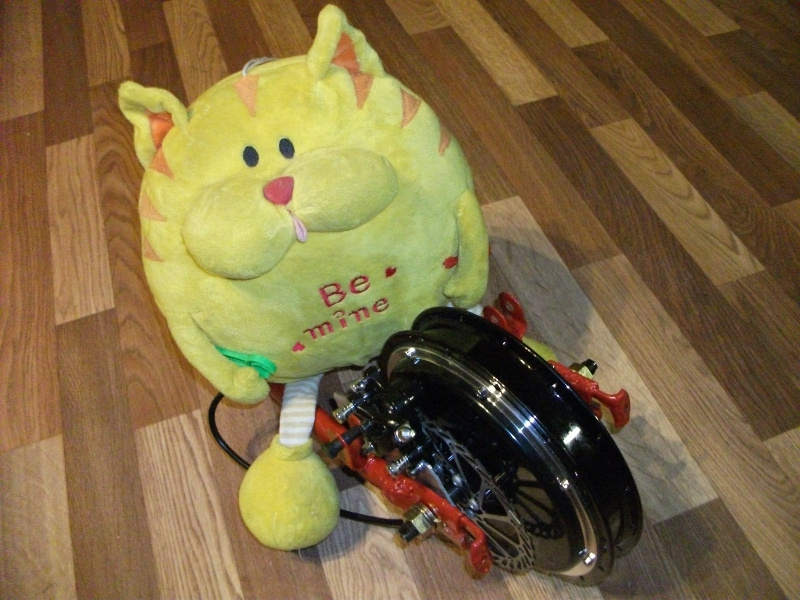
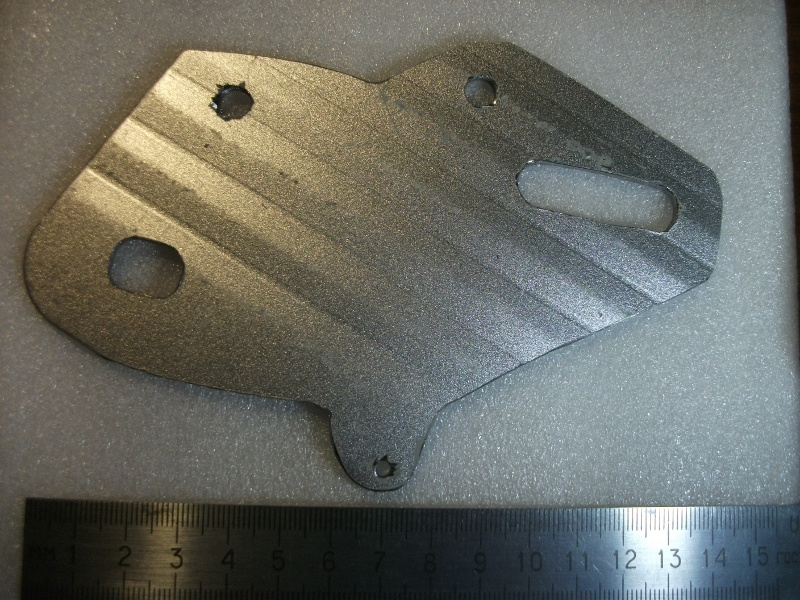
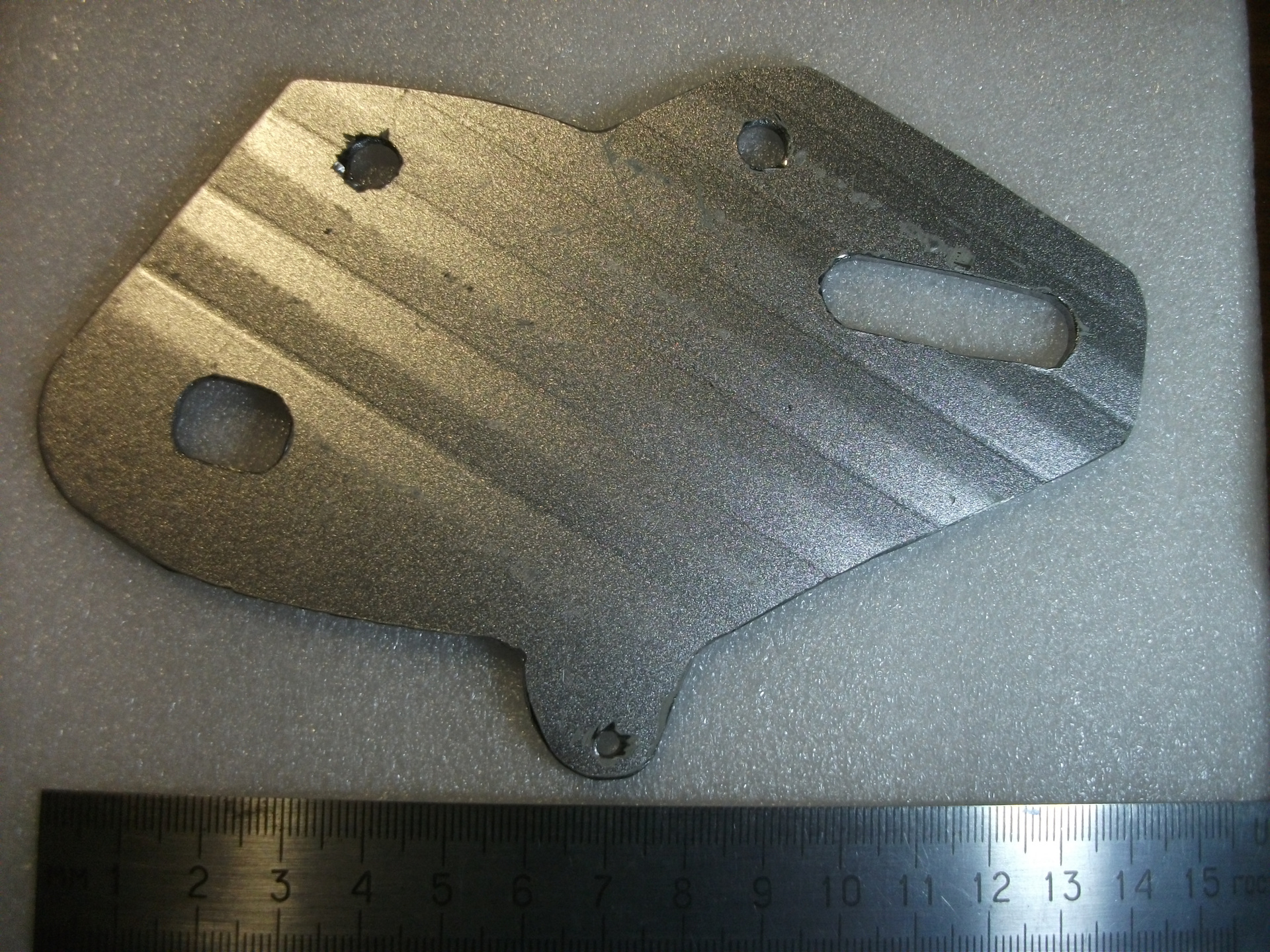
We maximize the dropouts by welding the plates, because all the torque is transmitted through the axis. My motor, by the way, is not flimsy tubular, but solid, with a groove for the cable. Not a trifle, and nice. To install a bicycle brake (the cable disc is the cheapest, the bike is not assembled for speed, but for cross-country ability, and electric braking will help), we cut out a figured plate from steel. It will also serve as an additional torsion lever, transmitting the moment to the bolt of the shock absorber to the rear fork, bypassing the dropout. When adjusting the chain tension, the plate will move along with the axis of the wheel, so that the position of the brake caliper relative to the disk remains unchanged.
The carriage motor is a specialized solution for a bicycle frame and gear changes with asterisks. It is expensive, power is usually small, more likely to help pedaling, transfers traction through a bicycle-type chain. And Cherry is a rather heavy apparatus, even in comparison with Soviet bicycles, not to mention modern ones, and the transfer of all power for a thin chain is an excessive load. Not good.
An electric motor in the trunk, in place of a gasoline engine, or even a cylinder or crank chamber, while maintaining the standard gearbox. Craftsmen created many options, one more extravagant. Screwdrivers, angle grinders (“grinders”), commutator motors from fans of automobile heaters, motors from the arsenal of modellers are used… All this is noisy, not very reliable and aesthetically pleasing, often has a small resource, requires a complicated transmission, and when using a standard motorcycle in it loses a lot of energy, which is critical for an electric bike. Finally, a car generator has become a classic in certain circles as an engine, with or without rewind, preservation of the field winding or its replacement with permanent magnets. A good, reliable, powerful AC machine, but there are questions about cooling and dust and moisture protection, and for a small moped it is cumbersome. With such an engine in my craft there will be little room for a traction battery and it will be difficult to put the pedals.
Yes, it’s the pedals! The cherry will remain a moped, only an electric one, or, in other words, it will become a heavy electric bike, and instead of a pedal trigger, it will receive a full-fledged single-speed pedal drive - a carriage, a drive and a driven sprocket, a roller-chain. This will help to overcome difficult areas, keep yourself in physical shape, and also with relative, given the severity of the apparatus, comfortably reach your home in the event of a discharge or a malfunction of the electric drive.
Therefore, we choose a motor wheel. But which gearbox, with its noise and wear of plastic gears, or direct drive? The moped’s rim is just 16 motorcycle inches, it’s 20 "by bicycle count. With the same torque and speed, the traction is higher, and the lower the speed, the smaller the wheel diameter, and vice versa. Our wheels do not need a gearbox, because a direct-drive hub motor is clearly suitable, and a rated power of 1 kW is quite enough,
only we have a 32-spoke rim and 36 motor hubs on the market ... You can buy a mokik rim ZiD Pilot, it is identical to the mopeds of Karpaty, Verkhovyna, Riga but has holes for 36 spokes. fraternize with the good Chinese, who will manufacture an electric motor for as many spokes as we need.I will share a link to the engine I purchased. The rest of the components I bought from different sellers, for the sake of cheapness and the study of the range. Some of them failed, about which further, but the hub motor pleased in everything.
To calculate the length of the needles, we will use the SpoCalc program, or some online calculator, they all give almost equal results. We will knit in two crosses, as was the case in stock. Due to the larger diameter of the motor hub compared to the standard brake sleeve, the nipples will snap into the holes at a sharper angle. The rim, fortunately, is not pistoned, and the abnormal angle will not cause problems. On the contrary, more tangential, as it is customary to say among cycle masters, the knitting pattern is not only beautiful, but also better in terms of transmitting torque to the rim from the hub.
ERD (effective diameter) of the 16-inch rim of a two-speed moped of the USSR is 380 mm, the shift of the spoke holes from the center is 4 mm. The diameter of the circle with the holes for the spokes of our Conchis motor 230, the full length of the axis 210, the width between the dropouts 135, the thickness of the hub in place of the holes 35, and it is located exactly in the middle of the axis without shifting left or right. As a result, with 2 crosses and 32 knitting needles, we need them 135 mm long, 12G thick. A photo of the assembled wheel has already been and still will be, but for now we will take care of its reliable fastening.
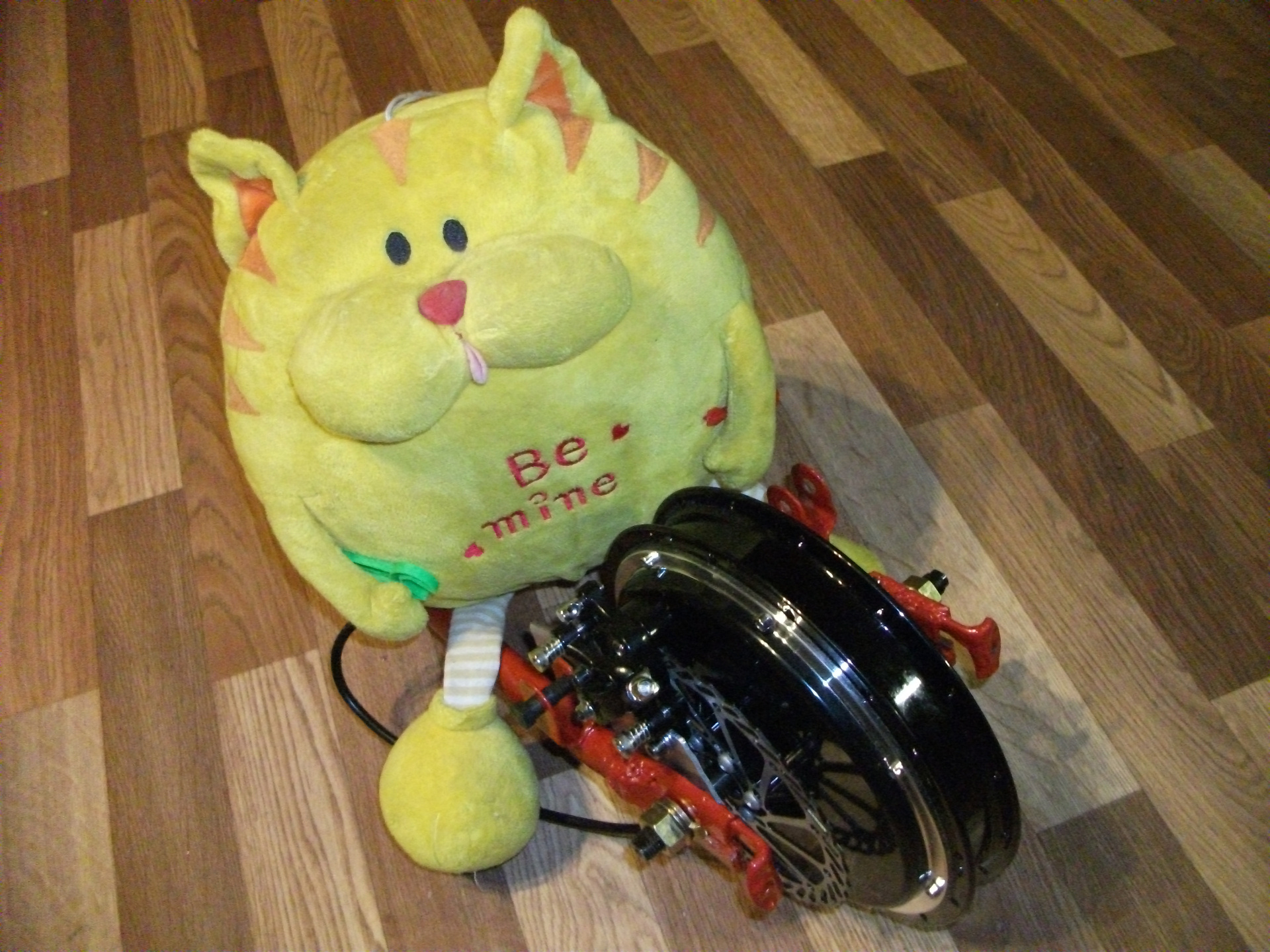
We maximize the dropouts by welding the plates, because all the torque is transmitted through the axis. My motor, by the way, is not flimsy tubular, but solid, with a groove for the cable. Not a trifle, and nice. To install a bicycle brake (the cable disc is the cheapest, the bike is not assembled for speed, but for cross-country ability, and electric braking will help), we cut out a figured plate from steel. It will also serve as an additional torsion lever, transmitting the moment to the bolt of the shock absorber to the rear fork, bypassing the dropout. When adjusting the chain tension, the plate will move along with the axis of the wheel, so that the position of the brake caliper relative to the disk remains unchanged.
We design a pedal drive
So, we take the carriage assembly, pedals and the front star from the bike that ordered it to live for a long time, weld the mounts under the moped frame, put the chain and enjoy? Not so simple. My bike is a fat man, his frame is much wider than a bicycle one (even a fat bike), and the pedal axis of some Urals, Kama or Desna will be too short. But we prudently saved the pedal shaft from the standard Sh-57 engine, it is exactly the length that is needed. The well-preserved connecting rods, (in fact, cranks, but cyclists call them that), from a teenage bike, just under a wedge of the required length of 125 mm, and with a leading sprocket of a suitable diameter, also lay in stocks. A star from an adult bicycle would make us push the pedal axis too far from its original position in the motor, since otherwise it would touch the rear suspension pendulum axis. And we want traction rather than high-speed drive, because the small drive sprocket is what the doctor ordered. It should be located slightly to the left of the connecting rod than usual, therefore we will cut it from it and weld it to a fragment of another, broken, with fastening under a wedge, for which we will cut a groove in the right place on the pedal axis. All welding spots are treated with a rust modifier.

We will build the carriage out of four ball bearings (in bicycle terminology of industrial or industrial bearings), two stoppers and two oil seals, and its body will be an aluminum pipe from a dispensing gun for gas stations, the remains of which, finally, awaited useful use. Argon and aluminum welding wire are not yet available, therefore we are thinking of fixing a home-made carriage to the moped frame from what is.
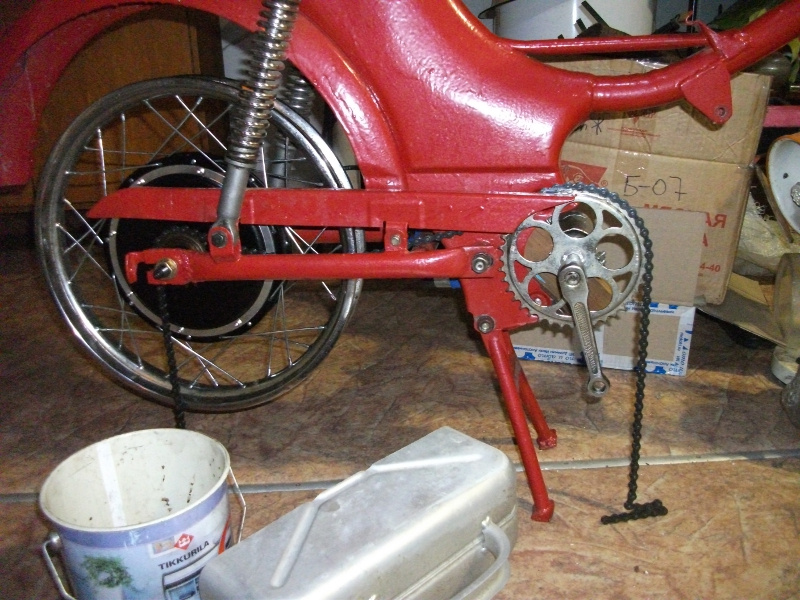
A number of estimates and around-the-clock walks led to the idea of clamping the carriage between the clamp and the bed in a wooden block, which at a good angle enters the cavity of the frame and is even clamped there by forces acting during operation. Reliable fixation is carried out by two brackets made of sheet steel, installed in place of the mounting tides of the crankcase of a standard engine. We do not modify the frame of Riga-12 in this place, nothing needs to be sawed, cut, drilled and welded, which, of course, is very good. I don’t know yet how long such a “collective farm” fastening of the pedal mechanism will last, but it should be possible to arrange sea trials and enjoy the first season. Then it will be possible (and necessary) to manufacture a more capital carriage assembly with fastening.
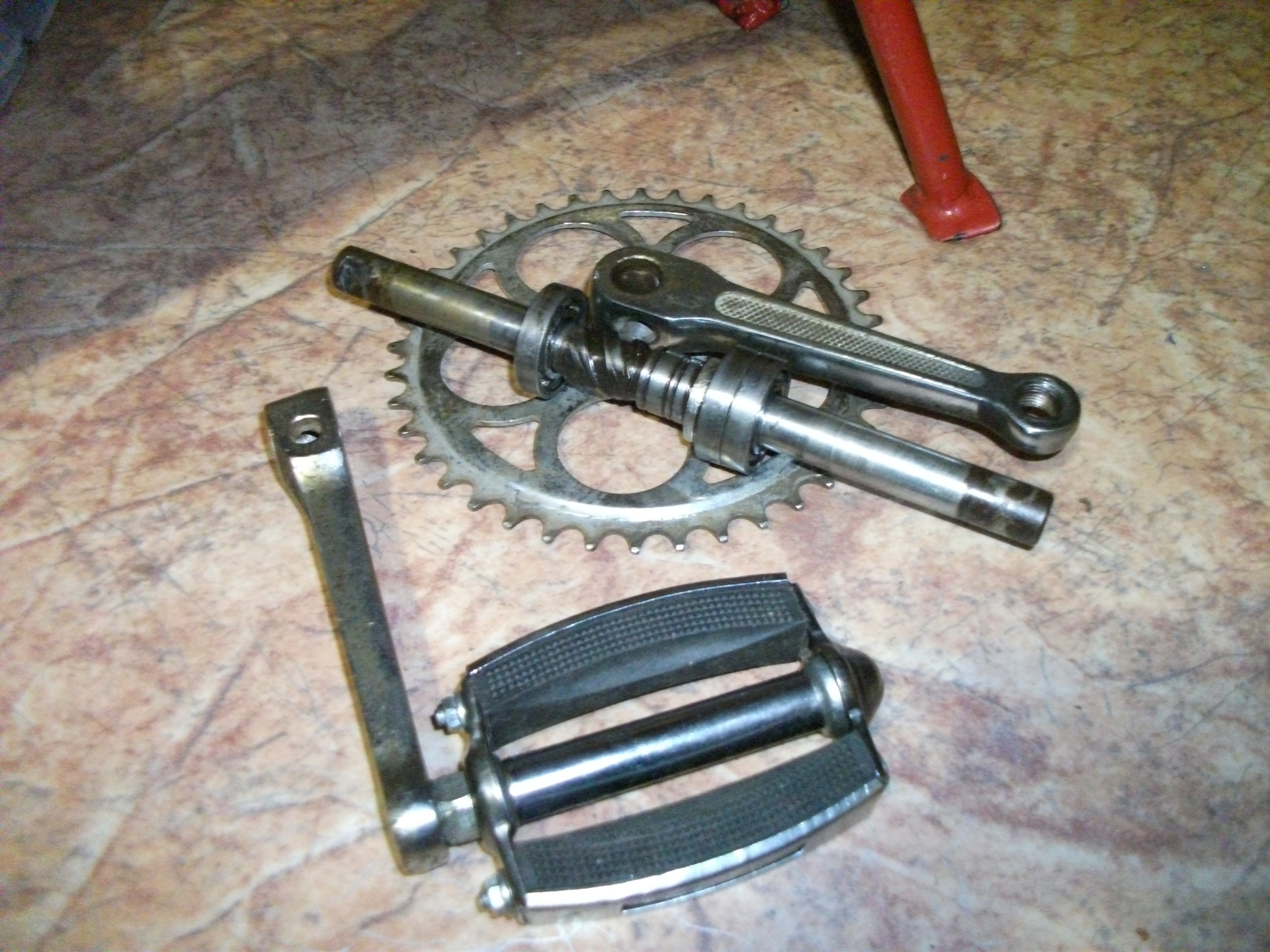
We will build the carriage out of four ball bearings (in bicycle terminology of industrial or industrial bearings), two stoppers and two oil seals, and its body will be an aluminum pipe from a dispensing gun for gas stations, the remains of which, finally, awaited useful use. Argon and aluminum welding wire are not yet available, therefore we are thinking of fixing a home-made carriage to the moped frame from what is.

A number of estimates and around-the-clock walks led to the idea of clamping the carriage between the clamp and the bed in a wooden block, which at a good angle enters the cavity of the frame and is even clamped there by forces acting during operation. Reliable fixation is carried out by two brackets made of sheet steel, installed in place of the mounting tides of the crankcase of a standard engine. We do not modify the frame of Riga-12 in this place, nothing needs to be sawed, cut, drilled and welded, which, of course, is very good. I don’t know yet how long such a “collective farm” fastening of the pedal mechanism will last, but it should be possible to arrange sea trials and enjoy the first season. Then it will be possible (and necessary) to manufacture a more capital carriage assembly with fastening.
Motor wheel controller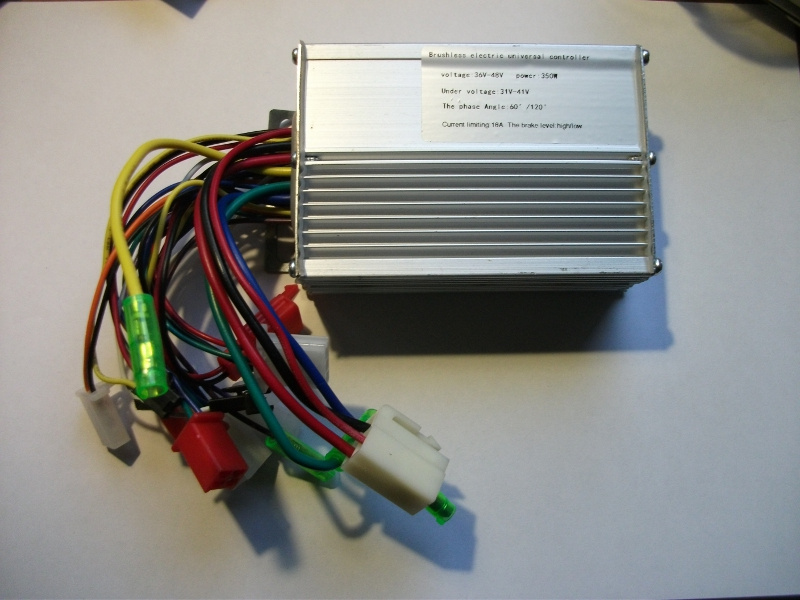
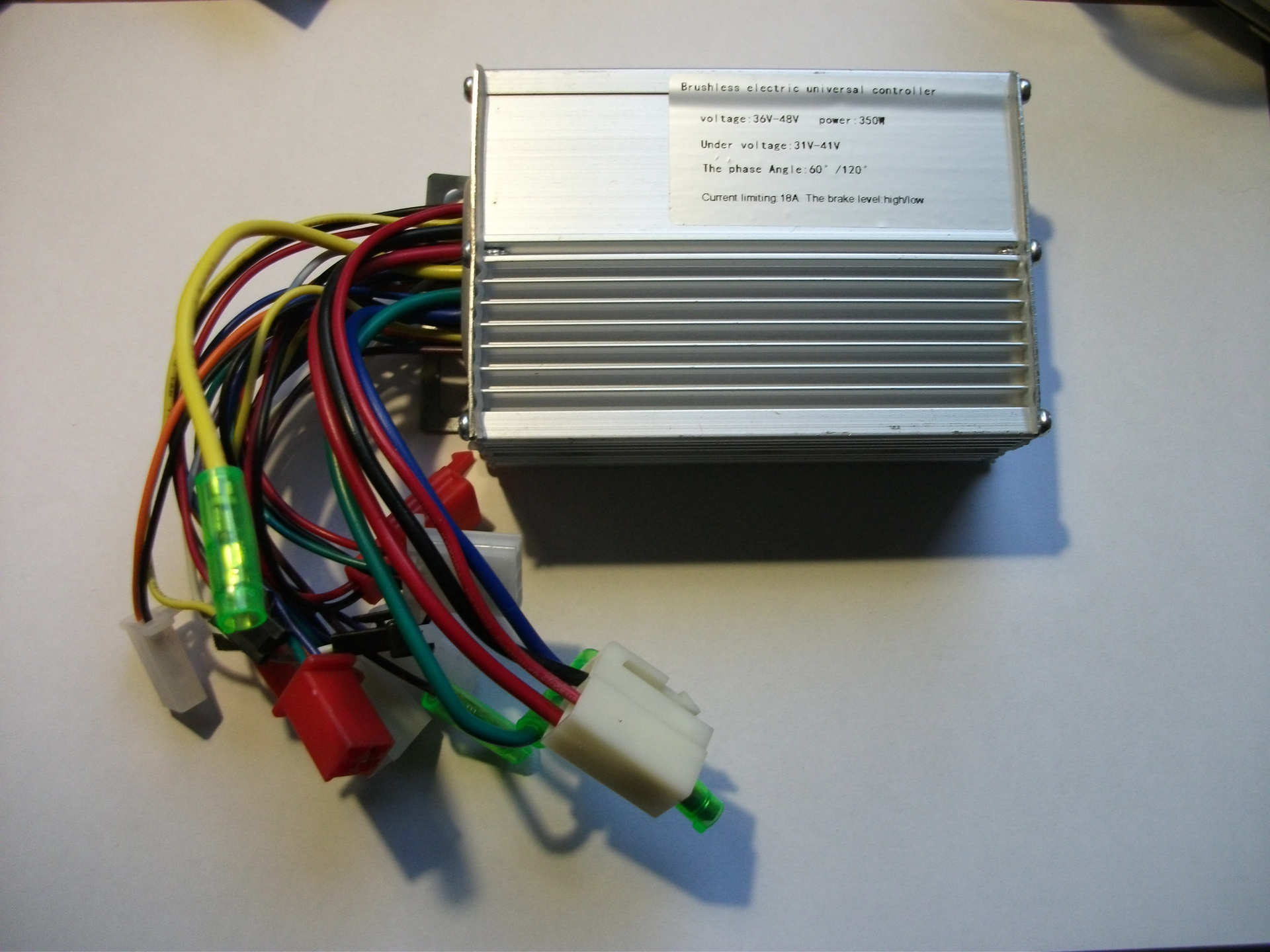
The brushless motor controller (BLDC) was purchased for the cheapest trial. It is called Universal, universal, for the ability to work at different voltages, both with Hall sensors and without them, to automatically determine the phases and the phase angle, to learn and remember the direction of rotation, and all this is possible in the field, it is enough to close two wiring. The controller is often positioned as a repair one, it is replaced by a regular one in case of Hall sensor failure, if there are reasons to refrain from replacing them. The rated power of this option is 350 watts, but 18 amperes at 48 volts DC - almost kilowatts. If the controller does not like or deteriorate, I will remake or even develop my own, but, looking ahead, I will say that the first trips were very pleased. It seems that the controller is what you need.
By a good tradition, electric transport fans will share data on my copy. Bracket bent at the post office, this is not scary. The presence of garbage inside the block in the form of a pair of pieces of solder is already more serious, but we are craftsmen, therefore, before the test switch-on, we will examine the device, remove the garbage, and eliminate the leakage and short circuits if it is detected. I didn’t have them. The sticker on the radiator case reads as follows. Brushless electric universal controller voltage: 36V-48V power: 350w Under voltage: 31V-41V The phase Angle: 60 ° / 120 ° The controller has the following conclusions. White connector - to the traction battery and anti-theft lock or switch. Black thick wire - minus batteries, power ground.
Red thick - plus batteries, power supply.
Slim red - VCCO - plus batteries through the lock (if equipped), power electronics.
The red connector is for charging.
Red - plus batteries, parallel to the red power.
Black - minus batteries, ground.
The white connector is to the accelerator handle.
Black is the mass.
Red - + 4.3V.
Green - analog input from the Hall sensor of the accelerator handle.
Black connector male
White - ground
Black male connector
White - XX - enables self-learning when shorted to ground before turning on the power.
White connector - to the brake handles, with a short to ground (bicycle version of the wiring).
Orange - Brake LOW, discrete input pulled through the resistor to + 5V.
Black is the mass.
White connector - to the brake handles, in the case of a scooter version of the wiring.
Purple - Brake HI - connects to the plus wire of the brake light, through the microswitches of the brake levers going to the plus battery.
In an electric bike, only one of these signals can be used, either Brake LOW or Brake HI.
The red connector is a speed switch.
Blue - LO - enables minimum ground fault speed.
Black is the mass.
Yellow - HI - includes maximum speed when shorted to ground.
When the connector is not connected or the switch is in the middle position, when LO and HI are disconnected from the ground, the average speed is turned on.
The green connector is to the speedometer.
Violet - SD1 - output from the phase winding of the motor and power switches. You can generate pulses and consider them digitally, or you can convert the frequency to voltage in an analogous way. Of course, this will work only for a gearless motor.
Red connector - to the bike computer or anti-theft alarm.
Orange - VCCO - low current plus batteries.
Green - SD2 - parallel to SD1, output from the same phase.
Blue - the output of the board called FD.
Black connector - to the pedal sensor PAS - help pedaling.
Black is the mass.
Red - + 4.3V.
Yellow - 1: 1.
There are, of course, three thick wires of the motor phases and a five-pin connector to the Hall sensors.
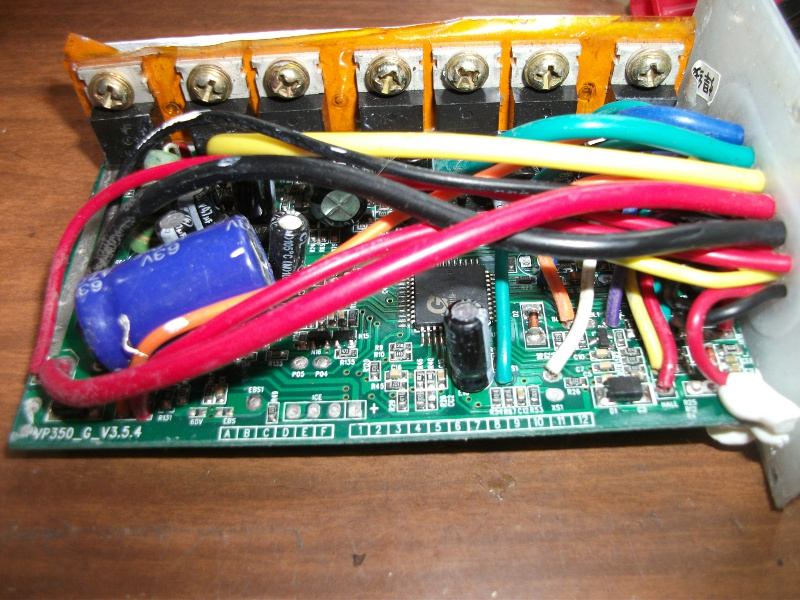
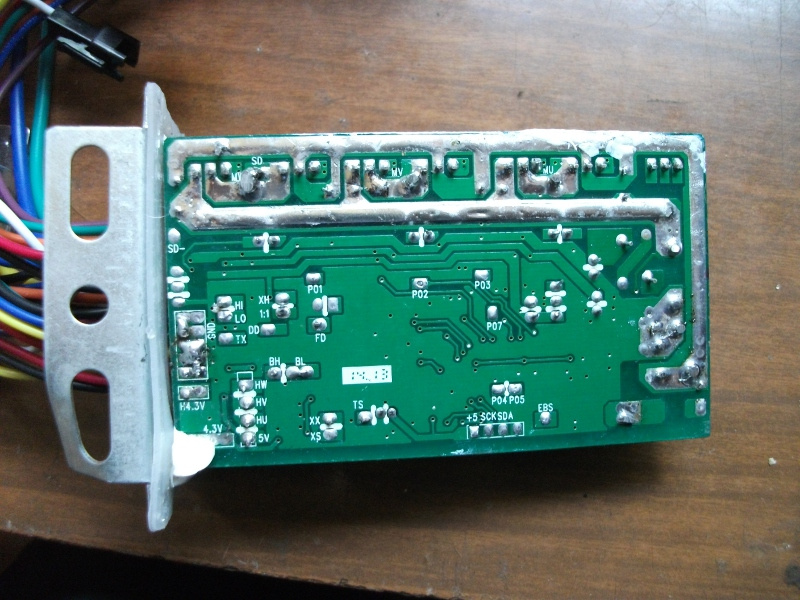
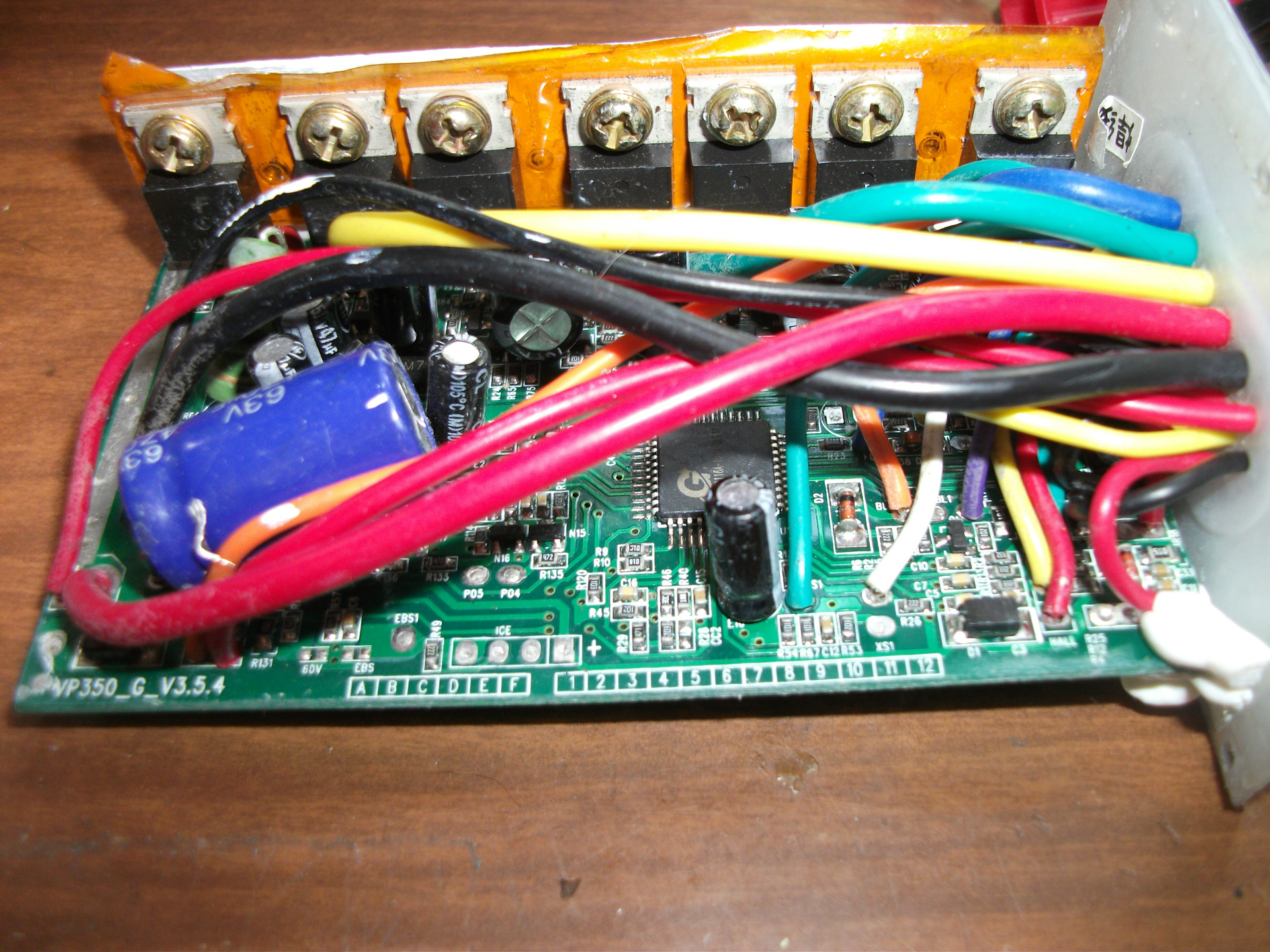
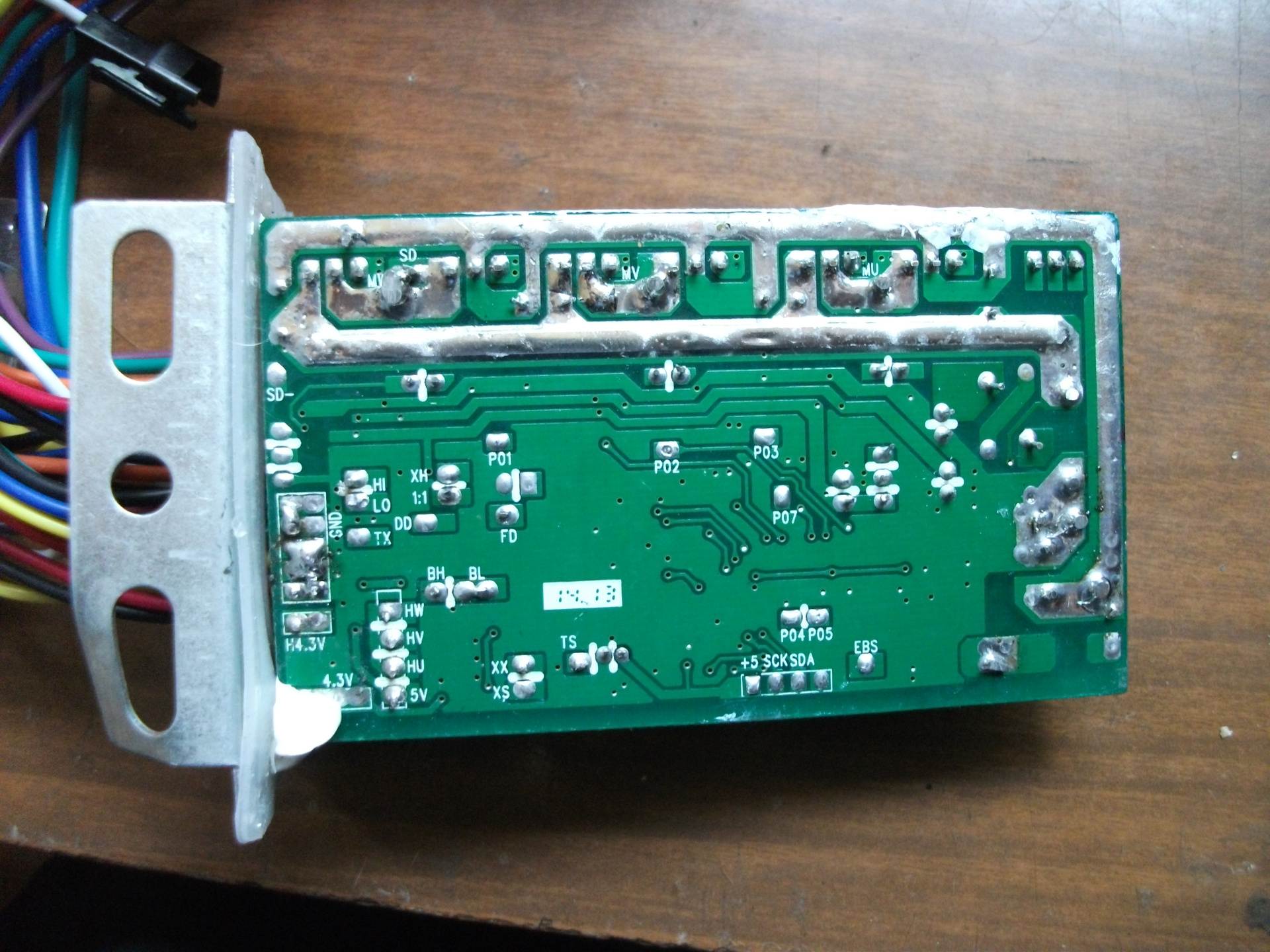
The board is marked VP350_G_V3.5.4. As power keys are S68N08R, these are N-channel MOSFET 68V, 80A, 6.5mOhm. There are unused pads, of which the following are interesting.
JTAG ICE - microcontroller in-circuit programming connector.
+ 5V - power from the programmer with firmware.
SCK - external clocking.
SDA is the data bus.
unsigned point is earth.
EBS1 - as I understand it, a discrete input for the recovery function.
Also on the board there are unsoldered jumpers marked 60V and EBS. Their purpose is obvious - switching the controller to a 60-volt battery and enabling regenerative braking. So, for just a thousand rubles, we have a very flexible and full-featured Infineon family controller.
The brushless motor controller (BLDC) was purchased for the cheapest trial. It is called Universal, universal, for the ability to work at different voltages, both with Hall sensors and without them, to automatically determine the phases and the phase angle, to learn and remember the direction of rotation, and all this is possible in the field, it is enough to close two wiring. The controller is often positioned as a repair one, it is replaced by a regular one in case of Hall sensor failure, if there are reasons to refrain from replacing them. The rated power of this option is 350 watts, but 18 amperes at 48 volts DC - almost kilowatts. If the controller does not like or deteriorate, I will remake or even develop my own, but, looking ahead, I will say that the first trips were very pleased. It seems that the controller is what you need.
By a good tradition, electric transport fans will share data on my copy. Bracket bent at the post office, this is not scary. The presence of garbage inside the block in the form of a pair of pieces of solder is already more serious, but we are craftsmen, therefore, before the test switch-on, we will examine the device, remove the garbage, and eliminate the leakage and short circuits if it is detected. I didn’t have them. The sticker on the radiator case reads as follows. Brushless electric universal controller voltage: 36V-48V power: 350w Under voltage: 31V-41V The phase Angle: 60 ° / 120 ° The controller has the following conclusions. White connector - to the traction battery and anti-theft lock or switch. Black thick wire - minus batteries, power ground.
Red thick - plus batteries, power supply.
Slim red - VCCO - plus batteries through the lock (if equipped), power electronics.
The red connector is for charging.
Red - plus batteries, parallel to the red power.
Black - minus batteries, ground.
The white connector is to the accelerator handle.
Black is the mass.
Red - + 4.3V.
Green - analog input from the Hall sensor of the accelerator handle.
Black connector male
White - ground
Black male connector
White - XX - enables self-learning when shorted to ground before turning on the power.
White connector - to the brake handles, with a short to ground (bicycle version of the wiring).
Orange - Brake LOW, discrete input pulled through the resistor to + 5V.
Black is the mass.
White connector - to the brake handles, in the case of a scooter version of the wiring.
Purple - Brake HI - connects to the plus wire of the brake light, through the microswitches of the brake levers going to the plus battery.
In an electric bike, only one of these signals can be used, either Brake LOW or Brake HI.
The red connector is a speed switch.
Blue - LO - enables minimum ground fault speed.
Black is the mass.
Yellow - HI - includes maximum speed when shorted to ground.
When the connector is not connected or the switch is in the middle position, when LO and HI are disconnected from the ground, the average speed is turned on.
The green connector is to the speedometer.
Violet - SD1 - output from the phase winding of the motor and power switches. You can generate pulses and consider them digitally, or you can convert the frequency to voltage in an analogous way. Of course, this will work only for a gearless motor.
Red connector - to the bike computer or anti-theft alarm.
Orange - VCCO - low current plus batteries.
Green - SD2 - parallel to SD1, output from the same phase.
Blue - the output of the board called FD.
Black connector - to the pedal sensor PAS - help pedaling.
Black is the mass.
Red - + 4.3V.
Yellow - 1: 1.
There are, of course, three thick wires of the motor phases and a five-pin connector to the Hall sensors.
The board is marked VP350_G_V3.5.4. As power keys are S68N08R, these are N-channel MOSFET 68V, 80A, 6.5mOhm. There are unused pads, of which the following are interesting.
JTAG ICE - microcontroller in-circuit programming connector.
+ 5V - power from the programmer with firmware.
SCK - external clocking.
SDA is the data bus.
unsigned point is earth.
EBS1 - as I understand it, a discrete input for the recovery function.
Also on the board there are unsoldered jumpers marked 60V and EBS. Their purpose is obvious - switching the controller to a 60-volt battery and enabling regenerative braking. So, for just a thousand rubles, we have a very flexible and full-featured Infineon family controller.
Electrical layout
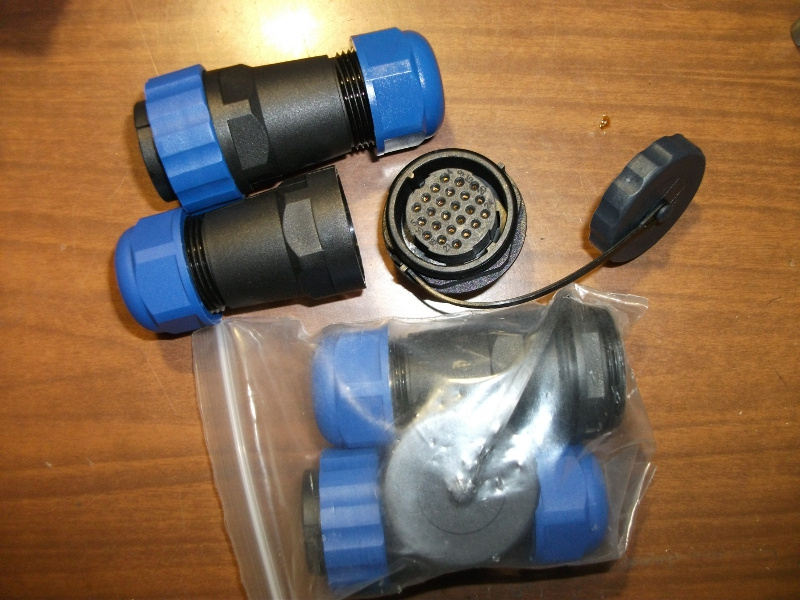
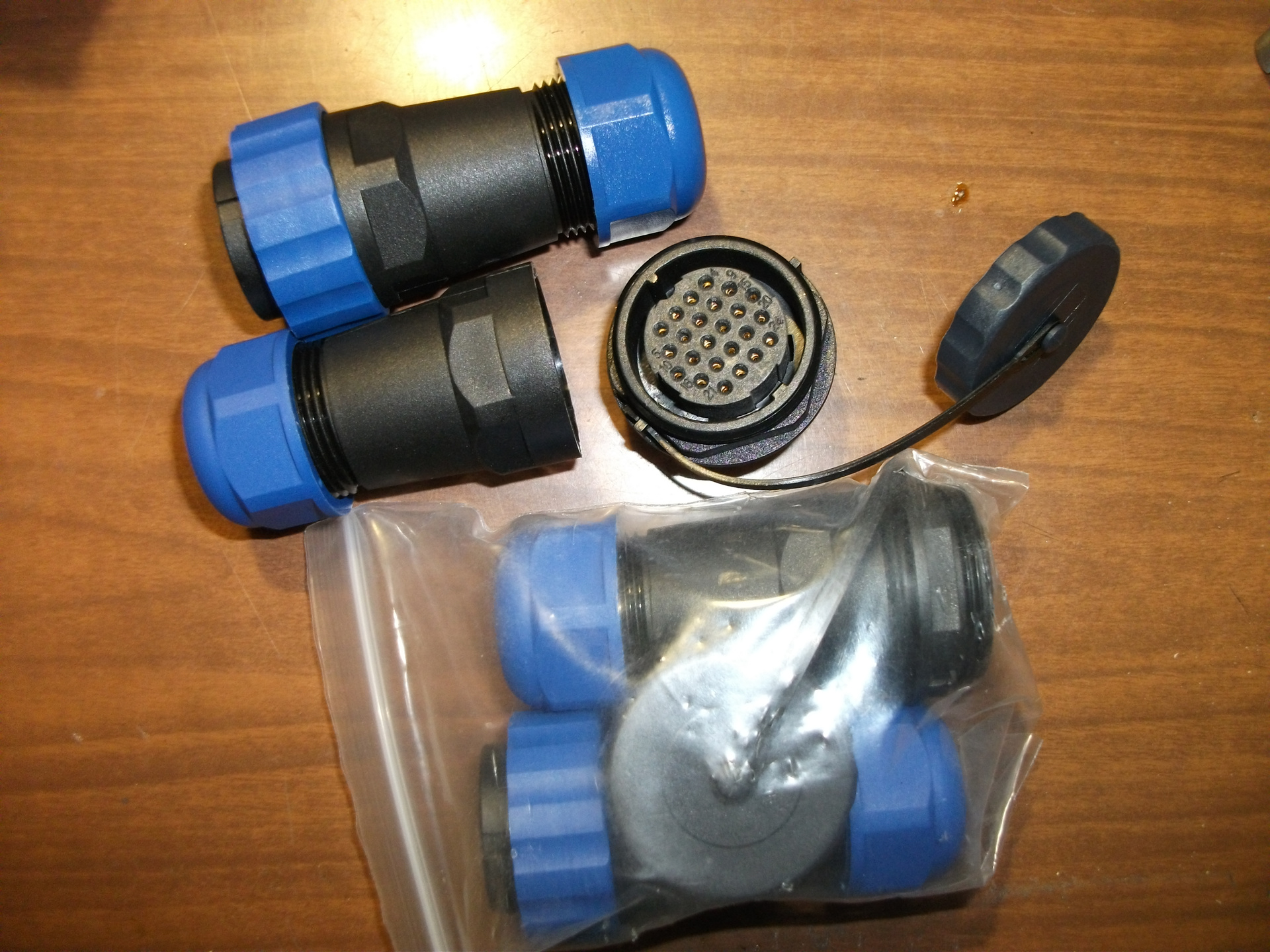
The electric motor is synchronous, has 3 phase wires, 3 wires from Hall sensors and ground wires and power wires of the latter. So that the wheel can be removed comfortably, we will use such a waterproof connector, which we will fix on the shortened protrusion of the muffler. There are 24 contacts at the connector, 5 will be occupied by Hall sensors, two phases will each receive 6, and one of them will be 7. This is enough for our currents. According to the mind, the assembled plug is filled with sealant, but hot glue will come down, followed by silicone grease treatment.
It was decided to assemble the electrical equipment of the Cherry inside the former gas tank. Some builders of electric motorcycles convert the tank into a tool box or luggage compartment, but Riga-12 has a tool compartment under the saddle, in the cavity of the frame, where it would be possible to place the electronics, but it is difficult to maintain, and it is undesirable to make cuts and openings in the supporting spatial frame. In addition, the gas tank is located exactly at the point where all the wires naturally converge. Here's what happened. The U-shaped rubber profile for edging the tank and sealing the halves is the timing cover gasket VAZ 2108. I needed 4 of them - 2 for the frame and 2 for the joint.
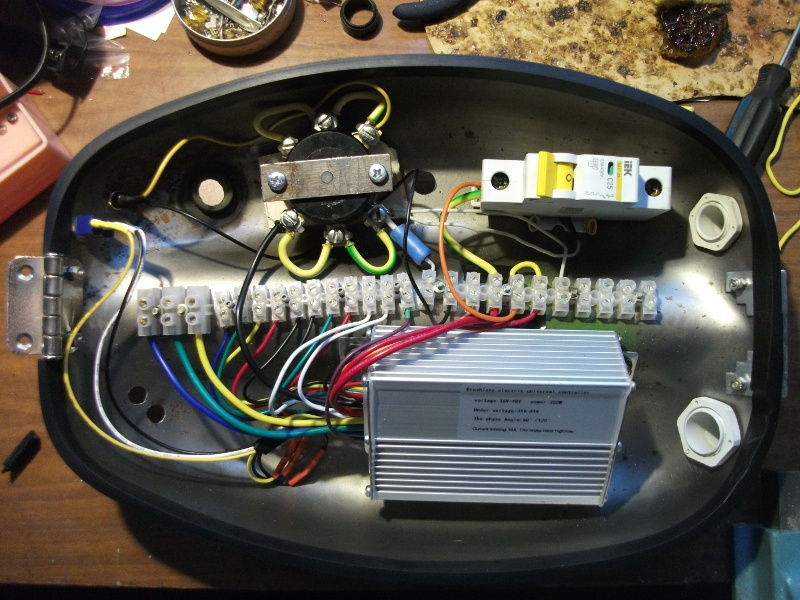
Unused wires from the controller are removed, all standard connectors are also used, instead of them are the line of electrical terminals. Plus, the battery is connected through a 25A machine, and minus the mass through a packet switch with a slightly changed mount. To prevent sparking of the mass switch, a chain of resistor and button is connected in parallel to it. By pressing the button before turning on the mass, we charge the smoothing capacitor of the controller. Although this unit could not be installed with such a controller, the capacitor is of a small capacity; when the device is powered up, the contacts will not spark. The toggle switch is connected to the conclusions of switching speed modes. The anti-theft lock, speedometer, odometer, battery indicator, will be placed on the top cover of the former tank, and on the inside, fuses and power and control circuits for low-current circuits - light devices and an audible signal. I will devote the following publication to these modules. In the meantime, since we no longer have a gas tank or a gas engine, we will assemble our energy storage device - a traction battery.
It was decided to assemble the electrical equipment of the Cherry inside the former gas tank. Some builders of electric motorcycles convert the tank into a tool box or luggage compartment, but Riga-12 has a tool compartment under the saddle, in the cavity of the frame, where it would be possible to place the electronics, but it is difficult to maintain, and it is undesirable to make cuts and openings in the supporting spatial frame. In addition, the gas tank is located exactly at the point where all the wires naturally converge. Here's what happened. The U-shaped rubber profile for edging the tank and sealing the halves is the timing cover gasket VAZ 2108. I needed 4 of them - 2 for the frame and 2 for the joint.
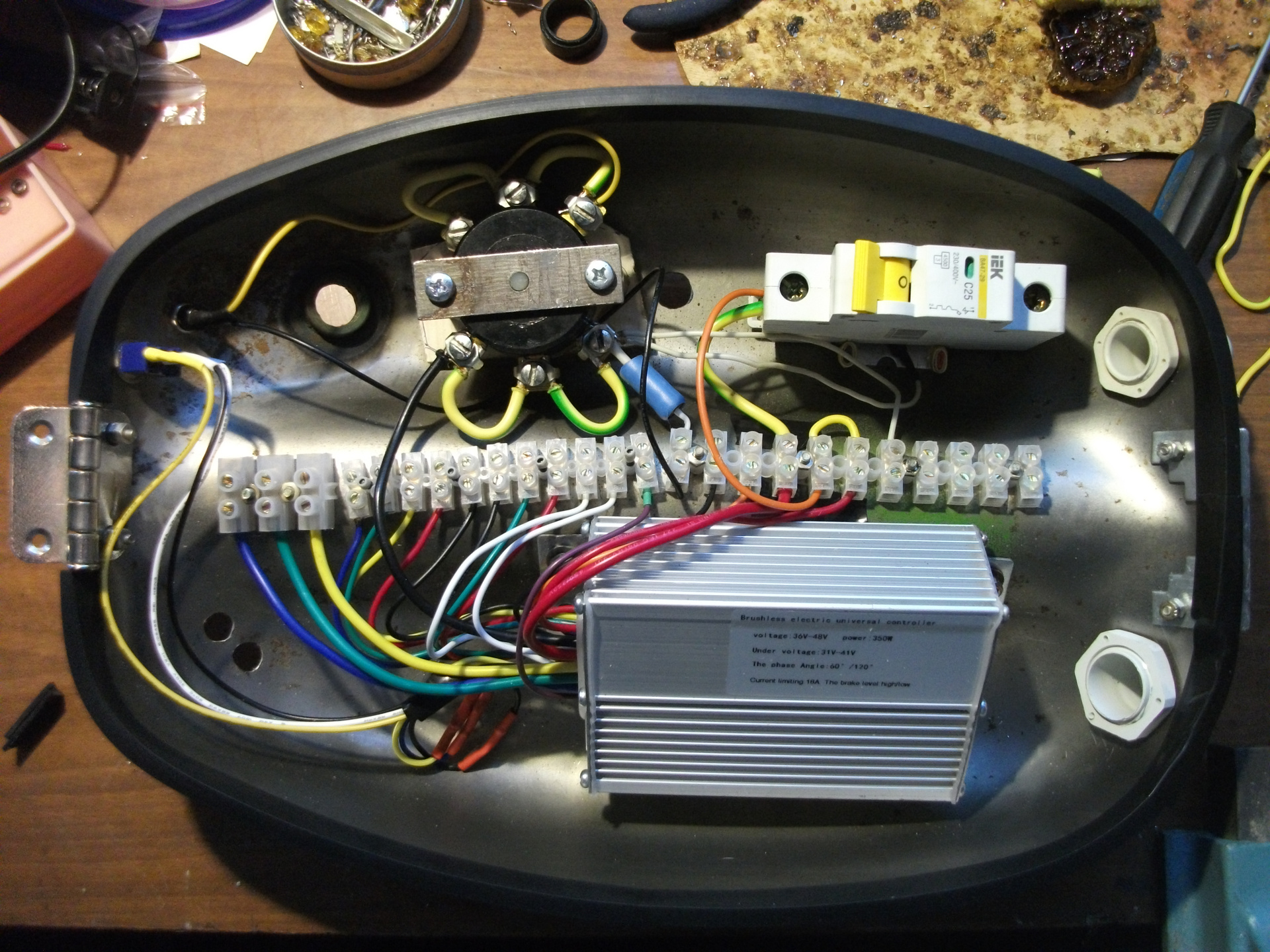
Unused wires from the controller are removed, all standard connectors are also used, instead of them are the line of electrical terminals. Plus, the battery is connected through a 25A machine, and minus the mass through a packet switch with a slightly changed mount. To prevent sparking of the mass switch, a chain of resistor and button is connected in parallel to it. By pressing the button before turning on the mass, we charge the smoothing capacitor of the controller. Although this unit could not be installed with such a controller, the capacitor is of a small capacity; when the device is powered up, the contacts will not spark. The toggle switch is connected to the conclusions of switching speed modes. The anti-theft lock, speedometer, odometer, battery indicator, will be placed on the top cover of the former tank, and on the inside, fuses and power and control circuits for low-current circuits - light devices and an audible signal. I will devote the following publication to these modules. In the meantime, since we no longer have a gas tank or a gas engine, we will assemble our energy storage device - a traction battery.
Batteries
We did not make a reservation, this is really a battery, an acid battery. It is bulky and heavy, but fire and explosion safe, cheap and reliable with proper handling. With regard to environmental cleanliness and safety for health, again, with proper operation, a working VRLA - a valve-regulated lead-acid battery - does not emit dangerous and harmful vapors and gases. This is exactly what we will use.
Common types of VRLA, or simply sealed batteries, are gel, with a thickened electrolyte, and AGM, with a separator in the form of an absorbent layer of fiberglass. There are many modifications, specifications and prices are different, we will talk about this later. For now, let's determine the size of our batteries.
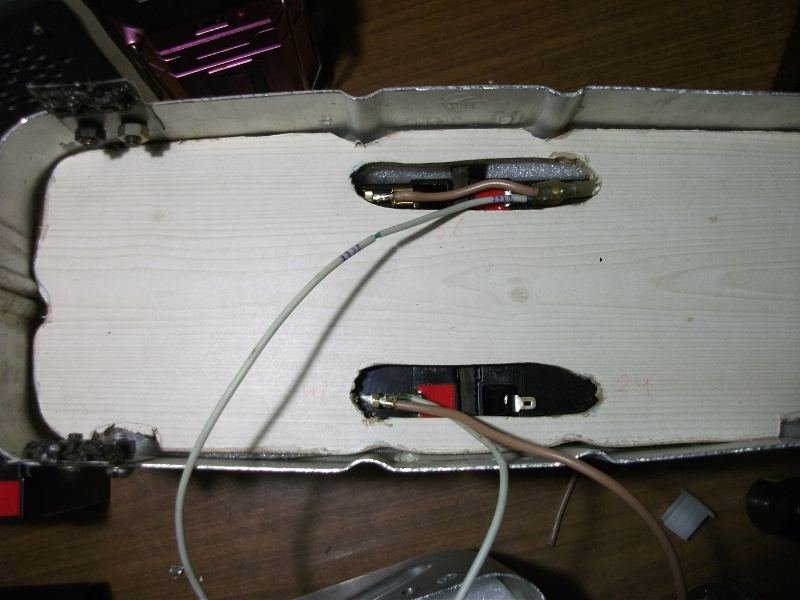
The case of the battery will serve as a cut-off aluminum canister for drinking water. It will be located under the ridge of the frame, below the former gas tank, and it perfectly includes 4 batteries 12V 12A * h. Separate the bottom row of two batteries from the top by a partition made of suitable dielectric sheet material, the thickness of which must exceed the height of the terminals. I took a piece of the MDF wall panel. The terminals are treated with silicone grease, which creates a water-repellent film in case water gets into the battery pack. In the lower one (the block will stand at an angle, this is the norm for sealed batteries), small drainage holes are made to the edge of the aluminum case. Oh God! The author of the article installed cheap traction batteries intended for burglar alarms as traction! You won’t go far on such people, and they won’t last long!
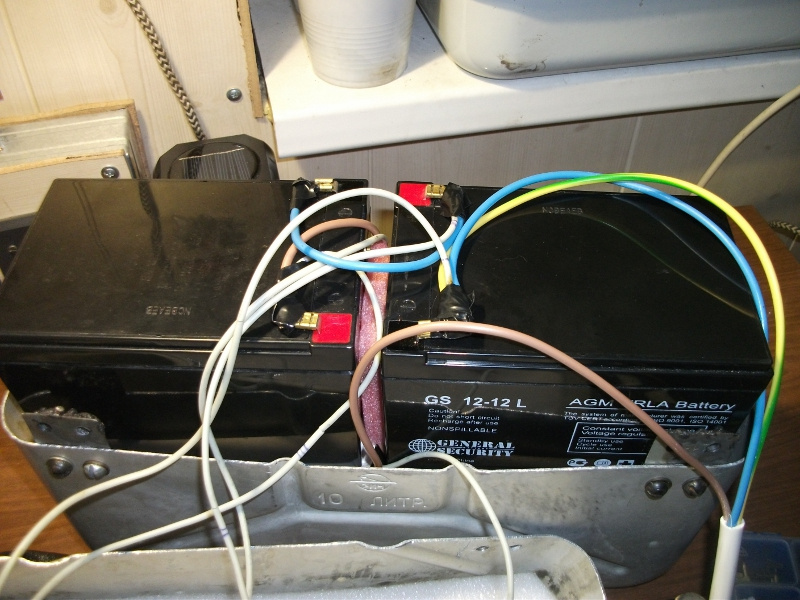
Yes, batteries were intentionally purchased from the almost lower price segment, in order to test their capabilities in personal electric vehicles. Do not like it, - I’m not too lazy to remove and disassemble the battery case, and install specialized “green” 6-DZM-12 for electric scooters or others designed for a two-hour discharge without losing the delivered capacity. Then General Security GS-12-12L will start the service of lighting my house and powering the computer and the soldering station in the face of frequent power outages in the village.
The topic of lead-acid batteries, their characteristics and operating modes will need to be returned. For now, let's discuss battery mounting. A battery is a weighty and inert thing, and if it is not attached properly, it will beat against the nearest objects, as a result of which it will crack, with all its consequences, starting with an electrolyte that, although thickened, or, in our case, is absorbed, but assumes the integrity of the battery can . In our container, the batteries are tightly clamped by spacers from damping materials that were not prone to shrinkage, which would prevent their displacement during accelerations. The bottom row is on strips of rubber. The top cover is put on with some effort, reliably fixing the batteries.
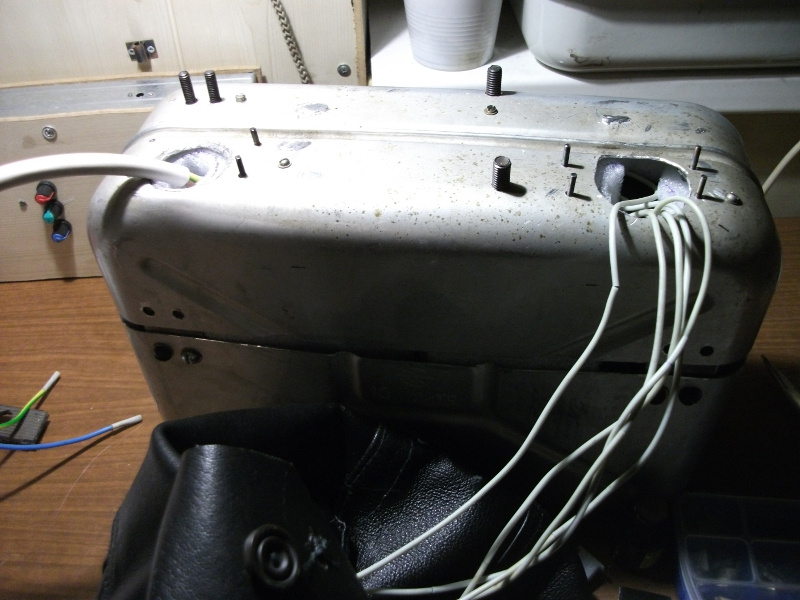
In addition to the power cable, wires for separate charge were removed from each of the jumpers between the poles of the battery, for the sake of reliability, they were clad in additional insulation from PVC tubes. And, finally, a bag-bag is put on top of the assembled coffer, sewn from a good-quality leather substitute and generously treated with a water-repellent and shoe cream. This bag will give the moped a vintage look and prevent water from entering the battery pack, eliminating the need to fill and seal the former canister, which, as can be seen from the photo, would be difficult due to the relief pattern. The battery pack is attached to the frame at 4 points, - the pedal carriage mount, the bent engine mount brackets and the plate to which the ignition coil was attached.
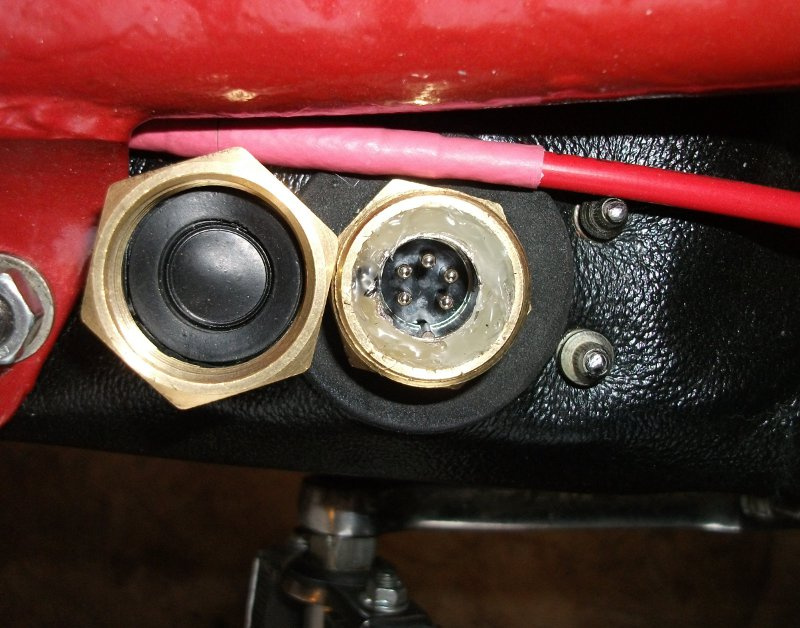
The charging connector, a 5-pin “gun”, is fixed in a 3/4 inch brass fitting using small self-tapping screws, then the space between the fitting and the socket is filled with hot-melt adhesive. The charging connector and the input sleeve of the power cable are attached to the top cover of the case on the duralumin plates located between the cover and the bag and fixed with screws on top of the cover material.
So, at the moment, Cherry has a 48 volt battery, 12 amp hours. This is just over half a kilowatt hour. Not so much, especially considering the fact that non-specialized batteries in traction mode give less energy than with a longer discharge. Actual speed and mileage on such batteries, as well as more suitable ones, are topics for further research and publications. And of course, you can put in the coffer case Cherries not only traction batteries of a deep cycle, but also lithium-based options. Then distant eco-travels will become a reality. In the meantime, train on what is.
Common types of VRLA, or simply sealed batteries, are gel, with a thickened electrolyte, and AGM, with a separator in the form of an absorbent layer of fiberglass. There are many modifications, specifications and prices are different, we will talk about this later. For now, let's determine the size of our batteries.

The case of the battery will serve as a cut-off aluminum canister for drinking water. It will be located under the ridge of the frame, below the former gas tank, and it perfectly includes 4 batteries 12V 12A * h. Separate the bottom row of two batteries from the top by a partition made of suitable dielectric sheet material, the thickness of which must exceed the height of the terminals. I took a piece of the MDF wall panel. The terminals are treated with silicone grease, which creates a water-repellent film in case water gets into the battery pack. In the lower one (the block will stand at an angle, this is the norm for sealed batteries), small drainage holes are made to the edge of the aluminum case. Oh God! The author of the article installed cheap traction batteries intended for burglar alarms as traction! You won’t go far on such people, and they won’t last long!
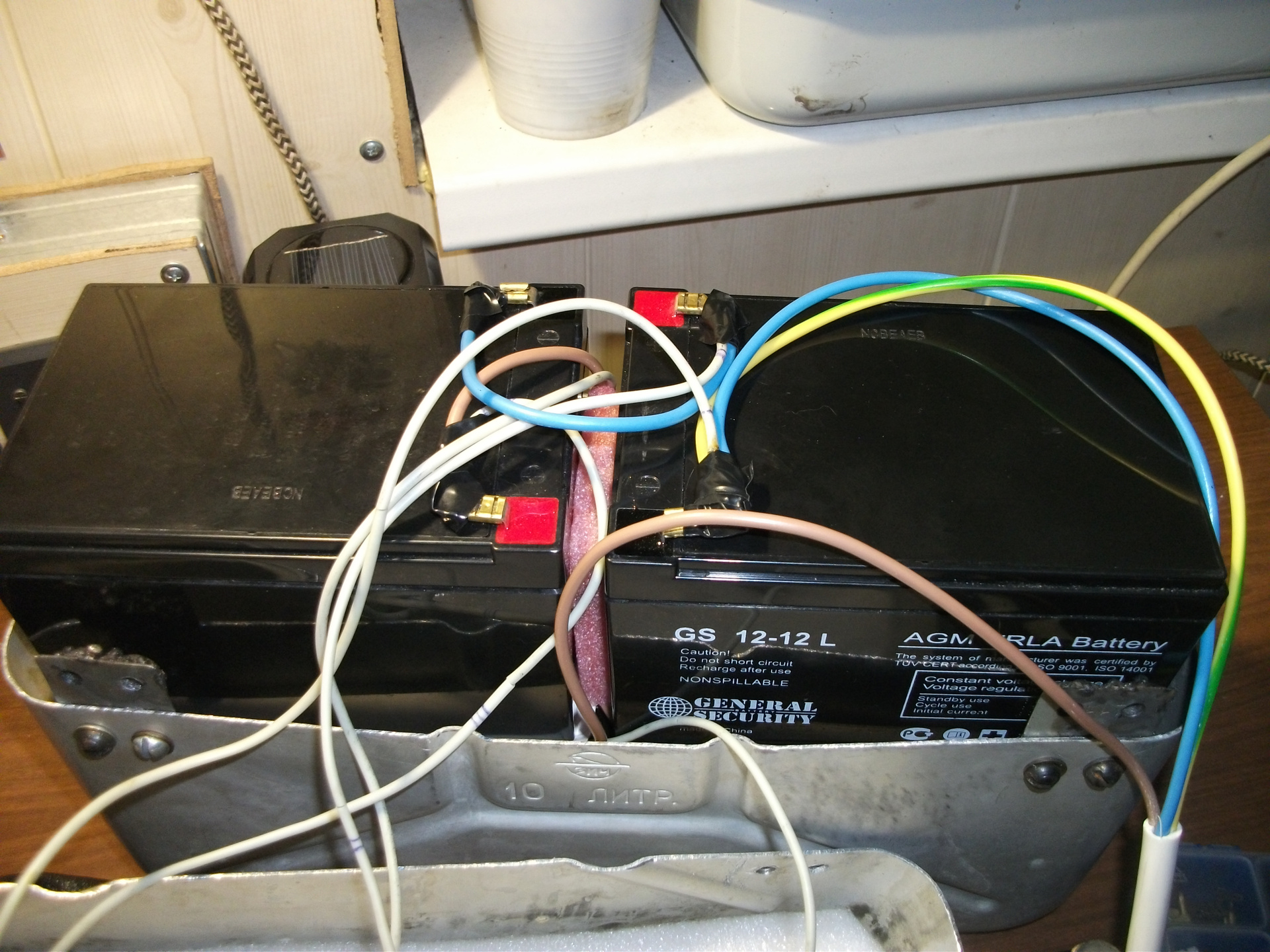
Yes, batteries were intentionally purchased from the almost lower price segment, in order to test their capabilities in personal electric vehicles. Do not like it, - I’m not too lazy to remove and disassemble the battery case, and install specialized “green” 6-DZM-12 for electric scooters or others designed for a two-hour discharge without losing the delivered capacity. Then General Security GS-12-12L will start the service of lighting my house and powering the computer and the soldering station in the face of frequent power outages in the village.
The topic of lead-acid batteries, their characteristics and operating modes will need to be returned. For now, let's discuss battery mounting. A battery is a weighty and inert thing, and if it is not attached properly, it will beat against the nearest objects, as a result of which it will crack, with all its consequences, starting with an electrolyte that, although thickened, or, in our case, is absorbed, but assumes the integrity of the battery can . In our container, the batteries are tightly clamped by spacers from damping materials that were not prone to shrinkage, which would prevent their displacement during accelerations. The bottom row is on strips of rubber. The top cover is put on with some effort, reliably fixing the batteries.
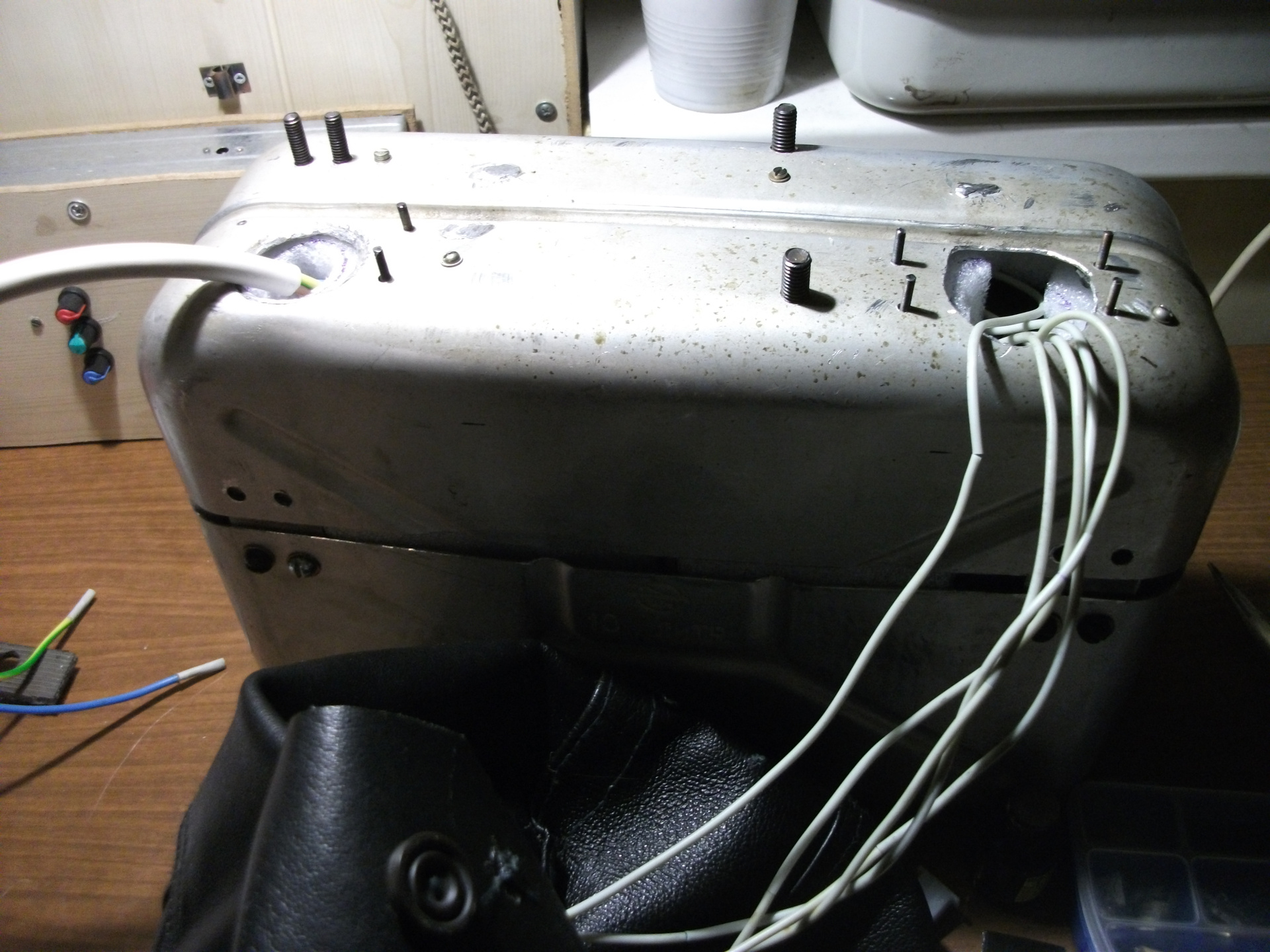
In addition to the power cable, wires for separate charge were removed from each of the jumpers between the poles of the battery, for the sake of reliability, they were clad in additional insulation from PVC tubes. And, finally, a bag-bag is put on top of the assembled coffer, sewn from a good-quality leather substitute and generously treated with a water-repellent and shoe cream. This bag will give the moped a vintage look and prevent water from entering the battery pack, eliminating the need to fill and seal the former canister, which, as can be seen from the photo, would be difficult due to the relief pattern. The battery pack is attached to the frame at 4 points, - the pedal carriage mount, the bent engine mount brackets and the plate to which the ignition coil was attached.
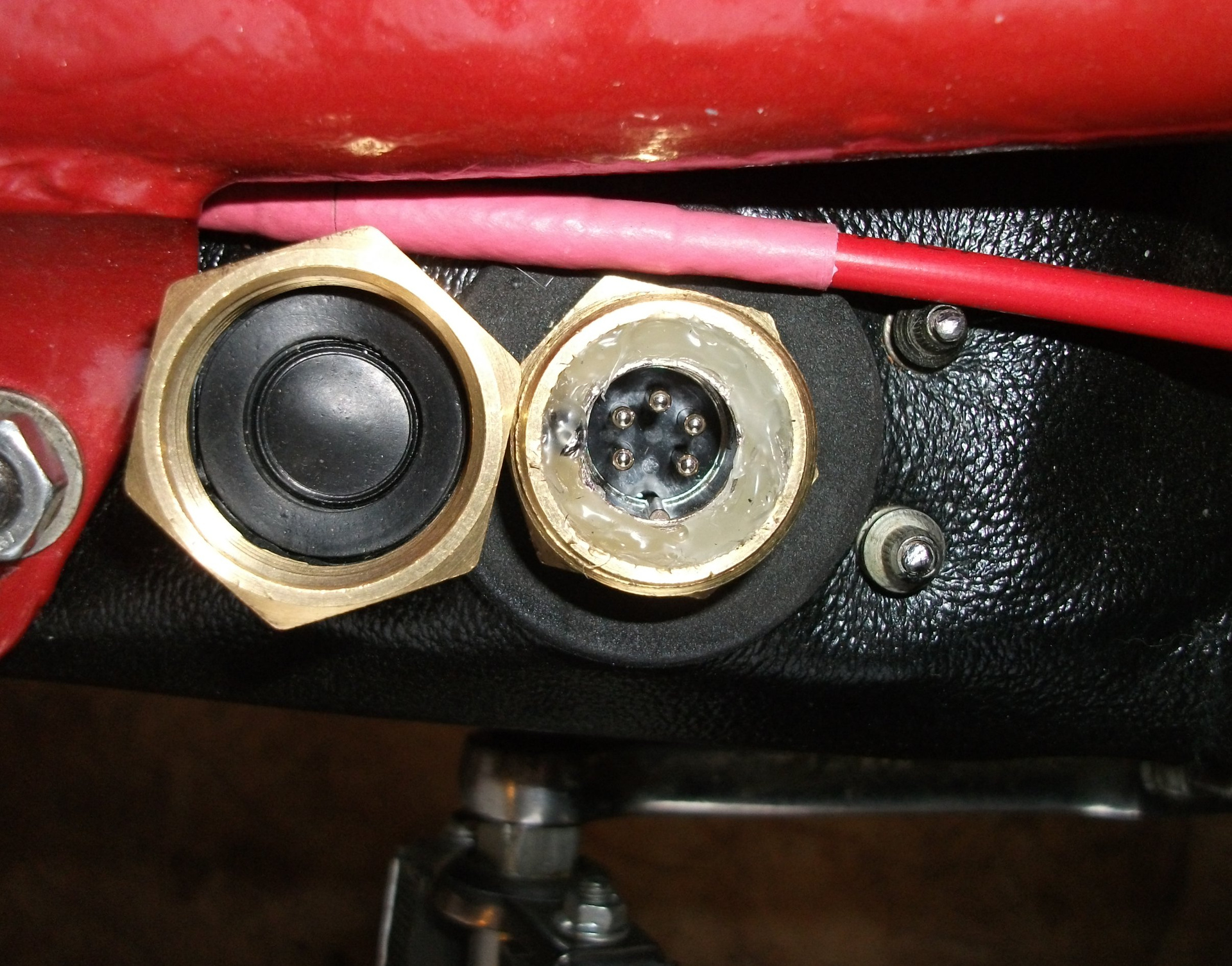
The charging connector, a 5-pin “gun”, is fixed in a 3/4 inch brass fitting using small self-tapping screws, then the space between the fitting and the socket is filled with hot-melt adhesive. The charging connector and the input sleeve of the power cable are attached to the top cover of the case on the duralumin plates located between the cover and the bag and fixed with screws on top of the cover material.
So, at the moment, Cherry has a 48 volt battery, 12 amp hours. This is just over half a kilowatt hour. Not so much, especially considering the fact that non-specialized batteries in traction mode give less energy than with a longer discharge. Actual speed and mileage on such batteries, as well as more suitable ones, are topics for further research and publications. And of course, you can put in the coffer case Cherries not only traction batteries of a deep cycle, but also lithium-based options. Then distant eco-travels will become a reality. In the meantime, train on what is.
Governing bodies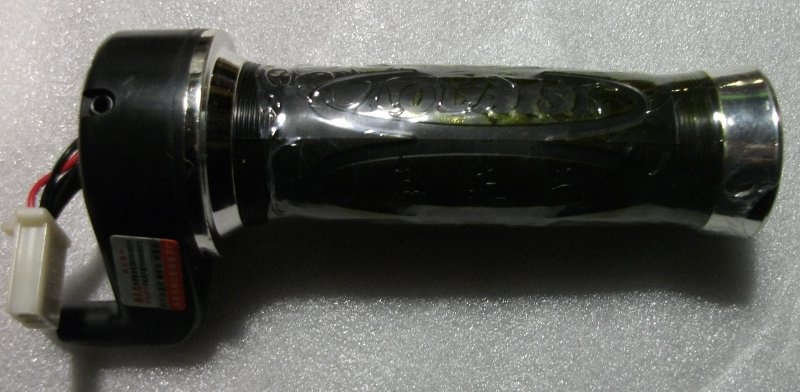
One could immediately buy a decent accelerator knob and steering wheel switch, and not such one-day ones. But experience gained. Not to mention the short low-quality wires that had to be soldered on both products, the handle broke out of the mount on one of the first trips with a sharp maneuver when a crazy village cat threw himself under the wheel. Kitty, pilot and other components of the bike were not affected, but there was a fall.
Every electric biker must know this.A typical accelerator knob in the “horn” has a tide of the housing from which the cable exits, an analog Hall sensor, and two small magnets are located on the rotary handle. When the handle is released, the right magnet is approached to the sensor, when viewed from the left end, the output voltage corresponds to zero speed. Turning the knob all the way, we will bring the left magnet closer to the sensor, and the voltage level will be formed for the maximum speed in this mode. In the middle position of the handle, the sensor is located in the middle between the magnets, and we have a signal half of the maximum speed.
The Hall sensor will give exactly the same voltage corresponding to half speed when moving away from the magnets if the “horn” breaks off or the handle flies out. The engine will rotate the wheel and push the vehicle forward. Bicycle electric motors are often very fast and high-torque, therefore, if the accelerator handle breaks down, the electric cyclist must press any brake handle, thereby giving a signal to turn off the engine or electric braking, and then, in no case, releasing the brake handle,turn off the controller with an anti-theft key or switch. The controller switch or anti-theft lock on any electric bike must be in immediate instant availability for the rider. A very bad situation will be created if you need to reach somewhere under the saddle or in the trunk to turn off the electric drive, while holding the brake lever, and all this happens on a difficult terrain or roadway with traffic.
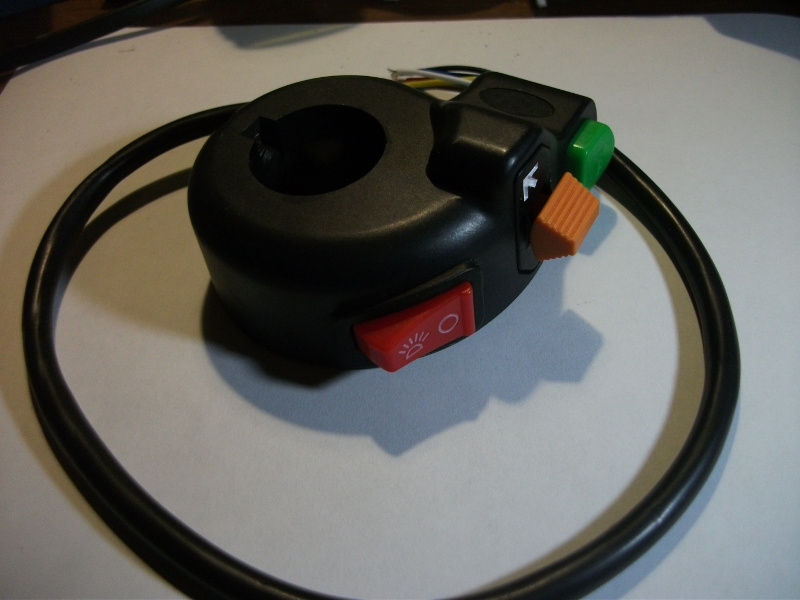
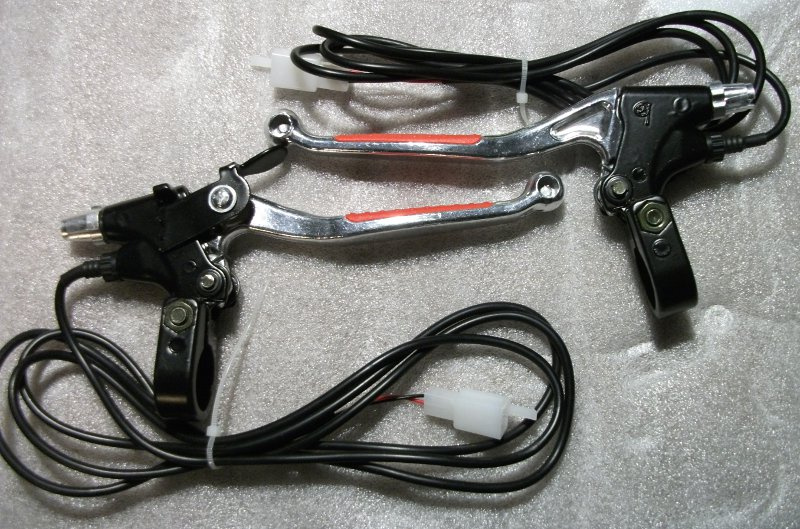
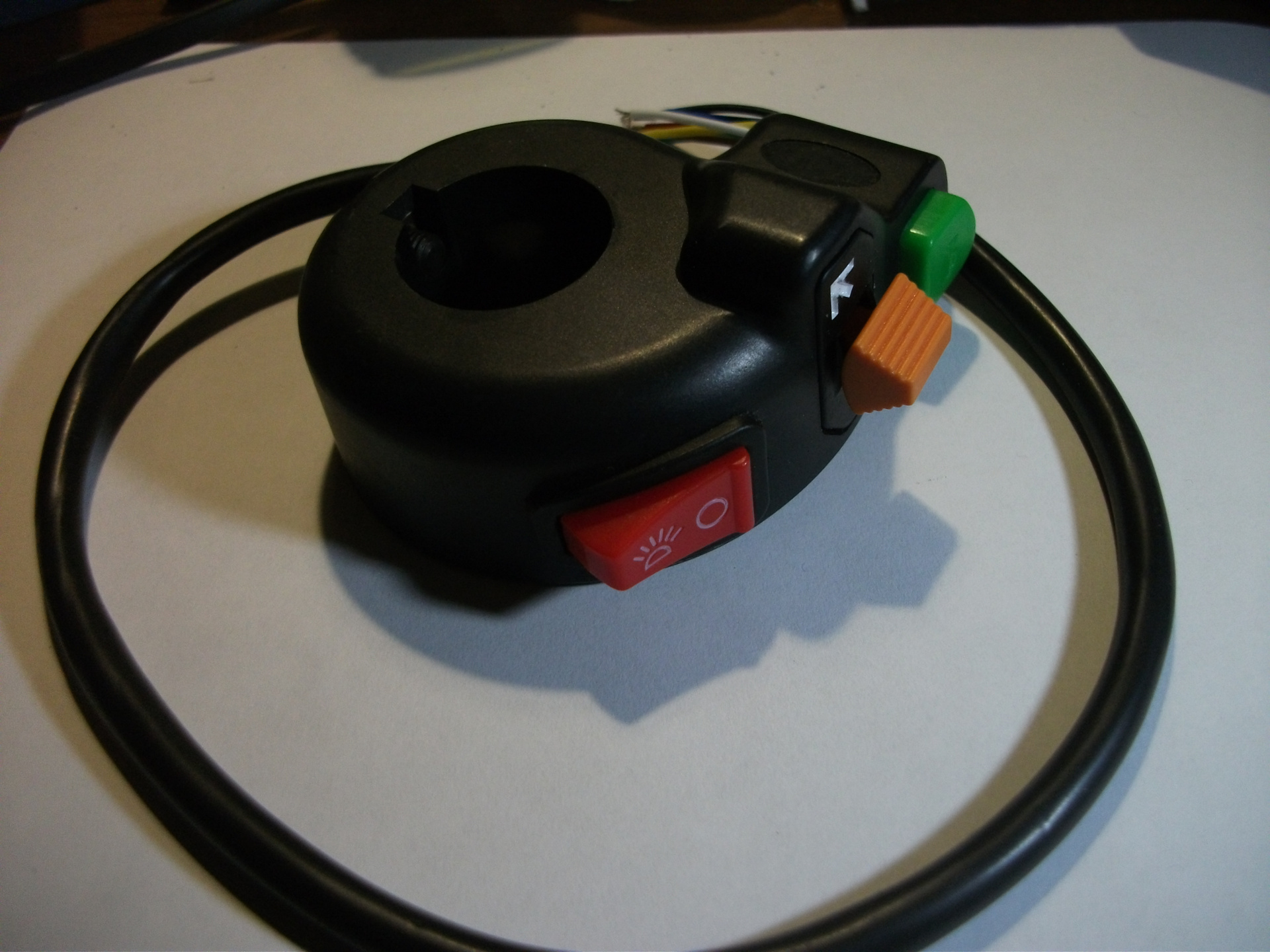
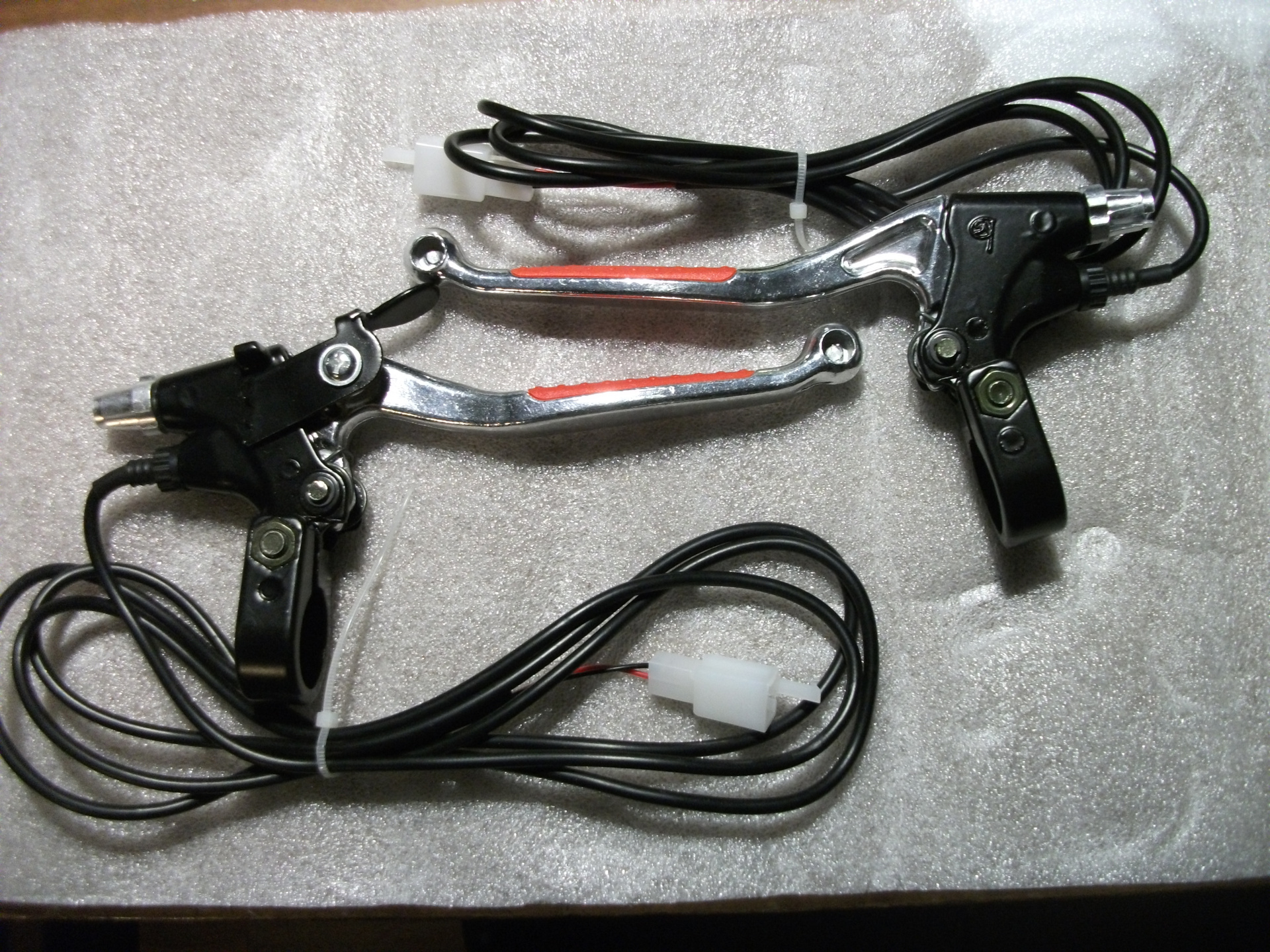
This steering wheel switch shortens the direction indicator contact. Inside a thin plastic case are cheap switching elements, almost not protected from moisture. It is unlikely that they can withstand the current of a motorcycle buzzer or headlights, although at my custom the wires of control and power are not output to the steering wheel. Be that as it may, inexpensive, but much more decent pens and switches for Cherry and the next project are already coming from China. But the brake levers did not disappoint. The quality of metal and workmanship, ergonomics and length of wires here pleased. The handles have cable tension regulators, and the left one also has a lock, which is needed for the parking brake of the tricycle or when used as a clutch lever for a motorbike gasoline engine. I have removed this lock, a two-wheeled electric machine does not need it.
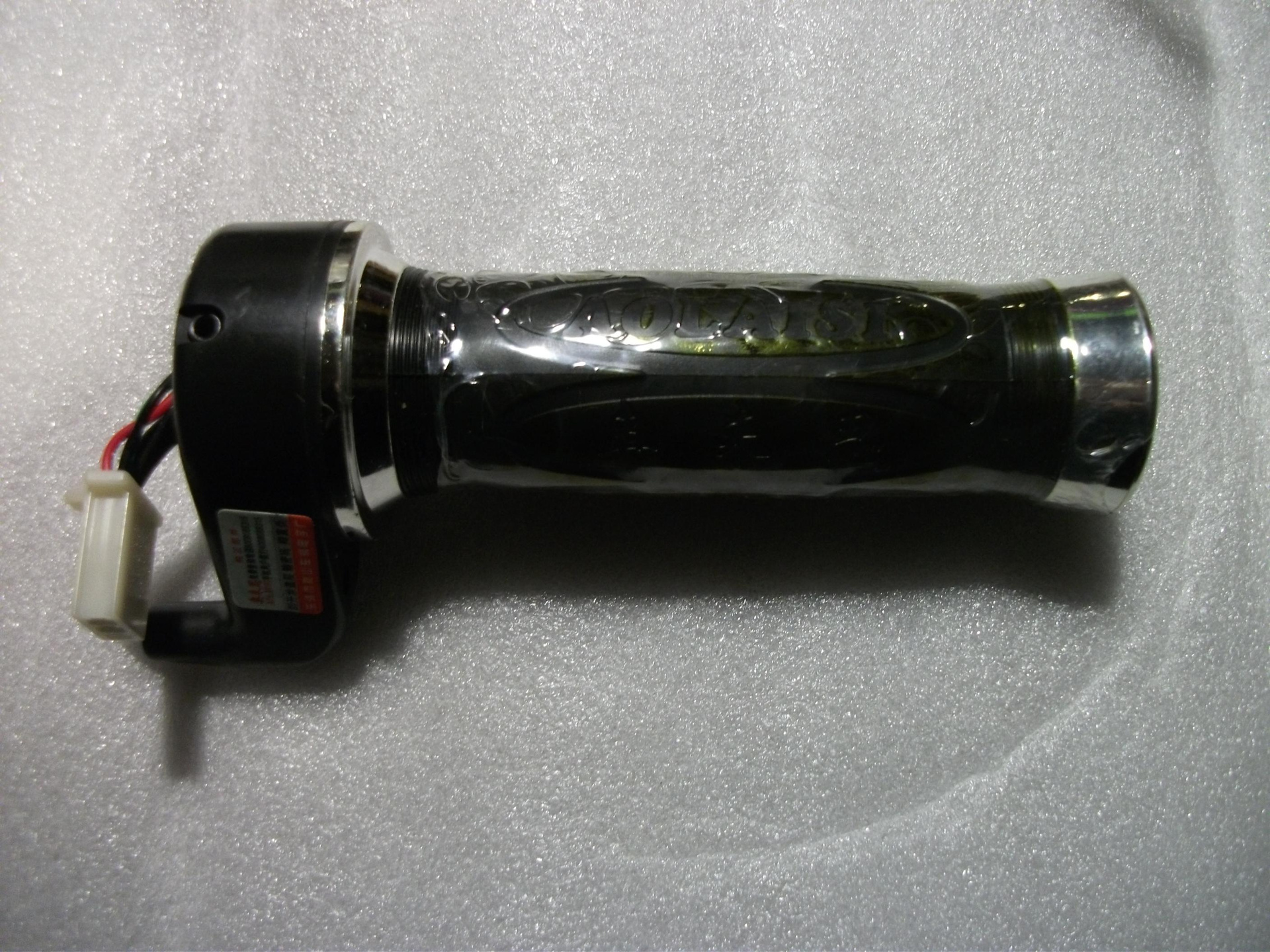
One could immediately buy a decent accelerator knob and steering wheel switch, and not such one-day ones. But experience gained. Not to mention the short low-quality wires that had to be soldered on both products, the handle broke out of the mount on one of the first trips with a sharp maneuver when a crazy village cat threw himself under the wheel. Kitty, pilot and other components of the bike were not affected, but there was a fall.
Every electric biker must know this.A typical accelerator knob in the “horn” has a tide of the housing from which the cable exits, an analog Hall sensor, and two small magnets are located on the rotary handle. When the handle is released, the right magnet is approached to the sensor, when viewed from the left end, the output voltage corresponds to zero speed. Turning the knob all the way, we will bring the left magnet closer to the sensor, and the voltage level will be formed for the maximum speed in this mode. In the middle position of the handle, the sensor is located in the middle between the magnets, and we have a signal half of the maximum speed.
The Hall sensor will give exactly the same voltage corresponding to half speed when moving away from the magnets if the “horn” breaks off or the handle flies out. The engine will rotate the wheel and push the vehicle forward. Bicycle electric motors are often very fast and high-torque, therefore, if the accelerator handle breaks down, the electric cyclist must press any brake handle, thereby giving a signal to turn off the engine or electric braking, and then, in no case, releasing the brake handle,turn off the controller with an anti-theft key or switch. The controller switch or anti-theft lock on any electric bike must be in immediate instant availability for the rider. A very bad situation will be created if you need to reach somewhere under the saddle or in the trunk to turn off the electric drive, while holding the brake lever, and all this happens on a difficult terrain or roadway with traffic.
This steering wheel switch shortens the direction indicator contact. Inside a thin plastic case are cheap switching elements, almost not protected from moisture. It is unlikely that they can withstand the current of a motorcycle buzzer or headlights, although at my custom the wires of control and power are not output to the steering wheel. Be that as it may, inexpensive, but much more decent pens and switches for Cherry and the next project are already coming from China. But the brake levers did not disappoint. The quality of metal and workmanship, ergonomics and length of wires here pleased. The handles have cable tension regulators, and the left one also has a lock, which is needed for the parking brake of the tricycle or when used as a clutch lever for a motorbike gasoline engine. I have removed this lock, a two-wheeled electric machine does not need it.
Current Results and Future Plans
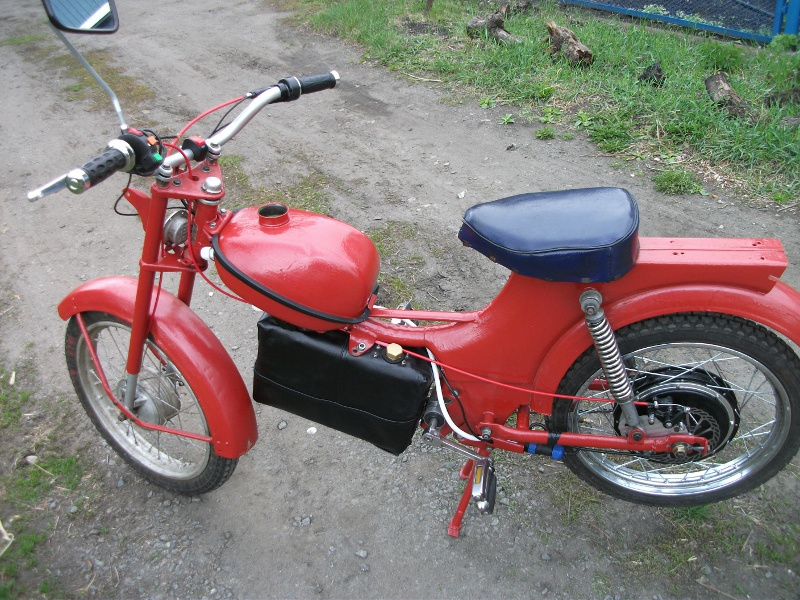
So, the budget retro electric bike "Cherry" based on the good old Riga-12 is ready for the first test drive. We roll out of the gate, turn on the mass and power of the electronics, gently turn the accelerator, and forward, into a new life! The apparatus starts moving without difficulty, and at the same time gently, it does not "goat", as forced custom of respected bicycle extremals do. The pedal drive operates, the backlash of temporary fastening of the carriage is within normal limits. We drive almost silently. Here it is, a childhood dream come true!
It remains to complete and install the protection of the chain and the drive sprocket, a digital speedometer, an odometer and a charge indicator, an audio signal and light devices, as well as a trunk and side wardrobe trunks. I hope, dear colleagues, it will be interesting to continue the story with Cherry. Goodbye, good luck on the road, and enjoy your summer vacation!
It remains to complete and install the protection of the chain and the drive sprocket, a digital speedometer, an odometer and a charge indicator, an audio signal and light devices, as well as a trunk and side wardrobe trunks. I hope, dear colleagues, it will be interesting to continue the story with Cherry. Goodbye, good luck on the road, and enjoy your summer vacation!